

You open your old resume, change your email address, and stop at the last employment date. Suddenly, the years you spent doing the work seem less important than the years you spent away from it.
That date needs context. It doesn’t need to become the whole document.
Start with the role you want and the experience that supports it. Keep your work history in a clear order, give a substantial recent break a short, honest explanation, and add evidence of current skills where you have it. You can do all of that without turning a private part of your life into a job application essay.
The examples below are illustrative. Replace their names, dates, and achievements with your own facts.
Choose a format that makes your experience easy to find
A skills-only document may feel tempting when the dates make you nervous. The trade-off is that the reader can’t easily tell where or when you used those skills.
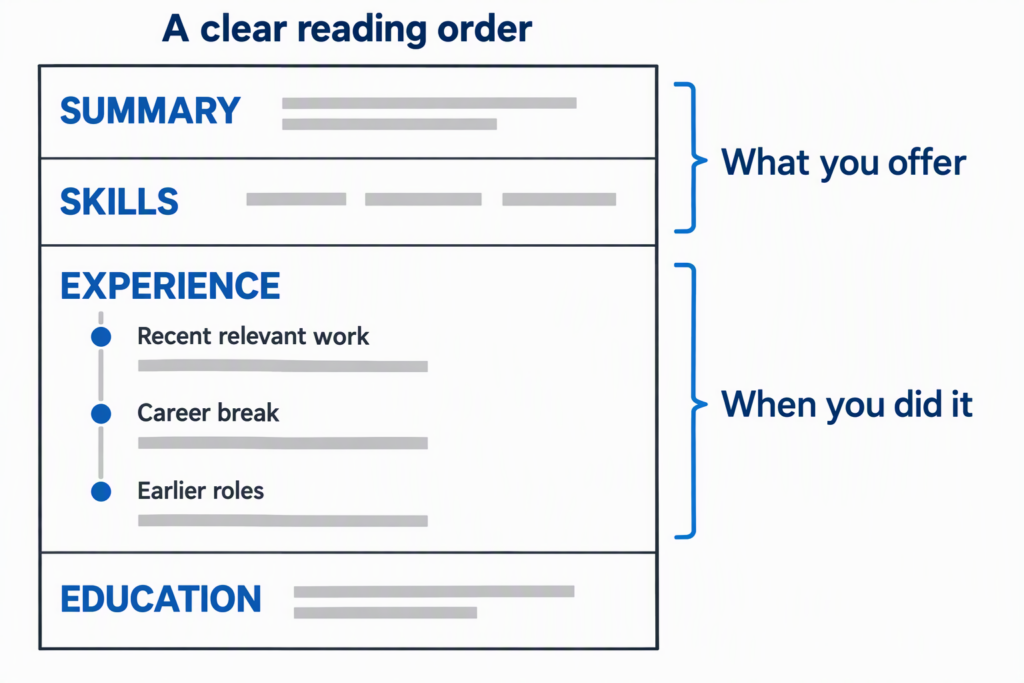
For most returning professionals, a practical starting point is a short summary and skills section followed by reverse-chronological experience. That lets you lead with your strengths while keeping employers, roles, and dates visible. Recruiter Jenny Foss recommends this combination in her return-to-work guidance for The Muse.
Use the job posting to choose what leads:
- Returning to the same field: emphasize relevant previous roles and any recent refresh of the tools they require.
- Moving into a new field: bring a relevant project or volunteer assignment higher, clearly labeled, before your earlier employment.
Keep entries newest-first within each section. Avoid creating several overlapping sections that make the reader assemble your history like a puzzle.
Give the time away a clear, proportionate entry
There isn’t a universal number of months that makes an explanation mandatory. A recent multi-year absence usually benefits from a brief entry; a short interval between jobs may need no separate entry at all. A break outside the work history you’ve chosen to include generally doesn’t need to be reintroduced.
For a substantial recent absence, place a Career Break entry among the dates it explains. Use month and year consistently, matching your records. Years-only dates are accepted in some guidance, but they can blur short gaps; month-and-year dates give the reader a clearer sequence. Don’t stretch an employer’s dates or leave an old job marked “Present.”
A straightforward entry can be enough:
Career Break — Family Caregiving
September 2022–August 2026
Took time away from paid employment to care for a family member.
Choose wording that accurately reflects your circumstances and the detail you’re comfortable sharing:
| Situation | Possible label | Useful detail, if needed |
|---|---|---|
| Childcare or eldercare | Career Break — Family Caregiving | A brief explanation of time away |
| Health or other private matters | Career Break — Personal Reasons | No diagnosis or treatment history |
| Moving or travel | Career Break — Relocation or Travel | A short factual description |
| Full-time study | Education or Professional Development | Program, institution, and actual dates |
If study already accounts for the period in your education section, you may not need a second entry saying the same thing. Likewise, genuine freelance work belongs under its actual role and dates. One small project shouldn’t become four years of continuous consulting.
Show what you can do now
“My skills are up to date” asks the reader to take your word for it. A recent, relevant piece of work gives them something to examine.
Compare the job’s requirements with your current abilities. If a meaningful gap exists, choose an activity that addresses it: a reporting project, a volunteer bookkeeping assignment, a refreshed portfolio, or training in a tool the role actually uses.
Turn an activity into evidence
Name the work, what you produced, and when you did it. Include a link if the result can be shared safely.
Inventory Reporting Project — Independent
August–September 2026
Used SQL to check a public retail dataset for duplicate records and built a Power BI dashboard comparing inventory turnover by product category.
That example describes a self-directed project honestly. It doesn’t imply a paying client or a business result that never happened. For courses, give the course title, provider, and completion date; don’t turn a course-completion certificate into a professional certification.
If the break was simply a break
You don’t need to invent professional development to justify caregiving, recovery, or time away. Keep the explanation brief and use your real employment record. If your target role requires current licensing or a skill you’ve lost, address that specific requirement before claiming readiness.
Relevant unpaid work can help, but household responsibilities don’t need an inflated title such as “Chief Household Officer.” Describe an actual volunteer role as voluntary and explain its scope.
Make earlier achievements carry their weight
Before deleting old experience, ask whether it proves something this employer needs. A long break can push your most relevant work outside a conventional look-back window; relevance deserves a closer judgment than an automatic cutoff.
Vivian Steir Rabin, iRelaunch co-founder and executive recruiter, writes: “Your resume should resemble an executive summary of your career, not the full report.”
Give useful roles detail and compress unrelated ones. For each bullet, recover three things: the action, the scope, and the result. Use records you can substantiate. If you can’t verify a percentage, describe the delivered work or responsibility precisely instead.
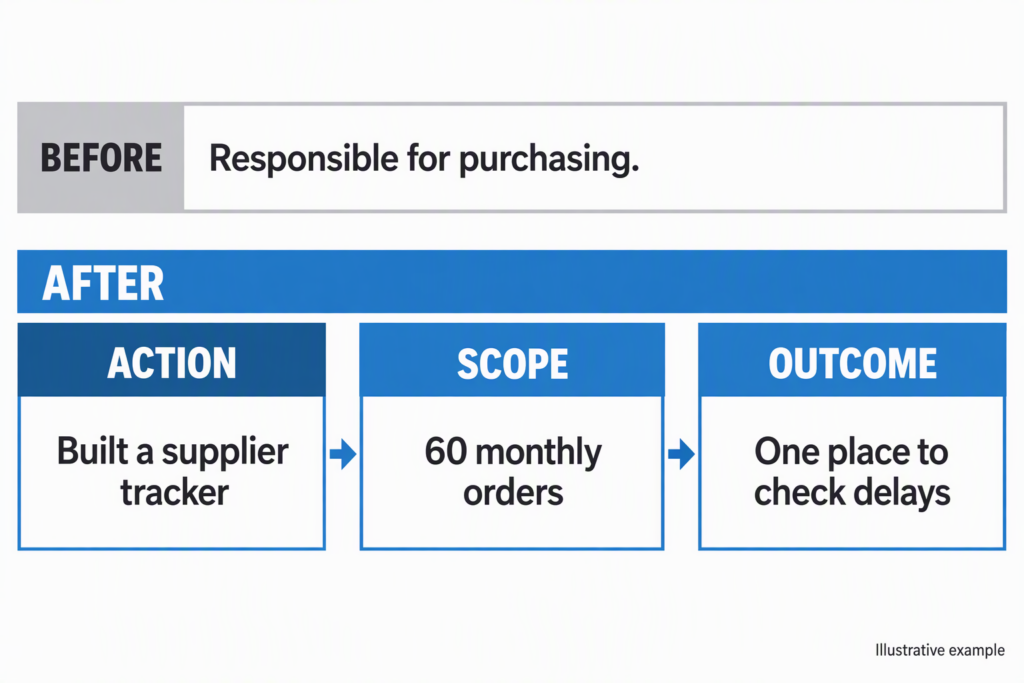
Write the summary after choosing those accomplishments. Name your professional background, a relevant strength, and the contribution you’re targeting. Skip an opening apology or a generic objective about “seeking an opportunity.”
See how the pieces fit together
This shortened example is for an operations coordinator returning after caregiving. Its dates deliberately show a volunteer assignment overlapping the break: time away from paid employment can still include unpaid work.
JORDAN ELLIS
Columbus, Ohio | jordan.ellis@example.com | [Phone number]
Professional Summary
Operations coordinator with six years of experience in supplier communication, purchasing, and order tracking. Recently maintained volunteer schedules for a community food pantry. Seeking to bring organized follow-through and clear documentation to a distribution team.
Skills
Excel pivot tables; purchase-order tracking; supplier communication; volunteer scheduling.
Relevant Experience
Volunteer Scheduling Coordinator — Riverside Food Pantry
February–September 2026
- Maintained weekly schedules for 18 volunteers and created a shared shift-handoff checklist.
Career Break — Family Caregiving
September 2022–August 2026
Took time away from paid employment to provide family care.
Operations Coordinator — Cedar Supply Co.
September 2016–August 2022
- Tracked approximately 120 purchase orders each month and followed up with suppliers on overdue deliveries.
- Introduced a shared exception log so warehouse and customer-service teams could check delivery updates in one place.
Education
The Ohio State University, Columbus, Ohio
Bachelor of Science in Business Administration
For your own version, choose facts that support the advertised duties. Jordan’s summary emphasizes coordination because the example targets operations; a career change would need a different emphasis, not just a new job title.
Check the file before it leaves your hands
Keep your application resume easy to read and easy to scan as text. A simple layout helps with both.
MIT’s career guidance recommends avoiding images, text boxes, and tables in resumes submitted through applicant tracking systems. Use conventional headings such as Experience, Education, and Skills, and follow the employer’s requested file type. Keep contact details in the main document body.
Copy the finished document into plain text to check for missing content or scrambled reading order. This catches basic formatting problems; it doesn’t certify compatibility with every hiring system. Also review any fields the application fills automatically.
Use one page if it comfortably holds your relevant evidence; two can be appropriate for substantial experience. Cut weak material before shrinking the type.
Put a clear application in motion
Pick one suitable vacancy and finish a version for that role. Then send it to a trusted former colleague for a focused review: does the experience support the work being advertised? That gives you something concrete to improve and a reason to reconnect.
Frequently Asked Questions
These questions cover circumstances that may change what you include or how you apply.
Do I have to explain a health-related break in detail?
You can use a broad label such as “personal reasons” without naming a condition. For U.S. hiring, the EEOC says employers generally cannot ask disability-related questions before a conditional offer, with limited accommodation-related exceptions. An accommodation request is a separate conversation; it doesn’t require putting medical history on your resume.
What if I’m still caregiving while applying?
Don’t claim the break has ended if it hasn’t. You can use “Present” on the break entry while applying for work you can realistically take. Discuss availability and any start-date arrangements when relevant; your resume doesn’t need to describe your family’s care schedule.
Should a cover letter repeat the explanation?
Use the letter to connect your return with this particular role or employer. A brief sentence can provide context, followed by the contribution you offer. Avoid copying the break entry or retelling your employment history. If no letter is requested, follow the application’s instructions.
Is a returnship worth considering?
It can be, especially if structured training would help you reenter your field. Eligibility varies. IBM’s Tech Re-Entry guidance, for example, describes a paid program for technical professionals with a break of at least a year and skills matching available roles. Check the current posting, and keep your break dates clear so eligibility is visible.