
Your Education section acts as a credibility booster and demonstrates your commitment to learning and your enthusiasm to acquiring relevant knowledge and skills. It also helps you to highlight specific course work, projects or achievements that align with the desired job requirements.
This article will provide you with tips and strategies on “How to effectively format the education section for your resume”. For more detailed guidance, learn how to list summa cum laude on a resume so you can place your academic honors correctly and give employers the right context.
Let’s dive in .
Understanding the Role of Education in Your Resume
Your education section acts as a qualification filter and helps the employers assess your eligibility for the position based on your education background.
It also contributes to the overall story of your professional journey, especially for recent graduates or career changers. Therefore, By effectively presenting your education, you can give yourself a competitive edge and increase your chances of securing an Interview.
Click here for Resume Templates.
Key Elements of an Effective Education Section
So , what are constituents of the Education section?
Your education section contains:-
- Institution Name
- Degree Earned
- Graduation Year(Expected year of passing if not passed yet)
- Location (Optional)
Dos and don’ts for formatting education details.
1. List your education qualifications in reverse chronological order ie. list your highest degree first. For example :-
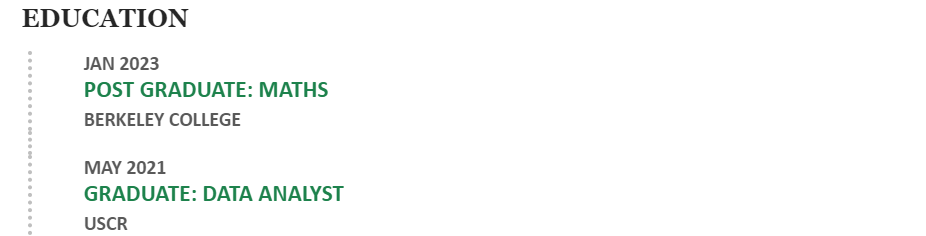
2. One shall always be consistent in terms of use of font size, spacing throughout the section. Using same formatting gives your resume a professional appearance. It is highly recommended that you should avoid anything that can make your resume appear unprofessional.
3. Be clear and concise i.e. Include essential details like institution name, degree earned, and graduation year(or expected graduation year for ongoing studies).

Do not include a list of every single course you took. Instead focus on the most impactful and relevant ones.
4. Highlight the relevant Coursework that align with the requirements of your target job or industry, especially for those who have graduated recently or for those who are planning to switch careers.
5. Use of strong verbs is necessary as they attract the attention of the potential employers. Action verbs or strong verbs should be used to describe your academic achievements and projects, showcasing your skills and initiative.
Some examples of action verbs are :- “Developed”, “Led”, “Analyzed” etc. At the same time avoid using abbreviations. But you can use commonly understood abbreviations like “BA” or “MBA”.
6. Another important thing you should keep in mind while writing the education section in your resume is that it should be tailored as per the job requirement. Include the relevant education and certification emphasizing the most relevant experience and skills for specific job positions. Avoid listing irrelevant educational experience or personal details like address or phone number. For a practical breakdown of essential sections of a resume, see our guide and learn how to organize your contact information, summary, work history, education, and skills.
7. Include your Marks or GPA only if it is impressive (typically above 3.5) and relevant to the job otherwise you can exclude it.
8. At last but not the least, Proofread meticulously to ensure that all the information is accurate and free of any typo or grammatical errors.
These are some tips that can make your education section more effective.
Sample resume education sections for Different Scenarios
1. Recent Graduate:- If you are a recent graduate and looking for Entry-Level position, then following format is for you :-
- Degree Name
- Major/ Subject
- University/ Institution name
Example :-
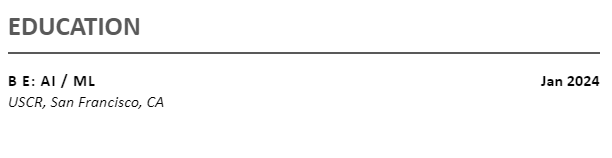
In case you have done some diploma or post graduate after graduation, mention that too. And follow reverse chronological format i.e. newer degree first.
Additional Tip :- You can Include your Marks/ GPA only if impressive and relevant.
Remember your education section should contain only Education qualifications, and for skill there Should be a separate section in your resume.
2. Career Changers :- Seeking a career change? You should take special care while highlighting your education qualifications. Do not include education qualifications which are irrelevant to the job you are applying for. Instead focus on showcasing your transferable skills and how your education prepared you for the new career path.
- Education:
- University Name,(YYYY)
- Major / Subject
Example:-
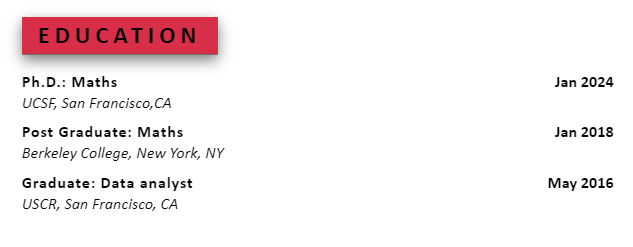
3. Experienced Professional :- List your Highest degree first and work backwards, including your all relevant degrees and certifications. Reserve this section to showcase your education qualifications only and you can include your awards and honors in a separate section. Do not interchange your skills and education.
Example:-
- University Name, State(YYYY)
- MBA – Finance
How to include continuing education on your resume.
In today’s rapidly evolving world, the value of continuing education and professional development is undeniable. By investing in your personal and professional growth, you equip yourself with the skills and knowledge necessary to remain competitive, thrive in your career, and unlock new opportunities. Showcasing your ongoing education demonstrates your commitment to lifelong learning and career growth through education pursuits.
Education is a pathway to promotions, salary increases, and new opportunities.
If you are currently enrolled in or pursuing additional education or training, mention this in the education section of your resume. Specify the program or the course you are undertaking, the institution or provider, and the expected completion date.
Be honest and accurate about your certifications and avoid exaggerating or misrepresenting your qualifications.
Read More :- How to Write Work Experience Section On Resume
Showcasing Skills Developed Through Education
Although our resume templates provide you with a separate section to showcase your skills, you can incorporate ‘Skill- based education achievements’ to enhance resume appeal.
Additional information :- Resumes for federal jobs are normally 4-5 pages. While writing your education for USAJobs you should include all the information extensively. And so you’re in the education section. Mention your all the education and certifications along with the institute / University name.
Now, you may be probably wondering, “Now I have an idea of how to format my education section. But where do I mention my extra curricular activities?” .
Well !! Our resume templates have dedicated sections for Certifications, Awards & Honors and for Extra Curricular activities. Check out our professional Resume templates.
Summary
- In Short, the Education section on your resume should be professional, concise, and informative.
- It should reflect your academic academic qualifications and achievements in a clear and confident manner.
- Use clear and formal language, prioritizing essential details such as degrees earned, institution attended, graduation date, and relevant honors or awards.
- Utilize the action verbs to describe academic achievements and activities.
By following these recommendations, you can create an education section that effectively captures the attention of hiring managers, highlights your strengths and qualifications, and ultimately helps you stand out in the competitive job market.
Remember, your resume is your first impression, so presenting your education in a professional and impactful manner is crucial for securing an interview and landing your dream job.
We Promise continued support and resources for career development and resume refinement.
Additional Resources:
- Resume templates
- Resume skills
- Resume summary
- Suggestions for further reading and exploration of related topics in resume building.
FAQs
Your education section should typically include:
* Degree or diploma
* Major or field of study
* School, college, or university name
* Graduation month and year (or expected graduation date)
* GPA (only if it’s strong and relevant)
* Academic honors, scholarships, or relevant coursework (optional)
* Only include information that strengthens your application and is relevant to the job.
It depends on your experience level.
* Students and recent graduates: Place education near the top of your resume.
* Experienced professionals: Place it after your work experience section.
As your professional experience grows, your education becomes less important to recruiters.
Include your GPA only if:
* It is 3.5/4.0 or higher (or equivalent).
* You recently graduated.
* The employer specifically requests it.
If you have several years of work experience or a low GPA, it’s generally better to leave it off and focus on your professional achievements.
Yes. If you’re currently studying or didn’t complete your degree, you can still include it.
Mention:
* Degree program
* Institution
* Expected graduation date (if still studying)
If you left the program permanently, only include it if it’s relevant to the role and won’t create confusion.
Include your high school education only if:
* You’re a high school student.
* You’re a recent graduate with no college education.
* It’s your highest completed qualification.
Once you’ve completed college or university, your high school education can usually be removed.
Professional certifications are usually better placed in a separate Certifications section.
However, if you have only one or two certifications and no dedicated section, you can include them under your education section, provided they’re relevant to the job.
Relevant coursework is most useful for:
* Students
* Recent graduates
* Career changers
Once you have meaningful work experience, coursework adds little value and can usually be removed in favor of professional accomplishments.