


The work experience section shows where you worked, what you did, and how your responsibilities grew. Start with your most recent job. For each role, include your job title, employer, location, and dates, followed by short descriptions of the work most relevant to the job you want.
Include relevant work from internships, contracts, or gigs and label it clearly. If you’re applying for your first job, see what to put on a resume with no work experience.
What the Work Experience Section Looks Like
Here’s a complete example for someone applying for a customer service supervisor role. It shows how they went from helping customers in a store to training agents and handling difficult cases. The employers and results are fictional.
Work Experience
Customer Support Team Lead
- Lead a team of six agents who answer order, delivery, and return questions by phone, email, and chat.
- Review difficult refund cases and coordinate with the warehouse team when customers report missing or damaged orders.
- Reorganized the support queue so urgent delivery cases reached the right agent sooner, reducing average first reply time from eight hours to five.
- Created a return policy guide and used it to train four new agents on refunds, replacements, and when to ask a supervisor for help.
Customer Service Representative
- Resolved 30–40 customer questions per shift about order changes, shipping delays, and returns.
- Followed up with customers after arranging replacements or refunds and updated each case before closing it.
- Collected examples of shipping errors that helped the warehouse team spot orders with missing apartment numbers.
Retail Sales Associate
- Helped shoppers find products, answered questions about store policies, and processed purchases and returns.
- Showed new cashiers how to process exchanges and handle register handovers.
The team lead role gets the most space because it’s closest to the job the person wants. The earlier roles use fewer lines but still show relevant skills and make the promotion easy to see.
Work Experience
[Most recent job title]
- [Describe the work that best matches the job you want.]
- [Show something you improved, made, or helped finish.]
- [Add a result or a detail that shows the size of the work.]
[Previous job title]
- [Describe one or two parts of this job that are still relevant.]
What to Include for Each Job
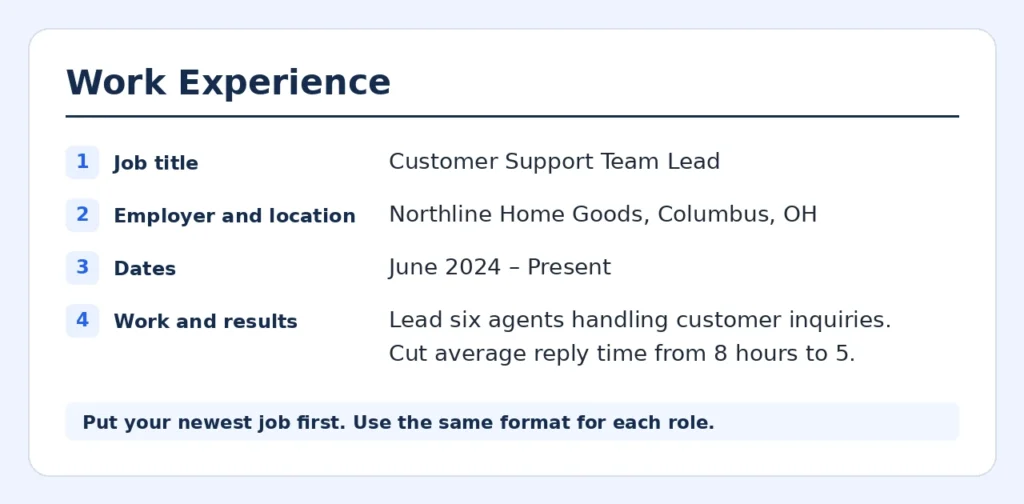
Each entry should tell the reader what your job was, where you worked, and when you held the role. Put those details at the top, then describe the work underneath.
- Job title. Use the title you held. If your employer used an internal title such as Associate II, you can clarify it with a short description: Associate II (Customer Support).
- Employer. Give the company or organization name. A short explanation can help if the name alone gives the reader little context.
- Location. Give the city and state where you worked. For a fully remote role, you can write Remote.
- Dates. Use the same month and year format for each role, such as April 2022 – May 2024. Write Present if you still hold the role.
- Work you did. Put the details that best match the job you want near the top. Show what you handled, improved, or helped complete.
How to List Two Jobs at the Same Company
If you were promoted or moved into a different role, you can show both jobs under one company name. Give each role its own title, dates, and descriptions. Put the newer role first so the reader can see your progression at a glance.
Northline Home Goods · Columbus, OH
Customer Support Team Lead June 2024 – Present
- Lead six support agents and handle refund requests that need supervisor approval.
- Created a guide to returns and used it to train four new agents.
Customer Service Representative April 2022 – May 2024
- Resolved 30–40 questions per shift about orders, delivery delays, and returns.
- Arranged replacements for missing or damaged orders and followed up with customers until each case was closed.
Both entries use the same employer, but the descriptions show what changed. The first role involved resolving customer issues. The promotion added responsibility for training agents and making decisions about refunds.
How to Describe Your Work Experience
Start with something you did that matters for the job you want. Then give the reader a detail they can picture. If you wrote “Handled customer returns,” ask yourself what you handled, how you helped, or what changed because of your work.
Write About What You Did and What Happened
Use three questions to plan what to write. This is called the CAR method, short for Context, Action, and Result.
- Context: What was happening? Customers kept asking the same questions about returns.
- Action: What did you do? You wrote reply templates for the support team.
- Result: What changed? Agents could answer common questions faster.
On the resume, lead with the action. Here are two ways to write about that same work.
Wrote reply templates for common return questions, helping reduce the team’s average response time from 12 hours to 8 hours.
Wrote reply templates for common return questions that the support team added to its shared library and used to train new agents.
Use numbers you can explain. If your team never measured the result, show who used what you made or what problem it helped solve. See more examples of resume achievements without numbers.
See the Difference in a Resume
In the first image, the social media line names a duty. In the second, it shows the work behind it and the result: follower engagement increased by 30%. The same approach makes the marketing and customer service lines more specific.


Use present tense for work you still do, such as Train new support agents. Use past tense for completed work, even in your current job, such as Wrote a guide for new agents. For more ways to start each line, see our resume action verbs guide.
How to Format the Work Experience Section
Use one column and put your newest job first. Give every job the same layout so the reader can scan down the page and find your titles, employers, and dates. You can see this pattern in the complete work experience example above.
Formatting Settings You Can Use
- Section heading
- Use Work Experience or Professional Experience. Match the size and style of your other section headings.
- Job titles
- Put each title in bold. Give it its own line so it’s easy to spot.
- Employer and dates
- Put the employer and location below the title. Align the dates on the right if they fit comfortably, or put them on the next line. Use the same approach for every job.
- Font size
- Start with 11 pt for the descriptions. Use the same font throughout the resume and check that the text is easy to read at normal size.
- Spacing
- Keep the lines for each job close together. Leave a little more space between jobs so it’s clear where one ends and the next begins.
How Much Space Should Each Job Get?
Three to five short points is a good starting range for a recent job that closely matches the one you want. One or two may be enough for an older job. Give the most relevant work the most space, even if some of it happened in an earlier role. For more examples, see how many points to include per job.
If the section looks crowded, cut repeated duties first. For example, if three jobs all involved answering customer questions, give the strongest example in detail. Use the other entries to show what was different, such as training new hires or handling refunds.
Where to Put Work Experience on Your Resume
Put Work Experience before Skills and Education if your past jobs show you can do the work. Move Education or Skills above it when the employer needs to see a degree, license, or specific technical skill first.
Keep your name and contact details at the top. If you use a short resume summary, it usually goes below them. Then arrange the main sections like this:
Put Work Experience First When Your Jobs Are the Strongest Match
For example, if you’ve supervised support agents and you’re applying for a customer service supervisor role, show that experience before your skills list or degree.
- Work Experience
- →Skills
- →Education
Put Education First When Your Degree or Training Is the Strongest Match
For example, if you recently finished an accounting degree and your past jobs were in retail, lead with the degree for a junior accounting role. Use your work history to show useful skills such as handling cash or checking records.
- Education
- →Work Experience
- →Skills
Put Skills First When the Job Calls for Specific Tools
For example, if a reporting job asks for Excel, SQL, and Power BI, a short skills list can make those tools easy to find. Put Work Experience directly below it and show how you used them.
- Skills
- →Work Experience
- →Education
If you’ve never worked, start with Education or Projects, whichever best shows what you can do. See what to put on a resume with no work experience for a complete example.
For help arranging the rest of the page, see our guide to the main sections of a resume.
Entry-Level, Mid-Career, and Senior Examples
At entry level, show the work you can already do. At mid-career, show what you took responsibility for and improved. At senior level, show the teams or services you led, the decisions you made, and what changed. The employers and results in these examples are fictional.
Entry-Level Work Experience Example
This applicant is moving from a part-time retail job into a customer support role. The part-time job shows how they help customers directly. The internship shows that they can also handle written requests and keep track of open cases.
Work Experience
Customer Service Associate, Part-Time
- Help 25–35 shoppers per shift with product questions, exchanges, and pickup orders.
- Check receipts and order records before processing returns and explain refund options to customers.
- Record unresolved pickup issues at the end of each shift so the next associate can follow up.
Customer Support Intern
- Drafted email replies to questions about shipping and order changes for a team lead to review.
- Updated order records and flagged delayed shipments that needed follow-up.
Mid-Career Work Experience Example
This applicant has moved from answering requests to owning a process that helps other agents work. The newest role shows what they changed, who used it, and how service improved.
Work Experience
Customer Support Operations Specialist
- Manage ticket routing and keep the support guides current for a team of 14 agents.
- Rebuilt routing rules for billing and login issues, reducing the share of tickets reassigned between queues from 18% to 10% over three months.
- Review weekly ticket reports with team leads and update help articles for questions agents see repeatedly.
- Worked with the product team to add clearer renewal instructions after identifying subscription charges as a common source of complaints.
Customer Support Specialist
- Handled account setup, billing, and access issues for small business customers by email and chat.
- Documented repeat login errors with steps the engineering team could follow to reproduce them.
- Coached new hires on how to document cases and hand off unresolved tickets.
Senior Work Experience Example
This applicant is applying for a director role. The example shows the size of the operation, the decisions they owned, and what improved for customers.
Work Experience
Director of Customer Support
- Lead 42 support staff through four managers and oversee staffing, service targets, and escalations for business customers.
- Adjusted staffing to match demand across time zones, cutting median first response time from six hours to three while keeping customer satisfaction above 90%.
- Set up monthly reviews with Product and Engineering to track common support issues and assign owners to fix the causes.
- Introduced one escalation process across phone, chat, and email so urgent customer issues had a clear owner at each handoff.
Customer Support Manager
- Managed 16 agents, set weekly schedules, and coached team leads on feedback and case reviews.
- Introduced a weekly review of recurring ticket errors, helping lower the reopened case rate from 12% to 8% over six months.
- Built a training plan for new hires that covered product setup, billing, and escalation decisions.
Choose the example closest to your experience and replace the details with your own. To see how work history fits alongside a summary, skills, and education, explore our full customer service resume examples.
What to Put If You Have No Work Experience
If you’ve never had a job or internship, leave out the Work Experience heading. Use the space for your education, projects, skills, or volunteer work. Start with whichever section gives the employer the clearest idea of what you can already do.
- A recent degree or training course: Put Education near the top. Include relevant coursework if it helps explain what you know.
- A class or personal project: Use a Projects section. Say what you made or studied, what you did yourself, and what you finished.
- A volunteer role or club responsibility: Use Volunteer Experience or Activities. Include the role, organization, dates, and what you did.
Resume Example for Someone Who Has Never Had a Job
This fictional applicant is applying for a first customer support job. Their class project shows they can sort requests, track open issues, and write clear replies.
Education
Associate Degree in Business Administration
Cedar Grove Community College, Raleigh, NC · May 2026
Relevant coursework: Business Communication, Spreadsheet Applications
Projects
Customer Support Inbox Simulation
Business Communication class project · April 2026
- Built a spreadsheet to track 25 sample customer requests by topic, priority, and status.
- Wrote email replies for delayed orders and refund requests, with a clear next step in each reply.
- Created a checklist showing which requests a support agent could handle and which needed supervisor approval.
Skills
Excel filters and sorting, tracking requests, writing customer emails
If you don’t have a project yet, think of something you helped run. If you managed the sign-in desk for a school event, you could describe how you checked names, answered questions, or directed visitors. List it under Activities or Volunteer Experience and use a title that reflects what you did.
For help building the rest of the page, see our guide to writing a resume for your first job.
Do Internships, Coursework, and Projects Count?
Internships can go under Work Experience, whether they were paid or unpaid. Coursework usually belongs under Education. Class and personal projects usually belong under Projects. If you completed a project as part of a job or internship, describe it under that role.
| What you did | Where to put it on your resume |
|---|---|
| Internship | Put it under Work Experience or Internships. Use your actual title, such as Customer Support Intern, and include the organization and dates. |
| Relevant coursework | Add a Relevant Coursework line under Education. List courses that relate to the job, such as Business Communication for a customer support role. |
| Class or personal project | Use Projects. Say what kind of project it was, what you did, and what you produced. A short class project can also go under Education. |
| Project from a job or internship | Describe it under the role where you did it. For example, put a return policy guide you wrote as a support intern under Customer Support Intern. |
| Volunteer role | Use Volunteer Experience or Relevant Experience. Include the organization, dates, and what you did. Label the role as volunteer work so the reader understands the experience. |
What if you did a class project for a real company? You can name the company if you’re allowed to and explain what you delivered. Label it as a class project for a client and list it under Projects.
If an application asks for years of professional experience, follow the employer’s instructions. An internship can belong on your resume even when a particular application counts internships separately.
See the entry-level example for an internship listed under Work Experience, or the first-job example for a class project. For more examples, see our guides to listing relevant coursework and listing projects on a resume.
How to List Freelance, Contract, and Gig Work
Freelance, contract, and gig work can all go under Work Experience. Use a title that tells the reader what you did, then name the employer, client, or platform as appropriate. Include the dates and describe the work that fits the job you want. The details below are fictional.
How to List Freelance Work on a Resume
If you worked directly with several clients and did similar work for each, group it under one freelance title. Use Self-Employed or your business name, and describe the most relevant projects underneath. A long assignment that is especially relevant can have its own entry.
Freelance Customer Support Specialist
- Handle email support for two online stores, answering product questions and arranging refunds or replacements.
- Built a shared tracker for open returns so store owners could see which requests still needed action.
- Wrote answers to common delivery questions that one client added to its online help page.
For more ways to present client work, see our guide to listing self-employment on a resume.
How to List Contract Work on a Resume
If a staffing agency employed you and assigned you to a client, list the agency as your employer. Add the client on a separate line if you can share its name. If a company hired you directly for a fixed term, list that company and add Contract to the title.
Customer Support Associate (Contract)
Client assignment: Alder Home Supply
- Answered customer emails about holiday orders, delivery delays, and exchanges during a four-month assignment.
- Worked with the warehouse team to confirm shipment details before promising replacements.
- Prepared a handover list of open cases so the permanent support team could follow up after the contract ended.
If the client name is confidential, you can describe the assignment in general terms, such as Client assignment: home goods retailer.
How to List Gig Work on a Resume
Group similar short gigs into one entry. If you found the work through a platform, name it as the platform. If you booked gigs directly with different clients, Independent or Various Clients can work. Use dates that reflect when you did the work and label it occasional if you only took gigs from time to time.
Event Guest Services Assistant (Occasional Gigs)
- Checked in guests at conferences and community events, verified registrations, and helped attendees find their sessions.
- Resolved badge and ticket issues at the front desk and passed requests that needed approval to the event lead.
- Recorded accessibility requests and shared them with venue staff before sessions began.
If you’re changing careers, keep the parts of older work that help explain why you fit the new job. For example, an event gig can show that you know how to answer questions, fix problems, and help people during a busy shift. See our guide to tailoring your resume to a job description for a worked example.
Check Your Work Experience Section
Open your finished resume and read through the experience section once. Can you quickly tell what each job was and why it matters for the role you’re applying for?
Before You Send Your Resume
Work Experience FAQs
Do I need to list every job I’ve had?
Choose the jobs that help explain why you’re a fit for the role. You can leave out an older job that adds little or shorten it to one line if it helps explain your timeline. If the employer’s application asks for your full work history, provide it on the form.
How far back should my work experience go?
Start with your recent jobs and go back as far as you need to show the experience the employer is asking for. An older job can still earn a place if it shows a skill, industry background, or level of responsibility that your newer jobs don’t show.
How do I show two jobs I held at the same time?
Give each job its own entry and keep the actual dates. If one role was part-time or freelance, add that to the title. For example, Customer Support Specialist (Full-Time) and Event Assistant (Part-Time) make it clear how the two roles overlapped.
Should I include a job I just started?
Include it if it helps show why you’re qualified or makes your current work history clearer. Use your start month and year followed by Present. Describe what you already handle or have completed. See more examples of how to list a job you just started.
Do I need to explain a gap between jobs on my resume?
A short gap often needs no separate entry. For a longer break, you can add a brief line if it helps explain your timeline, such as Career Break, May 2024 – February 2026. Keep the dates accurate and share only the details you’re comfortable including. See our guide to explaining employment gaps on a resume.
Which jobs should I include if I’m changing careers?
Keep roles that show skills you’ll use in the new job. For example, a retail supervisor applying for an office coordinator role could highlight scheduling, training, and recordkeeping. Keep the original job title and use the description to show how the work relates to the new role.