

Your work history ends in March 2024 and starts again in February 2026. The dates are accurate, but the empty space can make you feel as if you owe the reader a life story.
You usually don’t. Explain a recent, substantial break only when the missing context may distract from your qualifications. A neutral label, accurate dates, and one factual line are often enough. Add a relevant course, project, or volunteer role only when you actually completed it.
The examples below are fictional. Replace every name, date, and activity with your own facts.
Key Takeaways
- Not every interval needs its own entry. A short transition, an old period outside the experience you include, or time already explained by education can remain unlabeled.
- A gap entry should answer one question, then get out of the way. State what the period was, show its dates, and return attention to the experience that qualifies you.
- Private does not mean dishonest. “Personal Leave” can be accurate without naming a diagnosis, family conflict, or other detail that does not belong in a resume.
- Real activity can strengthen the timeline; invented work damages it. Label courses, projects, volunteering, freelance assignments, and caregiving for what they were.
Decide whether the blank space needs a label
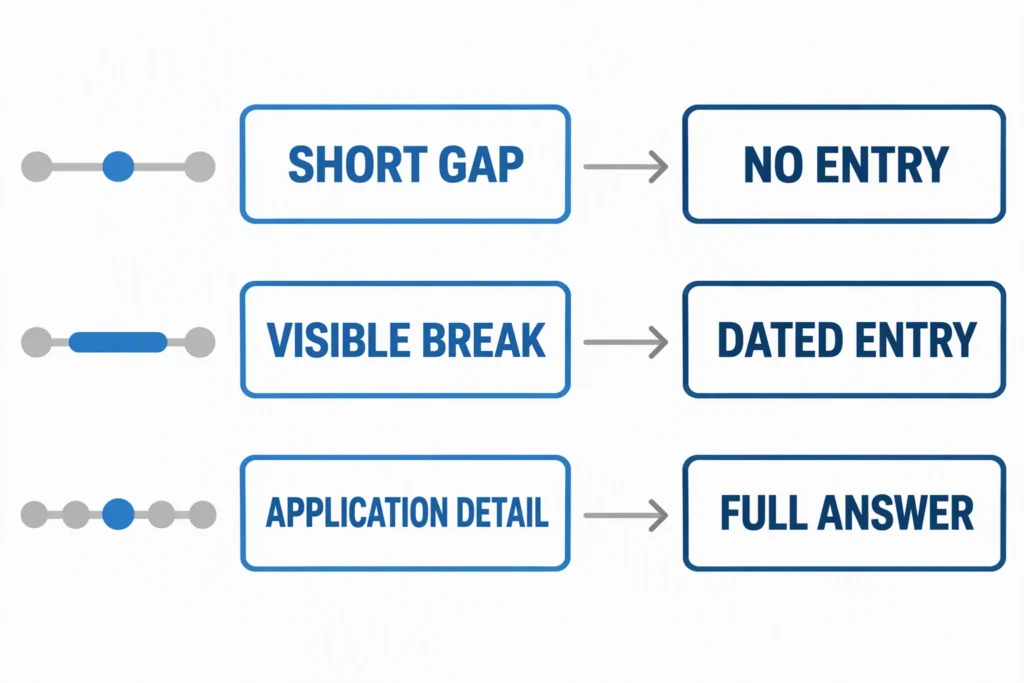
There is no single number of months that every employer treats as a problem. Look at the period in context: how recent it is, how long it appears beside your other roles, and whether another section already accounts for it.
| Situation | Practical treatment |
|---|---|
| Three months between two dated roles | Usually leave it alone; ordinary job searches and transitions happen. |
| Two years of full-time study shown in Education | Let the education entry explain the dates; don’t add a duplicate break entry. |
| A recent multi-year absence from paid work | Consider a dated entry in the experience chronology. |
| An older gap before the roles selected for this resume | No separate explanation is usually needed. |
| A period containing relevant freelance or volunteer work | List the real work with its actual status and dates. |
Use month and year when that is your date style, and apply it to every role. Switching only the inconvenient entries to years can look like an attempt to blur the timeline.
Put the explanation where it solves the question
The resume, application form, cover letter, and interview do different jobs. Giving each one the same paragraph wastes space and can create inconsistent versions of the story.
| Place | What belongs there |
|---|---|
| Work chronology | A short dated entry when the period itself needs context |
| Professional summary | Your relevant background and current direction, not an apology |
| Cover letter | One sentence connecting your return or transition to this role, if useful |
| Application form | Every detail the form requests, with dates consistent with your records |
| Interview | A brief explanation followed by why you are ready for the work now |
A targeted resume may omit unrelated work, while an application may ask for a complete history. Follow the form’s instructions rather than copying the shorter resume into every field.
How to explain employment gaps without oversharing
Use a simple four-part entry: label, dates, factual context, and optional relevant evidence. The fourth part is optional because a break does not need to become a professional-development project to be legitimate.
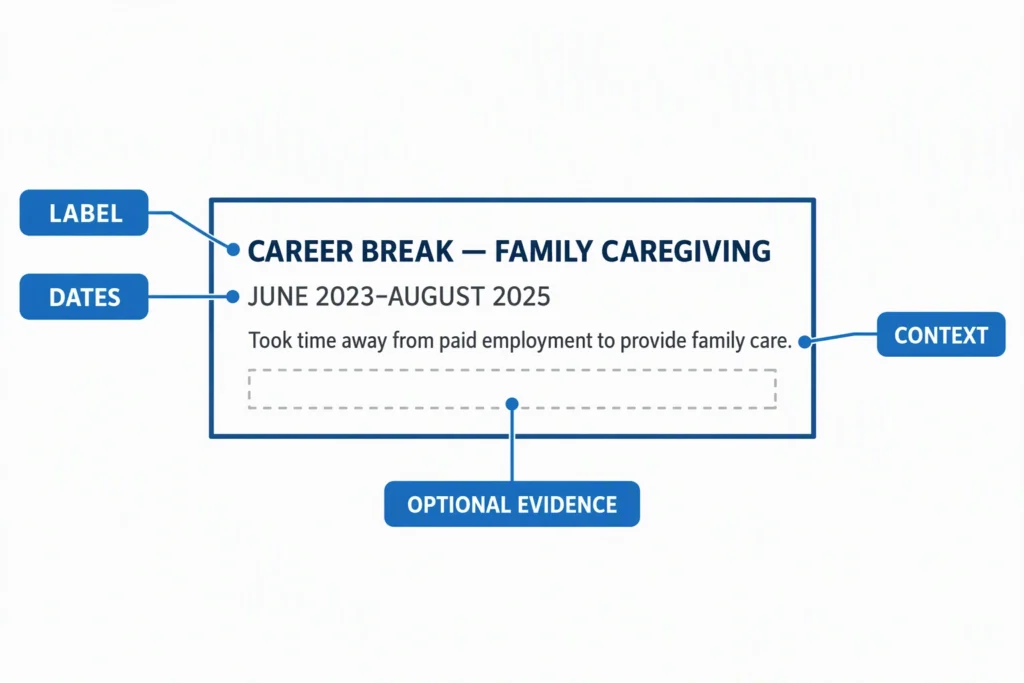
The same entry can be supplied as literal HTML for the website while remaining unrendered in this document:
Career Break — Family Caregiving
June 2023–August 2025
Took time away from paid employment to provide family care.
That version is complete. If the same period also included relevant work, add it as a separate, accurately labeled entry rather than cramming it into the explanation.
Choose plain language. “Family Caregiving,” “Personal Leave,” “Full-Time Study,” and “Personal Travel” tell the reader more than a vague title such as “Sabbatical” when that word does not match what happened. For a health-related period, you can keep the reason broad; your diagnosis and treatment history are not resume content.
Resume gap examples for common situations
The wording should change with the facts, but the level of detail can stay restrained. These models show what enough context looks like.
Caregiving without a professional activity
Caregiving can stand on its own. Don’t turn ordinary household responsibilities into corporate achievements.
Career Break — Family Caregiving
January 2022–September 2025
- Took time away from paid employment to care for a family member.
Health or another private reason
Use a broad label when the exact circumstances are personal. The entry needs to explain the dates, not disclose medical information.
Personal Leave
May 2024–February 2025
- Took a planned leave for personal reasons and am now available to return to full-time work.
If the leave is ongoing, don’t write that it has ended. Discuss realistic availability when the employer needs it.
Education, training, or a real project
When study or a project is the substance of the period, name it directly. Give the provider, output, or scope that makes the activity verifiable.
Data Reporting Certificate — Example Community College
September 2025–May 2026
- Completed coursework in Excel Power Query, SQL, and dashboard design; built a capstone report using a public transit dataset.
Don’t convert a short online course into a year of consulting. The accurate label is stronger because it gives the reader something specific to assess.
Unemployment after a layoff
A layoff does not require an “Unemployed” job entry. End the previous role on its actual date. If the following months included substantial, relevant activity, list that activity under its own name.
Professional Development
April–November 2026
- Completed an advanced bookkeeping course and volunteered two hours weekly to reconcile donation records for a community organization.
If the period consisted mainly of applying and interviewing, leave it unlabeled and prepare a short spoken explanation. Job searching is real effort, but it is not work experience.
Keep the chronology easy to trust
An explanation helps only when the surrounding dates and labels are accurate. Review the entire timeline before sending the document.
- Don’t extend an old job’s end date to reduce the gap.
- Don’t call yourself a consultant without actual clients or assignments.
- Don’t hide every date in a skills-only format; keep employers, roles, and chronology visible.
- Don’t add weak filler because it happened recently. Older relevant achievements may deserve more space.
- Don’t repeat the same reason in the summary, chronology, and cover letter.
Use a summary to lead with value: your field, useful experience, and target contribution. Then let the dated history show where that experience came from. A familiar one-column layout also makes the sequence easier for people and application systems to read.
Turn the written line into a confident answer
The interview version can be three sentences: what happened, what is relevant from the period, and why you are ready now. Keep the middle sentence out when there was no job-related activity.
For example: “My position ended in a companywide reduction in March 2025. Since then, I completed an advanced Excel course and helped a local nonprofit clean up its donor records. I’m now looking for an operations role where I can use that reporting experience.”
Keep the facts aligned with the resume and application. Then move into the employer’s problem, the work you have done before, and the contribution you can make.
Make the timeline clear and move forward
Choose the smallest truthful explanation that removes uncertainty, then spend the rest of the page proving your fit. A reader needs a coherent sequence and useful evidence, not a defense of every month of your life.
Frequently Asked Questions
These edge cases can change how much context belongs on the page.
How long can I be out of work before I need an explanation?
There is no universal cutoff. A recent multi-year absence is more likely to benefit from a dated entry than a few months between roles. Judge whether the blank period interrupts the story your selected experience tells.
Can I use years instead of months to make the timeline look smoother?
Years-only dates are a legitimate style when used consistently, but they can blur the length of shorter roles and transitions. Don’t change only selected dates to conceal information. Applications and background checks may still request exact months.
What if I have several separate breaks?
Label the recent or substantial periods that would otherwise confuse the chronology. You don’t need a paragraph for each one. Use consistent neutral wording, and give more detail only to activities that support the target job.
Do I have to disclose a medical condition?
No diagnosis is needed on a resume; “Personal Leave” may provide enough context. In U.S. hiring, the EEOC says employers generally cannot ask disability-related questions before a conditional offer, with limited exceptions involving accommodation. Discuss an accommodation through the appropriate process rather than placing medical history in the document.