
500+ Resume Keywords for 2026: ATS Keywords, Examples & How to Use Them

  • Free MS Word Downloadable Resume
  • Free Resume Samples
  • ATS Friendly Resume Examples
"Keywords for Resume Optimization"

Resume keywords are the specific words and phrases employers use to describe the skills, qualifications, experience, certifications, tools, and job titles they are looking for in a candidate. These keywords often appear directly in the job description and can help your resume align with both Applicant Tracking Systems (ATS) and recruiter expectations.

Using the right resume keywords is not about copying every term from a job posting. Instead, it means identifying the most relevant requirements and naturally incorporating the ones that genuinely match your background. When used strategically, keywords can make your resume easier to scan, improve its relevance for a particular role, and help highlight why you are a strong fit for the position.

In this guide, you’ll learn how to find resume keywords, where to place them, which keywords to prioritize, and how to use them naturally without keyword stuffing.

Key Takeaways

  • Get your primary keywords from the specific job description.
  • Prioritize job titles, hard skills, tools, certifications and qualifications.
  • Use the employer’s exact terminology when accurate.
  • Place keywords naturally across the summary, skills and experience sections.
  • Never add keywords for skills or credentials you don’t actually possess.
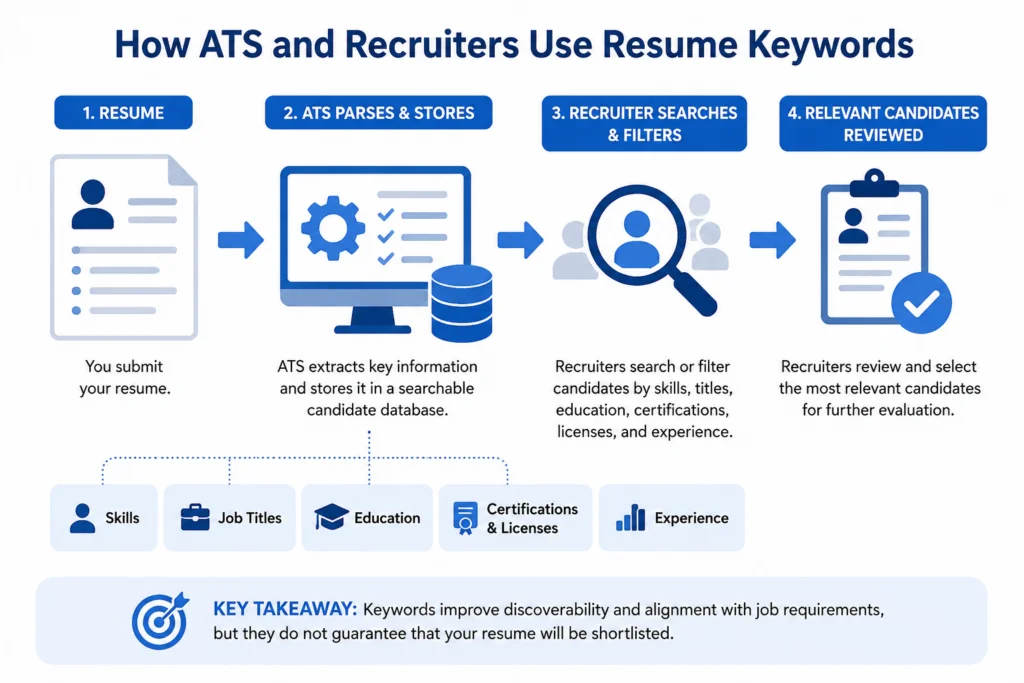
how ATS parses resume information and how recruiters search and filter candidates using resume keywords such as skills, job titles, education, certifications, and experience.

How to Identify Relevant Resume Keywords

The best resume keywords usually come directly from the job description. Look for terms related to required skills, job titles, tools, certifications, qualifications, and experience.

You can also review similar job postings on LinkedIn, Indeed, and Glassdoor or explore industry-specific resources to identify commonly used terminology.

Use general keyword lists for inspiration only. Your final keywords should match the specific job requirements and accurately reflect your qualifications—never copy and paste keywords just to increase their frequency.

Premium Tip:- Best source to identify keywords in your resume is from the job description. Read thoroughly the job description and job eligibility criteria along with job requirements. This will give you a clear idea of what exactly the employer is expecting from the candidates. Simply include all that in your resume and BOOM ! You will surely get your resume shortlisted.

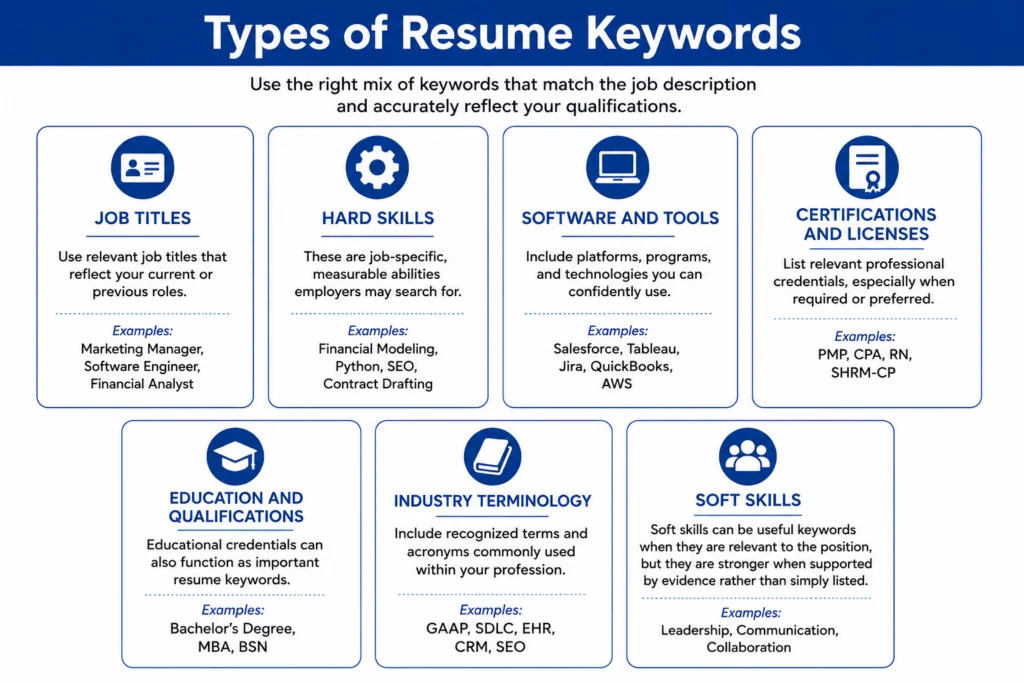
Infographic showing seven types of resume keywords: job titles, hard skills, software and tools, certifications and licenses, education, industry terminology, and soft skills.

Where to Put Keywords on a Resume

Resume keywords should appear naturally across relevant sections, rather than being concentrated in one place. Use the table below as a quick guide.

Resume SectionWhat Keywords to IncludeExample
Resume Headline / Target TitleUse the exact job title when it accurately describes your target role.Digital Marketing Manager
Professional SummaryAdd 2–4 important skills, qualifications, or areas of expertise.Digital Marketing Manager with 5+ years of experience in SEO, Google Ads, and lead generation.
SkillsInclude hard skills, software, tools, languages, and technical competencies.SEO, Python, Salesforce, Tableau, GA4
Work ExperienceUse keywords while showing how you applied the skill and what you achieved.Managed Google Ads campaigns, increasing qualified leads by 30%.
EducationInclude relevant degrees, majors, and coursework.Bachelor’s Degree in Marketing
Certifications & LicensesAdd credentials required or preferred for the role.Project Management Professional (PMP)
ProjectsShow relevant skills, tools, and methods used in real projects. Particularly useful for students, career changers, and technical candidates.Built a dashboard using Python and Tableau to analyze sales data.
Additional SectionsAdd relevant languages, training, publications, portfolios, or other qualifications.Spanish – Professional Working Proficiency

For more detailed guidance, see resume summary examples, resume skills, and how to format the work experience section of your resume.

Remember: Your work experience section is especially valuable because it lets you prove that you have actually used the skills and qualifications represented by your keywords. Use keywords accurately and naturally rather than adding them simply to increase keyword frequency.

Ready to Land Your Next Job?

Don’t let your resume get lost in the stack. Build a professional, ATS-friendly resume that highlights your leadership, achievements, and industry expertise.

Infographic showing how to find resume keywords in a job description by reviewing the job title, requirements, responsibilities, repeated terms, and must-have qualifications, with a Digital Marketing Manager example.

Common Resume Keyword Mistakes to Avoid

Using the right keywords matters, but how you use them matters just as much. Avoid these common mistakes:

  • Don’t stuff keywords: Repeating the same keyword unnecessarily can make your resume difficult to read. Use important terms where they naturally fit.
  • Don’t replace exact skills with unrelated synonyms: Project management, team leadership, and project coordination are related, but they do not mean exactly the same thing.
  • Don’t list keywords without context: Show how you used a skill through accomplishments and results. Forced keyword use is one of several common resume mistakes that can reduce clarity and credibility.
  • Don’t keep keywords in one section: Relevant terms can appear naturally throughout your summary, skills, work experience, education, and certifications.
  • Don’t add skills you don’t have: Every keyword should accurately represent your real qualifications and experience.

Exact Match vs. Natural Language

For important hard skills, software, job titles, and certifications, use the exact wording from the job description when it truthfully applies to you.

For example, if the employer asks for “Project Management” and you have that experience, include the actual phrase rather than replacing it entirely with team leadership or project coordination.

Job description: Project Management
Better resume bullet: Managed cross-functional projects using strong project management practices, delivering initiatives on schedule and within budget.

The goal is simple: match important terminology accurately, but make the surrounding language sound natural. Don’t sacrifice readability just to insert more keywords.

Infographic showing how to use full terms and acronyms for resume keywords, with examples including SEO, CRM, PMP, and GAAP.

Job Wise Examples Demonstrating Effective Use Of Resume Keywords

Resume keywords differ across professions, so it is important to focus on the skills, tools, technologies, qualifications, and terminology relevant to your target role. The examples below cover Software Developer/Engineer, Marketing Manager, Financial Analyst, Registered Nurse, Data Analyst, Data Engineer, and Animator, showing how job-specific keywords can be used naturally within a resume.

These examples include keywords related to programming languages, frameworks and libraries, databases, cloud and DevOps, development tools, software and web development, cybersecurity, marketing strategy, digital marketing, analytics, CRM, finance and accounting, investment and risk, compliance, clinical skills, healthcare systems, data analysis, data engineering, and animation. Use them as inspiration, but always choose keywords that match the specific job description and your actual experience.

Resume keywords for Software Developer/Engineer:

Here are strong ATS-friendly resume keywords for Software Developer/Software Engineer that cover technical skills, development practices, and soft skills.

Programming Languages

  • Java
  • Python
  • JavaScript
  • TypeScript
  • C++
  • C#
  • Go (Golang)
  • PHP
  • Ruby
  • Kotlin
  • Swift
  • SQL
  • HTML5
  • CSS3

Frameworks & Libraries

  • React.js
  • Angular
  • Vue.js
  • Node.js
  • Express.js
  • Spring Boot
  • .NET Core
  • Django
  • Flask
  • Laravel
  • Ruby on Rails
  • Next.js

Databases

  • MySQL
  • PostgreSQL
  • Microsoft SQL Server
  • Oracle Database
  • MongoDB
  • Redis
  • Firebase
  • SQLite
  • DynamoDB

Cloud & DevOps

  • AWS
  • Microsoft Azure
  • Google Cloud Platform (GCP)
  • Docker
  • Kubernetes
  • Jenkins
  • GitHub Actions
  • CI/CD
  • Terraform
  • Ansible

ATS Power Keywords

  • Software Engineer
  • Software Developer
  • Full-Stack Developer
  • Front-End Developer
  • Back-End Developer
  • Application Development
  • System Design
  • Software Architecture
  • Technical Documentation
  • Feature Development
  • Bug Fixing
  • Version Control
  • Continuous Integration
  • Continuous Deployment
  • Cloud Computing
  • Database Management
  • API Development
  • Code Optimization
  • Software Maintenance
  • Enterprise Applications
  • Scalable Applications

Development Tools

  • Git
  • GitHub
  • GitLab
  • Bitbucket
  • Visual Studio Code
  • IntelliJ IDEA
  • Eclipse
  • Jira
  • Postman
  • Swagger

Software Development

  • Software Development Life Cycle (SDLC)
  • Agile Development
  • Scrum
  • Object-Oriented Programming (OOP)
  • REST APIs
  • GraphQL
  • Microservices
  • API Integration
  • Multithreading
  • Design Patterns
  • Data Structures
  • Algorithms
  • Unit Testing
  • Integration Testing
  • Test-Driven Development (TDD)
  • Debugging
  • Code Review
  • Refactoring

Web Development

  • Responsive Web Design
  • Front-End Development
  • Back-End Development
  • Full-Stack Development
  • RESTful Services
  • JSON
  • XML
  • AJAX
  • Bootstrap
  • Tailwind CSS

Mobile Development

  • Android Development
  • iOS Development
  • React Native
  • Flutter
  • Mobile Application Development

Cybersecurity & Performance

  • Secure Coding
  • Authentication
  • Authorization
  • OAuth
  • JWT
  • Encryption
  • Performance Optimization
  • Scalability
  • Load Balancing
  • Caching

Soft Skills

  • Problem Solving
  • Analytical Thinking
  • Critical Thinking
  • Team Collaboration
  • Cross-Functional Collaboration
  • Communication
  • Time Management
  • Adaptability
  • Attention to Detail
  • Leadership
  • Mentoring
  • Continuous Learning

These keywords cover most Software Developer, Software Engineer, Full-Stack, Front-End, and Back-End job descriptions and are suitable for ATS optimization.

Below are examples for “How Can You Use These Keywords “In Your Resume

  • Worked with software development and testing team members to design and develop robust solutions to meet client requirements for functionality, scalability, and performance.
  • Analyzed proposed technical solutions based on customer requirements.
  • Maintained existing software systems by identifying and correcting software defects.
  • Designed and developed forward-thinking systems that meet user needs and improve productivity.
  • Improved software efficiency by troubleshooting and resolving coding issues.
  • Enhanced user experience through designing and implementing user-friendly interfaces.
  • Developed customized software solutions for diverse clients, resulting in increased satisfaction and repeat business.
  • Consistently met project milestones while maintaining rigorous quality control standards throughout all stages of the development life cycle.
  • Revised, modularized and updated old code bases to modern development standards, reducing operating costs, and improving functionality.

Resume Keywords For Marketing Manager

Marketing Manager resumes should highlight keywords that reflect your ability to plan campaigns, grow brands, reach target audiences, and measure marketing performance. Focus especially on job-specific terms related to digital marketing, SEO, analytics, CRM platforms, campaign management, lead generation, and marketing tools that match the employer’s requirements.

Marketing Strategy

  • Marketing Strategy
  • Brand Management
  • Brand Strategy
  • Product Marketing
  • Go-to-Market Strategy
  • Market Research
  • Market Analysis
  • Competitive Analysis
  • Consumer Insights
  • Customer Segmentation
  • Positioning
  • Campaign Management
  • Marketing Planning
  • Integrated Marketing Communications (IMC)

Digital Marketing

  • Digital Marketing
  • Search Engine Optimization (SEO)
  • Search Engine Marketing (SEM)
  • Pay-Per-Click (PPC)
  • Google Ads
  • Meta Ads
  • Social Media Marketing
  • Content Marketing
  • Email Marketing
  • Influencer Marketing
  • Affiliate Marketing
  • Marketing Automation
  • Conversion Rate Optimization (CRO)
  • A/B Testing

Analytics & Performance

  • Google Analytics (GA4)
  • Marketing Analytics
  • Campaign Performance
  • KPI Tracking
  • ROI Analysis
  • Data Analysis
  • Customer Acquisition
  • Lead Generation
  • Customer Retention
  • Marketing Metrics
  • Dashboard Reporting
  • Performance Optimization

Brand & Content

  • Brand Development
  • Brand Awareness
  • Brand Identity
  • Copywriting
  • Content Strategy
  • Editorial Planning
  • Storytelling
  • Public Relations (PR)
  • Corporate Communications
  • Event Marketing

CRM & Customer Management

  • Customer Relationship Management (CRM)
  • Salesforce
  • HubSpot
  • Customer Journey Mapping
  • Customer Experience (CX)
  • Lead Nurturing
  • Loyalty Programs
  • Marketing Funnels

Marketing Tools

  • Google Search Console
  • Ahrefs
  • SEMrush
  • HubSpot
  • Mailchimp
  • Hootsuite
  • Buffer
  • Canva
  • Adobe Creative Suite
  • WordPress

Sales & Business Growth

  • Business Development
  • Sales Enablement
  • Revenue Growth
  • Demand Generation
  • Pipeline Management
  • Product Launch
  • Customer Acquisition Strategy
  • Market Expansion
  • Partnership Development

Soft Skills

  • Leadership
  • Strategic Thinking
  • Communication
  • Creative Problem Solving
  • Analytical Thinking
  • Decision-Making
  • Negotiation
  • Relationship Building
  • Adaptability
  • Time Management
  • Collaboration
  • Presentation Skills

ATS Power Keywords

  • Marketing Manager
  • Digital Marketing Manager
  • Brand Manager
  • Growth Marketing
  • Performance Marketing
  • Marketing Campaigns
  • Demand Generation
  • Lead Generation
  • Customer Acquisition
  • Brand Positioning
  • Marketing Operations
  • Product Marketing
  • Business Growth
  • Market Expansion
  • Marketing Communications
  • Campaign Optimization
  • Data-Driven Marketing
  • Omnichannel Marketing
  • Marketing Leadership
  • Revenue Optimization

Project & Team Management

  • Cross-Functional Collaboration
  • Team Leadership
  • Project Management
  • Budget Management
  • Vendor Management
  • Stakeholder Management
  • Strategic Planning
  • Resource Allocation
  • Process Improvement
  • Performance Management

Below are examples for “How Can You Use These Keywords “In Your Resume

  • Performed market segmentations, targeting and positioning for each product line.
  • Managed budget allocation and resource utilization to maximize marketing ROI.
  • Captured new customers by optimizing business strategies and launching products to diversify offerings.
  • Developed and implemented marketing strategies to use for launches, rebranding campaigns and promotions.
  • Managed marketing budget and associated P&L to develop and execute marketing strategies, budgets and sales plans for business segments.
  • Launched successful digital marketing campaigns that achieved goals for increased website traffic.
  • Conducted market research to identify new opportunities and target markets.
  • Continually maintained and improved company’s reputation and positive image in markets served.
  • Devised content strategy to effectively engage target audiences.
  • Optimized content strategy across multiple channels to support search engine rankings, brand recognition, and user engagement goals.

Resume Keywords For Financial Analyst

Financial Analyst resumes should emphasize keywords that demonstrate your ability to analyze financial data, build forecasts, evaluate performance, and support business decisions. Focus on role-specific terms related to financial analysis, FP&A, financial modeling, budgeting, accounting and compliance, investment analysis, reporting, and financial tools that match the job description.

Financial Analysis

  • Financial Analysis
  • Financial Modeling
  • Financial Forecasting
  • Budgeting
  • Budget Analysis
  • Financial Planning
  • Variance Analysis
  • Cost Analysis
  • Profitability Analysis
  • Business Analysis
  • Revenue Analysis
  • Expense Management
  • Investment Analysis
  • Risk Assessment

Accounting & Finance

  • Financial Reporting
  • General Ledger
  • Accounts Payable
  • Accounts Receivable
  • Cash Flow Analysis
  • Balance Sheet Analysis
  • Income Statement Analysis
  • Profit and Loss (P&L)
  • Capital Budgeting
  • Cost Accounting
  • Corporate Finance
  • Managerial Accounting
  • Fixed Asset Management
  • Tax Planning

Investment & Risk

  • Portfolio Analysis
  • Investment Research
  • Equity Research
  • Credit Analysis
  • Valuation
  • Discounted Cash Flow (DCF)
  • Financial Ratios
  • Risk Management
  • Due Diligence
  • Capital Markets
  • Mergers & Acquisitions (M&A)

Software & Tools

  • Microsoft Excel
  • Advanced Excel
  • Pivot Tables
  • VLOOKUP
  • XLOOKUP
  • Power Query
  • Power Pivot
  • Microsoft Power BI
  • Tableau
  • SQL
  • SAP
  • Oracle Financials
  • QuickBooks
  • NetSuite
  • Bloomberg Terminal

Compliance & Reporting

  • Financial Compliance
  • Regulatory Reporting
  • Internal Controls
  • GAAP
  • IFRS
  • SOX Compliance
  • Audit Support
  • Financial Auditing
  • Reconciliation
  • Documentation

Business & Strategy

  • Strategic Planning
  • Business Forecasting
  • Decision Support
  • Cost Reduction
  • Process Improvement
  • Operational Efficiency
  • Resource Allocation
  • Business Performance Analysis
  • Financial Strategy
  • Stakeholder Reporting

Soft Skills

  • Analytical Thinking
  • Problem Solving
  • Critical Thinking
  • Attention to Detail
  • Communication
  • Time Management
  • Decision-Making
  • Organizational Skills
  • Collaboration
  • Presentation Skills
  • Strategic Thinking
  • Adaptability

ATS Power Keywords

  • Financial Analyst
  • Senior Financial Analyst
  • Corporate Finance
  • Financial Planning & Analysis (FP&A)
  • Budget Forecasting
  • Financial Modeling
  • Business Intelligence
  • Financial Reporting
  • Investment Analysis
  • Data-Driven Decision Making
  • Financial Performance
  • Cost Optimization
  • Revenue Forecasting
  • Risk Analysis
  • Business Insights
  • Financial Operations
  • Strategic Finance
  • Profitability Analysis
  • Cash Flow Management
  • Budget Management

Below are examples for “How Can You Use These Keywords “In Your Resume

  • Analyzed complex financial information to offer recommendations to management, driving decision-making.
  • Analyzed financial data to identify trends, patterns and strategies.
  • Evaluated financial records for accuracy and conformance to regulations.
  • Generated financial reports to garner forecasting, trending and narrative results analysis for management.
  • Utilized statistical, economic and financial principles and techniques to prepare reports and other requests.
  • Created financial models to assess opportunities.
  • Administered and maintained data to facilitate tracking and trending analysis.
  • Prioritized and expedited assigned work to meet changing business circumstances.
  • Conducted audits and reported findings to facilitate research and resolution.
  • Assisted senior management maintain profitability by analyzing portfolios and implementing strategies and techniques.
  • Established financial policies and procedures to set standards for compliance.
  • Implemented company end-to-end technology platform.
  • Used best practice models to analyze large amounts of data and share insights.
  • Analyzed trends in financial performance to identify areas for improvement.

Resume Keywords for Registered Nurse

A strong Registered Nurse resume should use keywords that reflect your clinical skills, healthcare systems knowledge, nursing credentials, specialty experience, and patient-care responsibilities. Instead of simply listing these terms, use them naturally in your work experience to show how you applied the skill in real patient-care situations.

CategoryResume KeywordsExample of How to Use Them in a Resume
Clinical SkillsPatient Assessment; Medication Administration; Care Planning; IV Therapy; Infection Control; Patient Monitoring; Discharge Planning; Patient SafetyPerformed comprehensive patient assessments and developed individualized care plans with multidisciplinary teams. Administered medications and IV therapy while monitoring patients for adverse reactions.
Records & SystemsElectronic Health Records (EHR); Electronic Medical Records (EMR); Epic; Cerner; Clinical Documentation; Medical RecordsDocumented treatment, medications, and patient progress accurately in Electronic Health Records (EHR) using Epic.
Licenses & CertificationsRegistered Nurse (RN); Basic Life Support (BLS); Advanced Cardiovascular Life Support (ACLS); Pediatric Advanced Life Support (PALS)Maintained active Registered Nurse (RN), BLS, and ACLS credentials while delivering care in a fast-paced clinical environment.
Specialty KeywordsCritical Care; Emergency Nursing; Medical-Surgical Nursing; Telemetry; Acute Care; Chronic Disease Management; Patient EducationDelivered critical care and telemetry monitoring for acute-care patients while providing clear patient and family education.
Care CoordinationDischarge Planning; Interdisciplinary Collaboration; Patient Advocacy; Care CoordinationCoordinated discharge planning with physicians and interdisciplinary teams and educated patients on follow-up care and self-management.

Tip: Use these keywords for inspiration only. Always compare them with the specific nursing job description and include only the skills, certifications, systems, and specialties that accurately reflect your experience.

Resume Keywords for Data Analyst

A strong Data Analyst resume should highlight keywords related to data analysis, databases, visualization, reporting, statistical methods, and analytics tools. Instead of listing every possible keyword, focus on the technologies and analytical skills required by the job and show how you used them to produce measurable business results.

CategoryResume KeywordsHow to Use Them in Your Resume
Data AnalysisData Analysis; Data Cleaning; Data Validation; Trend Analysis; Forecasting; Exploratory Data Analysis (EDA)Analyzed customer data to identify trends and forecast demand, improving quarterly planning accuracy by 18%.
SQL & DatabasesSQL; MySQL; PostgreSQL; Database Management; Data Extraction; Data IntegrityUsed SQL to extract and validate data from multiple databases, reducing reporting errors by 25%.
Visualization & BITableau; Power BI; Data Visualization; Business Intelligence (BI); Dashboard Development; KPI ReportingBuilt interactive Tableau dashboards to track KPIs and provide leadership with real-time performance insights.
Excel & Analytics ToolsMicrosoft Excel; Power Query; Power Pivot; SAS; SPSSAutomated recurring reports using Excel Power Query and Power Pivot, reducing manual reporting time by 30%.
Statistical AnalysisStatistical Analysis; Regression Analysis; A/B Testing; Predictive Analytics; Data ModelingApplied regression analysis to identify factors influencing customer retention and support business decisions.
Data PreparationETL; Data Transformation; Data Integration; Data Wrangling; Data QualityDeveloped ETL workflows to clean and transform data from multiple sources, improving reporting reliability.
Reporting & Business InsightsKPI Tracking; Performance Metrics; Business Intelligence; Reporting; ScorecardsCreated performance scorecards and KPI reports that helped management identify operational improvement opportunities.

Tip: Prioritize specific, searchable skills such as SQL, Tableau, Power BI, Excel, ETL, and statistical analysis over generic terms such as problem solving or attention to detail. Use only the keywords that match both the job description and your actual experience.

Resume Keywords for Data Engineer

A strong Data Engineer resume should focus on data pipelines, databases, cloud platforms, data warehousing, and modern data-engineering tools. The existing examples should be replaced because several—such as engineering drawings, equipment design, monitors, and manufacturing instructions—describe general or manufacturing engineering rather than modern data engineering.

CategoryResume KeywordsHow to Use Them in Your Resume
Programming & QueryingSQL; Python; ScalaDeveloped Python and SQL workflows to process large datasets and automate recurring data operations.
Data PipelinesETL; ELT; Data Pipelines; Data Integration; Data TransformationBuilt automated ETL pipelines that reduced daily data-processing time by 40%.
Data WarehousingSnowflake; Data Warehousing; Data Lakes; Data ModelingDesigned and optimized Snowflake data warehouses, improving query performance by 35%.
Big DataApache Spark; Databricks; Apache KafkaProcessed large datasets using Apache Spark and Databricks to support analytics workloads.
Workflow & TransformationApache Airflow; dbt; Workflow OrchestrationDeveloped Airflow and dbt workflows to automate data transformation and improve pipeline reliability.
Cloud PlatformsAWS; Microsoft Azure; Google Cloud Platform (GCP)Migrated data pipelines to AWS, improving scalability while reducing infrastructure costs by 22%.
DatabasesPostgreSQL; MySQL; NoSQL; Database OptimizationOptimized PostgreSQL queries and database structures to improve data retrieval performance.
Data Quality & GovernanceData Quality; Data Validation; Data Governance; Data TestingImplemented automated data validation and quality checks, reducing reporting errors by 30%.

Tip: For Data Engineer resumes, prioritize concrete technologies such as SQL, Python, Snowflake, Databricks, Spark, Airflow, dbt, Kafka, and AWS/Azure/GCP over vague phrases such as problem solving or engineering skills.

Resume Keywords for Animator

A strong Animator resume should highlight keywords related to animation software, 2D/3D animation, character development, storyboarding, motion graphics, and production workflows. Prioritize specific tools and technical abilities, then demonstrate creative skills such as storytelling and collaboration through actual project accomplishments.

CategoryResume KeywordsHow to Use Them in Your Resume
Animation Skills2D Animation; 3D Animation; Character Animation; Keyframe Animation; Motion GraphicsProduced 2D and 3D character animations for 15+ digital projects while maintaining consistent movement and visual style.
Software & ToolsAdobe After Effects; Blender; Maya; Cinema 4D; Adobe Animate; Toon Boom HarmonyCreated and refined 3D animations in Blender and Maya, reducing production time by 20%.
Storyboarding & Pre-ProductionStoryboarding; Concept Development; Animatics; Visual Development; Pre-ProductionDeveloped storyboards and animatics that translated creative concepts into clear production sequences.
Character & Visual DesignCharacter Design; Rigging; Texturing; Lighting; Modeling; RenderingDesigned and rigged 3D characters, applying textures and lighting to create production-ready assets.
Post-ProductionCompositing; Rendering; Video Editing; Keyframe Management; TimingManaged keyframes, timing, and compositing to create smooth scene transitions during post-production.
Production WorkflowAnimation Pipeline; Asset Management; Quality Control; Production DeadlinesManaged multiple assets through the animation pipeline, delivering projects on schedule while meeting quality standards.
Creative CollaborationCreative Direction; Client Collaboration; Art Direction; Feedback ImplementationCollaborated with clients and creative teams during pre-production, translating feedback into approved animation concepts.

Premium Tip :- Do the smart work and Use our Resume Builder to build your resume now and rest assured. We will take care of all the sections, format and keyword incorporation. So that you can be worry free and ace that interview you are seeking. We have a good customer base, and many people trust us. 

Resume Keywords for Administration

Administration resumes should prioritize keywords that show your ability to manage office operations, coordinate schedules, maintain records, support executives, and use administrative systems efficiently. Rather than using a long list of repetitive or generic soft skills, group the most useful keywords by function and prioritize specific, job-related competencies.

CategoryResume KeywordsHow to Use Them in Your Resume
Office AdministrationAdministrative Support; Office Management; Office Administration; Executive Assistance; Office Procedures; Facilities ManagementProvided administrative support to senior leaders while coordinating daily office operations and facilities requirements.
Scheduling & CoordinationCalendar Management; Meeting Coordination; Appointment Scheduling; Meeting Logistics; Travel Arrangements; Event CoordinationManaged executive calendars, meetings, and travel arrangements, coordinating schedules across multiple departments.
Records & DocumentsRecords Management; Document Control; Data Entry; Filing; Meeting Minutes; Business CorrespondenceMaintained accurate records and document-control systems while preparing reports, correspondence, and meeting minutes.
Finance & PurchasingExpense Reporting; Billing and Invoicing; Purchasing; Budget Management; Inventory ControlProcessed expense reports and invoices and monitored departmental purchasing against approved budgets.
Vendors & FacilitiesVendor Management; Contract Negotiation; Office Supplies Management; Facilities ManagementCoordinated vendor relationships and facilities services, supporting efficient day-to-day office operations.
Software & SystemsMicrosoft Office; Microsoft Excel; Google Workspace; SAP; Salesforce; Database ManagementUsed Microsoft Excel and Salesforce to maintain administrative records, generate reports, and track business information.
Operations & ComplianceWorkflow Optimization; Policy Implementation; Regulatory Compliance; Quality Assurance; Resource AllocationImproved administrative workflows and maintained documentation in accordance with company policies and compliance requirements.
Executive & Team SupportExecutive Assistance; Project Coordination; Stakeholder Engagement; Staff Supervision; ConfidentialityProvided confidential executive assistance and coordinated projects with internal and external stakeholders.

Check out our System Administrator resume example to learn more about presenting IT skills, systems, and technical expertise.

Resume Keywords for Human Resources

Human Resources resumes should focus on keywords related to recruitment, employee relations, performance management, HR compliance, benefits, HR technology, and workforce strategy. I’ve removed repetitive variations and grouped the strongest role-specific keywords into clear categories, while keeping generic soft skills out of the main keyword list.

CategoryResume KeywordsHow to Use Them in Your Resume
Recruitment & Talent AcquisitionTalent Acquisition; Recruitment and Selection; Onboarding; Workforce Planning; Succession Planning; Talent Management; Job Analysis; Job DescriptionsManaged full-cycle talent acquisition and onboarding for 40+ annual hires while improving time-to-fill for priority roles.
Employee Relations & PerformanceEmployee Relations; Employee Engagement; Performance Management; Performance Appraisals; Performance Improvement Plans (PIPs); Grievance Handling; Conflict Mediation; Employee RetentionResolved employee relations issues and supported performance improvement plans, contributing to stronger employee retention.
Learning & DevelopmentTraining and Development; Employee Development Plans; Leadership Development; HR Training Programs; Diversity Training; HR CoachingDesigned training and employee development programs for 120+ staff and supported leadership development initiatives.
Compensation, Benefits & PayrollCompensation and Benefits; Employee Benefits Administration; Payroll Administration; Employee Recognition Programs; Health and Wellness ProgramsAdministered employee benefits and payroll processes while coordinating recognition and wellness programs.
Compliance & Employment LawEmployment Law; HR Compliance; FMLA; ADA; EEO; Workplace Safety; HR Audits; HR Investigations; HR Risk ManagementMaintained HR compliance with FMLA, ADA, and EEO requirements and supported internal HR audits and investigations.
HR Systems & AnalyticsHuman Resources Information System (HRIS); HR Analytics; HR Metrics; HR Reporting; HR Data Management; Workday; ADP; SAP SuccessFactorsUsed Workday and HR analytics to track workforce metrics, prepare HR reports, and improve data accuracy.
Diversity, Equity & InclusionDiversity and Inclusion; Inclusion Initiatives; Diversity Metrics; Employee SurveysSupported diversity and inclusion initiatives and analyzed employee survey data to identify engagement opportunities.
HR Strategy & Organizational DevelopmentHuman Resources Management; Organizational Development; Change Management; HR Strategy; HR Business Partnering; HR Project Management; HR ConsultingPartnered with business leaders on HR strategy, organizational development, and change-management initiatives.
Policies & AdministrationHR Policies and Procedures; Employee Handbooks; HR Policy Development; HR Administration; HR Communication; ConfidentialityUpdated HR policies and employee handbook content while maintaining confidential employee records and communications.

Learn from our HR Assistant resume examples to see how human resources skills and experience can be presented effectively.

Resume Keywords for Legal

Legal resumes should prioritize specific, searchable competencies related to legal research, drafting, litigation, contracts, compliance, practice areas, and legal technology. I’ve removed repetitive variations such as Legal Writing Skills/Legal Writing Style and Legal Documentation/Legal Documentation Drafting and grouped the strongest terms into clear categories.

CategoryResume KeywordsHow to Use Them in Your Resume
Legal Research & AnalysisLegal Research; Legal Analysis; Statutory Interpretation; Legal Precedents; Case Evaluation; Legal Investigation; Legal Risk AssessmentConducted legal research and statutory analysis to evaluate case risks and support litigation strategy.
Legal Writing & DraftingLegal Writing; Legal Drafting; Legal Briefs; Legal Memoranda; Legal Opinions; Legal Correspondence; Document DraftingDrafted legal briefs, memoranda, and client correspondence for attorney review and court submissions.
Litigation & Case ManagementLitigation; Civil Litigation; Trial Preparation; Discovery; Case Management; Court Filings; Case File Organization; Legal ProceduresManaged discovery materials, court filings, and case documentation while supporting attorneys through trial preparation.
Contracts & Due DiligenceContract Law; Contract Drafting; Contract Review; Contract Negotiation; Legal Due Diligence; Document ReviewReviewed and drafted commercial contracts and performed legal due diligence to identify contractual risks.
Compliance & RiskLegal Compliance; Regulatory Compliance; Compliance Audits; Compliance Programs; Legal Risk Management; Legal EthicsSupported regulatory compliance reviews and legal risk assessments while maintaining documentation for internal audits.
Practice AreasCorporate Law; Intellectual Property Law; Employment Law; Real Estate Law; Family Law; Criminal LawSupported matters involving corporate and employment law by researching regulations and preparing case documentation.
Dispute Resolution & AdvocacyLegal Negotiation; Mediation; Arbitration; Dispute Resolution; Legal Advocacy; Legal RepresentationPrepared case materials for mediation and arbitration and supported attorneys during settlement negotiations.
Legal Technology & ToolsWestlaw; LexisNexis; Legal Case Management Software; Legal Document Automation; Legal Database ManagementUsed Westlaw and LexisNexis for legal research and maintained case records in legal case-management software.
Client & Court SupportClient Communication; Court Filings; Legal Documentation; Document Management; Legal Counsel SupportCoordinated client communications and prepared legal documentation and filings for attorney and court review.

Explore our Legal Secretary resume example to see how legal skills, terminology, and administrative experience can be highlighted.

Resume Keywords for Marketing

Marketing resumes should prioritize keywords related to marketing strategy, digital channels, analytics, content, brand management, CRM, and customer acquisition. I’ve removed repeated terms such as Marketing Plans, Market Segmentation, Marketing Communications, Content Creation, and SEO and organized the strongest keywords into clear categories.

CategoryResume KeywordsHow to Use Them in Your Resume
Marketing Strategy & ResearchMarketing Strategy; Market Research; Competitive Analysis; Consumer Behavior; Market Segmentation; Marketing Planning; Industry ResearchDeveloped a marketing strategy using market research and competitive analysis to identify new audience segments and growth opportunities.
Digital Marketing & AcquisitionDigital Marketing; Search Engine Optimization (SEO); Search Engine Marketing (SEM); Pay-Per-Click (PPC); Google Ads; Display Advertising; Retargeting; Customer AcquisitionManaged SEO and Google Ads campaigns that increased qualified website traffic and supported customer acquisition goals.
Content & CommunicationsContent Marketing; Content Strategy; Copywriting; Content Creation; Content Distribution; Marketing Communications; Integrated Marketing Communications (IMC); Thought LeadershipCreated and distributed SEO-focused content across digital channels, strengthening brand visibility and audience engagement.
Social Media & Influencer MarketingSocial Media Marketing; Social Media Strategy; Social Media Advertising; Social Media Analytics; Influencer Marketing; Influencer Partnerships; Community EngagementExecuted social media and influencer campaigns, using performance analytics to optimize engagement and campaign reach.
Email, CRM & AutomationEmail Marketing; Email Campaigns; Email Automation; Customer Relationship Management (CRM); Marketing Automation; HubSpot; Marketo; Lead NurturingBuilt automated email and lead-nurturing workflows in HubSpot to improve campaign efficiency and prospect engagement.
Brand ManagementBrand Management; Brand Development; Brand Identity; Brand Positioning; Brand Messaging; Brand Guidelines; Brand AwarenessRefined brand positioning and messaging across campaigns to maintain a consistent identity and strengthen brand awareness.
Analytics & OptimizationMarketing Analytics; Web Analytics; Marketing ROI; Marketing Metrics; Marketing Attribution; Conversion Rate Optimization (CRO); A/B Testing; Website Optimization; Landing Page OptimizationUsed web analytics and A/B testing to optimize landing pages, increasing conversion rates and improving marketing ROI.
Customer & Lifecycle MarketingCustomer Retention; Customer Segmentation; Customer Lifetime Value (CLV); Customer Journey Mapping; Customer Experience (CX); Marketing FunnelAnalyzed customer segments and journey data to improve retention campaigns and increase customer lifetime value.
Product & Growth MarketingProduct Launches; Go-to-Market Strategy; Sales Enablement; Marketing Partnerships; Affiliate Marketing; Omnichannel Marketing; Mobile Marketing; App Store Optimization (ASO)Supported a product launch through go-to-market planning, sales enablement, and coordinated omnichannel campaigns.
Campaigns, PR & EventsMarketing Campaigns; Advertising Campaigns; Public Relations (PR); Event Marketing; Trade Shows; Sponsorship Management; Marketing BudgetingManaged integrated marketing campaigns, PR activities, and trade-show programs while tracking performance against budget.

Read our Marketing resume examples to learn how to showcase marketing skills, tools, campaigns, and measurable achievements.

Resume Keywords for Sales

Sales resumes should prioritize keywords that demonstrate your ability to generate leads, manage pipelines, close deals, grow revenue, and maintain customer relationships. I’ve removed repetitive variations from the original list and grouped the strongest, most searchable sales keywords into practical categories.

CategoryResume KeywordsHow to Use Them in Your Resume
Sales Strategy & ManagementSales Strategy; Sales Management; Sales Leadership; Sales Planning; Sales Operations; Sales Development; Sales Process ImprovementDeveloped and executed a sales strategy that improved team productivity and supported 18% year-over-year revenue growth.
Prospecting & Lead GenerationLead Generation; Prospecting; Cold Calling; Networking; Lead Qualification; Client AcquisitionGenerated and qualified 60+ leads per month through targeted prospecting, cold calling, and networking.
Pipeline & ForecastingPipeline Management; Opportunity Management; Sales Funnel Management; Sales Forecasting; Forecast Accuracy; Sales AnalyticsManaged a $2.5M sales pipeline and improved forecast accuracy by tracking opportunities and conversion trends in CRM.
Selling & ClosingConsultative Selling; Solution Selling; Value Selling; Sales Negotiation; Sales Closing; Proposal Development; Contract NegotiationUsed consultative selling and contract negotiation to close enterprise deals and exceed quarterly quota by 15%.
Account & Customer ManagementAccount Management; Customer Relationship Management (CRM); Relationship Building; Customer Retention; Client SatisfactionManaged strategic accounts in Salesforce CRM, strengthening customer relationships and maintaining a 92% retention rate.
Territory & Revenue GrowthTerritory Management; Territory Expansion; Revenue Growth; Sales Targets; Sales Quotas; Cross-Selling; UpsellingExpanded territory revenue by 22% through account growth, cross-selling, and targeted new-business development.
B2B, B2C & Channel SalesB2B Sales; B2C Sales; Channel Management; Partner Relationships; Sales CollaborationGrew B2B channel sales by developing partner relationships and coordinating joint account opportunities.
Sales Enablement & Team DevelopmentSales Enablement; Sales Training; Sales Coaching; Team Management; Performance Improvement; Incentive ProgramsCoached a 10-member sales team and introduced enablement resources that improved average quota attainment.
CRM, Automation & ReportingSalesforce; HubSpot; CRM; Sales Automation; Sales Reporting; Sales Dashboards; Performance Metrics; Sales Data AnalyticsUsed Salesforce dashboards and sales analytics to monitor KPIs, identify pipeline gaps, and prioritize high-value opportunities.

Explore our Sales resume examples to learn how to present sales skills, customer relationships, and revenue-focused achievements.

Resume Keywords for Healthcare

Healthcare resumes should prioritize keywords related to patient care, clinical operations, health records, compliance, healthcare technology, quality improvement, and revenue-cycle management. I’ve removed repetitive “Healthcare + term” variations and organized the strongest keywords into practical categories that apply across clinical, technical, and administrative healthcare roles.

CategoryResume KeywordsHow to Use Them in Your Resume
Clinical & Patient CarePatient Care; Clinical Operations; Patient Safety; Patient Education; Patient Advocacy; Case Management; Discharge Planning; Interdisciplinary CollaborationCoordinated patient care and discharge planning with interdisciplinary teams while providing clear patient education and advocacy.
Healthcare Administration & OperationsHealthcare Administration; Healthcare Management; Healthcare Operations; Medical Administration; Workflow Optimization; Healthcare LeadershipManaged healthcare operations and optimized administrative workflows to improve service efficiency and patient support.
Health Records & InformaticsElectronic Health Records (EHR); Electronic Medical Records (EMR); Health Information Management (HIM); Healthcare Informatics; Medical Records Management; Healthcare Data AnalysisMaintained accurate EHR documentation and used healthcare data analysis to support clinical and operational reporting.
Quality, Safety & RiskQuality Improvement; Quality Assurance; Patient Safety; Risk Management; Risk Assessment; Incident Management; Infection Control; Emergency PreparednessLed quality-improvement and patient-safety initiatives, using risk assessments and incident reviews to strengthen clinical processes.
Compliance, Policy & AccreditationHealthcare Compliance; Healthcare Regulations; Healthcare Policy; Healthcare Law; Healthcare Ethics; Credentialing; Accreditation; Healthcare AuditsSupported healthcare compliance and accreditation activities by maintaining documentation and reviewing processes against regulatory requirements.
Billing, Coding & Revenue CycleMedical Billing; Medical Coding; Revenue Cycle Management; Healthcare Reimbursement; Claims Processing; Healthcare Insurance; Healthcare FinanceSupported revenue cycle management through accurate medical billing, coding, claims processing, and reimbursement documentation.
Technology & TelehealthHealthcare Technology; Telehealth; Healthcare Software; Systems Integration; Telemedicine; Health Informatics StandardsSupported telehealth services and healthcare systems integration while maintaining accurate digital patient records.
Population & Public HealthPopulation Health Management; Health Promotion; Disease Prevention; Community Outreach; Public Health Initiatives; Epidemiology; Occupational Health and SafetySupported population health and disease-prevention programs through community outreach and analysis of public-health data.
Performance, Analytics & ReportingHealthcare Analytics; Healthcare Reporting; Healthcare Metrics; Performance Improvement; Healthcare Data Analysis; Utilization ManagementAnalyzed healthcare metrics and utilization data to identify performance-improvement opportunities and support management decisions.
Training & Team LeadershipStaff Training and Development; Leadership Development; Team Collaboration; Interdisciplinary Collaboration; Healthcare LeadershipTrained healthcare staff on clinical procedures and compliance requirements while strengthening interdisciplinary team collaboration.

Read our guide to resume keywords for healthcare to identify relevant clinical skills, credentials, and healthcare terminology.

Resume Keywords for Business Analysis

Business Analysis resumes should focus on requirements, process improvement, data analysis, stakeholder management, solution validation, and business intelligence. I’ve removed overlapping terms such as Root Cause Analysis/Root Cause Identification and grouped the strongest keywords into practical categories.

CategoryResume KeywordsHow to Use Them in Your Resume
Requirements & ElicitationRequirements Gathering; Requirements Elicitation; Requirements Prioritization; Requirements Validation; User Stories; Use Case Analysis; Business Requirements Specification (BRS); Functional Requirements Specification (FRS); Non-Functional Requirements; Requirement Traceability Matrix (RTM)Gathered and prioritized business requirements, created user stories and an RTM, and validated requirements with key stakeholders.
Process Analysis & ImprovementBusiness Process Analysis; Business Process Modeling (BPM); Process Mapping; Gap Analysis; Business Process Improvement; Process Optimization; Business Process Reengineering (BPR); Business Process Automation; Value Stream MappingMapped current-state processes, performed gap analysis, and redesigned workflows to reduce processing time and improve efficiency.
Data & Business IntelligenceData Analysis; Data Modeling; Data Visualization; Business Intelligence (BI); Business Analytics; Dashboard Development; BI Reporting; Data Warehousing; Data Governance; Data Quality ManagementBuilt BI dashboards and analyzed operational data to identify trends, improve data quality, and support management decisions.
Analysis & Decision SupportSWOT Analysis; Feasibility Studies; Cost-Benefit Analysis; ROI Analysis; Risk Analysis; Root Cause Analysis; Impact Analysis; Business Case DevelopmentPrepared a business case using cost-benefit, ROI, and risk analysis to support investment decisions for a new system.
Agile & DeliveryAgile Business Analysis; Scrum; Kanban; Lean Six Sigma; Project Management; Change ManagementSupported Agile delivery by refining requirements, maintaining user stories, and collaborating with Scrum teams throughout implementation.
Testing & Solution ValidationUser Acceptance Testing (UAT); Quality Assurance (QA); Solution Assessment and Validation; Post-Implementation Review (PIR); Requirements ValidationCoordinated UAT, documented defects, and validated the implemented solution against approved business requirements.
Stakeholder ManagementStakeholder Management; Stakeholder Analysis; Requirements Workshops; Cross-Functional Collaboration; Business Strategy AlignmentFacilitated stakeholder workshops to align business requirements with strategic goals and resolve conflicting priorities.
Metrics, Trends & ForecastingKey Performance Indicators (KPIs); Business Metrics Definition; Trend Analysis; Forecasting; Statistical Analysis; Predictive Analytics; Quantitative AnalysisDefined KPIs and analyzed business trends to create forecasts and provide data-driven recommendations to leadership.
Market, Financial & Strategic AnalysisCompetitive Analysis; Market Analysis; Financial Analysis; Business Value Analysis; Business Architecture; Business Strategy AlignmentConducted market, competitive, and financial analysis to evaluate business opportunities and recommend strategic priorities.

Explore our Business Analyst resume example to learn how to highlight analytical skills, technical tools, and business expertise.


Resume Keywords for Finance and Accounting

Finance and Accounting resumes should prioritize keywords related to financial analysis, FP&A, accounting, reporting, auditing, compliance, risk, and financial software. I’ve removed repeated and near-duplicate terms from your original list and grouped the strongest keywords into clear categories so readers can find relevant terms quickly.

CategoryResume KeywordsHow to Use Them in Your Resume
Core Finance & FP&AFinancial Analysis; Financial Planning and Analysis (FP&A); Budgeting; Forecasting; Financial Modeling; Variance Analysis; Cost Analysis; Cash Flow AnalysisBuilt financial models and forecasts to analyze budget variances and support quarterly business planning.
Accounting & ReportingGAAP; Financial Reporting; Financial Statements; Balance Sheet; Income Statement; Cash Flow Statement; General Ledger; Revenue Recognition; Cost Accounting; Management AccountingPrepared GAAP-compliant financial statements and reconciled general ledger accounts to improve reporting accuracy.
Accounts, Payroll & TaxAccounts Payable (AP); Accounts Receivable (AR); Payroll Processing; Tax Preparation; Tax ComplianceManaged AP and AR processes, supported payroll reporting, and prepared documentation for tax compliance.
Audit, Controls & ComplianceAuditing; Internal Audit; External Audit; Internal Controls; SOX Compliance; Regulatory Compliance; Financial Controls; Financial GovernanceStrengthened internal controls and supported SOX compliance and audit activities across financial processes.
Risk, Credit & TreasuryRisk Management; Financial Risk Analysis; Credit Analysis; Treasury Management; Cash Management; Debt ManagementPerformed credit and financial risk analysis while monitoring cash flow and treasury requirements.
Investment & Corporate FinanceInvestment Analysis; Asset Management; Corporate Finance; Valuation; Financial StrategyConducted investment analysis and valuation to support corporate finance and strategic decision-making.
Tools & AnalyticsMicrosoft Excel; SQL; Tableau; Power BI; QuickBooks; SAP; Oracle; Financial Analytics; Financial Data AnalysisUsed Excel, SQL, and Tableau to analyze financial data and build management dashboards for decision support.
Business & Process ImprovementFinancial Operations; Financial Process Improvement; Financial Metrics; Decision Support; Cost Optimization; Strategic PlanningImproved financial reporting processes and developed performance metrics that supported cost optimization and management decisions.

Explore our Finance and Accounting resume examples to learn how to present financial skills, tools, and qualifications effectively.

Resume Keywords for Information Technology (IT)

Information Technology resumes should prioritize specific technical skills, platforms, frameworks, security standards, and IT methodologies rather than repetitive or generic terminology. The original list can be streamlined into the categories below, covering IT infrastructure, support, cybersecurity, cloud, software development, networking, governance, and IT management.

CategoryResume KeywordsHow to Use Them in Your Resume
IT Infrastructure & OperationsIT Infrastructure; IT Operations; System Administration; Network Administration; Data Center Management; Virtualization; IT Asset Management; System Upgrades and MaintenanceManaged IT infrastructure and system administration across 200+ endpoints, improving system availability and reducing recurring support issues.
IT Support & Service ManagementIT Support; IT Service Management (ITSM); ITIL; Service Desk; Troubleshooting; Incident Management; Change Management; Service Level Agreements (SLAs); Knowledge ManagementResolved service-desk incidents within SLA targets using ITIL-based incident and change-management processes.
Cybersecurity & AccessCybersecurity; Network Security; Identity and Access Management (IAM); Endpoint Security; Firewall Configuration; Data Encryption; Vulnerability Assessment; Penetration Testing; Security Incident ResponseImplemented IAM and endpoint-security controls and supported vulnerability assessments to strengthen organizational security.
Cloud & DevOpsCloud Computing; AWS; Microsoft Azure; Google Cloud Platform (GCP); Cloud Migration; Cloud Security; DevOps; CI/CD; Docker; KubernetesMigrated workloads to AWS and automated CI/CD pipelines, improving deployment speed and cloud scalability.
Software DevelopmentSoftware Development; Software Development Life Cycle (SDLC); Java; Python; C++; Agile; Scrum; Test-Driven Development (TDD); Git; Full-Stack DevelopmentDeveloped Python applications using Agile SDLC practices, Git version control, and test-driven development.
Web & Application DevelopmentReact; Angular; Vue.js; Node.js; Django; Flask; Front-End Development; Back-End Development; Mobile Application DevelopmentBuilt web applications using React and Node.js, integrating front-end interfaces with scalable back-end services.
Networks & SystemsNetwork Design; Network Implementation; Network Monitoring; Network Troubleshooting; Systems Integration; Network Optimization; Patch ManagementMonitored and optimized enterprise networks while managing patching and systems integration across business-critical environments.
Governance, Risk & ComplianceIT Governance; IT Risk Management; IT Compliance; COBIT; NIST; ISO 27001; TOGAF; Regulatory Compliance; IT Auditing; Policy DevelopmentSupported IT governance and risk assessments using NIST and ISO 27001 controls while maintaining compliance documentation.
Business Continuity & RecoveryDisaster Recovery; Disaster Recovery Planning; Business Continuity Planning; Backup and Recovery; Incident ResponseDeveloped disaster-recovery and business-continuity procedures that improved recovery readiness for critical systems.
IT Strategy & ManagementIT Strategy; IT Project Management; IT Architecture; IT Solutions; IT Vendor Management; IT Procurement; IT Budgeting; IT Performance MetricsLed IT projects and vendor relationships while tracking budgets and performance metrics against technology strategy.

“Stopping advertising to save money is like stopping your watch to save time.” — Henry Ford

Resume Keywords for Operations

Operations resumes should emphasize specific, role-related keywords covering operations management, supply chain, logistics, production, inventory, quality control, procurement, and process improvement. I’ve removed repetitive variations such as Operations Metrics/Performance Metrics, Operations Analysis, and similar generic “Operations + term” combinations and organized the strongest keywords into practical categories.

CategoryResume KeywordsHow to Use Them in Your Resume
Core Operations & PlanningOperations Management; Operations Planning; Operations Strategy; Operational Efficiency; Resource Allocation; Operations KPIs; Performance ReportingManaged daily operations and resource allocation while tracking KPIs to improve productivity and service performance.
Supply Chain & LogisticsSupply Chain Management; Logistics Management; Demand Planning; Distribution Management; Freight Management; Transportation Logistics; Reverse LogisticsCoordinated supply chain and logistics activities, improving on-time distribution and reducing transportation delays.
Inventory & MaterialsInventory Management; Inventory Control; Materials Management; Just-in-Time (JIT); Order Fulfillment; Warehouse ManagementImproved inventory control and JIT replenishment processes, reducing stock shortages and supporting faster order fulfillment.
Procurement & VendorsProcurement; Vendor Management; Supplier Relationship Management (SRM); Operations OutsourcingManaged procurement and supplier relationships, negotiating service improvements and supporting cost-control initiatives.
Production & ManufacturingProduction Planning; Manufacturing Operations; Lean Manufacturing; Operations Standardization; Operations AutomationImplemented lean manufacturing and standardized production processes to increase throughput and reduce operational waste.
Quality ManagementQuality Control; Quality Management Systems (QMS); Total Quality Management (TQM); Root Cause Analysis; Corrective and Preventive Actions (CAPA)Performed root cause analysis and implemented CAPA measures to reduce recurring quality issues.
Lean & Continuous ImprovementContinuous Improvement; Six Sigma; Value Stream Mapping; Kaizen; Kanban; Poka-Yoke; 5S Methodology; Business Process Reengineering (BPR)Applied Six Sigma and value stream mapping to eliminate process bottlenecks and improve cycle time.
Risk, Compliance & ContinuityOperations Risk Management; Risk Assessment; Operations Compliance; Compliance Audits; Business Continuity Planning; Change ManagementConducted operational risk assessments and compliance reviews while supporting business continuity planning.
Systems, Analytics & OptimizationOperations Systems; Operations Technology; Operations Dashboards; Operations Analytics; Workflow Optimization; Process Improvement; BenchmarkingBuilt operations dashboards and analyzed performance data to identify workflow improvements and efficiency opportunities.

Resume Keywords for Education

Education resumes should prioritize keywords related to teaching, curriculum development, instructional methods, assessment, educational technology, student support, and educational leadership. I’ve organized the strongest terms into clear categories and reduced generic soft skills such as communication, collaboration, and problem solving, which are better demonstrated through accomplishments.

CategoryResume KeywordsHow to Use Them in Your Resume
Teaching & InstructionTeaching; Lesson Planning; Pedagogy; Differentiated Instruction; Classroom Management; Literacy Instruction; Numeracy InstructionDeveloped differentiated lesson plans and instructional activities that improved student engagement and supported varied learning needs.
Curriculum & Instructional DesignCurriculum Development; Instructional Design; Curriculum Alignment; Project-Based Learning; Inquiry-Based Learning; Experiential LearningDesigned standards-aligned curriculum using project-based and inquiry-based learning to strengthen student participation and understanding.
Assessment & Student ProgressStudent Assessment; Formative Assessment; Summative Assessment; Rubrics; Standardized Testing; Educational Assessment Tools; Academic InterventionUsed formative and summative assessments to identify learning gaps and implement targeted academic interventions.
Educational TechnologyEducational Technology; Learning Management Systems (LMS); E-Learning; Online Learning; Blended Learning; Distance Learning; Digital Literacy; Classroom Technology IntegrationIntegrated LMS and blended-learning tools into classroom instruction to expand digital access and improve assignment completion.
Specialized & Inclusive EducationSpecial Education; Inclusive Education; English as a Second Language (ESL); Bilingual Education; Culturally Responsive Teaching; Multicultural EducationApplied inclusive and culturally responsive teaching strategies to support ESL learners and students with diverse educational needs.
STEM & Subject EducationSTEM Education; STEAM Education; Environmental Education; Health Education; Financial Literacy; Media Literacy; Information LiteracyDeveloped STEM and digital-literacy activities that connected classroom concepts with practical, real-world applications.
Student Support & DevelopmentStudent Engagement; Student Support Services; Academic Advising; School Counseling; Social and Emotional Learning (SEL); Career Readiness; College and Career CounselingProvided academic advising and student-support services while implementing SEL and career-readiness initiatives.
Educational Leadership & AdministrationEducational Leadership; School Administration; Teacher Training; Professional Development; Education Policy; Student Success InitiativesLed teacher training and professional-development programs while supporting school-wide student-success initiatives.
Education Levels & Learning SettingsEarly Childhood Education; Elementary Education; Secondary Education; Higher Education; Adult Education; AndragogyDesigned age-appropriate instruction for adult learners using andragogy principles and flexible learning strategies.

Resume Keywords for Engineering

Engineering resumes should focus on specific disciplines, technical methods, design tools, engineering systems, analysis techniques, and industry standards. I’ve streamlined the original list and grouped the strongest keywords so candidates can quickly identify terms relevant to their particular engineering field.

CategoryResume KeywordsHow to Use Them in Your Resume
Engineering DisciplinesMechanical Engineering; Electrical Engineering; Civil Engineering; Chemical Engineering; Aerospace Engineering; Industrial Engineering; Structural Engineering; Software Engineering; Systems Engineering; Biomedical EngineeringApplied mechanical engineering principles to design and validate components for new product-development projects.
Design & Product DevelopmentDesign Engineering; Computer-Aided Design (CAD); Computer-Aided Engineering (CAE); Product Development; Prototyping; Technical Drawing; Testing and Validation; Research and Development (R&D)Created CAD models and prototypes and performed testing and validation to improve product performance before production.
Mechanical & Structural AnalysisThermodynamics; Fluid Mechanics; Heat Transfer; Mechanics of Materials; Structural Analysis; Finite Element Analysis (FEA); Failure AnalysisPerformed FEA and structural analysis to identify design weaknesses and improve component reliability.
Electrical, Controls & AutomationElectrical Systems; Power Distribution; Circuit Design; Control Systems; PLC Programming; Robotics; Automation; Instrumentation; Embedded SystemsProgrammed PLC-based control systems and automated production equipment to reduce manual intervention and downtime.
Software & Computer EngineeringC++; Java; Python; Software Development Life Cycle (SDLC); Software Testing; Database Management; Machine Learning; Artificial Intelligence (AI); Internet of Things (IoT); DevOpsDeveloped Python-based engineering tools using SDLC practices to automate data processing and technical analysis.
Quality, Reliability & SafetyQuality Assurance (QA); Reliability Engineering; Failure Analysis; Risk Management; Engineering Standards and Codes; Regulatory Compliance; Health and Safety EngineeringConducted failure analysis and risk assessments to improve reliability and maintain compliance with engineering standards.
Civil & InfrastructureGeotechnical Engineering; Soil Mechanics; Foundation Engineering; Transportation Engineering; Traffic Engineering; Bridge Engineering; Tunnel Engineering; Seismic Engineering; Water Resources EngineeringPerformed geotechnical and foundation analysis to support safe design decisions for infrastructure projects.
Energy & SustainabilityRenewable Energy Systems; Solar Energy; Wind Energy; Hydroelectric Power; Geothermal Energy; Energy Efficiency; Environmental Sustainability; Green Engineering; Life Cycle Assessment (LCA)Evaluated renewable-energy and energy-efficiency options using life-cycle assessment to support sustainable engineering decisions.
Environmental EngineeringEnvironmental Impact Assessment (EIA); Pollution Control; Waste Management; Air Quality Engineering; Water Resources Engineering; Hazardous Materials Management; Sustainable InfrastructureCompleted environmental impact assessments and developed pollution-control measures for infrastructure projects.
Project & Engineering ManagementProject Management; Project Scheduling; Cost Control; Process Engineering; Manufacturing Engineering; Systems Engineering; Risk ManagementManaged engineering schedules, budgets, and technical deliverables while coordinating cross-functional project teams.

Resume Keywords for Customer Service

Customer service resumes should prioritize keywords related to support channels, issue resolution, customer experience, CRM systems, service metrics, and retention. Instead of relying heavily on generic terms such as communication, patience, or multitasking, focus on specific, searchable customer-service competencies and demonstrate soft skills through achievements.

CategoryResume KeywordsHow to Use Them in Your Resume
Customer Support ChannelsCustomer Service; Customer Support; Call Center; Help Desk; Chat Support; Email Support; Social Media Support; Omnichannel Support; Remote Customer SupportProvided phone, email, and live-chat support in an omnichannel environment, resolving 50+ customer inquiries per day.
Issue Resolution & EscalationProblem Resolution; Complaint Handling; Issue Escalation; Conflict Resolution; Service Recovery; Escalation Procedures; TroubleshootingResolved complex customer complaints and escalated technical issues according to service procedures, improving resolution speed.
Customer Experience & RetentionCustomer Experience (CX); Customer Satisfaction; Customer Retention; Customer Engagement; Customer Advocacy; Customer Success; Client SatisfactionImproved customer experience through proactive support and follow-up, contributing to a 94% customer satisfaction rating.
CRM & Account SupportCustomer Relationship Management (CRM); Account Management; Order Processing; Billing Inquiries; Product Knowledge; Software SupportManaged customer accounts in CRM, processed orders, resolved billing inquiries, and provided accurate product support.
Service Metrics & PerformanceFirst Call Resolution (FCR); Average Handle Time (AHT); Net Promoter Score (NPS); Service Level Agreements (SLAs); Performance Metrics; Quality MonitoringMaintained SLA targets while improving first call resolution and consistently meeting quality-monitoring standards.
Customer Feedback & InsightsVoice of Customer (VOC); Customer Feedback Analysis; Feedback Collection; Customer Journey Mapping; Customer Satisfaction MetricsAnalyzed Voice of Customer feedback and customer journey data to identify recurring service issues and improvement opportunities.
Technical & Self-Service SupportTechnical Support; Troubleshooting; Software Support; Knowledge Management; Self-Service Options; Help DeskProvided technical troubleshooting and updated knowledge-base content to help customers resolve common issues through self-service.
Sales & Revenue SupportUpselling; Cross-Selling; Sales Support; Product Demonstrations; Account Management; Customer RetentionIdentified relevant cross-selling opportunities during support interactions while maintaining a customer-first service approach.
Quality, Training & ImprovementQuality Assurance; Call Monitoring; Service Improvement; Training and Development; Coaching and Mentoring; Performance EvaluationReviewed customer interactions through call monitoring and coached team members to improve service quality and adherence to standards.

Ready to Land Your Next Job?

Don’t let your resume get lost in the stack. Build a professional, ATS-friendly resume that highlights your leadership, achievements, and industry expertise.

Resume Keywords for Research and Development (R&D)

Research and Development resumes should emphasize research methods, experimentation, data analysis, product development, testing, scientific communication, and regulatory compliance. I’ve removed duplicates such as Research Publication and Research Ethics and consolidated closely related terms to make the list more useful and easier to scan.

CategoryResume KeywordsHow to Use Them in Your Resume
Research Methods & PlanningResearch and Development (R&D); Research Methodologies; Research Planning; Research Strategy; Experimental Design; Research Protocols; Hypothesis TestingDesigned research protocols and experiments to test hypotheses and support new product-development initiatives.
Data & Statistical AnalysisData Analysis; Statistical Analysis; Quantitative Research; Qualitative Research; Data Collection; Data Interpretation; Data VisualizationAnalyzed experimental data using statistical methods and visualized findings to support evidence-based research decisions.
Laboratory & ExperimentationLaboratory Techniques; Research Instrumentation; Experimentation; Test Design; Test Execution; Research Tools and EquipmentConducted laboratory experiments using specialized research instrumentation and documented test results for technical review.
Innovation & Product DevelopmentInnovation; Product Development; Technology Development; Prototype Development; Proof of Concept; Applied ResearchDeveloped and tested prototypes and proof-of-concept solutions to evaluate the feasibility of new technologies.
Testing, Validation & QualityValidation Testing; Verification Testing; Quality Assurance (QA); Risk Assessment; Research DocumentationPerformed verification and validation testing and documented results to support quality and technical requirements.
Compliance & Research EthicsResearch Ethics; Research Compliance; Regulatory Compliance; Regulatory Affairs; Compliance DocumentationMaintained research documentation and ensured experimental activities followed ethical and regulatory requirements.
Intellectual Property & PatentsIntellectual Property (IP); Patent Research; Patent Analysis; Literature Review; Citation AnalysisConducted patent and literature reviews to assess existing technologies and identify opportunities for innovation.
Scientific & Technical CommunicationScientific Writing; Technical Writing; Manuscript Preparation; Peer Review; Research Publication; Research Reports; Conference PresentationPrepared research reports, manuscripts, and conference presentations to communicate scientific findings to technical audiences.
Funding & Research ManagementGrant Writing; Research Proposals; Funding Applications; Research Grants Management; Research Budgeting; Project ManagementPrepared grant proposals and managed research budgets and project milestones for funded R&D initiatives.
Research CollaborationResearch Collaboration; Cross-Functional Teams; Interdisciplinary Research; Academic Research; Industrial Research; Basic ResearchCollaborated with interdisciplinary and cross-functional teams to execute research projects and translate findings into practical applications.

Resume Keywords for Project Management

Project Management resumes should focus on keywords related to planning, scheduling, budgeting, risk management, stakeholder coordination, delivery methodologies, and project tools. I’ve removed repetitive variations from the original list and grouped the strongest terms into practical categories.

CategoryResume KeywordsHow to Use Them in Your Resume
Project Planning & ExecutionProject Management; Project Planning; Project Execution; Project Lifecycle; Project Scope; Project Coordination; Project Closure; Work Breakdown Structure (WBS)Led end-to-end project planning and execution, defining scope, WBS, milestones, and deliverables for cross-functional initiatives.
Scheduling & TrackingProject Schedule; Schedule Management; Gantt Charts; Critical Path Method (CPM); Milestone Tracking; Project Tracking; Project MonitoringBuilt project schedules using Gantt charts and CPM, tracking milestones to keep deliverables on schedule.
Budget, Cost & ResourcesProject Budget; Budget Management; Cost Management; Resource Management; Resource Allocation; Earned Value Management (EVM)Managed a $1.2M project budget and resource plan using EVM to monitor cost and schedule performance.
Risk, Issues & ChangeProject Risk Management; Risk Assessment; Risk Mitigation; Issue Management; Change Management; Change ControlMaintained risk and issue registers and implemented mitigation and change-control processes to protect project scope and timelines.
Stakeholder & Communication ManagementStakeholder Management; Stakeholder Engagement; Stakeholder Analysis; Stakeholder Mapping; Stakeholder Communication; Project ReportingManaged stakeholder communication and delivered project status reports to sponsors, clients, and cross-functional teams.
Agile & Delivery MethodologiesAgile Project Management; Scrum; Kanban; Lean Project Management; Waterfall; Project Management MethodologiesLed Agile delivery using Scrum and Kanban practices while coordinating sprint priorities and project milestones.
Team & LeadershipProject Leadership; Team Management; Team Leadership; Team Collaboration; Conflict Resolution; Performance ManagementLed a 12-member cross-functional project team, resolving delivery conflicts and maintaining accountability for key milestones.
Procurement & VendorsProject Procurement; Procurement Management; Vendor Management; Contract ManagementManaged vendor selection, contracts, and procurement activities to meet project cost, quality, and delivery requirements.
Governance, Quality & PerformanceProject Governance; Project Quality Management; Project Documentation; Project Metrics; Key Performance Indicators (KPIs); Continuous Improvement; Lessons LearnedEstablished project governance and KPI reporting and documented lessons learned to improve future project delivery.
Tools & CertificationsMicrosoft Project; Jira; Asana; Project Management Professional (PMP); PRINCE2Used Microsoft Project and Jira to manage schedules and delivery, applying PMP-based project management practices.

Resume Keywords for Data Science

Data Science resumes should prioritize technical, searchable keywords related to data analysis, machine learning, statistical modeling, programming, big-data platforms, and visualization. I’ve removed duplicates such as Data Governance and grouped related terms so the list is easier to scan and more useful.

CategoryResume KeywordsHow to Use Them in Your Resume
Core Data Science & AnalyticsData Science; Data Analysis; Data Mining; Statistical Analysis; Quantitative Analysis; Exploratory Data Analysis (EDA); Statistical ModelingPerformed exploratory data analysis and statistical modeling to identify trends and support data-driven business decisions.
Machine Learning & Predictive ModelingMachine Learning; Predictive Modeling; Regression Analysis; Classification; Clustering; Ensemble Learning; Anomaly Detection; Recommendation SystemsBuilt and evaluated machine-learning models for classification and prediction, improving forecast accuracy on business datasets.
Advanced AIArtificial Intelligence (AI); Deep Learning; Neural Networks; Natural Language Processing (NLP); Computer VisionDeveloped NLP and deep-learning models to automate text classification and extract insights from unstructured data.
Data Preparation & Feature EngineeringData Wrangling; Data Cleaning; Data Preprocessing; Feature Engineering; Feature Selection; Data Transformation; Data IntegrationCleaned and transformed raw datasets and engineered features to improve model quality and downstream analysis.
Model Development & EvaluationModel Evaluation; Cross-Validation; Hyperparameter Tuning; Model Optimization; Model Interpretation; Model Deployment; Experimental Design; A/B TestingUsed cross-validation and hyperparameter tuning to optimize models before deployment and monitored performance against evaluation metrics.
Programming & Data LibrariesPython; R; SQL; Pandas; NumPy; Scikit-learn; TensorFlow; PyTorch; KerasUsed Python, SQL, Pandas, and Scikit-learn to prepare datasets, build models, and automate analytical workflows.
Big Data & Data PlatformsBig Data; Apache Spark; Hadoop; NoSQL; Data Lakes; Data Warehousing; Data Engineering; Data ArchitectureProcessed large datasets with Spark and integrated analytical data from data-lake and warehouse environments.
Visualization & Business IntelligenceData Visualization; Dashboard Development; Business Intelligence (BI); Matplotlib; Tableau; Power BIBuilt Tableau and Power BI dashboards to translate complex analysis into clear performance insights for stakeholders.
Data Governance, Quality & SecurityData Governance; Data Quality; Data Privacy; Data SecurityApplied data-governance and quality controls to improve dataset reliability while supporting privacy and security requirements.
Specialized AnalysisTime Series Analysis; Dimensionality Reduction; Predictive Analytics; Data Exploration; Data ManipulationApplied time-series analysis and dimensionality-reduction techniques to uncover patterns in high-dimensional datasets.

Click Here to Build your Data Scientist Resume 

Disclaimer :- This list is not exhaustive, and specific job families might vary depending on the industry and organization. However, it provides a good starting point for understanding the different categories of jobs within a company.

The Bottom Line

  • Adding relevant keywords and action verbs for resume is important if you want to get the attention of hiring managers and application tracking systems (ATS).
  • Keywords help connect your skills to the job requirements, which makes it more likely that your resume will be chosen for further study.
  • Applicant tracking systems (ATS) look through resumes for certain words and sentences and rank them by how often they appear and how relevant they are.
  • You can find keywords that are relevant by reading job descriptions, looking at resources that are specific to the business, and using online tools like Google Keyword Planner.
  • Use keywords in a smart way in the summary or objective, the skills section, the work experience, and the education part of your resume.
  • When you use keywords in your resume, don’t do common mistakes like phrase stuffing, repetition, and not giving enough context.
  • It can be deduced that it is of utmost importance that you use resume keywords in you resume.

 Our Resume Builder makes it easy to make a resume that is keyword- optimized and fits the job role and business you want. 

We Promise continued support anresources for career development and resume refinement.

Additional Resources:

How useful was this post?

Click on a star to rate it!

Average rating 4.7 / 5. Vote count: 1073

Be the first to rate this post.

We are sorry that this post was not useful for you!

Let us improve this post!

Tell us how we can improve this post?

  • Seema Rohilla

    Results-driven Content Writer with 4 years of experience in producing high-quality, engaging content. Adept at thorough research, developing compelling narratives, and precise editing. Strong collaborator with excellent grammar skills and proficiency in Microsoft Word, Office, and WordPress. Expertise in SEO optimization to enhance search engine rankings and drive web traffic.

  • Sergio Barnett is a seasoned resume writer and career strategist with over 10 years of experience helping job seekers craft compelling resumes and cover letters. As a Certified Professional Resume Writer (CPRW), Sergio specializes in tailoring career documents for blue-collar and healthcare professionals, ensuring ATS compliance and recruiter appeal.

Resume Template Preview

Build Your Resume in Minutes

Use Our tools to build an outstanding resume