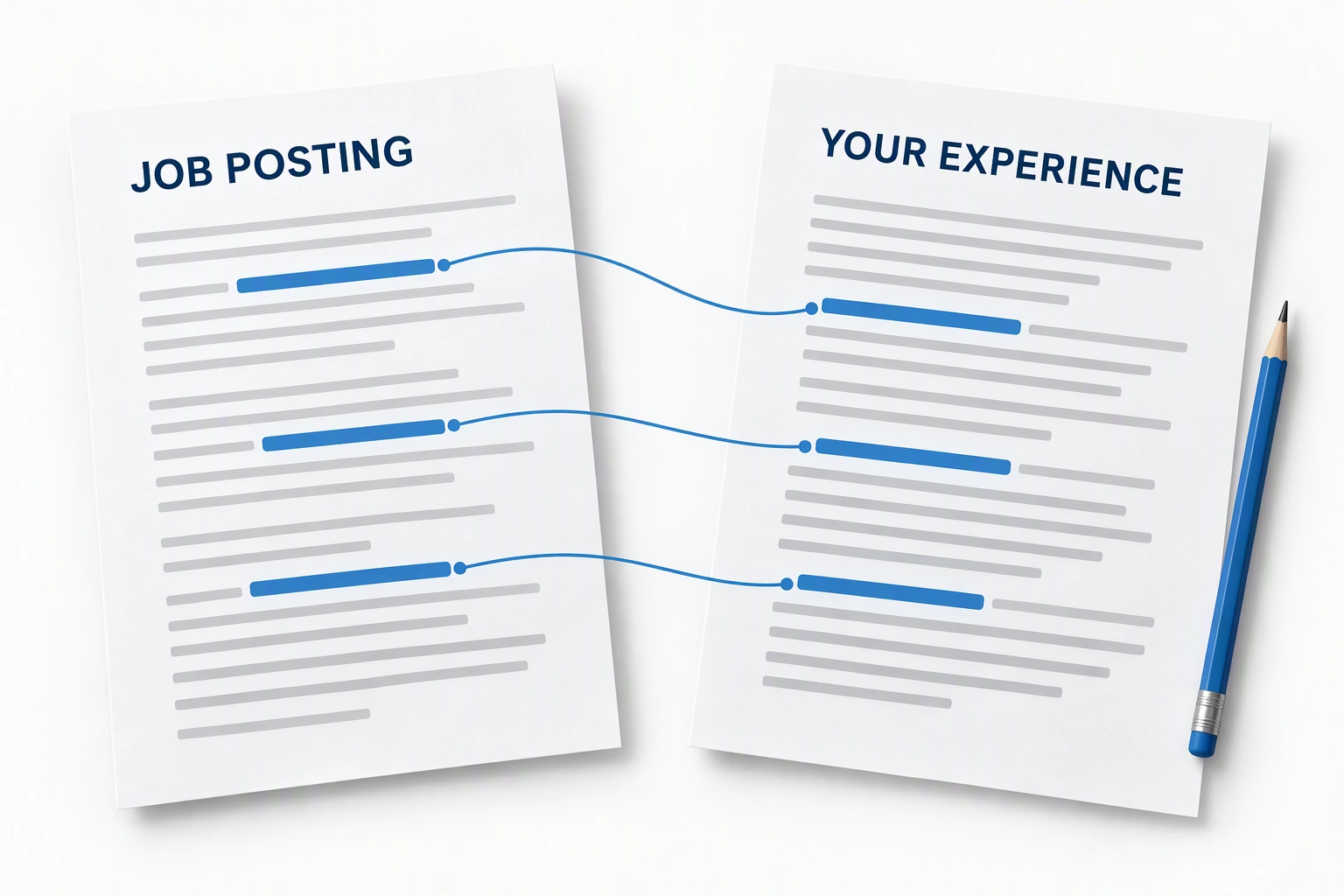

To tailor your resume to a job description, identify the skills, tools and experience the employer asks for. Then update your summary, skills and work experience to show how your background matches.
Start with a copy of your existing resume. Choose the experience that matters for this job, make vague sentences more specific, and shorten details that are less relevant.
See how to do it with a real job posting. We will use a customer support vacancy to show you how to find keywords and use them in a resume. The candidate is fictional, and we will explain each change. You can follow the same steps for other jobs.
What Does It Mean to Tailor a Resume to a Job Description?
Tailoring means presenting your experience for a specific job. You help the employer see the connection between what they need and what you have already done.
For example, if a customer support job asks for experience handling complaints, explain a complaint you resolved and how you handled it. That tells the employer more than a general statement such as “helped customers.”
Your job titles, employment dates and qualifications stay accurate. You change which details you highlight and how you explain them.
How Tailoring Helps Make Your Resume ATS-Friendly
An applicant tracking system (ATS) helps employers collect and manage applications. Recruiters can use some systems to search resumes for particular skills, tools and qualifications.
Tailoring helps you name your relevant experience clearly. Formatting also matters: the system needs to read the information in your document.
- Use the correct names for skills and tools
If a posting mentions Zendesk and you have used it, include its name instead of writing only “support software.” Keep software names, licenses and certifications accurate.
- Explain how you used those skills
Support relevant skills with details from your work. If you used Zendesk to record customer issues and track their resolution, describe that experience. A list of keywords alone leaves the work unexplained.
- Keep the document easy to read
Use clear headings such as Skills and Work Experience. Follow the employer’s file instructions and use selectable text. After uploading, check any details that the application fills in automatically.
Use relevant keywords where they describe your experience. Repeating them or reaching a particular resume-checker score does not guarantee an interview.
Greenhouse documents how recruiters can search resumes for keywords and how formatting can affect imported resume details. Other systems and employer settings may differ.
How to Tailor Your Resume to a Job Description
Keep the job posting beside a copy of your resume. First, identify what the employer needs. Then choose matching experience and update each relevant section.
1. Find Keywords and Requirements in the Job Posting
Read the responsibilities, required qualifications and preferred skills. Highlight specific tasks, tools, qualifications and experience. These are more useful than general phrases such as “join our growing team.”
Customer Support Specialist
Selected details, summarized from the posting:
- Provide customer support and investigate software problems.
- Maintain support tickets and explain progress to customers.
- Document troubleshooting and prepare unresolved issues for escalation.
- Bring relevant technical knowledge, including basic SQL concepts.
Source: Upshop’s Customer Support Specialist posting on Greenhouse. Reviewed November 5, 2026. This selection is not the full vacancy or its complete requirements. The posting may change or close.
Next, sort the details so you understand what each term means for your application:
| Category | Terms to notice | How to read them |
|---|---|---|
| Experience | Customer support or technical support | Relevant support experience is required. |
| Main tasks | Troubleshooting, documentation, escalation | Look for work where you performed these tasks. |
| Ticketing tools | Zendesk or another ticketing platform | The requirement also allows the ability to learn a platform quickly. Zendesk is not the only option. |
| Technical knowledge | APIs, JSON, webhooks or Postman; basic SQL | These appear under required qualifications. Read the full wording before assessing your fit. |
| Desired skills | Jira, DataDog, retail or grocery experience | These are listed as desired skills rather than required qualifications. |
Repeated does not automatically mean required. Repetition can show emphasis, but read the employer’s wording. A required qualification mentioned once can still matter more than a preferred skill mentioned twice.
Make a short list of the important terms before editing. Our guide to choosing resume keywords provides more examples by industry.
Next, check which requirements you can support with your own experience. Finding a keyword does not mean it belongs on your resume.
2. Match the Job Requirements to Your Experience
For each important requirement, write down something you have done that shows the skill. Use your work history, projects, training or volunteer experience. Be clear about where you gained it.
We will use the fictional candidate below for the rest of the example. These details are invented for teaching; replace them with your own truthful information.
Jamie Rivera
- Customer Support Associate at fictional company Cedar Lane Software, July 2023–present.
- Answers customer questions by phone and email, using Zendesk to record issues and follow up.
- Troubleshoots sign-in problems and sends unresolved cases to the technical team with screenshots and steps to reproduce the problem.
- Writes help articles explaining common account tasks.
- Practiced basic SQL queries in a course, but has not used SQL at work.
- Has no experience with APIs, JSON, webhooks, Postman, Jira or DataDog.
| Job requirement | Jamie’s experience | Resume decision |
|---|---|---|
| Customer support | Handles customer questions by phone and email. | Highlight this experience in the summary and work history. |
| Ticketing platform | Uses Zendesk to record issues and follow up. | Name Zendesk in Skills and explain its use under the current job. |
| Troubleshooting and escalation | Investigates sign-in problems and documents unresolved cases for the technical team. | Describe these tasks clearly without claiming broader technical expertise. |
| Basic SQL knowledge | Practiced basic queries during a course. | Identify this as coursework. Do not suggest professional SQL experience. |
| API-related knowledge | No experience with APIs, JSON, webhooks or Postman. | Leave these tools and skills off the resume. This remains a gap in the required qualifications. |
| Desired tools | Has used Zendesk, but not Jira or DataDog. | Include Zendesk. Do not add the other tools simply because the posting names them. |
This candidate meets some requirements, not all. Clearer wording can make Jamie’s relevant experience easier to find. It cannot supply the missing technical knowledge or establish that Jamie qualifies for the role.
Once you have made your comparison, use the strongest relevant experience to update your summary, skills and work history. Keep genuine gaps separate from experience you can support.
3. Tailor Your Resume Summary to the Job Description
If you use a resume summary, focus it on the experience most relevant to the vacancy. Mention your background, a few matching skills and the work you can explain confidently in an interview.
Here is how Jamie’s summary could change for the customer support posting. Both versions are illustrative.
Hardworking professional with excellent communication and problem-solving skills. Experienced in helping customers and working with a team. Looking for an opportunity to contribute to a growing company.
This version does not explain the type of support Jamie provides, the software used or the problems handled.
Customer support professional with 3+ years of experience assisting software customers by phone and email. Uses Zendesk to track customer issues, troubleshoots sign-in problems, and documents unresolved cases for the technical team. Writes help articles explaining common account tasks.
Why the revised summary is more relevant:
- It identifies the background: customer support for software customers.
- It names a relevant tool: Zendesk, which Jamie has used.
- It describes matching work: troubleshooting, documenting cases and writing help articles.
- It keeps the experience accurate: it does not imply professional SQL experience or knowledge of tools Jamie has never used.
Use these examples as a guide. Replace the experience, tools and tasks with your own facts. Jamie’s “3+ years” comes from the fictional employment dates used in this article.
A description such as “organized” becomes more useful when the surrounding sentence explains what you organized. Choose specific experience before adding more descriptive words.
For other ways to present your background, browse our resume summary examples, then adapt your chosen example to the job.
4. Update Your Resume Skills to Match the Job
Put the relevant skills you have near the beginning of your skills section. Use specific names for software and tasks so the employer can understand your abilities.
Here is how Jamie’s skills section could change. These examples use the fictional background established in Step 2.
Communication, teamwork, problem-solving, computer skills.
These broad terms leave out useful details. They do not tell the employer which support tools Jamie uses or which customer problems Jamie handles.
Customer support: Phone and email support, sign-in troubleshooting, case documentation, escalation, help article writing.
Software: Zendesk ticket tracking and follow-up.
SQL: Basic queries practiced in coursework.
The revised version names relevant tasks and software. It also identifies where Jamie practiced SQL, so the reader can distinguish coursework from workplace experience. Adapt every item to your own background.
- Keep the skill level accurate. Troubleshooting sign-in problems does not establish advanced knowledge of networks or databases.
- List the tools you can use. Jamie can include Zendesk, but should leave out Jira, DataDog and Postman.
- Support skills elsewhere in the resume. Use work experience or project descriptions to show how you applied the most important skills.
Communication and teamwork still matter. You can make them more convincing by describing the customers you supported or how you worked with the technical team.
For help choosing and organizing your list, see what skills to put on your resume.
5. Rewrite Your Work Experience for the Job
Under each relevant job, put the statements that best match the vacancy first. Explain what you did, the tools you used and any useful details you can support.
Choose action verbs for your resume that describe your contribution. If a phrase is vague or repetitive, use our resume synonyms guide to find a more precise alternative.
Below, the revised examples use only the fictional experience established for Jamie. The bold words show the action in each sentence.
Customer support and Zendesk
Helped customers with questions.
Answered software customers’ questions by phone and email, using Zendesk to record issues and follow-up notes.
Why this fits: It identifies the customers, communication channels and ticketing tool. “Answered” explains Jamie’s contribution more clearly than “helped.”
Troubleshooting and escalation
Worked with the technical team on customer problems.
Troubleshot customer sign-in problems and escalated unresolved cases to the technical team with screenshots and steps to reproduce the issue.
Why this fits: It shows the type of troubleshooting and the information Jamie supplied during escalation. It does not claim Jamie fixed every problem.
Help articles and customer instructions
Responsible for support documents.
Wrote help articles explaining common account tasks for software customers.
Why this fits: It names the document, its subject and its audience. “Wrote” shows what Jamie did instead of leaving the responsibility unclear.
Add results when you know them. Jamie’s background does not establish faster response times, fewer tickets or higher customer satisfaction. Those claims should not appear in the revised statements. Replace the sample details with facts from your own work.
If you have a verified result, include it where it helps explain your contribution. When you do not have figures, our guide to resume achievements without numbers shows how to describe completed work and observable outcomes.
Keep important skill and software names accurate. Choosing a synonym should make the sentence clearer while preserving the meaning of your experience.
6. Remove Details That Do Not Support Your Application
Read your revised resume beside the posting again. Keep details that help explain your fit. Shorten repeated points and information that adds little to this particular application.
- Keep specific experience ahead of general claims
Jamie’s Zendesk experience and troubleshooting tasks deserve more attention than phrases such as “hardworking” or “good with computers.”
- Remove repetition that adds no new information
Listing Zendesk in Skills and explaining its use in Work Experience serves a purpose. Repeating “excellent customer service” in several places gives the reader little extra detail.
- Shorten less relevant experience
An earlier job may need only a brief description. Keep useful transferable experience, but give more space to work that supports this vacancy. Keep the employment timeline clear.
- Keep required qualifications easy to find
Do not remove a relevant license, qualification or project just because it is older. Check what the employer asks for before deciding what to cut.
Keep a complete original resume. Save the tailored version as a separate file. A detail you shorten for this application may be useful for another job.
7. Check Your Resume Before Applying
Review the file you will actually submit. Open the exported Word or PDF document and compare it with the job posting.
- Check the content and facts
Can the reader quickly find your most relevant experience? Check job titles, dates, qualifications and contact details. Make sure every tool, task and result describes something you can explain in an interview.
- Check the exported document
Follow the employer’s requested file format. Look for awkward page breaks, missing text and inconsistent spacing. Copy the text into a plain-text editor to check its reading order. This can reveal some problems, but does not confirm compatibility with every hiring system.
- Check the uploaded application
Confirm that you attached the intended version. If the application fills in fields automatically, review the imported names, titles and dates. Correct errors before submitting.
Jamie_Rivera_Upshop_Customer_Support_Resume.docx
Save the submitted resume alongside a copy of the posting. You can refer to both when preparing for an interview.
Resume Tailored to a Job Description: Before and After
Here are Jamie’s summary, skills and current job together. The tailored version uses the same background, with specific details relevant to the customer support posting.
These are fictional resume excerpts. Contact information, education and any earlier jobs are not shown. Replace every sample detail with your own information.
Jamie Rivera
Summary
Hardworking professional with excellent communication and problem-solving skills. Experienced in helping customers and working with a team. Looking for an opportunity to contribute to a growing company.
Skills
Communication, teamwork, problem-solving, computer skills.
Work Experience
Customer Support Associate | Cedar Lane Software
July 2023–Present
- Helped customers with questions.
- Worked with the technical team on customer problems.
- Responsible for support documents.
Jamie Rivera
Summary
Customer support professional with 3+ years of experience assisting software customers by phone and email. Uses Zendesk to track customer issues, troubleshoots sign-in problems, and documents unresolved cases for the technical team. Writes help articles explaining common account tasks.
Skills
Customer support: Phone and email support, sign-in troubleshooting, case documentation, escalation, help article writing.
Software: Zendesk ticket tracking and follow-up.
SQL: Basic queries practiced in coursework.
Work Experience
Customer Support Associate | Cedar Lane Software
July 2023–Present
- Answered software customers’ questions by phone and email, using Zendesk to record issues and follow-up notes.
- Troubleshot customer sign-in problems and escalated unresolved cases to the technical team with screenshots and steps to reproduce the issue.
- Wrote help articles explaining common account tasks for software customers.
What changed? The revised resume names relevant tools, explains Jamie’s tasks and makes the support experience easier to assess. The employer, job title and employment dates stay the same. The technical gaps identified earlier still remain.
How to Use ChatGPT to Tailor Your Resume to a Job Description
Give ChatGPT the job description and your current resume. Add relevant facts that your resume leaves out, such as a tool you use or a project you completed. Ask it to compare the two before suggesting changes.
Remove unnecessary personal details and confidential employer information first. Then use the prompt below, replacing the bracketed instructions with your information.
Help me tailor my resume to the job description below.
First, list the main responsibilities, required qualifications and preferred skills. Compare them with my resume and additional facts. Identify supported matches and genuine gaps.
Then suggest changes to my summary, skills and work experience. Show the original wording, your proposed wording and a short reason for each change.
Use relevant job-description terms naturally. Keep my official job titles, employers, dates and qualifications accurate. Do not invent tools, responsibilities, results or numbers. Identify coursework and volunteer experience clearly.
If you need more information, ask me before adding a claim. Flag anything I need to verify. Write in simple language.
Job description: [Paste the full job description here.]
Current resume: [Paste your resume here.]
Additional facts: [Add relevant experience or write “None.”]
Check the proposed wording against your own experience. Look closely at new numbers, software names and words such as “led,” “managed” or “expert.”
“Used SQL to investigate customer database problems.”
Jamie practiced basic SQL queries in coursework. The background we provided does not support using SQL at work or investigating customer databases.
Wording supported by Jamie’s background“Practiced basic SQL queries in coursework.”
Check additions as carefully as errors. A polished sentence can still introduce experience you never had. Keep only wording you can explain and support.
For broader guidance and other prompts, see our guide to using ChatGPT for your resume.
How to Tailor a Resume With No Experience
If you have no paid work experience, look for relevant tasks from volunteering, coursework, student activities or personal projects. Explain what you did and clearly identify where the experience came from.
Choose opportunities suited to your current background. A project can demonstrate a skill, but it does not replace a required license or years of professional experience.
Separate illustrative example: an entry-level support application
Imagine a posting asks for email communication and accurate recordkeeping. Our fictional applicant volunteered at community events, answered registration questions by email and updated a sign-up spreadsheet.
Those tasks provide relevant experience to describe, even though they were unpaid.
Instead of writing only “helped at community events,” the applicant could explain the matching tasks:
Answered event registration questions by email and updated a sign-up spreadsheet with participants’ details as a community event volunteer.
This statement shows email communication and recordkeeping through specific tasks. It belongs under Volunteer Experience, with the organization and dates. Adapt the example only if it reflects work you have done.
Name the experience accurately. A class assignment belongs under Projects or Education. A volunteer role belongs under Volunteer Experience. Keep the setting clear when using job-related keywords.
If you need help identifying relevant abilities, see our guide to skills for a resume with no experience.
How to Tailor a Resume for a Career Change
Compare the new job’s responsibilities with tasks you have already performed. These connections are your transferable skills: abilities you can use in a different role or industry.
Keep your actual job title, then describe the relevant work beneath it. Give recent training or projects their own clearly labeled entries when they help demonstrate preparation for the new role.
Separate illustrative example: retail to customer support
Imagine a customer support posting emphasizes handling complaints and keeping accurate records. Our fictional retail associate handled returns, checked purchase records and explained return options to customers.
Those responsibilities are relevant to describe, even though the applicant has not held a customer support job in a software company.
Handled customer complaints about returns, checked purchase records and explained available options under the store’s return policy.
The statement shows complaint handling, record checking and customer communication. Keep it under the applicant’s actual retail job title. Adapt the tasks to your own experience before using the example.
Check what would still be new. Retail complaint handling does not establish software troubleshooting or Zendesk experience. Describe relevant training separately and assess any remaining requirements before applying.
If the application includes a cover letter, use it to explain your career move and preparation. Our career change cover letter examples show how to connect your previous work with a new role.
Common Resume Tailoring Mistakes to Avoid
Tailoring should make your experience clearer. Check for changes that add unsupported claims, hide useful details or make the wording harder to understand.
Copying duties without describing your work
Provide excellent customer support.
This describes an expectation. It does not explain the support you provided.
Answered software customers’ questions by phone and email, using Zendesk to record issues and follow-up notes.
Adding skills you have not used
Professional experience using SQL to investigate customer databases.
Jamie practiced basic queries in coursework. That does not establish workplace database experience.
Basic SQL queries practiced in coursework.
Changing your previous job title to match the vacancy
Replacing Jamie’s title with the advertised title would misstate the employment record.
Customer Support Associate | Cedar Lane Software
Explain matching responsibilities beneath the title. If an internal title needs clarification, add a brief, accurate explanation alongside it.
Choosing a stronger verb that overstates your role
Led the technical team in fixing software problems.
Jamie supplied information to the technical team. The example does not establish team leadership or responsibility for the fixes.
Escalated unresolved sign-in issues to the technical team with screenshots and steps to reproduce the problem.
Using adjectives without supporting details
Excellent communicator with outstanding writing skills.
Descriptive words can be useful, but this sentence gives the employer no example of the writing.
Wrote help articles explaining common account tasks for software customers.
Repeating keywords without adding information
Customer support professional providing customer support through customer support tools.
Name the work and tool instead. Jamie’s statement about answering questions and recording issues in Zendesk already provides that information.
Keep relevant skill and software names where they help explain your experience. Replacing every occurrence with a synonym can also make the meaning less clear.
These corrections use Jamie’s fictional background. Apply the same checks to your own resume and keep only statements that reflect your experience.
Resume Tailoring Checklist
Use this checklist before submitting your application. Check each item after reviewing your resume beside the job posting.
This checklist is for your review. Your selections are not saved by this page.
Frequently Asked Questions About Tailoring a Resume
Should you tailor your resume for every job application?
Review your resume against each posting. Similar jobs may need only a few changes, while a different role or industry may require more editing. Focus on the employer’s actual responsibilities and qualifications.
How much of your resume should you change?
There is no fixed percentage. Update the sections that need a clearer connection to the job, usually your summary, skills and relevant experience. Keep useful information that already fits.
Can you use the same tailored resume for similar jobs?
Yes, use it as a starting point. Compare each new posting for differences in tools, responsibilities and qualifications. Save the version you submit so you know what each employer received.
Can you copy keywords from a job description?
Use the employer’s skill, tool and qualification names when they accurately describe your background. Write the surrounding explanation about your own work instead of copying entire duties.
What if you do not meet every requirement?
Separate required qualifications from preferred skills. Consider whether your experience supports the main responsibilities and whether the employer allows alternatives. A missing required credential is different from unfamiliarity with a preferred tool. Keep gaps accurate when deciding whether to apply.
How long does it take to tailor a resume?
It depends on your starting resume and how different the role is. Keeping a complete record of your experience makes editing easier. Allow time to check the final document and uploaded application, as well as the wording.
What should you do when the job description is vague?
Look at the employer’s website and related openings for context. Keep those clues separate from confirmed requirements for this vacancy. If possible, ask the recruiter which responsibilities matter most. Describe your relevant experience without guessing at qualifications the employer has not specified.