


List relevant freelance work in your Work Experience section, just as you would a salaried role. Give your specialty, identify the work as freelance or contract, include dates, and describe what you delivered. For several similar clients, one self-employed entry is usually easier to read than a separate job for every assignment.
Here’s a fictional example you can adapt:
Freelance Graphic Designer
Self-employed | Austin, TX | March 2024–Present
- Designed product catalogs and email graphics for independent retailers, taking projects from brief through final production files.
- Created reusable layout templates that store teams could update without commissioning a new design each week.
A client name can replace “Self-employed” when you’re highlighting one substantial engagement. You don’t need to invent a company name to make independent work count.
Practice explaining your strongest qualities with these examples of how to answer “What is your greatest strength?”.
Decide which assignments deserve space
Start with the job you’re applying for. MIT’s career guidance recommends selecting experiences that demonstrate the skills in the position description. Those experiences can include paid work, personal projects, and other relevant activities.
For an in-house design role, packaging work and collaboration with a printer may matter more than unrelated tutoring. For an operations role, managing client schedules, preparing handoffs, and documenting processes may be stronger evidence than the creative deliverable itself.
An assignment’s length alone doesn’t determine its value. A short accessibility audit could be more relevant than a year of routine work.
Jacob Meade, a Certified Professional Resume Writer and Academy Certified Resume Writer, offers a useful distinction in ResumeBuilder: “Leave in unrelated jobs if they help fill an employment gap, but don’t include more than basic details about them.”
Learn how a good professional resume supports your job search and helps employers understand your qualifications.
Choose a structure that fits your client history
Within an umbrella entry, you can identify selected clients in individual bullets if their names or industries add useful context. For example, a writer applying to a healthcare company could identify work for a hospital and a medical software business without listing every unrelated client.
If you operate under a business name, use it in the organization line: Freelance Web Designer, followed by [Studio Name] | Self-employed. Choose a title that describes the work you want evaluated. “Founder” alone doesn’t tell a hiring manager whether you designed websites, managed accounts, or sold products.
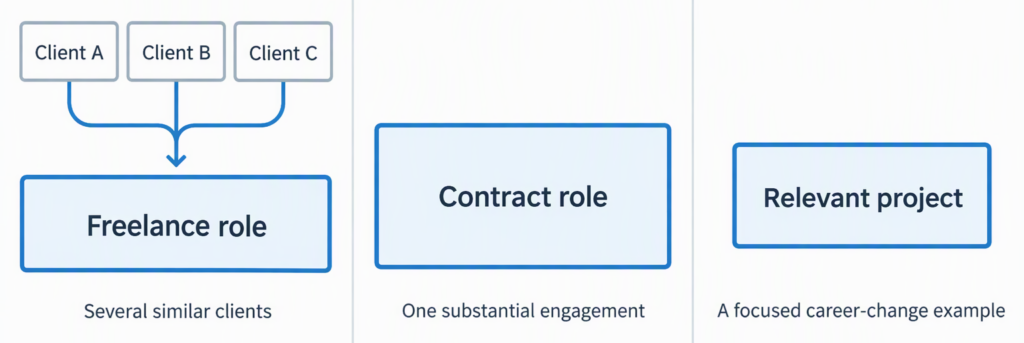
Choose the layout that gives the relevant work enough space.
Show the value of your community involvement by learning how to list volunteer experience on a resume.
One substantial client engagement
A separate entry works when a contract involved a distinct role, sustained collaboration, or a major deliverable. It gives that experience room without turning every small assignment into a job.
Contract Data Analyst
[Client Name] | Remote | January–September 2026
- Combined sales and inventory exports into a Power BI dashboard used in weekly replenishment meetings.
- Documented refresh steps and trained the operations coordinator to maintain the report after the contract ended.
If you also include an umbrella freelance entry, make the split clear: use it for your other clients. Don’t count this same engagement again as an additional project or imply two separate roles covered the same work.
One project that supports a career change
A Relevant Projects section can give a small but important assignment a place when your main employment is in another field.
Customer Onboarding Guide — Freelance Project
[Software Client] | June–July 2026
- Interviewed customer-support staff and turned recurring setup questions into an illustrated onboarding guide.
- Organized instructions by user task and tested the draft with a first-time user before publication.
For someone moving from customer service into technical writing, this is direct evidence of the new skill. The section heading describes the work’s relevance without disguising the rest of the person’s employment history.
Make dates and working arrangements understandable
Use month and year consistently, and arrange your experience with the most recent work first. Concurrent engagements can have overlapping dates; you don’t need to change them to create an artificial sequence.
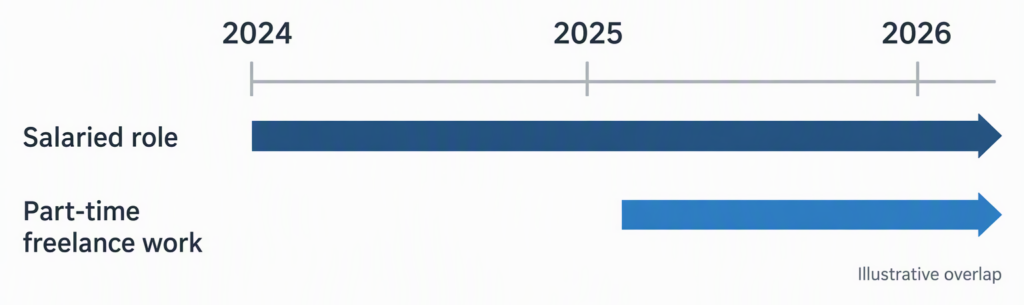
Overlapping dates can show two roles held at the same time.
An umbrella entry can span the period during which you operated an ongoing freelance practice. If you completed occasional assignments, add “intermittent” or “part-time” to the organization or date line. Meade’s guidance specifically recommends clarifying time commitment so occasional work doesn’t look like a full-time schedule.
For example, Self-employed, intermittent projects | May 2023–August 2026 describes a different commitment from a continuous full-time contract. If one assignment ended in 2023 and another began in 2026, separate project dates may be clearer than a single uninterrupted range.
Use “Present” for work that’s genuinely ongoing. Keeping a marketplace account open or remaining available for bookings doesn’t, by itself, establish a current client engagement.
Write bullets around work someone can evaluate
Linda Moore, identified by The Muse as head of HR at Slipintosoft, offers a useful test: “Each entry should briefly describe the project’s scope, the problem solved, and the results achieved.”
Consider the difference between these two fictional bullets:
Vague: Responsible for website content and client communication.
Specific: Rewrote 18 product pages using customer-support questions, then coordinated product-team review before the catalog launch.
The second version identifies the deliverable, the input, and your part in getting it published. It doesn’t need an invented sales increase to be useful.
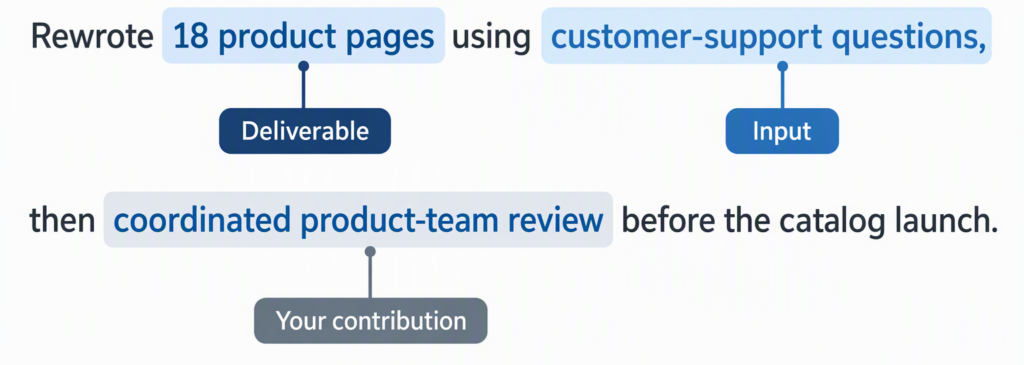
A concrete bullet gives the reader work they can evaluate.
When you have reliable outcome data, give the context that makes it meaningful. “Reduced monthly reporting time from six hours to two by automating spreadsheet imports” explains both the change and the work behind it. If that result came from a team effort, state your contribution rather than claiming the whole outcome.
If a client never shared performance figures, describe something you can substantiate: the number of deliverables, technical complexity, audiences served, an approval milestone, or the handoff. Revenue, conversion rates, and traffic growth are useful only when you know what was measured and can reasonably connect your work to it.
Choose verbs that match what happened. “Built,” “edited,” “reconciled,” and “tested” tell the reader more than a string of traits such as “self-motivated, adaptable, and entrepreneurial.” Mention tools within the work when they matter to the role: a spreadsheet reconciliation, a Figma prototype, or a Python data-cleaning script.
Examples for less straightforward situations
These entries use fictional details. Adapt the structure to your own work; replace the tasks and figures with evidence you actually have.
Freelancing alongside a salaried job
Freelance Bookkeeper
Self-employed, part-time | Columbus, OH | February 2025–Present
- Reconciled bank and credit-card accounts for two service businesses and prepared month-end reports in QuickBooks Online.
- Organized receipts and documented unresolved transactions for each client’s accountant.
Keep your salaried role in the same work-history timeline. This freelance entry supplies additional accounting experience; it doesn’t need a paragraph explaining why you worked outside your main job.
Work through a staffing agency
Front-End Developer, Contract
[Staffing Agency], assigned to [Client] | Remote | April–August 2026
- Built accessible form components in React and worked with the client’s QA team to resolve keyboard-navigation defects.
- Wrote component documentation for the permanent development team.
Use the actual arrangement. An agency employee on assignment isn’t necessarily self-employed. For application or background-check forms, name the employer or contracting entity those forms request.
Make your bullet points more specific with these alternatives to “responsible for” on a resume.
Clients found through a freelance marketplace
Freelance Video Editor
Self-employed | Remote | October 2024–Present
- Edited product demonstrations into captioned videos for software companies, preparing separate cuts for product pages and social channels.
- Managed client feedback through review rounds and delivered organized source files for later updates.
A marketplace used to find clients isn’t automatically your employer. You can mention that channel when relevant, but the entry should identify your service and client work. A platform rating is usually less informative than the deliverables unless the rating adds context the employer would understand.
An unpaid assignment for a nonprofit
Volunteer Web Designer
[Community Organization] | Denver, CO | May–June 2026
- Reorganized donation and event pages so visitors could find registration details and contact information.
- Trained a volunteer administrator to update the site after launch.
Depending on the rest of your resume, this entry can sit under Volunteer Experience or Relevant Experience.
Describe confidential work without exposing it
Before naming a client, publishing a result, or linking a sample, check the agreement governing that work. Resume Worded’s guidance warns against disclosing confidential client information or projects in breach of an NDA.
Where disclosure is permitted, an industry description may provide enough context: Freelance UX Researcher | Regional healthcare software company. A bullet might describe preparing an interview guide and synthesizing usability findings without identifying participants or sharing internal research.
Removing the name isn’t always sufficient. A combination of product details, dates, location, and figures can still identify the client or reveal protected information. If the agreement is unclear, get permission for the wording or choose another example. Don’t assume a private application exempts you from confidentiality obligations.
Published work also needs context. A public website may show the finished product, but it won’t necessarily show your contribution. Briefly identify whether you wrote the copy, developed the front end, or handled a specific part of the research.
Moving from freelance work into a permanent role
Show the parts of independent work that transfer to the position: collaborating with an internal team, following review processes, maintaining documentation, and staying accountable after delivery. Select examples of those behaviors instead of adding a general claim that you can “work well in a team.”
If you’re applying to project-management roles, a client engagement might demonstrate how you agreed on scope, tracked dependencies, and handled a changed deadline. For a production role, the stronger detail may be how you prepared files, checked specifications, and resolved defects.
Explain your interest in permanent work in a cover letter or interview when useful. A straightforward reason, such as wanting to own a product beyond launch or work with a continuing team, gives the employer context without using resume space to defend freelancing.
Take the next step
Once your entries are in place, pick a project you’d be comfortable walking through in an interview. Be ready to explain a decision you made, a challenge you handled, and what you’d do differently next time.
Frequently asked questions
Keep a private record of engagement dates, contracts, invoices, approved samples, and client contacts. That record makes it easier to answer verification questions consistently. It doesn’t all belong in the application attachment.
Can a freelance client provide a reference?
A client or project lead may be able to provide a reference about your work. Ask first and confirm which contact details they want shared.
How do I prove self-employment during a background check?
If a screening provider asks for proof of self-employment, follow its instructions and provide only the necessary records through the requested channel; don’t send an unredacted folder of client documents as a precaution.
What should I put in a required employer field?
When an application has a required “Employer” field, use your actual business or self-employed status for direct freelance work, with the relevant client in a separate field or description if appropriate. Don’t turn a client into a salaried employer to fit the form. Contact the recruiter if the available choices don’t represent your arrangement.