

Changing fields does not erase your work history. The page still needs dates, employers, scope, and outcomes, but it should interpret that record for a new audience. Lead with a precise target, translate relevant results into the target field’s language, and add current proof where your experience cannot yet carry the claim.
Use a master document to inventory everything, then create a focused version for each role family. The finished page should answer three questions quickly: What work are you pursuing? Which past results transfer? What recent evidence reduces the employer’s risk?
Key Takeaways
- Target one role family at a time. “Open to anything” gives the reader no basis for deciding which experience matters.
- Translate outcomes without rewriting history. Keep the original employer and title truthful while describing relevant problems, actions, and results in plain industry language.
- Preserve a chronological spine. A focused summary and skills section can help, but dates and employers should remain easy to follow.
- Create proof for real gaps. A course may teach vocabulary; a completed project, work sample, volunteer assignment, or supervised deliverable shows application.
Define the destination before editing
Choose a specific title or a narrow cluster of closely related titles. Read several current postings, the employer’s own role description, and an occupational source such as O*NET to separate recurring work from one company’s preferences.
Build a requirement sheet with four columns:
| Requirement | Evidence already earned | Evidence to build | Resume location |
|---|---|---|---|
| Facilitate live learning | Led weekly classes and staff workshops | Record a short adult-learning workshop | Summary, experience, portfolio |
| Develop learning materials | Created lesson plans and assessment guides | Adapt one module for employee onboarding | Experience, project |
| Evaluate effectiveness | Used assessment results to revise instruction | Create a feedback survey and revision note | Experience, project |
| Use an LMS | Managed course content in a school platform | Complete a sample module in the target LMS | Skills, project |
Do not copy an entire posting into the page. Use its language only where it accurately describes your experience, and keep employer-specific terms out of unrelated applications.
Moving into a new field? Explore these resume summary examples for career changers to connect your background with your target role.
Translate evidence instead of titles
Hiring readers may not recognize the value of an old title in the new context. Connect a concrete result from the previous field to a capability the target role uses, then point to proof.
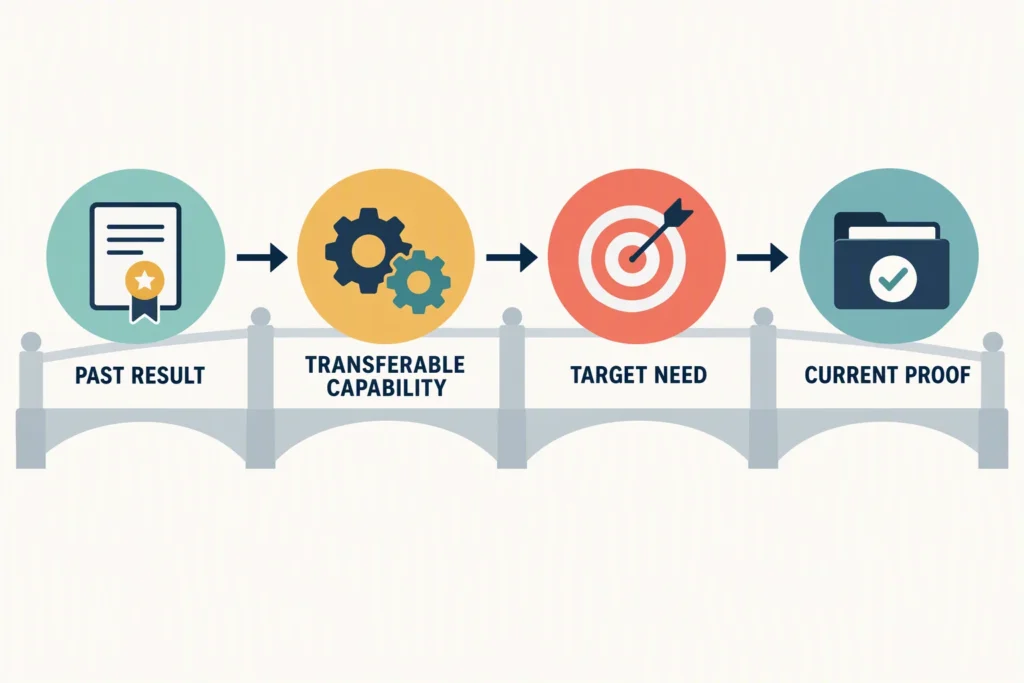
The practical formula is past result → transferable capability → target need → proof. For example:
Revised a six-week unit after analyzing assessment patterns, raising completion from 78% to 91% → uses evaluation and instructional design → supports a training-effectiveness requirement → backed by a de-identified module outline and revision memo.
Your previous experience may be more relevant than you think. Learn how to identify and present transferable skills on your resume with evidence that fits the new position.
Inventory achievements in their original context
For each role, record the audience, problem, action, collaborators, tools, scale, and outcome. Keep only facts you can support. If a number was never tracked, describe a verifiable change in quality, speed, error rate, adoption, completion, or process.
Separate transferable ability from missing experience
Communication, analysis, planning, facilitation, stakeholder coordination, and problem solving can transfer, but the new context may still require domain knowledge or a tool you have not used. Name the shared capability and close the specific gap instead of declaring the roles equivalent.
Want to highlight your skills while keeping your work history easy to follow? See how to structure a hybrid resume format.
Choose a structure that keeps trust
Most changers benefit from reverse chronology or a hybrid that adds a focused summary and skills block above the work history. A purely functional layout can make dates and progression difficult to assess.
| Structure | When it helps | Main control |
|---|---|---|
| Reverse chronological | Recent work already contains relevant achievements | Reorder bullets so the closest evidence appears first |
| Hybrid | Transferable strengths need interpretation before the timeline | Keep the skills block concise and prove every item later |
| Functional | Rare cases where a reviewer explicitly accepts it | Do not use categories to obscure employers, titles, or dates |
Keep the original job title. You may add a short parenthetical clarification when it is factual, such as Teacher (Curriculum Lead), but do not replace it with the title you hope to earn.
Considering a resume organized around your abilities? Explore our functional resume format guide to understand its layout and when to use it.
Make the top third resolve the change
The opening area should establish the destination, strongest bridge, and relevant tools without a long personal story.
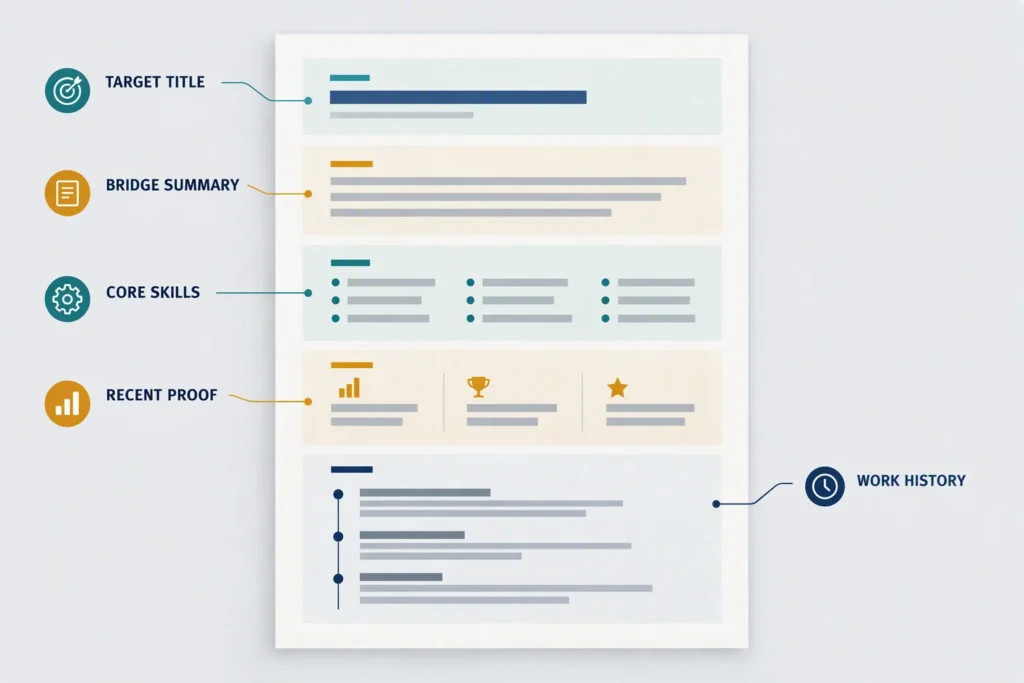
Use a target title and bridge summary
Place a truthful target descriptor below the name, then write two or three lines covering direction, relevant experience, strongest outcomes, and current proof.
Learning and Development Specialist
Educator with seven years of experience designing instruction, facilitating groups, and revising programs from participant data. Built a sample employee-onboarding module and feedback plan using Articulate Rise and Moodle.
Do not lead with why you are leaving. The summary explains the professional value you bring now; the cover letter or interview can supply a brief motivation when useful.
Explain why you are changing careers and what you can contribute with these career change cover letter examples.
Curate a compact skills section
Group skills around the target work, such as Instructional design, Facilitation, Evaluation, and Tools. Remove unrelated software and broad traits. If a tool appears, the experience or project section should show how you used it.
Rewrite experience for the new reader
Keep company, title, location, and dates intact. Lead each role with the achievements closest to the target and cut routine duties that do not improve the case.
Before
- Taught English to high school students and prepared lesson plans.
After
- Designed and facilitated a six-week writing program for 120 students; analyzed weekly assessments and revised two modules, increasing completion from 78% to 91%.
The revised version adds audience, program length, evaluation method, change, and outcome. It does not pretend the work occurred in a corporate training department.
Use target vocabulary only when the underlying task matches. “Stakeholders” may accurately describe administrators, families, vendors, or community partners, but replacing every specific group with that word removes useful context.
Built something that demonstrates skills for your new field? Learn how to list projects on a resume and describe your contribution clearly.
Add bridge proof where the timeline stops
A small Relevant Projects section can show recent application. Choose a problem that resembles the target work and produce an artifact a reviewer can inspect: a needs analysis, process map, campaign brief, dashboard, code repository, training module, or research memo.
Employee Onboarding Module | Articulate Rise, Moodle, Google Forms
February 2026 – March 2026
- Interviewed five volunteer users about first-week information needs and converted recurring questions into four learning objectives.
- Built a 20-minute module with scenario checks, an accessibility review, and a feedback survey; revised navigation after a five-person pilot.
Label self-directed, volunteer, and simulated work honestly. A portfolio sample should not appear under paid experience unless it was part of that job.
Earned a credential relevant to your target role? See how to list certifications on a resume, including where to place them and which details to include.
Review a complete transition example
This fictional example shows a teacher moving toward workplace learning. Its value comes from the connected evidence, not the specific fields.
Maya Patel
Denver, CO | maya.patel@example.com | linkedin.com/in/mayapatel | mayapatel.com/portfolio
Learning and Development Specialist
Educator with seven years of experience designing instruction, facilitating groups, and improving programs from participant data. Created a sample onboarding module and evaluation plan using Articulate Rise, Moodle, and Google Forms.
Core Skills
Design: Needs analysis, learning objectives, curriculum development, assessment
Delivery: Classroom and virtual facilitation, coaching, presentation
Evaluation: Surveys, completion analysis, revision planning
Tools: Articulate Rise, Moodle, Google Workspace, Microsoft PowerPoint
Relevant Project
Employee Onboarding Module | Articulate Rise, Moodle, Google Forms
February 2026 – March 2026
- Interviewed five volunteer users and converted recurring first-week questions into four measurable learning objectives.
- Built and piloted a 20-minute module, reviewed it for accessibility, and revised navigation from participant feedback.
Experience
English Teacher and Curriculum Lead, Summit Public Schools, Denver, CO
August 2019 – Present
- Designed and facilitated a six-week writing program for 120 students; revised two modules from weekly assessment patterns, increasing completion from 78% to 91%.
- Led four professional-development workshops for 28 teachers on feedback practices and created reusable facilitator guides and participant materials.
- Coordinated a curriculum review with six teachers and two administrators, documented decisions, and delivered the revised sequence before the fall term.
Program Coordinator, Open Door Youth Center, Denver, CO
June 2017 – July 2019
- Scheduled weekly workshops, coordinated 14 volunteers, and maintained attendance and feedback records for three youth programs.
- Standardized volunteer orientation materials and introduced a checklist that reduced missed setup steps during observed sessions.
Education
Colorado State University, Fort Collins, CO
Bachelor of Arts in English
May 2017
Transition: Classroom teaching to workplace learning
Current proof: Onboarding module and pilot revision
Go beyond listing duties by exploring these resume accomplishment examples and showing what changed because of your work.
Keep the application story consistent
Verify every date, title, number, tool, and artifact. Test portfolio links without your login and remove protected or proprietary information. Keep the cover letter and interview consistent, then ask a target-field reviewer what remains unclear before adding more keywords.
Unsure how to address time away from work? Follow our guide to explaining employment gaps on a resume to keep your timeline clear without oversharing.
Make the bridge easy to trust
The strongest transition page respects the past and makes the future specific. Preserve the timeline, translate only genuine overlap, and create current proof for missing experience so the reader can evaluate the move without guessing.
Frequently Asked Questions
These answers cover length, unrelated roles, and new credentials.
Should I remove unrelated jobs?
Keep recent roles needed for a clear timeline. Condense older or less relevant positions to progression and transferable results; an Additional Experience section can preserve context.
Do I need a new degree before applying?
Only when the occupation, employer, license, or posting requires it. Otherwise, focused coursework plus a finished project may close a specific gap. List the credential’s status accurately.
Where should I explain why I am changing fields?
Let the resume show the target and evidence. Use the cover letter for a concise motivation tied to the employer, and prepare an interview answer that connects your decision to the work you have already explored or completed.