


You may be changing industries, but you are not starting from zero. The useful question is not, “Have I already held this exact title?” It is, “Which parts of my past work solve problems this employer has now?”
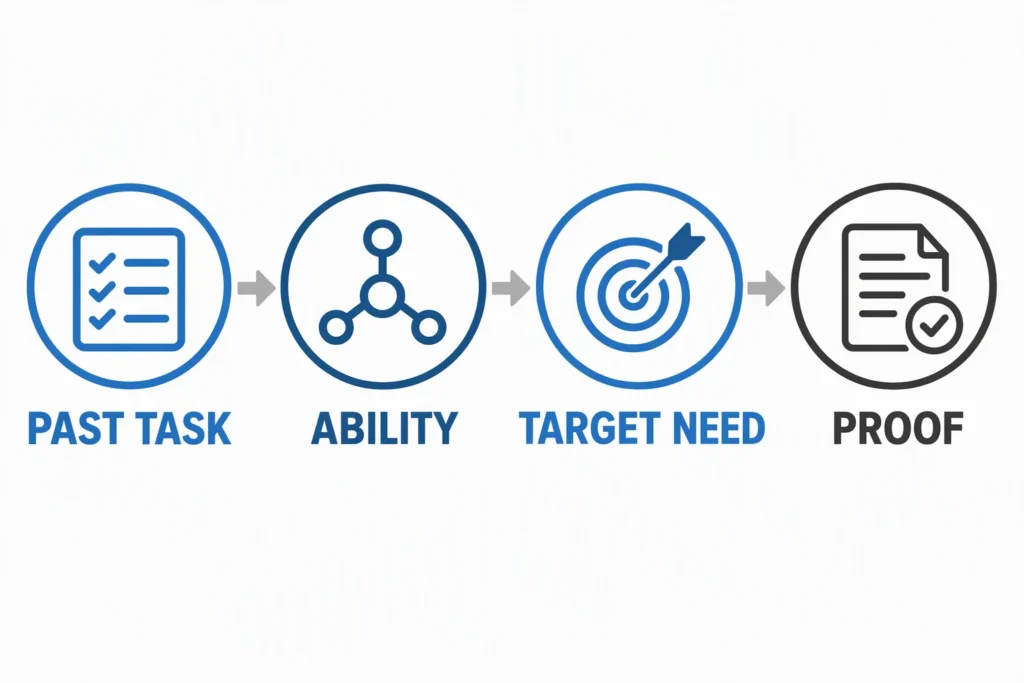
Start with proof. Pull a real task from a job, class project, military assignment, volunteer role, or caregiving responsibility. Name what you did, how you did it, and what changed. Then connect that evidence to the target posting without pretending you have experience you do not have.
All names, numbers, and situations below are fictional. Replace them with facts you can explain in an interview.
Key Takeaways
- A reusable ability is broader than a job title. Planning, analysis, instruction, negotiation, quality control, and workflow improvement can matter in many occupations.
- A list is not proof. The skills section can help with scanning, but experience and project bullets must show where you used each ability.
- Match the employer’s language only when it is accurate. A posting helps you prioritize evidence; it does not give you permission to claim work you never performed.
- Career changers should translate, not disguise. Keep the real title and context, then describe the contribution in language the new field can understand.
Find the evidence before naming the strength
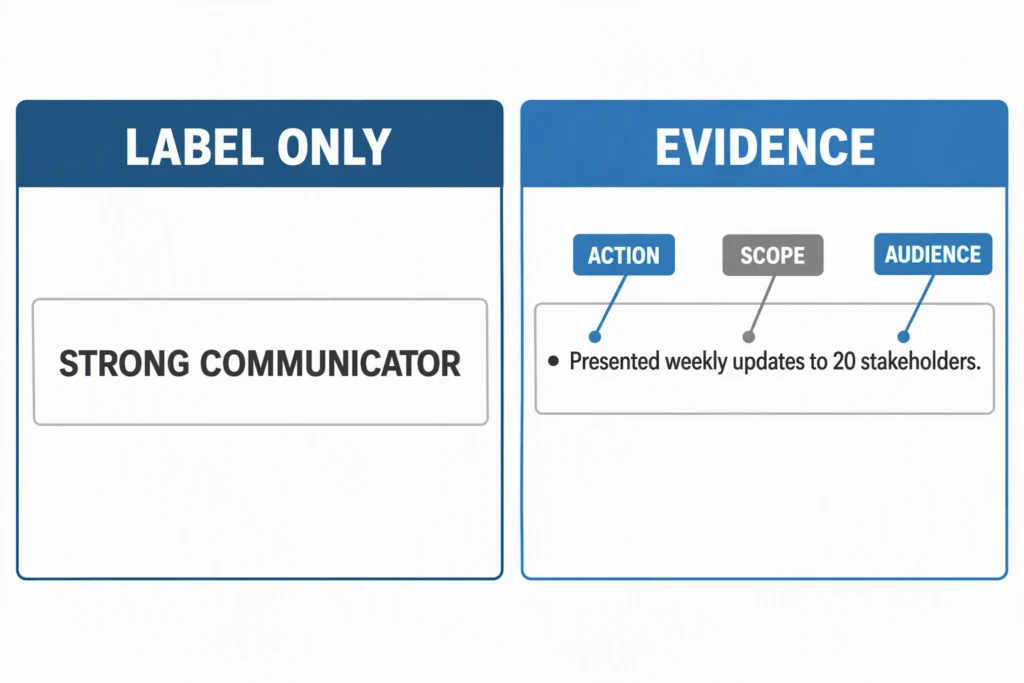
Generic labels feel easy because they skip the hard part. “Strong communicator” tells the reader almost nothing. “Presented weekly inventory risks to store and regional managers” gives the ability a setting, audience, and purpose.
Build a quick evidence inventory with four questions:
- What task, problem, or project did you own?
- What action did you personally take?
- Which ability made that action possible?
- What result, scope, or useful change can you verify?
| Past evidence | Reusable ability | Possible target use |
|---|---|---|
| Scheduled staff and handled last-minute coverage | Prioritization and resource coordination | Operations or project support |
| Explained complex policies to frustrated customers | Listening and clear communication | Client success or account support |
| Trained new hires with a repeatable checklist | Instruction and process documentation | Onboarding or learning support |
| Reconciled cash, invoices, and inventory records | Accuracy and control awareness | Finance or administrative operations |
O*NET’s categories are a useful reminder that portable strengths are not limited to interpersonal qualities. They can include social, systems, resource-management, technical, and complex problem-solving abilities.
Choose what the target role actually needs
Read the posting for repeated actions and outcomes. If several lines mention coordinating deadlines, updating stakeholders, and tracking risks, the employer is signaling project follow-through. If the posting emphasizes investigating errors and recommending fixes, analytical judgment matters more than a long claim about being “detail-oriented.”
Separate three things as you read:
- Abilities: analyzing information, teaching, negotiating, planning, troubleshooting
- Tools: Excel, Salesforce, Jira, laboratory equipment
- Domain knowledge: payroll rules, insurance claims, clinical protocols
An ability may carry into the new role while a tool or knowledge gap still needs training. Say both honestly. “Built weekly reports in Google Sheets and am completing an Excel Power Query course” is more credible than presenting the tools as interchangeable.
Use exact posting language when it fits your evidence. Keep a master list of examples, then select the five to eight strengths most relevant to this application instead of pasting the same block into every resume.
Put each claim where it does the most work
The same idea should not appear in four sections. Give each location a different job.
| Resume location | Best use |
|---|---|
| Professional summary | Connect your background, strongest relevant evidence, and target direction |
| Skills section | Provide a compact, accurate index of role-relevant abilities and tools |
| Experience bullets | Prove the ability through action, scope, method, and outcome |
| Projects or volunteering | Supply evidence that paid employment does not cover |
MIT’s career guidance makes the central point: abilities listed in a skills section become stronger when experience descriptions put them in context. A hiring manager should not have to take “leadership” or “problem solving” on faith.
Turn old responsibilities into relevant bullets
Keep the original role truthful. Change the angle by selecting work that matters to the new employer and explaining it in plain language.
Customer support to operations
Weak: Responsible for customer tickets and escalations.
Stronger: Reviewed 75 weekly support tickets, tagged recurring billing issues, and coordinated fixes with product and finance teams, reducing repeat escalations by 18%.
The revised version shows analysis, cross-functional coordination, and process improvement without renaming the candidate as an operations specialist.
Teaching to project coordination
Weak: Taught four classes and prepared lessons.
Stronger: Planned a 12-week curriculum for four classes, coordinated materials and deadlines with six colleagues, and delivered every unit on schedule.
The evidence supports scheduling, stakeholder coordination, and delivery. It does not claim software or budget experience the teacher may not have.
Retail supervision to onboarding support
Weak: Good trainer and team player.
Stronger: Onboarded 14 associates with a standardized checklist, coached new hires through scheduling and policy questions, and gave managers one consistent training process.
When the client needs a web-renderable example, this markup can stay literal in the document and be copied into the site later:
Professional Summary
Customer-service professional with five years of experience in issue analysis, workflow documentation, and cross-team coordination.
Remove claims that cannot survive a follow-up question
Every item should lead to a story you can tell. Delete or revise it when you cannot name the situation, your action, or the result.
- Do not rate yourself “expert” without a clear standard.
- Do not copy a posting’s full keyword list into the skills section.
- Do not hide the real job title to make a career change look smaller.
- Do not rely on adjectives such as hardworking, dynamic, or people person.
- Do not bury the best evidence in an unrelated bullet because it came from an older role.
Read the finished page from the employer’s side. The target should be visible, the claims should be specific, and any missing license, tool, or industry knowledge should remain honest.
Build a bridge the employer can verify
Your past work becomes relevant when the reader can see the action and recognize its use in the new role. Choose a small set of high-value abilities, support each one with evidence, and let the job description guide emphasis without rewriting your history.
Frequently Asked Questions
These final checks help when the match is real but not obvious from your previous titles.
How many abilities should I list on a resume?
There is no universal number. Five to eight focused items are often easier to scan than a long inventory, but relevance matters more than the count. Include only what the target role needs and what the rest of the page can support.
Can technical abilities carry into a different industry?
Yes, when the underlying work is comparable. Data cleaning, quality testing, programming, equipment maintenance, and reporting may apply in several settings. Check whether the new field also requires different tools, regulations, credentials, or subject knowledge.
What if my best evidence comes from volunteering or school?
Use it. Projects, student organizations, military service, caregiving, and volunteer work can demonstrate planning, instruction, research, or leadership. Label the setting accurately and describe the contribution with the same specificity you would use for paid work.
Should every item use the exact wording from the job posting?
No. Use the employer’s term when it truthfully names your experience and helps the reader make the connection. Keep your own accurate wording when the posting’s phrase would exaggerate your level, scope, or domain knowledge.