

“Add numbers” sounds simple until you open your resume and realize nobody measured the work you’re proudest of. You untangled a confusing process. Fixed an issue before launch. Wrote the instructions people actually used. There was no dashboard for any of it.
You can still describe that work convincingly. Start with what you did, what you worked on, and a result you can support. If you don’t know the outcome, name the completed work and its purpose. A concrete contribution gives the reader something to assess without a made-up percentage.
Here’s how to find that contribution and turn it into a useful bullet.
Key Takeaways
- Relevance earns a bullet its place. Choose work that demonstrates a skill the target role needs, even if a less relevant project sounds more impressive.
- Your opening verb must match your responsibility. “Led,” “supported,” and “tested” describe different contributions; they aren’t interchangeable upgrades.
- Not every bullet needs to be a major win. A resume can combine achievements with specific evidence of useful skills and responsibilities.
Look for the trace your work left
“I just did my job” is often where the useful detail gets lost. Start with a particular task or project, then ask: What existed afterward? What problem did I resolve? What did someone use, approve, or ask me to do again?
Look for evidence in places you can legitimately access:
- Finished work: a published page, repaired feature, completed report, training material, or event you delivered.
- A documented change: an old and revised procedure, a closed issue, or a decision made using your analysis.
- Other people’s actions: a manager adopted your template, colleagues reused your materials, or a client approved your proposal.
- Specific feedback: a review or message identifying what you handled well. “Clear explanations during a difficult handoff” offers more direction than “great team player.”
Your calendar, project history, and sent messages may also help recover names, deadlines, and scope. Don’t take confidential company records to build a personal evidence file. A private note describing permitted facts is enough for this exercise.
No records left? Write down the concrete steps you remember and what you personally observed. A former colleague may help confirm a detail. You don’t need a certificate for every bullet, but uncertainty should narrow the claim you make.
For example, remember solving a booking problem but not its business impact? Describe the correction. Don’t turn “resolved a duplicate reservation” into “increased customer retention.”
Match the sentence to what you actually know
The hardest part is often deciding where the claim should stop. “Created,” “used,” and “improved” each need different evidence.
All examples and figures in this guide are illustrative. Adapt the wording only to work you’ve actually done.
Start with the completed work
Suppose your original bullet says, “Helped with product documentation.” You know that you wrote setup instructions for a new feature, using questions collected by the support team.
That gives you a specific contribution:
Drafted setup instructions for a new product feature using recurring questions from customer support.
The reader can now see writing, product knowledge, and the source material you used. You haven’t claimed that the instructions were published or that they changed customer behavior.
Add an outcome only when you know it happened
If the instructions appeared in the launch materials, you can say so:
Drafted setup instructions used in the product launch, drawing on recurring questions from customer support.
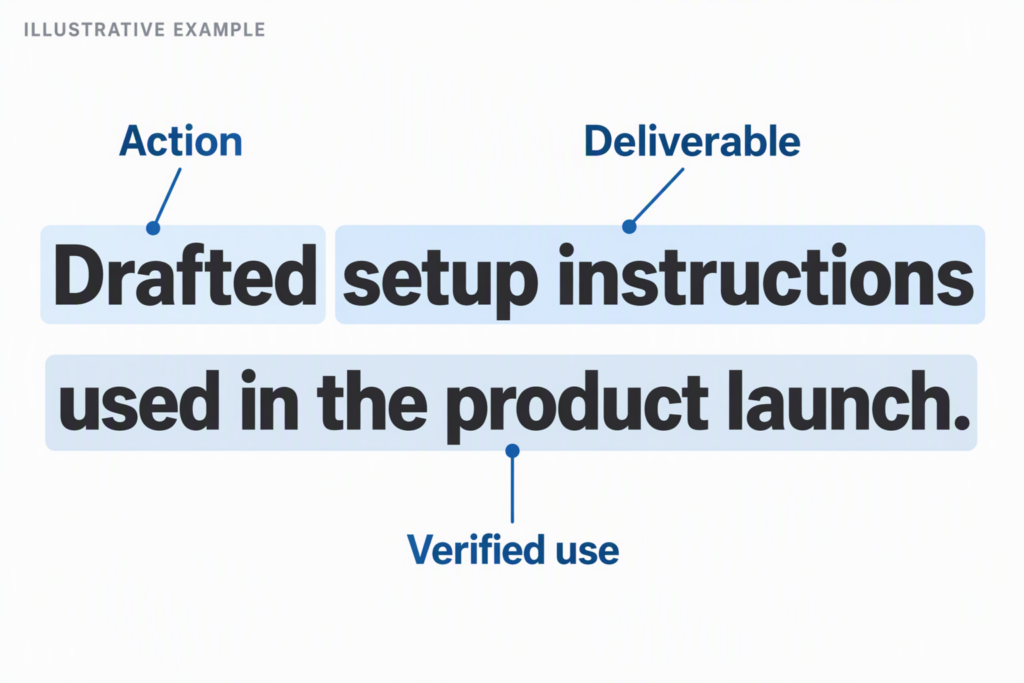
If publication hasn’t happened, “drafted setup instructions for a planned product launch” describes the purpose instead. It doesn’t quietly turn a plan into an achievement already delivered.
Be equally careful with “improved customer satisfaction” or “reduced support requests.” Those claims require evidence of that change. Removing a percentage doesn’t make an unsupported result accurate. The published instructions are a worthwhile outcome on their own.
Replace vague duties with specific contributions
Different roles leave different kinds of evidence. These examples show a resolved discrepancy, a reusable resource, a completed repair, and a decision supported by research.
| Work setting | Vague duty | More informative bullet |
|---|---|---|
| Retail | Handled stock | Reconciled a delivery discrepancy against purchase records and arranged replacement of missing stock with the supplier. |
| Administration | Organized files | Consolidated scattered vendor agreements into a searchable register with renewal dates and named contract owners. |
| Teaching | Prepared lessons | Developed visual fraction exercises that the grade-level team adopted for small-group instruction. |
| Software | Helped fix bugs | Reproduced a checkout error, documented the steps for engineering, and verified the fix before release. |
| Research | Researched suppliers | Compared supplier terms and delivery constraints in a recommendation report used by the purchasing team. |
Each revised line assumes those details are true. Notice the software example: the candidate reproduced the error and verified the fix; it doesn’t say they wrote the fix. The administrative example describes a concrete change without pretending to know how many hours it saved.
Routine work can also show judgment. “Handled customer complaints” becomes more informative when you specify the cases and your decisions: “Resolved delivery complaints by checking shipment records, arranging replacements within policy, and escalating disputed charges.” It describes capable work without claiming an award or a measured improvement.
Use numbers for context when the evidence exists
You may lack performance metrics but still know the size or frequency of your work: locations supported, reports prepared, sessions delivered, or requests handled. These figures describe scope, not automatically impact.
“Prepared weekly purchasing reports for four locations” gives useful context. It doesn’t establish that spending fell. Add a count when it helps the reader understand the workload or responsibility, not merely to put a digit on the page.
When an estimate is reasonable
An approximation needs a basis you can explain. Suppose four weekly logs show 17, 22, 19, and 21 requests handled during a temporary assignment. The average is 19.75. “Handled about 20 requests per week during a four-week assignment” fairly describes that record.
If those logs cover an unusually busy month in a long-running job, don’t present that pace as your normal workload. Keep the period explicit or use more representative records. A range needs a basis, too; “20–40” isn’t safer just because it looks less exact.
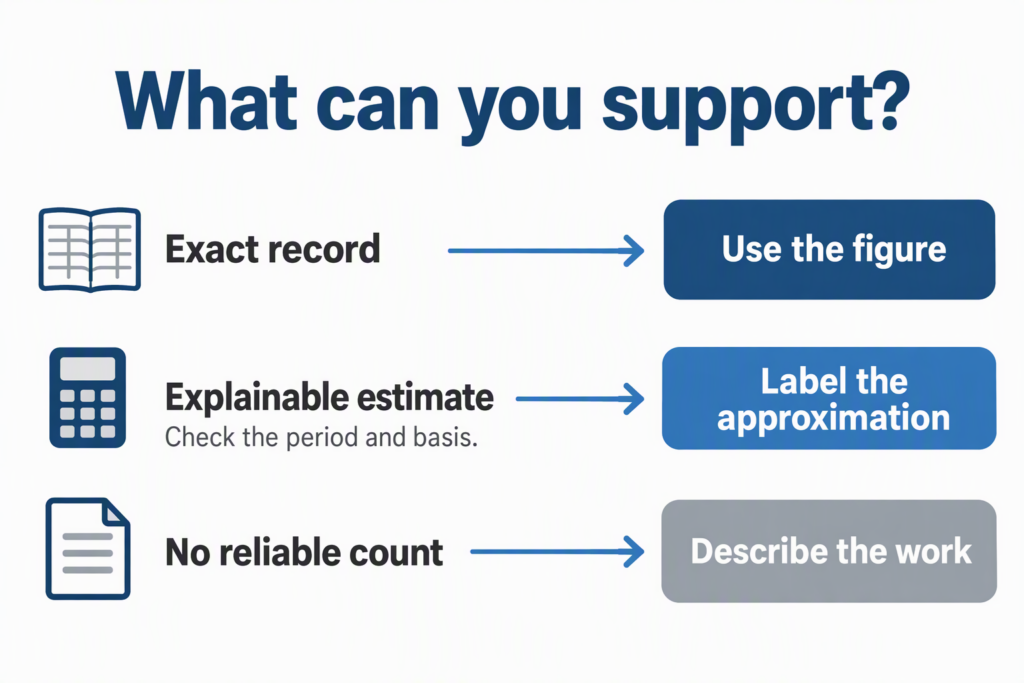
For improvement percentages, you also need a valid comparison. Knowing a task now takes 15 minutes doesn’t reveal how much faster it became. And time saved isn’t automatically money saved: freeing an hour of staff time doesn’t establish a reduction in company spending.
If the arithmetic depends on guesses piled on guesses, leave it out. You can still name the procedure you changed and the manual step it removed, if that’s what happened.
Give each bullet one clear job
Once the facts are right, trim the sentence. Keep the action, the detail that distinguishes the work, and the outcome or purpose that matters. Remove openings such as “Responsible for” and claims such as “highly successful” when the rest of the line should supply the substance.
Read the bullet as someone outside your company. Replace internal project nicknames with understandable descriptions, keeping relevant tools and technical terms. Use past tense for completed work and present tense for ongoing responsibilities.
Finally, ask yourself what you’d say if an interviewer asked, “Walk me through that.” You should be able to explain your steps and the basis for the result without revising the story.
Make the next update easier
Before you close the file, start a short accomplishment log for future work: the date, the situation, your contribution, what happened next, and where you confirmed it. A few notes while the details are fresh can save you from reconstructing a year’s work during your next job search.
FAQ
Some situations make the evidence harder to describe, even when the work is worth including. Here’s how to handle them.
What if I haven’t had a paid job yet?
Use relevant coursework, volunteering, student activities, or personal projects, and identify the setting clearly. For example: “Built and tested a mobile navigation prototype for a class project, revising the menu after peer usability feedback.” Don’t claim the prototype improved a real company’s sales or customer experience.
Can I include an achievement my whole team delivered?
Yes. State your part alongside the shared result. “Coordinated venue access and speaker briefings for a conference delivered by the events team” makes your contribution visible. If you include a team performance figure, identify it as the team’s result and avoid implying you produced it alone.
What if the results are confidential?
Describe permitted details about your methods, deliverables, or broad project context. Don’t assume that replacing a client name or using a percentage makes restricted information shareable. When unsure, check the relevant agreement or disclosure policy and get clarification before including it. Leave out any detail you aren’t permitted to disclose.