
The line beginning “I hereby declare” is often copied into resumes by habit. It is not a universal requirement. Add one when the employer asks for it or a prescribed application form includes it. When neither condition applies, use the space for evidence that helps a reader assess your fit.
If a declaration is required, resist the urge to make it sound more legal. One accurate sentence is usually enough for a normal resume. A government or institutional form may use longer wording; in that case, preserve the official text and complete its fields exactly.
Key Takeaways
- The application instructions decide whether the section belongs. A supplied form or explicit request takes priority over a generic resume template.
- The statement should confirm accuracy, not advertise character. It does not prove honesty, improve ATS performance, or replace verification.
- Freshers and experienced applicants can use the same wording. The facts being confirmed differ; the purpose does not.
- Place, date, and signature are conditional fields. Add them when the employer or prescribed format requests them rather than by default.
Decide before adding the section
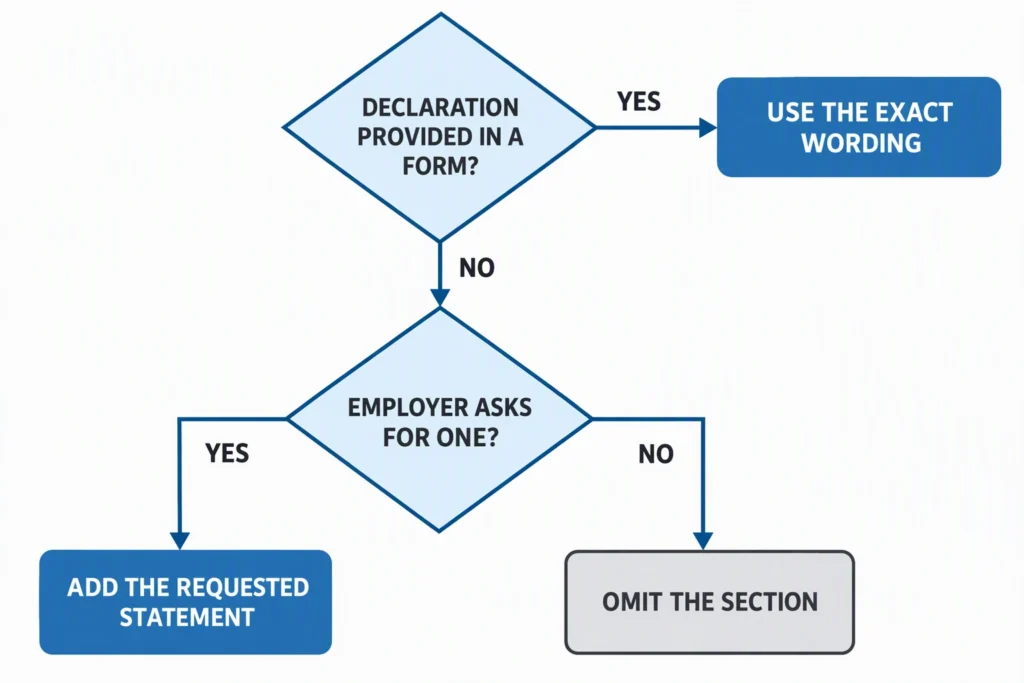
Use the document and submission instructions as evidence. The word “resume” by itself does not create a declaration requirement.
| Situation | What to do |
|---|---|
| The employer supplies a form with declaration text | Use the exact wording and complete each associated field. |
| The posting asks for a signed declaration in the resume | Add a short statement at the bottom and include only the requested fields. |
| An online application has its own accuracy checkbox | Complete the portal attestation; do not duplicate it in the uploaded file unless instructed. |
| No form, checkbox, or request mentions one | Omit the section and submit a fact-checked professional resume. |
A current STQC Directorate application form linked from the Government of India’s vacancy portal illustrates the first case. Its wording refers to the specific vacancy circular, qualifications, work experience, suppressed facts, and selection review, followed by place, date, and applicant-signature fields. That language belongs to that form. It should not be pasted into unrelated private-sector resumes.
Not sure what to include? Explore our guide to the sections of a resume and organize your information clearly.
Understand what the sentence actually does
A declaration records your confirmation that the submitted information is accurate. It does not verify the information for the employer. A recruiter may still check employment, education, licenses, references, or other claims through the hiring process.
The statement also cannot repair vague or inflated content. “Managed major projects,” a wrong employment date, or an invented score remains a weak or inaccurate claim after you sign beneath it. Check the underlying facts first.
Choose a layout that highlights your education and abilities with our guide to resume formats with no experience.
Choose wording that fits the request
When the employer gives you exact language, use it. When it asks for a declaration but leaves the wording open, choose the shortest statement that meets the request.
General accuracy statement
“I declare that the information provided in this resume is true and correct to the best of my knowledge.”
This version is concise and does not invent consequences or claim that an employer has already verified anything.
Employer-provided statement
Some forms refer to a vacancy number, eligibility conditions, supporting documents, or withheld facts. Copy that wording without editing it into a friendlier sentence. If a field does not apply, follow the form’s instruction for “Not applicable” rather than deleting it.
There is no special declaration for freshers. A graduate confirms education, projects, training, and internships; an experienced applicant confirms employment and achievements. Both can use the same general sentence when wording is not supplied.
Preparing your first application? Follow our first job resume guide to show what you can offer without a paid work history.
Place it after the final substantive section
Put the declaration after experience, education, skills, projects, and any other information the employer must assess. Keep it together with the fields that belong to it.
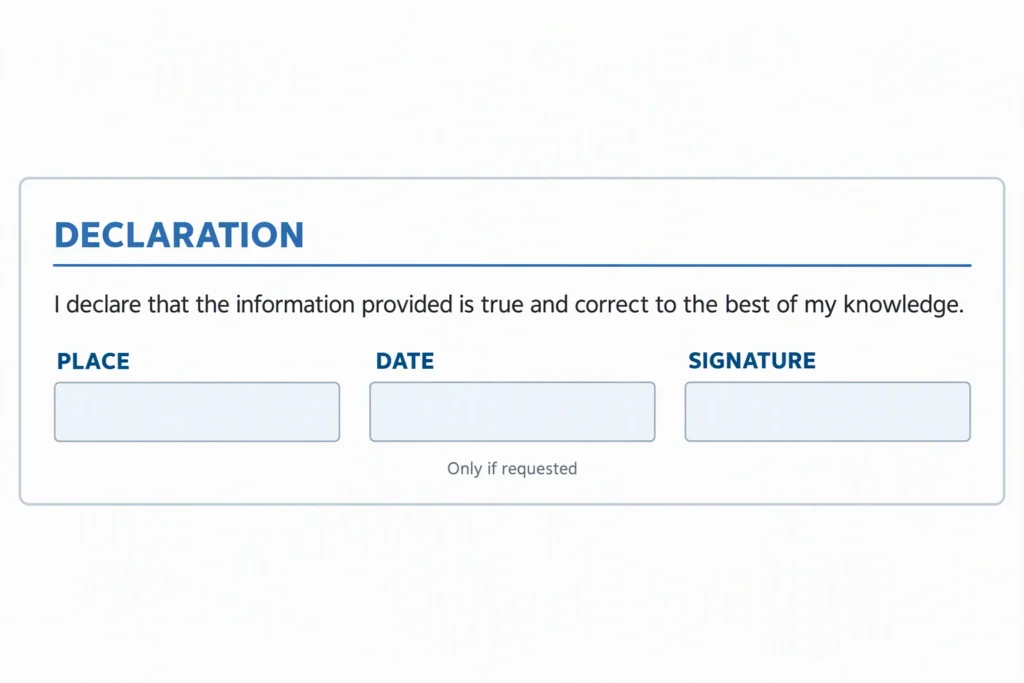
Keep the statement in normal body text. When requested, add Place: followed by the city, Date: followed by an unambiguous date such as 10 October 2026, and Signature: followed by the approved signature or typed name. Do not add a full home address.
Declaration
I declare that the information provided in this resume is true and correct to the best of my knowledge.
Place: Bengaluru
Date: 10 October 2026
Signature: [Applicant name]
The labels are bold, the date is italic and nonbold, and the statement remains normal weight. Remove any field the employer did not request.
Make your qualifications easy to follow by learning how to list education on a resume.
Avoid language you were not asked to accept
Do not add threats about disqualification, dismissal, prosecution, or liability to make the sentence sound serious. Those consequences depend on the employer, form, and applicable rules. If official wording includes them, preserve it; if it does not, do not draft policy for the employer.
Avoid claims such as “all documents have been verified” unless the named authority has actually verified them. Do not upload a reusable image of your handwritten signature to a broadly shared resume merely for decoration.
Unsure whether to submit a resume or a CV? Read our resume vs. CV guide to understand how the documents differ.
Audit the facts before you sign
Check the items the statement covers:
- employer names, role titles, and month–year dates;
- degrees, institutions, grades, licenses, and certification dates;
- project scope, tools, numbers, and individual contribution; and
- contact links plus vacancy, place, date, and signature fields on a prescribed form.
Fix contradictions between the resume, form, portfolio, and professional profile. A shorter declaration cannot resolve conflicting dates.
Introduce your strengths and career direction with these resume objective examples for freshers, adapted to the position you want.
Let the instructions carry the authority
Use the requested statement when the process calls for one, and keep it exact, brief, and attached to the right fields. When no requirement exists, accuracy is still mandatory; it simply belongs in the content rather than in an extra closing line.
Introduce your strengths and career direction with these resume objective examples for freshers, adapted to the position you want.
Frequently Asked Questions
These answers cover signatures and locations.
Is a signature always required below the statement?
No. Sign only when the form or employer asks. A typed name may be sufficient for an electronic file, while a prescribed form may require a handwritten or approved digital signature.
What should I write in the place field?
Use the city from which you are signing or submitting the form, unless the instructions define the field differently. Do not repeat your full postal address.