
“People person” is a personality claim. A resume needs behavior. Did you notice a customer’s real concern, clarify a confusing handoff, adapt an explanation, reconcile two priorities, or help a group reach a decision?
Those moments are evidence because another person had a need, perspective, or responsibility that shaped your response. The strongest example names what you did during the interaction and what became easier, clearer, or possible afterward.
All names, numbers, and situations below are fictional. Replace them with facts you can explain in an interview.
Key Takeaways
- Describe interaction, not personality. Listening, clarifying, instructing, negotiating, and coordinating are observable behaviors.
- Match the behavior to the role. Customer service, project coordination, supervision, sales, and technical work require different kinds of contact.
- Credit shared results accurately. Show your contribution without claiming that you alone produced the team’s outcome.
- Use a result the interaction changed. A clear agreement, completed handoff, accepted plan, trained colleague, or resolved concern can be credible without a percentage.
Show four parts of the interaction
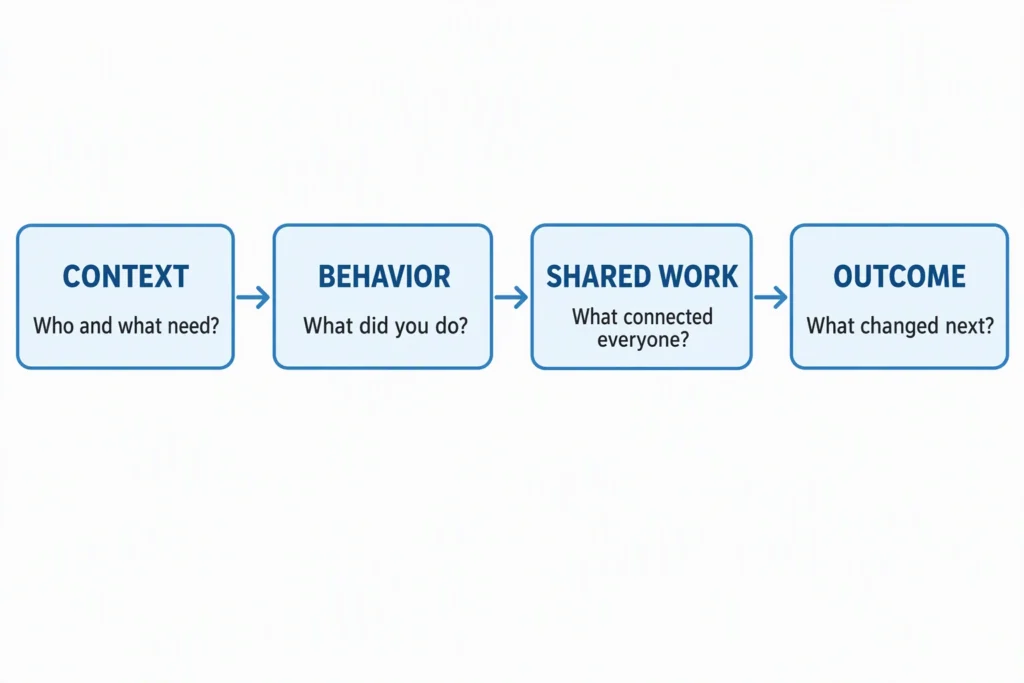
A useful example has context, behavior, shared work, and outcome. Draft all four before deciding what the final bullet needs.
| Part | Question to answer |
|---|---|
| Context | Who was involved, and what need, conflict, handoff, or decision existed? |
| Behavior | What did you listen for, clarify, adapt, teach, coordinate, or negotiate? |
| Shared work | What expectation, plan, service, project, or responsibility connected everyone? |
| Outcome | What agreement, action, understanding, or delivery followed? |
O*NET separates several forms of social work. Coordination means adjusting your actions around others. Negotiation focuses on reconciling differences. Instructing involves teaching, while social perceptiveness involves recognizing and understanding reactions. Choose the behavior that actually explains your example.
Show employers how you approach work and responsibilities with these examples of personal skills for a resume.
Find evidence in ordinary work
Some of the best examples look routine because the interaction went well. Search for moments when you prevented confusion, helped another person act, or kept shared work moving.
Ask yourself:
- When did I ask a question that revealed the real issue?
- When did I change my explanation for a customer, executive, new hire, or technical partner?
- When did I coordinate a handoff between people with different priorities?
- When did I give, receive, or apply difficult feedback?
- When did I help two people reach a workable agreement?
Evidence can come from customer service, meetings, training, cross-functional projects, volunteer leadership, class teams, caregiving, or community work. Label the setting accurately and identify your own behavior.
Choose strengths that match the role with our guide to soft skills for a resume, then support them with examples from your experience.
Match the behavior to the target role
Read the posting for the relationships the employee will manage and the work those relationships support.
| Posting signal | Evidence to prioritize |
|---|---|
| Build relationships, partner | Trust developed through follow-through, useful contact, or shared planning |
| Coordinate, collaborate | Handoffs, roles, timing, dependencies, and joint delivery |
| De-escalate, resolve | Listening, clarifying interests, setting expectations, reaching agreement |
| Train, coach, onboard | Explanation adapted to the learner, practice, feedback, or confirmed understanding |
| Present, influence, advise | Audience needs, clear rationale, questions handled, decision supported |
| Serve, support, assist | Need identified, response tailored, next step made clear |
Do not turn the skills section into a list of friendly adjectives. Terms such as conflict resolution, stakeholder communication, facilitation, customer de-escalation, coaching, or cross-functional coordination are more useful when the job asks for them and a bullet supports them.
Go beyond saying you are a good communicator by learning how to demonstrate communication skills on a resume.
Write a bullet around visible behavior
Use this working formula:
[Behavior] with [person or group] to address [shared need], resulting in [agreement, action, delivery, or understanding].
Then add scope or method only when it helps the reader understand the contribution.
Customer service
Weak: Friendly and helpful with customers.
Stronger: Listened to 25 weekly billing escalations, restated the disputed charge in plain language, and confirmed each next step before closing the call, reducing repeat questions during the following review period.
The evidence is not the adjective “friendly.” It is the repeatable listening and expectation-setting behavior.
Led a team, supported colleagues, or coordinated a project? See how to present leadership skills on a resume with clear evidence of your contribution.
Cross-functional coordination
Weak: Worked well with sales and operations teams.
Stronger: Coordinated weekly handoffs between sales and fulfillment, clarified owners for incomplete orders, and maintained a shared exception list that helped both teams release priority shipments on schedule.
The bullet identifies the relationship, coordination work, and joint result without taking sole credit for shipment delivery.
Conflict or competing priorities
Weak: Excellent conflict-resolution abilities.
Stronger: Facilitated a planning meeting between design and engineering, documented each team’s launch constraints, and guided the group to a revised scope both leads approved.
No dramatic dispute is required. The value lies in making interests visible and helping the group reach a usable agreement.
Applying for a customer-facing role? Explore our customer service resume guide for examples of relevant skills and ways to present them.
Training and onboarding
Weak: Good communicator and mentor.
Stronger: Trained nine new volunteers with short demonstrations, invited questions after each task, and used a final practice check to confirm everyone could complete the intake process independently.
This example shows instruction, feedback, and confirmed understanding.
- Clarified project roles with a six-person volunteer team, resolved two scheduling conflicts, and documented a handoff plan that kept the event setup on time.
Your previous roles, studies, and activities may have prepared you for a new position. Learn how to identify and highlight transferable skills on your resume.
Adapt the message without changing the facts
Effective communication is not saying the same thing in the same way to everyone. The core information should remain accurate while the detail, format, and next step fit the audience.
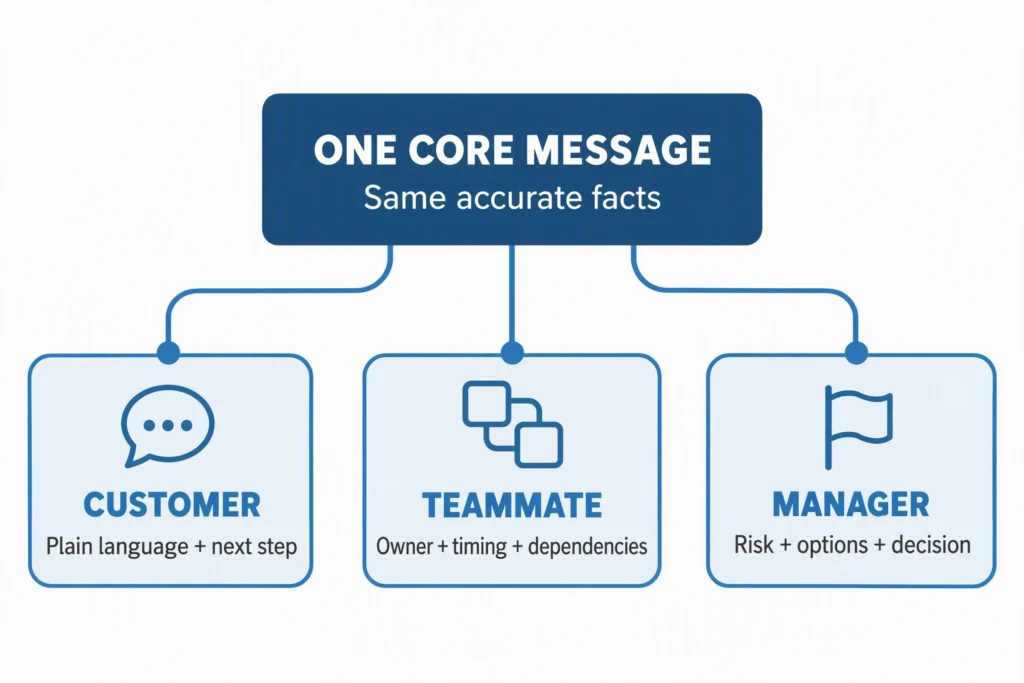
- A customer may need plain language, reassurance, and one clear next step.
- A teammate may need working detail, ownership, timing, and dependencies.
- A manager may need risk, options, recommendation, and decision timing.
If adaptation mattered to the result, name it. “Presented findings” is less informative than “translated technical findings into three options for a nontechnical leadership review.”
Show how you handled a challenge with these problem-solving skills examples for a resume, including ways to explain your actions and results.
Show a credible outcome without forcing a metric
Interaction often creates a qualitative result. You may have reached an agreement, restored a stalled handoff, confirmed understanding, gained approval, documented ownership, received actionable feedback, or helped someone complete a task independently.
Numbers can show scope—the number of people trained, teams coordinated, customers served, or sessions facilitated. Do not invent a satisfaction score or claim a team result that you cannot connect to your behavior.
Turn your examples into focused achievement statements by learning how to use the STAR method for a resume.
Put the evidence in the right section
Use the summary for one relevant pattern, such as coordinating technical and nontechnical stakeholders. Use the skills section for specific capabilities the posting requests. Use experience, projects, leadership, or volunteering for proof.
Avoid repeating “communication” throughout the page. One bullet may prove audience adaptation, another coordination, and another instruction. Each should add a distinct behavior.
Check whether the claim survives a conversation
Before submitting, ask:
- What did the other person need, believe, or control?
- What did I say, ask, notice, or change?
- How did I adapt instead of following a script?
- What part did I own, and what did others contribute?
- What evidence shows that understanding or agreement improved?
Remove personal labels you cannot support. Keep confidential details out, but retain enough context for a reader to understand the interaction.
Let the interaction prove the claim
A strong resume does not need to call you approachable, empathetic, or easy to work with. It can show how you listened, adjusted, coordinated, taught, or reconciled competing needs. Choose a relevant moment, state your behavior precisely, and credit the shared outcome honestly.
Frequently Asked Questions
These answers cover common choices about personality terms, remote work, and early-career evidence.
Should I write “people person” on my resume?
Usually, no. The phrase is broad and difficult to verify. Replace it with a specific capability the job needs and a bullet that shows the behavior in context.
Can remote collaboration provide good evidence?
Yes. You can show how you clarified written updates, coordinated across time zones, facilitated a video meeting, documented decisions, or checked understanding when body-language cues were limited.
What if my best example comes from school or volunteering?
Use it when it is relevant. Class teams, clubs, service groups, and community projects can show facilitation, instruction, feedback, negotiation, or shared accountability. Label the setting and your role accurately.