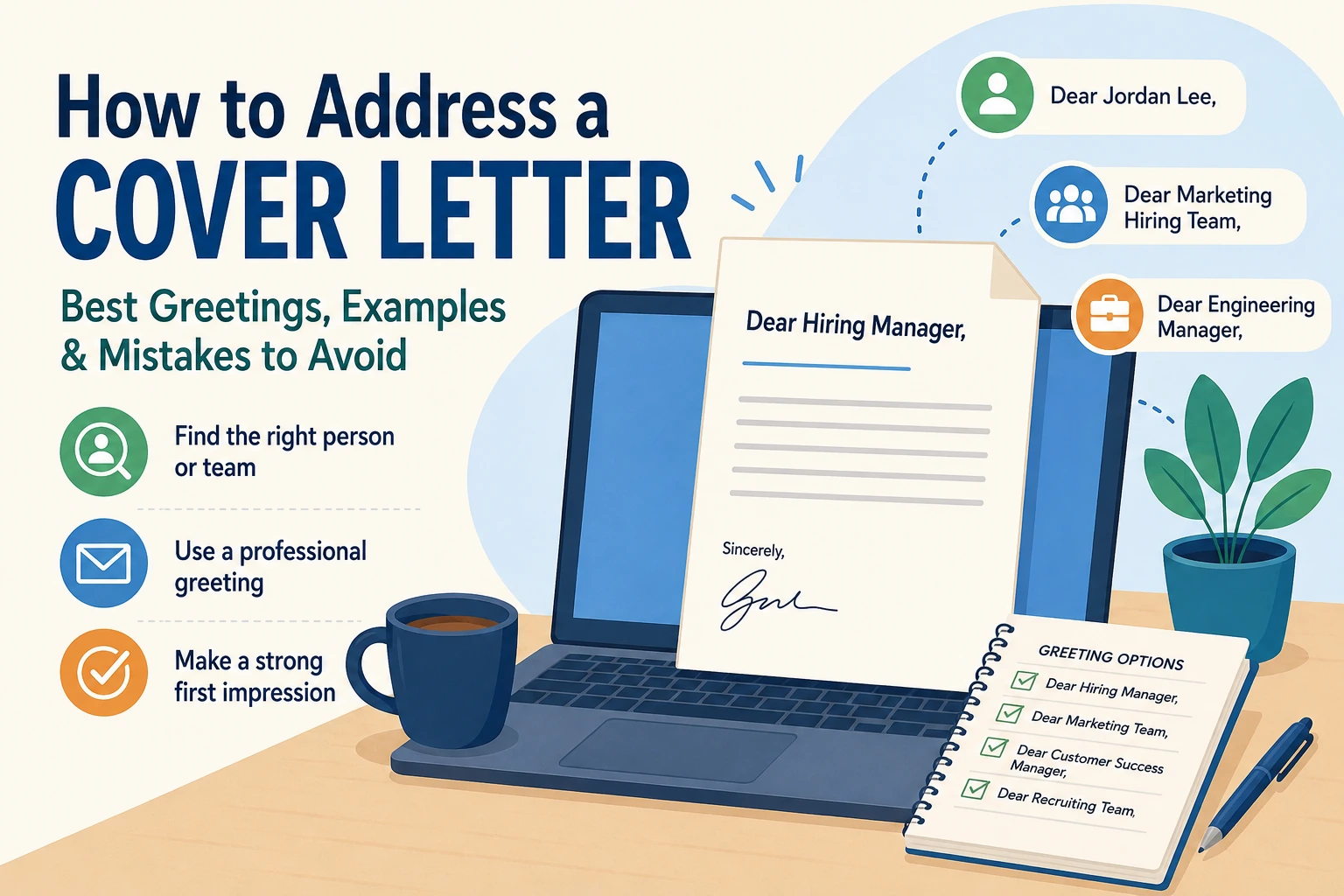

Whenever possible, address your cover letter to the hiring manager, recruiter, or person responsible for filling the position. Using the right name shows attention to detail and helps you speak directly to the person reviewing your application.
But addressing a cover letter is not always straightforward. Job postings may leave out the hiring manager’s name, or you may not be able to confirm who will read your application.
In that case, there are professional alternatives to simply guessing.
This guide explains how to address a cover letter, including how to address a cover letter without a name, with seven practical examples for common hiring situations.
Ready to Land Your Next Job?
Don’t let your resume get lost in the stack. Build a professional, ATS-friendly resume that highlights your leadership, achievements, and industry expertise.
Who Should You Address a Cover Letter To?
If the job posting provides a name, use it. If it does not, research the company and role before choosing a generic greeting. When you cannot reliably identify an individual, “Dear Hiring Manager” or a relevant department or team greeting is generally a professional alternative.
If you are wondering how do you address a cover letter to the right recipient, use this priority order:
- Named hiring manager — your first choice when verified.
- Department manager or department head — useful when the role’s reporting structure is clear.
- Named recruiter — appropriate when that recruiter is managing the vacancy.
- Relevant hiring team or department — such as “Dear Marketing Hiring Team.”
- Dear Hiring Manager — a safe option when how to address a cover letter without a name becomes necessary.
This approach keeps the addressing in cover letter professional without guessing someone’s identity.
Show how your teaching approach and classroom experience fit the school with these teacher cover letter examples.
“The best cover letter greeting is not the most personal one you can create—it is the most specific one you can verify.”
7 Cover Letter Addressing Examples
The right salutation depends on what you can reliably learn about the employer and the person handling the vacancy. These seven examples show how do you address a cover letter to a named individual, recruiter, department, or hiring team—and what to use when no individual name is available.
Example 1: Addressing a Cover Letter When You Know the Hiring Manager’s Name
Dear Jordan Lee,
When you have verified the hiring manager’s full name, addressing them directly is generally the most targeted option. Use the name as it appears in the job posting, company directory, or other reliable professional source. A full name also avoids making assumptions about titles such as Mr., Ms., or Mx. This approach makes addressing in cover letter openings straightforward and professional.
Finish your application with confidence using our guide to how to end a cover letter.
Example 2: Addressing Someone With a Professional Title
Dear Dr. Martinez,
Use an established professional or academic title when you know the recipient uses it and it is relevant to the professional setting. For example, “Dr.” may be appropriate for a physician or someone who uses a doctoral title professionally.
Confirm both the person’s name and title rather than assuming credentials. When uncertain, using the verified full name without an honorific can avoid an incorrect title.
Keep your introduction focused and concise with a short cover letter sample you can adapt to your application.
Example 3: Addressing a Cover Letter Without a Name
Dear Hiring Manager,
If you have made a reasonable effort to identify the recipient but cannot verify a name, “Dear Hiring Manager” is a clear, professional fallback. It directs the letter toward the person overseeing the hiring decision without inventing personal details.
For applicants researching how to address a cover letter without a name, this greeting is usually more appropriate than outdated or impersonal phrases such as “To Whom It May Concern.”
Connect your studies and practical abilities with the opportunity using these internship cover letter examples.
Example 4: Addressing a Department or Hiring Team
Dear Marketing Hiring Team,
When you know which department is recruiting but cannot identify one decision-maker, address the relevant team instead. A department-specific salutation gives the greeting more context than a completely generic opening.
For example, applicants for roles in finance, sales, or human resources could adapt the wording accordingly. Use this format only when you can confidently connect the vacancy with the department you name.
Make your letter comfortable to read with our guide to cover letter font size and style.
Example 5: Addressing a Department Manager
Dear Engineering Manager,
Sometimes the job description makes the reporting relationship clear even though it does not identify the manager by name. In that situation, addressing the responsible position can work well.
“Dear Engineering Manager,” for example, is appropriate when you know the engineering manager is overseeing or receiving applications. Prefer an accurate role-specific title over guessing which individual currently holds the position.
Explain your transition and highlight relevant strengths with these career change cover letter examples.
Example 6: Addressing a Recruiter
Dear Taylor Morgan,
A recruiter can be the appropriate recipient when they are explicitly identified as the contact responsible for the vacancy or application process. Verify that the recruiter is actually associated with the position before addressing the letter to them.
If the recruiter merely shared the vacancy but the application instructions identify a different hiring contact, direct your cover letter to the person specified by the employer instead.
Present your legal research, case preparation, and organizational abilities with our paralegal cover letter guide and examples.
Example 7: Addressing a Cover Letter After a Referral
Dear Morgan Chen,
A referral does not usually change who belongs in the salutation. Address the letter to the verified hiring contact, then mention the person who referred you naturally in the opening paragraph.
For example: “Alex Rivera recommended that I apply for the Account Manager position after telling me about your team’s current opening.” This immediately establishes the connection while keeping the salutation focused on the person receiving your application.
Ready to Land Your Next Job?
Don’t let your resume get lost in the stack. Build a professional, ATS-friendly resume that highlights your leadership, achievements, and industry expertise.
Who Do You Address a Cover Letter To?
Choosing the recipient is partly about identifying who is most closely connected to evaluating the role, rather than simply finding any employee at the organization. Application instructions should take priority because employers may route applications differently depending on their recruitment process.
Address the Hiring Manager First
The hiring manager is typically responsible for filling a particular vacancy and often has direct knowledge of the position’s responsibilities and requirements. This makes that person a logical recipient when their identity is confirmed. Look for clues such as the position’s reporting line or the manager responsible for the relevant function, but avoid inferring a recipient solely from a similar job title.
When a Recruiter Is the Right Recipient
A recruiter may be the better choice when they have contacted you about the opportunity, requested your application materials, or are explicitly listed as the recruitment contact. This can apply to both internal corporate recruiters and external recruiters representing an employer. Follow any recipient instructions they provide.
Should You Address It to HR?
Do not automatically address every cover letter to Human Resources. Recruiting responsibilities vary among organizations. HR is appropriate when the vacancy identifies an HR representative, directs candidates to that department, or clearly indicates that HR is coordinating recruitment for the position.
Write an opening that establishes your interest and qualifications with these examples of how to start a cover letter.
What If Several People Are Involved?
When a recruiter, manager, and other interviewers are involved, prioritize the verified contact who is most directly responsible for your application at that stage. If no single recipient can be established, a relevant department or hiring-team salutation avoids arbitrarily selecting one person.
How to Find the Hiring Manager’s Name
Before deciding how to address a cover letter without a name, spend a few minutes checking whether the recipient can be identified. Career guidance from Indeed recommends checking the job listing, professional networking sites and the employer’s website, and contacting the company if necessary.
Step 1: Read the Job Posting Again
Review the entire vacancy rather than only the job title and requirements. Look for a recruiter or contact name, application instructions, statements about whom the position reports to, and details identifying the team. These clues can narrow your search considerably.
Step 2: Check the Company’s Website
Visit the employer’s About, Team, Leadership, Careers and relevant department pages. If the posting says the position reports to a particular role, see whether the company identifies the person currently holding that position. Company team pages can be especially useful for connecting names with departments and responsibilities.
Step 3: Search LinkedIn
Use professional networking searches that combine the company name with the department, recruiter, hiring manager, or likely supervisor’s job title. Treat the result as a lead, not automatic proof. Profiles can be outdated, and someone with a relevant title may not be involved in that particular vacancy. Indeed specifically recommends professional networking sites as one way to research the hiring contact.
Step 4: Review Previous Communication
Check application emails, interview invitations and recruiter correspondence. If a company representative has already provided instructions about submitting your materials, follow that communication rather than conducting unnecessary guesswork.
Step 5: Contact the Company If Necessary
If public information does not resolve the question, call or email the employer and politely ask who manages recruitment for the specific position. This is a recognized way to identify the appropriate contact.
Before You Use a Name
- Verify the spelling.
- Confirm the person’s current role.
- Check that they are associated with the relevant department or vacancy.
- Never invent or assume a recipient simply to personalize the greeting.
Ready to Land Your Next Job?
Don’t let your resume get lost in the stack. Build a professional, ATS-friendly resume that highlights your leadership, achievements, and industry expertise.
How to Address a Cover Letter With a Name
Once you have identified the appropriate recipient, the next question is how do you address a cover letter using that person’s name. The safest approach is to reproduce the name accurately and choose a level of formality appropriate to a professional application.
Using the Person’s Full Name
Dear Jordan Lee,
Using the recipient’s full name is a practical option when you know their identity but do not know which honorific they use. It keeps the salutation professional while avoiding assumptions about gender, marital status, or personal preference.
Check the spelling carefully against a reliable source, particularly for hyphenated or multi-part names.
Using Mr., Ms., Dr., or Another Title
Dear Ms. Rodriguez,
Dear Dr. Williams,
An honorific or professional title can be used when you are confident it is correct. “Dr.,” for example, may be appropriate when the recipient professionally uses that title.
Avoid assigning Mr., Ms., Mrs., Dr., or another form of address based solely on a name, photograph, or assumption.
What If You Don’t Know Their Gender or Preferred Title?
You do not need to determine someone’s gender to write an appropriate salutation. If their preferred title is not stated in reliable professional information, use their verified full name:
Dear Avery Thompson,
This keeps the focus on identifying the recipient correctly rather than guessing how they prefer to be addressed.
First Name vs. Last Name
Organizational culture can influence whether first-name greetings are appropriate. A startup may communicate differently from a law firm, university, or government organization.
If previous correspondence clearly establishes a first-name basis, you can follow that convention. When the expected level of formality is uncertain, however, “Dear + Full Name” provides a useful neutral format for addressing in cover letter salutations.
How to Address a Cover Letter Without a Name
When deciding how to address a cover letter without a name, follow a simple rule: research first; use a professional generic greeting when a reliable name genuinely cannot be found. The goal is not to manufacture personalization, but to make the salutation as specific to the hiring process as the available information allows.
Dear Hiring Manager
Dear Hiring Manager,
This is a practical general-purpose greeting when the vacancy does not reveal an individual, department, or recruiting contact. It identifies the intended function of the recipient without making unsupported assumptions.
It is particularly useful for applications submitted through centralized applicant-tracking systems where the eventual reviewer is not identified.
Dear [Department] Hiring Team
Dear Marketing Hiring Team,
Dear Finance Hiring Team,
Dear Engineering Hiring Team,
A department-based greeting can add useful specificity when the job posting clearly associates the vacancy with a particular business function. It signals which team the letter is intended for without claiming to know which individual will review it.
Dear [Department] Manager
Dear Customer Success Manager,
This format can work when the organizational role responsible for the position is identifiable even though the current employee’s name is unavailable. Use the actual department or managerial title supported by the vacancy information rather than creating a title that merely sounds plausible.
Dear Recruiting Team
Dear Recruiting Team,
This greeting suits employers that use a centralized recruiting or talent-acquisition function to receive and process applications. It is most appropriate when application materials or employer communications indicate that a recruiting team, rather than a specific department manager, is handling initial candidate correspondence.
For quick reference, choose the salutation that matches the information you can verify:
| Situation | Recommended Approach |
|---|---|
| Name verified | Dear Cameron Brooks, |
| Professional title verified | Dear Dr. Patel, |
| Department known | Dear Marketing Hiring Team, |
| Manager role known | Dear Engineering Manager, |
| No reliable identifying information | Dear Hiring Manager, |
The key distinction is verification versus assumption: use greater personalization only when the information available supports it.
Cover Letter Greetings to Avoid
Some salutations can make a job application sound dated, overly casual, or based on information you have not confirmed. When addressing in cover letter openings, choose wording that fits contemporary professional correspondence and does not make unnecessary assumptions about the reader.
“To Whom It May Concern”
This phrase is broad and impersonal because it does not identify the audience or even the function receiving the letter. For a job-specific application, a role- or team-focused greeting usually communicates the intended audience more clearly.
“Dear Sir or Madam”
Although traditionally used in formal correspondence, this salutation assumes how potential recipients should be addressed and can sound dated. Neutral wording avoids that problem while maintaining professional formality.
“Dear Sir”
This greeting is unnecessarily gender-specific when the recipient’s identity has not been established. There is no reason to assume that the person reviewing an application is male.
“Hey” or “Hi There”
Conversational greetings can be too informal for an initial application. A different tone may be reasonable once a recruiter or employer has established an informal style through direct correspondence, but the application itself should generally begin professionally.
Guessing the Hiring Manager’s Name
Do not select a person merely because their job title appears related to the vacancy. Organizational structures and hiring responsibilities differ between employers.
A generic but accurate greeting is better than confidently addressing the letter to the wrong person.
“A strong salutation shows professional judgment: use a name when you know it, a relevant role when you don’t, and never turn uncertainty into a guess.”
How to Format the Address and Salutation
The recipient address block and the salutation serve different purposes. In traditional business-letter formatting, the inside address identifies the recipient and organization, while the salutation begins the message itself. A conventional example looks like this:
Casey Bennett
Marketing Director
ABC Company
Company Address
City, State ZIP
Dear Casey Bennett,
For an Uploaded Cover Letter
When submitting a cover letter as a PDF or Word document, a conventional business-letter structure is appropriate unless the employer requests another format. Depending on the format you choose, the document may include your contact information, the date, the employer’s inside address, the salutation, the letter body, and a closing. Keep the formatting consistent and easy to scan.
For an Email Cover Letter
If the cover letter itself appears in an application email, you generally do not need to reproduce a traditional recipient mailing-address block in the email body. Start with the appropriate salutation, write the message in a professional email format, and include relevant contact details in your signature.
For an Online Application
When a portal asks you to upload the cover letter as a separate document, treat it as a standalone professional letter. If the portal instead provides a text field, adapt the formatting to that interface.
Always follow application-specific instructions when the employer tells candidates whom to address or how to submit the letter.
If you plan to send your letter in the body of an email, see our guide to writing a short cover letter for email applications.
Ready to Land Your Next Job?
Don’t let your resume get lost in the stack. Build a professional, ATS-friendly resume that highlights your leadership, achievements, and industry expertise.
Common Cover Letter Addressing Mistakes
Even a short salutation can create problems when the recipient details are inaccurate or copied from another application. Before submitting your letter, check for these common cover letter addressing mistakes:
- Misspelling the hiring manager’s name: Compare the spelling with the employer’s current information rather than relying on memory.
- Addressing the wrong employee: A person working in the relevant department is not necessarily involved in recruitment.
- Guessing someone’s gender or title: Do not infer an honorific from a name, photograph, or other assumption.
- Using an outdated employee listing: Staff responsibilities can change, so check that your information is current.
- Automatically addressing the CEO: Seniority does not mean the CEO reviews applications for every vacancy.
- Using an excessively casual greeting: Match the professional context of an initial job application.
- Writing “To Whom It May Concern” when a more specific option is available: Choose wording connected to the vacancy where possible.
- Leaving a placeholder such as “[Hiring Manager Name]”: Proofread templates carefully before submission.
- Using the same recipient for every application: Recheck recipient details for each individual vacancy.
- Ignoring instructions in the job advertisement: Employer-provided submission and recipient directions should take precedence over general conventions.
Accuracy matters more than forced personalization.
Quick Decision Guide: Which Cover Letter Greeting Should You Use?
If you need to choose a salutation quickly, work through this sequence. Each question helps you use the most relevant information available without overcomplicating how to address a cover letter.
Do you know the hiring manager’s verified name?
→ Yes: Address that person by name.
→ No: Continue.
Do you know the relevant department or manager?
→ Yes: Use an accurate department, hiring-team, or manager title that corresponds to the vacancy.
→ No: Continue.
Is a recruiter specifically handling your application?
→ Yes: Address the recruiter when they are the designated contact for your application.
→ No: Continue.
Still cannot identify anyone after reasonable research?
→ Use Dear Hiring Manager.
This hierarchy prevents unnecessary guesswork. Whichever option you reach, check the vacancy one final time for recipient or submission requirements before sending your application. Employer-specific directions should always override a general cover letter convention.
Ready to Land Your Next Job?
Don’t let your resume get lost in the stack. Build a professional, ATS-friendly resume that highlights your leadership, achievements, and industry expertise.
FAQs About Addressing a Cover Letter
1. Who should I address a cover letter to?
Address the hiring manager when you can reliably identify that person. If another contact is explicitly managing the vacancy, such as a recruiter, that individual may be appropriate instead. Where recruitment is handled collectively, addressing the relevant department or hiring team can also work.
2. How do I address a cover letter without a name?
If you cannot identify an individual, use a role- or team-based salutation. “Dear Hiring Manager” is a practical choice, while “Dear Sales Hiring Team” or another accurate department-specific greeting can provide additional context when you know the business function.
3. Is “Dear Hiring Manager” acceptable?
Yes. “Dear Hiring Manager” is an acceptable professional salutation when reasonable research does not establish the recipient’s identity. It is particularly useful when applications are processed through a general recruitment system and candidates are not given the name of the person reviewing them.
4. Should I use “To Whom It May Concern” on a cover letter?
Usually, no. Although the phrase remains part of formal correspondence, it is very broad for a job-specific application. When the individual recipient is unknown, a hiring-manager, recruiting-team, or department-specific greeting generally identifies the intended audience more clearly.
5. Can I address a cover letter to a recruiter?
Yes, when the recruiter is clearly responsible for the vacancy or has directly requested your application. However, finding a recruiter who works for the same organization does not necessarily mean that person is involved with the particular position.
6. Should I use Mr. or Ms. in a cover letter?
Use Mr., Ms., Dr., or another title only when you have reliable information that it is correct and appropriate. If you know the recipient’s identity but cannot confirm their preferred honorific, their verified full name provides a professional alternative.
7. What if I address my cover letter to the wrong person?
Avoid guessing merely to make the letter appear personalized. If you cannot confidently establish who receives the application, choose an accurate department, team, or neutral hiring salutation instead. Verify any recipient details supplied by the employer before submitting your application.