

You helped coordinate three branch rollouts. Your resume says, “Assisted with office tasks.” Somewhere between doing the work and describing it, your strongest qualification disappeared.
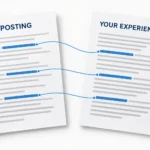
Start by putting the vacancy beside your resume. Identify the work the employer needs done, find examples you’ve actually delivered, and rewrite the most relevant lines so that connection is visible. Often, the missing ingredient is the detail you left out.
Let’s work through one application from the original wording to a finished resume excerpt. You’ll see what changes, what gets cut, and which tempting keyword stays off the page.
Key Takeaways
- Your employment facts stay fixed. Tailoring changes emphasis and wording; it doesn’t change your title, dates, credentials, or level of responsibility.
- A preferred skill isn’t automatically an entry requirement. Read the employer’s labels before deciding that one missing tool rules you out.
- A match score isn’t an employer’s hiring decision. Use a resume checker to spot possible omissions, then evaluate its suggestions against your actual experience.
Read the posting for decisions, not just keywords
Before editing, separate eligibility requirements from the work you’ll perform and the extras the employer would like. A license marked “required” needs different attention from software listed as “preferred.” Repeated wording can signal emphasis, but it doesn’t change those labels.
Here’s the vacancy for our example. The employer, candidate, dates, and achievements throughout this walkthrough are fictional. The posting is a teaching example, not a live opening.
Project Coordinator — posting excerpt
- Maintain project schedules and weekly status reports in Microsoft Excel.
- Coordinate updates across sales, finance, and operations.
- Record meeting decisions and follow up on action items.
- Required: at least one year of administrative or project coordination experience.
- Preferred: experience with Asana.
The immediate need is someone who can keep schedules, updates, and follow-through organized. “Project Coordinator” alone doesn’t tell you that; the responsibilities do.
Check any separate application questions, too. Employers can configure screening rules around answers such as whether you hold a required license. Stronger resume wording won’t resolve a genuine eligibility gap, and the answers still need to be accurate.
Build an evidence map before rewriting
Our candidate, Sam Rivera, has worked as an operations assistant at Cedar Lane Services since January 2023. Sam’s current resume opens with this:
Summary: Hardworking professional with excellent communication and organizational skills.
Experience: Assisted with office tasks, maintained spreadsheets, and attended meetings.
That wording leaves the reader to guess what the spreadsheets tracked and why the meetings mattered. Before reaching for stronger verbs, Sam checks project trackers, meeting notes, and a performance review to recover the details.
| What the posting asks for | What Sam actually did | Editing decision |
|---|---|---|
| Schedules and Excel status reports | Updated a weekly Excel tracker for three branch rollouts; flagged overdue tasks | Lead the experience section with this work |
| Updates across three departments | Collected sales, finance, and operations updates; followed up on pending approvals | Name the teams and the follow-up |
| Meeting decisions and action items | Recorded decisions, owners, and due dates; circulated notes | Replace “attended meetings” with the contribution |
| Administrative or coordination experience | Operations Assistant, January 2023–Present | Keep the official title and dates visible |
| Asana preferred | No Asana experience | Leave it out of the skills list |
Sam also created a handoff checklist that all three departments adopted. That’s useful supporting evidence. Ordering office supplies and covering reception are accurate duties, but they contribute less to this particular application.
You can make the same map with work, volunteer, academic, or personal projects. Label the setting clearly. A class project can demonstrate scheduling; it shouldn’t be presented as paid employment.
Turn those facts into a focused resume excerpt
The following is the revised portion of Sam’s resume. Contact information, education, and any earlier roles would remain elsewhere in the full document.
The revised version
This excerpt gives each section a job: the summary establishes fit, the skills line makes specific capabilities easy to find, and the experience bullets supply evidence.
Sam Rivera
Summary
Operations assistant with 3+ years of experience, including coordination support for three branch rollouts. Brings hands-on experience with Excel status reporting, meeting documentation, and follow-up across departments.
Skills
Microsoft Excel: schedule tracking and weekly status reports; meeting documentation; action-item tracking.
Experience
Operations Assistant | Cedar Lane Services
January 2023–Present
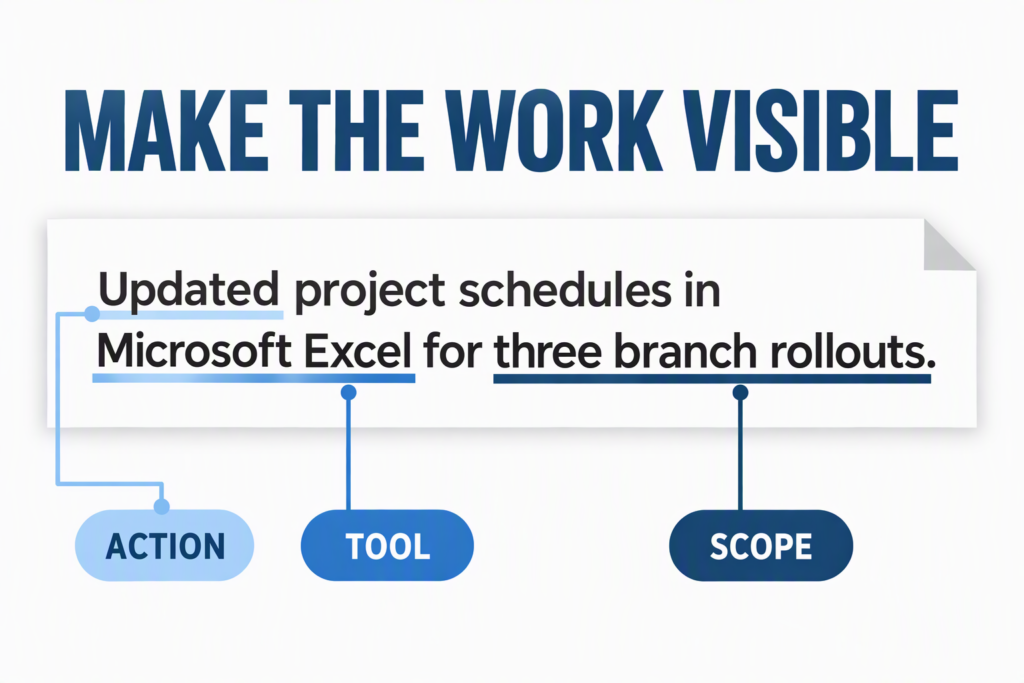
- Updated project schedules and weekly status reports in Microsoft Excel for three branch rollouts, flagging overdue tasks for follow-up.
- Collected updates from sales, finance, and operations and followed up with task owners on pending approvals.
- Recorded meeting decisions, action owners, and due dates, then circulated notes to the project team.
- Created a handoff checklist adopted by sales, finance, and operations to standardize the information passed between teams.
The first bullet now identifies an action, a tool, and the scope of the work. It doesn’t claim Sam managed the rollouts or completed them ahead of schedule. Those would be new claims, and the evidence doesn’t support them.
Why these edits earn their space
The summary’s “3+ years” comes from the example’s employment dates as of October 2026. On your resume, calculate experience from your own timeline; don’t copy the number.
“Microsoft Excel” now means something specific. Sam can discuss trackers and status reports, but the example supplies no evidence of advanced formulas, macros, or financial modeling. The skills line therefore names the tasks instead of claiming “advanced Excel.”
The checklist bullet adds a contribution beyond routine duties. Adoption by three departments is a concrete fact; a made-up efficiency percentage would weaken its credibility. When you don’t have a measured business result, describe the scope, deliverable, or documented change you can defend.
Finally, supplies and reception coverage come out of this excerpt. They remain in Sam’s master resume for other applications. Tailoring includes deciding what doesn’t deserve the reader’s attention here.
Use the employer’s language where it fits
A company’s internal phrase can hide a recognizable skill. If your team called the weekly status report a “Friday pulse,” use the ordinary term when it accurately describes the work. Keep necessary industry terms, and spell out an unfamiliar acronym on first use.
This helps both people and software. Greenhouse, for example, documents recruiter searches using keywords and exact phrases. That’s a reason to name relevant tools and responsibilities plainly. It isn’t evidence that every applicant tracking system, or ATS, uses the same scoring rules.
Keep terms inside meaningful claims. Pasting a job description into a resume, adding hidden keywords, or listing tools you haven’t used doesn’t demonstrate fit. Nor does replacing your official position with the vacancy’s title. If an internal title is obscure, add a brief, accurate functional explanation beside it while preserving the original.
For Sam, Asana remains a gap. Excel tracking is transferable experience, but it isn’t use of that product. If Sam later completes a practical Asana project, that project can be described with its actual scope and date.
Check the application the employer will receive
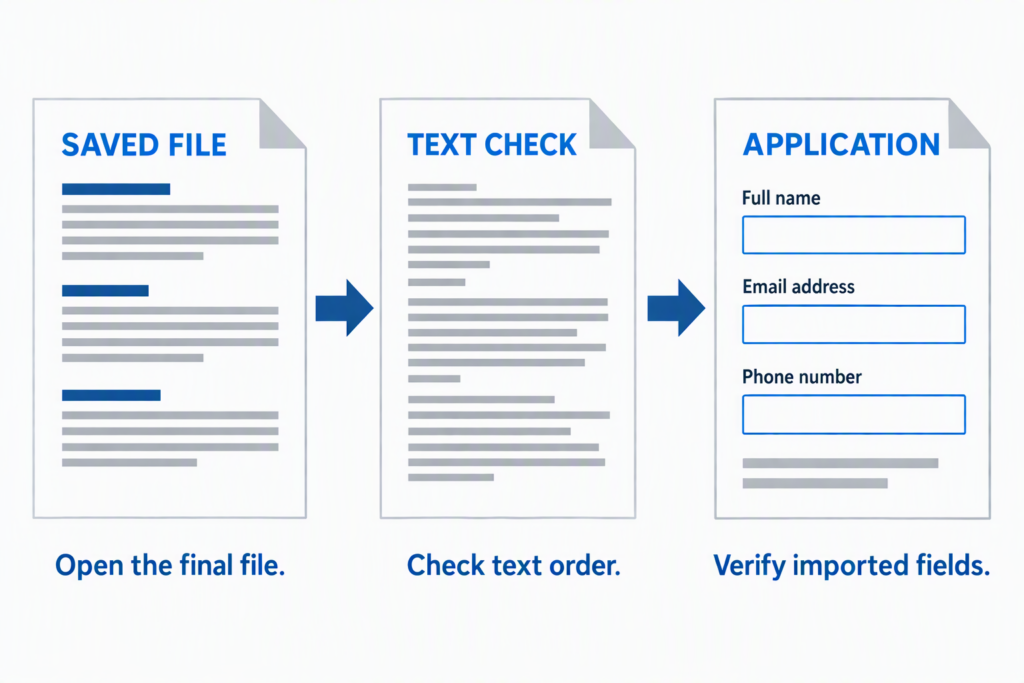
A good edit can still be undermined by the wrong attachment or scrambled text. Review the exported file, then the information the application form extracts from it.
- Keep the timeline readable. Reorder bullets by relevance within a job. Keep positions in reverse chronological order within each experience section.
- Use a straightforward resume layout. Clear headings and a single text column reduce avoidable reading-order problems. The illustrations in this guide belong to the article; your uploaded resume needs selectable text.
- Follow the requested file format. Open that actual Word or PDF file. Copy its text into a plain-text editor to look for missing content or odd ordering. This catches some problems; it doesn’t certify compatibility with every system.
- Inspect the upload result. Correct any imported titles, dates, or other fields that the application misreads. Confirm that the attachment is the intended version.
Save the submitted resume alongside the posting in your application records. A name such as Sam_Rivera_Project_Coordinator_Resume.docx helps distinguish it from other versions and gives you the right copy to review before an interview.
Know when the edit is finished
Ask someone unfamiliar with your work to read the posting and your resume. Can they point to evidence for the central responsibilities without an explanation from you? If they can, and every claim holds up, send the application. Another synonym swap probably isn’t the work that needs doing next.
FAQ
The walkthrough assumes a detailed posting and a usable work history. These situations need a slightly different approach.
What if the job description is vague?
Look at the employer’s careers page, team information, and related openings for context. Use those clues to choose relevant evidence, but don’t treat a different role’s requirements as this role’s requirements. If you can contact the recruiter, ask which responsibilities matter most in the first few months.
Can I reuse a version for similar openings?
Yes. Start with a version aimed at the same kind of work, then compare the new posting’s priorities, tools, and eligibility conditions. You may need only a few edits. There’s no useful fixed percentage of the resume that must change.
Can AI help with the rewrite?
Give it the posting and a factual inventory of your experience. Ask it to identify supported connections and flag missing evidence before suggesting wording. Check every new verb, number, tool, and claim of ownership. Keep confidential employer information and unnecessary personal details out of the prompt.