
“Java, Spring Boot, Maven, JUnit” is a stack, not proof that you can build a dependable service. A useful resume connects those tools to a request, business rule, data boundary, test, build artifact, and running application.
Start by choosing the job you want the page to support. A backend opening may value REST endpoints and persistence; an integration role may care more about message flow, failure handling, and external systems. Select projects and bullets for that target instead of presenting every class you have written.
Key Takeaways
- Trace a feature through the application. Show how a request reaches a controller, service, domain rule, repository, and data store when that path reflects your work.
- Name tested behavior, not just JUnit. A credible bullet identifies the unit or integration boundary, important cases, and a result you can reproduce.
- Treat the build as evidence. The repository should let another person resolve dependencies, run tests, package the application, and start it from documented commands.
- Keep configuration outside the code. Demonstrate safe handling of environment-specific values without exposing passwords, tokens, or private endpoints.
Decide which Java role the page presents
The same language supports very different work. Give the first half of the page to evidence the target employer is likely to inspect first.
| Target | Strong evidence to foreground |
|---|---|
| Backend or Spring developer | HTTP contract, validation, service logic, persistence, errors, tests, configuration, health checks |
| Integration developer | External API or message contract, mapping, retries, timeouts, idempotency, observability, failure recovery |
| Platform or tooling developer | Build automation, plugins, command-line behavior, packaging, CI, diagnostics, developer documentation |
| General junior developer | Object design, collections, exceptions, Git workflow, debugging, tests, readable documentation |
Use a specific target title only when the projects and experience support it. A basic console exercise does not establish enterprise or microservices experience.
Applying for a development role? Explore our software engineer resume examples to see how to present your coding skills, projects, and experience.
Build the first half around evidence
A new graduate can usually order the page as contact details, target summary, technical skills, projects, education, and internships or other experience. If paid development work is stronger than personal projects, place experience first.
Write a summary that sets scope
Use two lines to state level, direction, strongest stack, and the kind of system you completed. Skip personality claims and broad labels such as “expert.”
Junior backend developer who built Spring Boot services with Java, PostgreSQL, Maven, JUnit, and GitHub Actions. Experienced in implementing validated REST workflows, persistence, automated tests, and documented local setup.
Choose abilities that match the position with our guide to technical skills for a resume, including examples you can adapt to your field.
Organize skills by purpose
Useful groups include Languages, Frameworks, Data, Testing, Build and CI, and Tools. List a technology when you can discuss where you used it, the decision it supported, and a limitation you encountered. Versions matter when compatibility or the posting makes them relevant.
Make your software knowledge clear by learning how to select and present computer skills for a resume.
Present education consistently
Use the official program name and truthful completion status. Under the client’s house style, bold the institution, italicize the degree, and keep the date separate and nonbold.
Lakeside Institute of Technology, Pune, Maharashtra
Bachelor of Engineering in Computer Engineering
Expected May 2027 | CGPA: 8.4/10
Add selected coursework only when it helps explain project knowledge such as data structures, databases, networks, or software engineering.
Built an application, website, or database? Learn how to list projects on a resume and explain your contribution, tools, and results.
Trace one feature through the layers
A reviewer learns more from one coherent transaction than from a list of annotations. For a booking, order, or support-ticket service, explain the contract, rule, storage change, failure response, and test boundary you implemented.
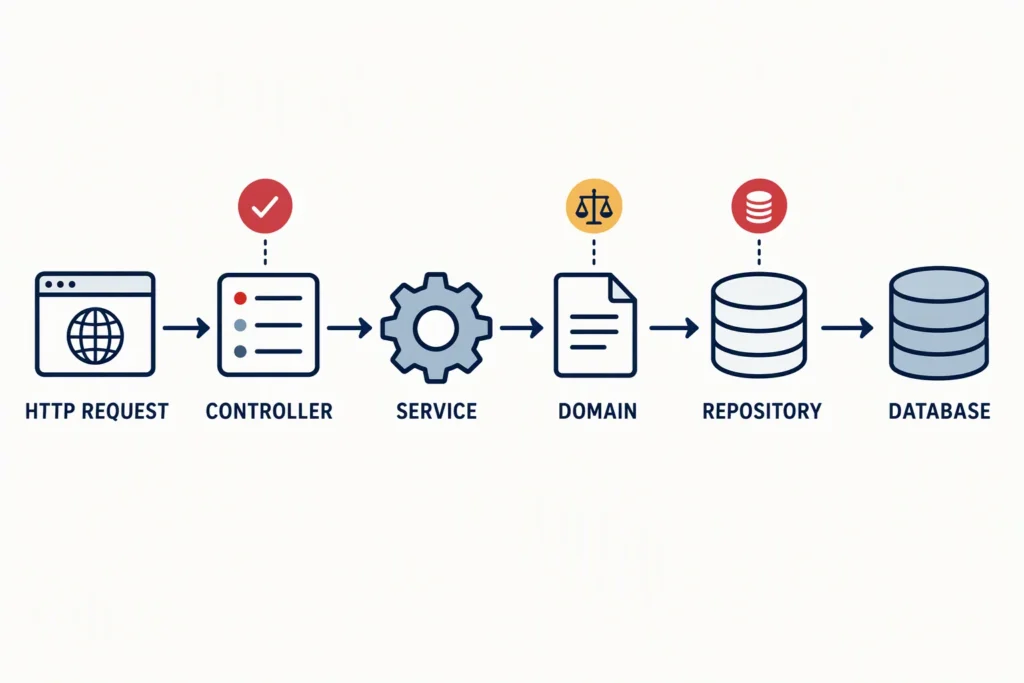
Use layers as a map of responsibility, not as a claim that every application needs the same architecture:
- Controller: accepts the request, validates the contract, and returns an intentional status or error body.
- Service: coordinates the use case and transaction rather than storing unrelated rules in the web layer.
- Domain: expresses meaningful state and rules in names a reviewer can follow.
- Repository: isolates persistence behavior and makes query or transaction choices visible.
- Database: enforces the constraints and stores the data the feature actually requires.
A concise project description could read:
Workshop Booking API | Java, Spring Boot, PostgreSQL, Maven, JUnit
January 2026 – March 2026
- Implemented booking creation and cancellation across controller, service, and repository layers, with validation for capacity and duplicate requests.
- Added unit tests for booking rules and integration tests for HTTP status, validation, and persistence behavior using an isolated test database.
- Packaged the service with Maven and documented environment variables, migration steps, test commands, and a local start command.
Before submitting your application, use our resume keywords guide to identify relevant terms from the job description and include them naturally.
Connect source code to a running service
The repository should support the exact path described on the page. Maven’s standard layout commonly separates production code, tests, and resources, while its lifecycle can compile, test, and package the project. Use that convention when it fits the repository; do not pretend the folder names alone prove quality.
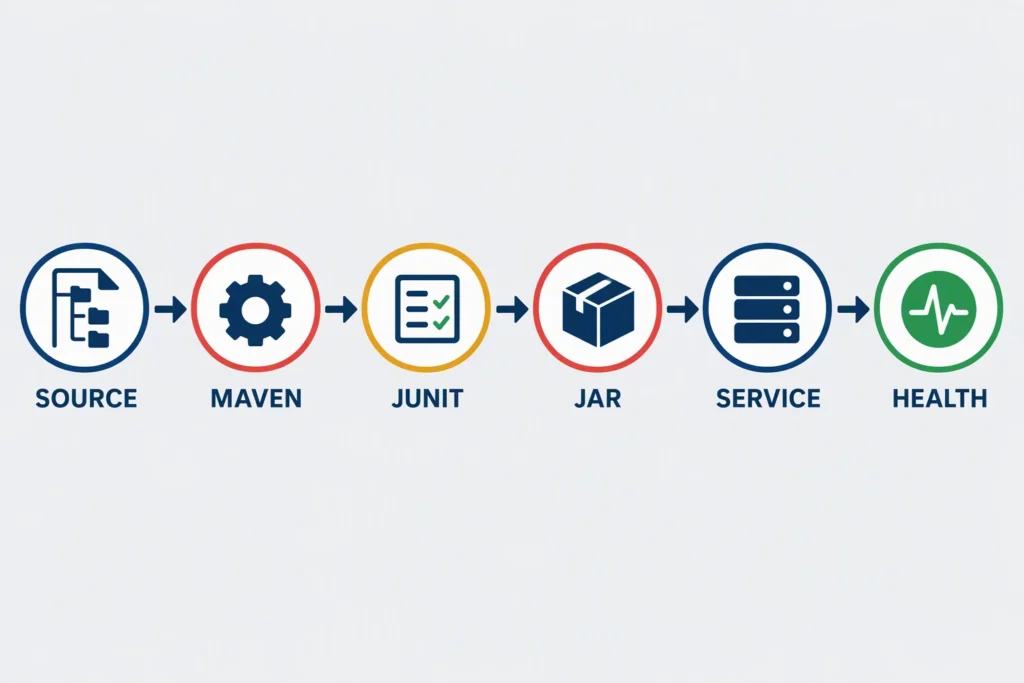
Check these links in the chain:
1. Source: the public branch contains the feature and no generated build output or secrets.
2. Dependencies: the build file declares required libraries and plugins without relying on an undocumented local setup.
3. Tests: JUnit tests cover named behaviors and fail for the intended reasons when a rule breaks.
4. Package: the documented Maven command creates the artifact the project claims to run.
5. Configuration: profiles, environment variables, or external property sources supply deployment-specific values safely.
6. Runtime: the application starts from a clean clone and exposes only the operational endpoint details you intend to publish.
Spring Boot Actuator can expose health and other management information, but endpoint availability and exposure depend on configuration. State exactly what you enabled and verified; do not imply that adding a dependency automatically creates production monitoring.
Show what your work achieved with these resume accomplishment examples, then adapt the wording to results you can verify.
Turn implementation work into strong bullets
Start with a delivered action, name the technical decision, and finish with a factual outcome. Numbers help when they come from a reproducible count or measurement; architectural clarity and verified behavior still matter when no honest metric exists.
| Weak wording | Stronger, defensible wording |
|---|---|
| Worked on REST APIs | Implemented four booking endpoints with request validation, consistent error responses, and controller integration tests. |
| Used JUnit for testing | Added JUnit tests for capacity limits, duplicate bookings, cancellation states, and repository rollback behavior. |
| Improved performance | Reduced the median response time in a documented 1,000-request local test from 180 ms to 112 ms after removing repeated queries. |
| Deployed a microservice | Packaged one Spring Boot service as an executable JAR and documented its database, environment, startup, and health-check steps. |
Call something a microservice only when you can explain its independent boundary, deployment, communication, and operational tradeoffs. Use “service” or “application” when that is more accurate.
Earned a relevant professional credential? See how to list certifications on a resume with clear details about the issuer and completion date.
Use a complete page as a consistency check
The following fictional example shows how the sections support one target without inflating the candidate’s scope.
Aarav Mehta
Pune, Maharashtra | aarav.mehta@example.com | github.com/aaravmehta | linkedin.com/in/aaravmehta
Summary
Junior backend developer who builds tested Java services with Spring Boot, PostgreSQL, Maven, and JUnit. Comfortable tracing REST requests through business rules, persistence, packaging, and documented runtime checks.
Technical Skills
Languages: Java, SQL
Frameworks: Spring Boot, Spring Web, Spring Data JPA
Testing: JUnit, Mockito, Spring Boot Test
Build and tools: Maven, Git, GitHub Actions, Docker
Projects
Workshop Booking API | Java, Spring Boot, PostgreSQL, Maven, JUnit
January 2026 – March 2026
- Built booking and cancellation workflows with capacity rules, duplicate-request protection, and consistent validation responses.
- Wrote unit tests for domain rules and integration tests for the controller-to-database path using isolated test data.
- Added a Maven CI workflow that compiled the project, ran tests, and packaged the executable JAR on pull requests.
Inventory Import Tool | Java, Maven, JUnit
October 2025 – December 2025
- Parsed supplier CSV files into validated inventory records and produced separate accepted and rejected outputs with row-level reasons.
- Added tests for duplicate identifiers, missing fields, malformed quantities, and partial-file failures; documented sample input and commands.
Experience
Software Engineering Intern, Northstar Labs, Pune, Maharashtra
May 2025 – July 2025
- Added input validation and structured error handling to an internal Java utility under mentor review.
- Reproduced three reported defects, added regression tests, and updated setup notes after testing a clean workstation install.
Education
Lakeside Institute of Technology, Pune, Maharashtra
Bachelor of Engineering in Computer Engineering
Expected May 2027 | CGPA: 8.4/10
Workshop Booking API
Stack: Java, Spring Boot, PostgreSQL, Maven, JUnit
January 2026 – March 2026
- Implemented validated booking and cancellation workflows.
- Tested domain rules and the controller-to-database path.
Starting your career in technology? Explore these resume objective examples for freshers to connect your skills with the role you want.
Verify every claim before sending
Clone the public repository into a clean directory and follow the README without relying on your IDE. Run the documented Maven command, inspect the test result, package the application, start it with safe sample configuration, and check the intended endpoint. Remove credentials, private data, internal URLs, and unsafe management exposure.
Then compare the resume with the repository: endpoint counts, test scope, Java version, framework modules, database, artifact type, dates, and performance figures must agree. Export a simple, selectable-text file and test every link.
Let the engineering path tell the story
A Java keyword can make a project relevant; connected evidence makes it credible. Show how a feature is structured, tested, packaged, configured, and observed at runtime, using only claims another person can verify.
Frequently Asked Questions
These answers cover versions, frameworks, and incomplete work.
Should I list the Java version?
List it when the posting, language features, build configuration, or runtime compatibility makes the version relevant. Make sure the repository and documented toolchain agree with the number.
Is Spring Boot required for a junior role?
No. Follow the posting. Strong core Java, object design, collections, exceptions, SQL, tests, and a complete runnable project may be more useful than a shallow framework list.
Can I include a project that is still in progress?
Yes, if you label its status and describe only completed behavior. Link to a stable branch or demo when possible, and state meaningful limitations rather than presenting planned features as delivered.