Not sure what to put on your bartender resume? Start with the
work you know: making drinks, helping guests, taking payments,
and keeping the bar ready for a busy shift.
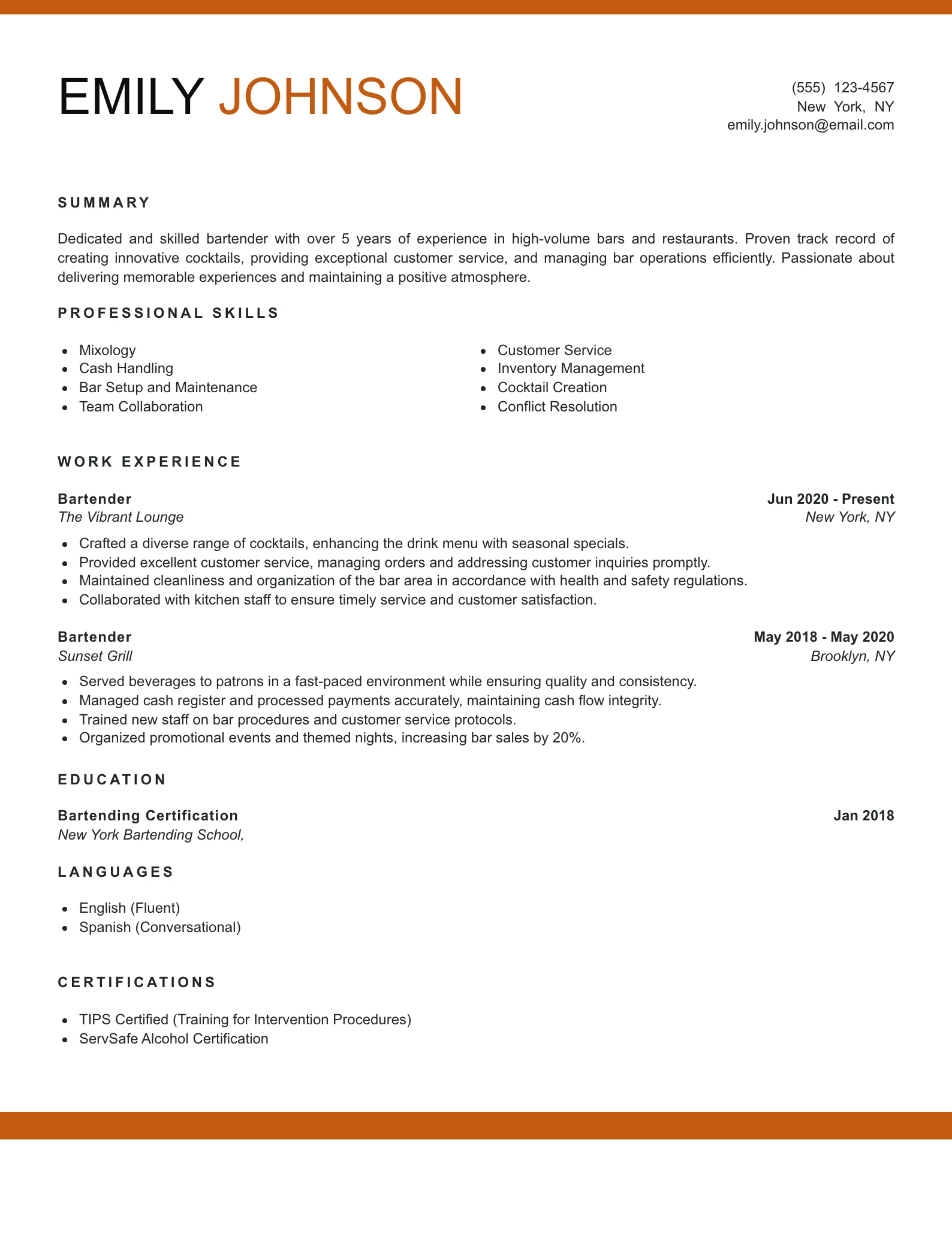
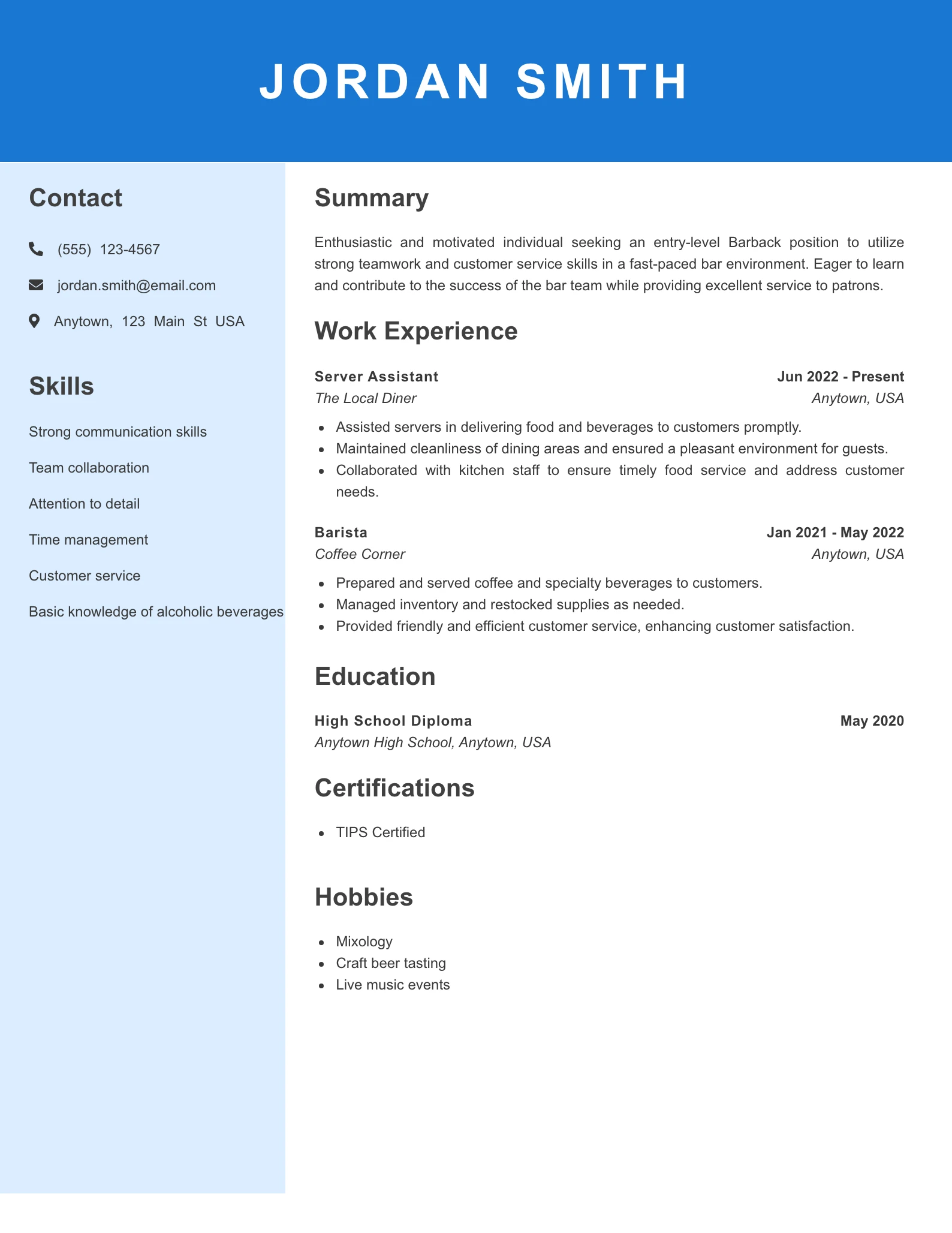
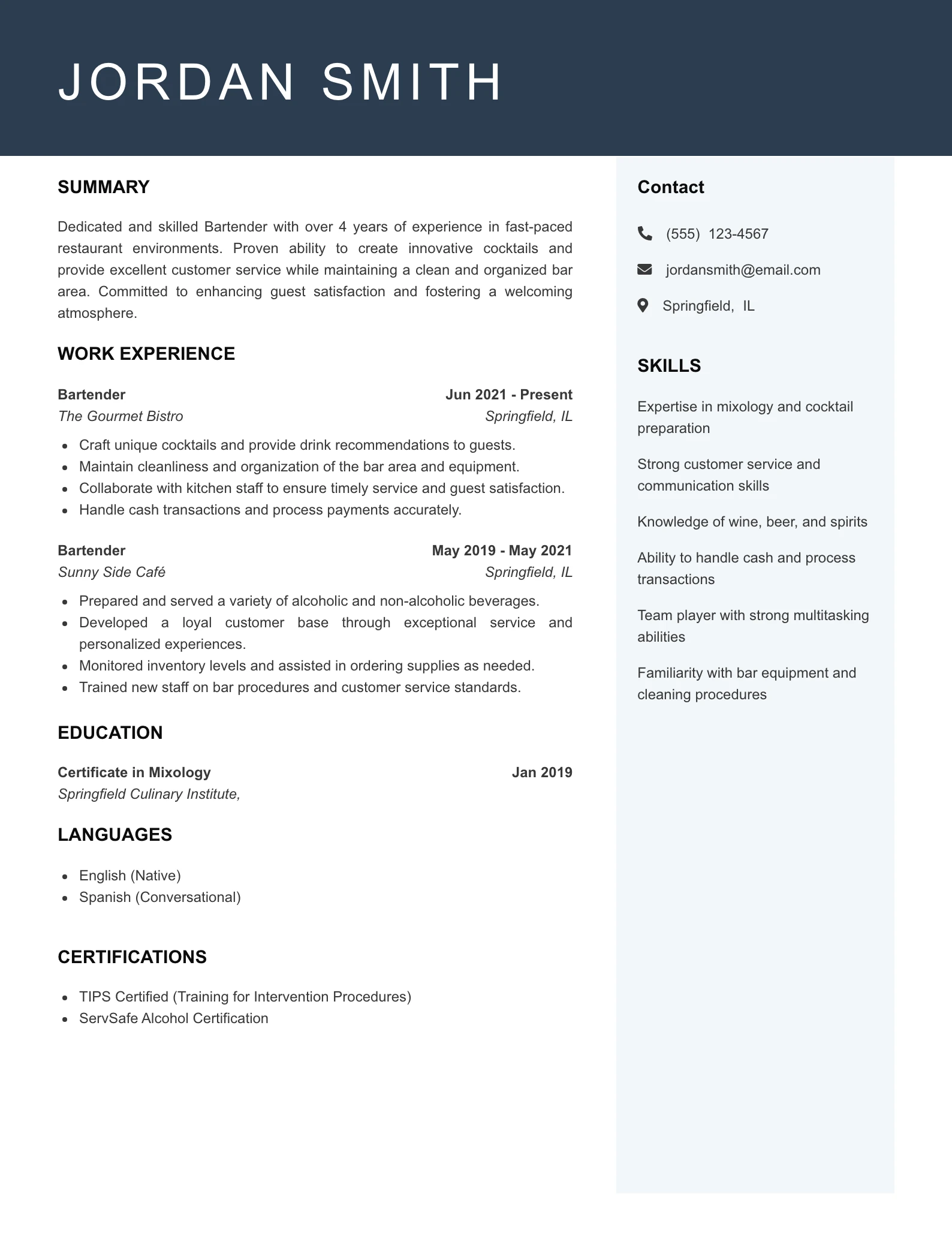
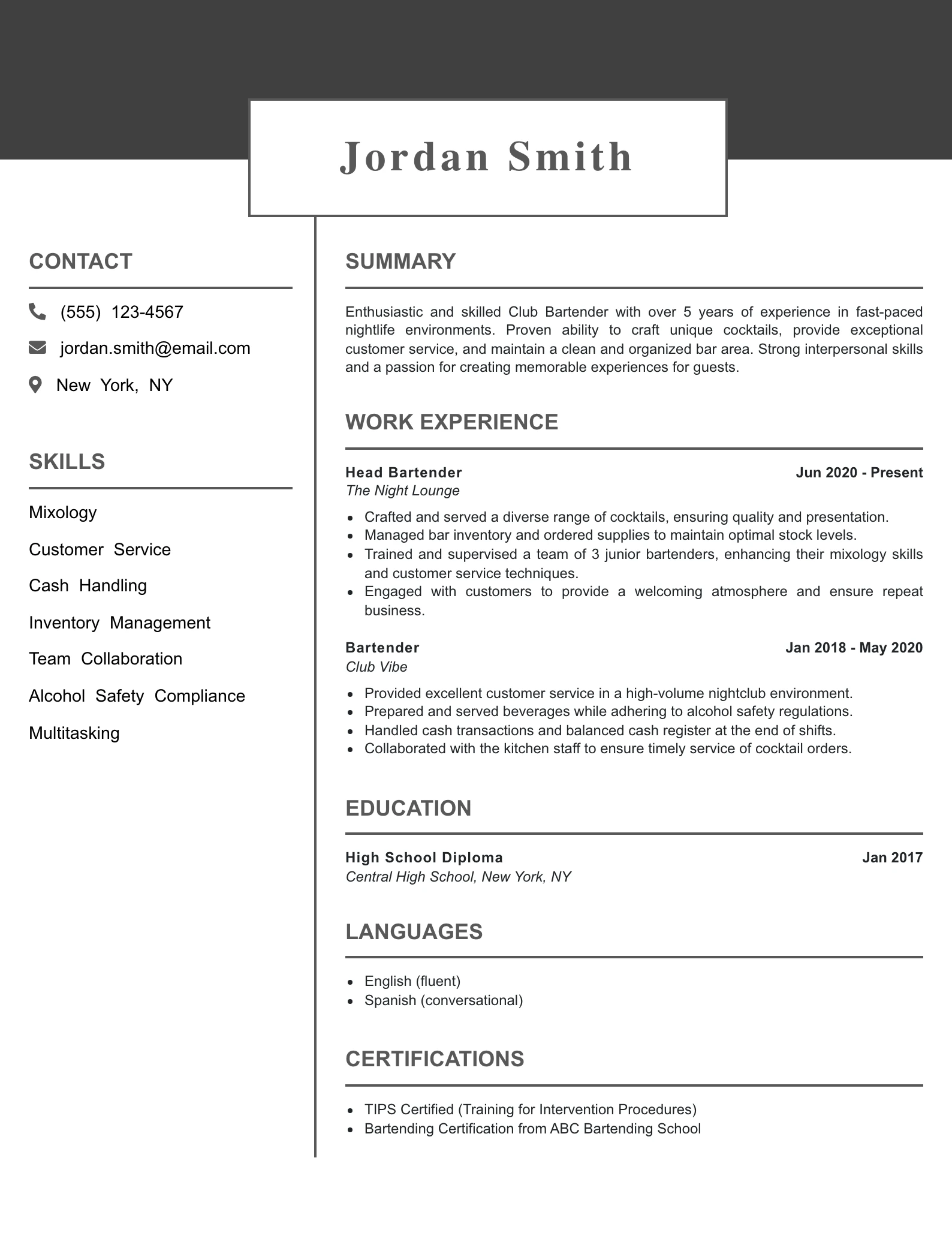
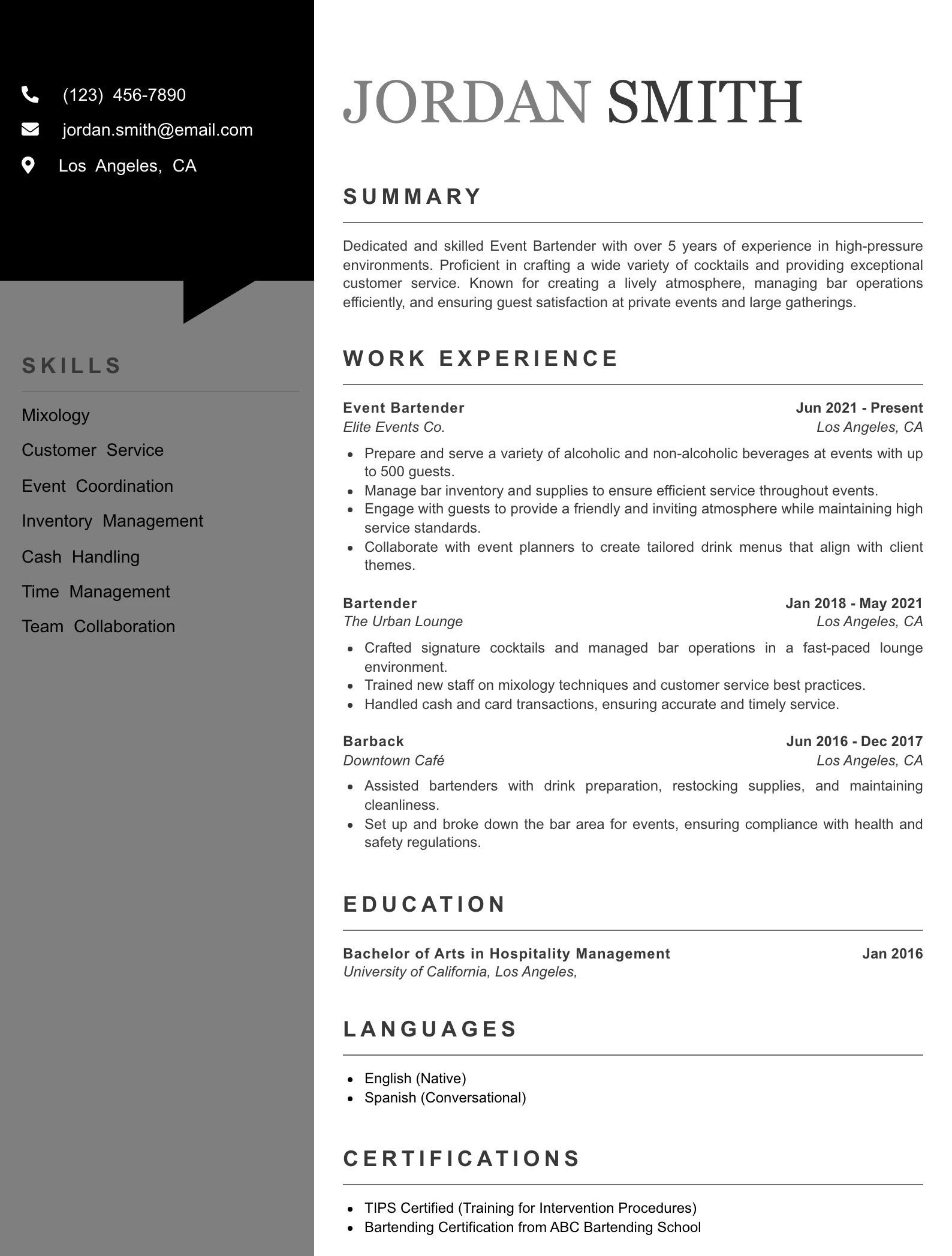
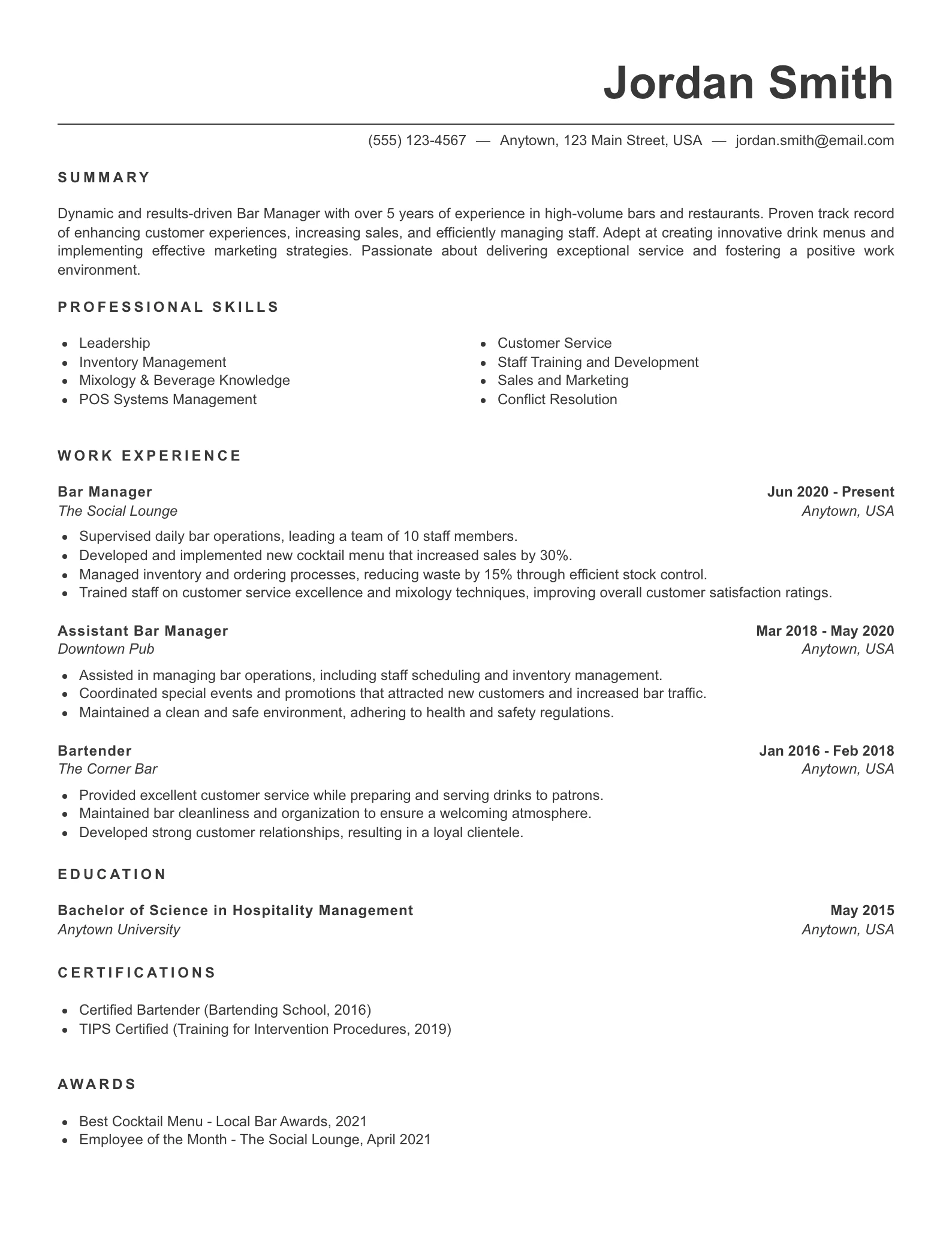
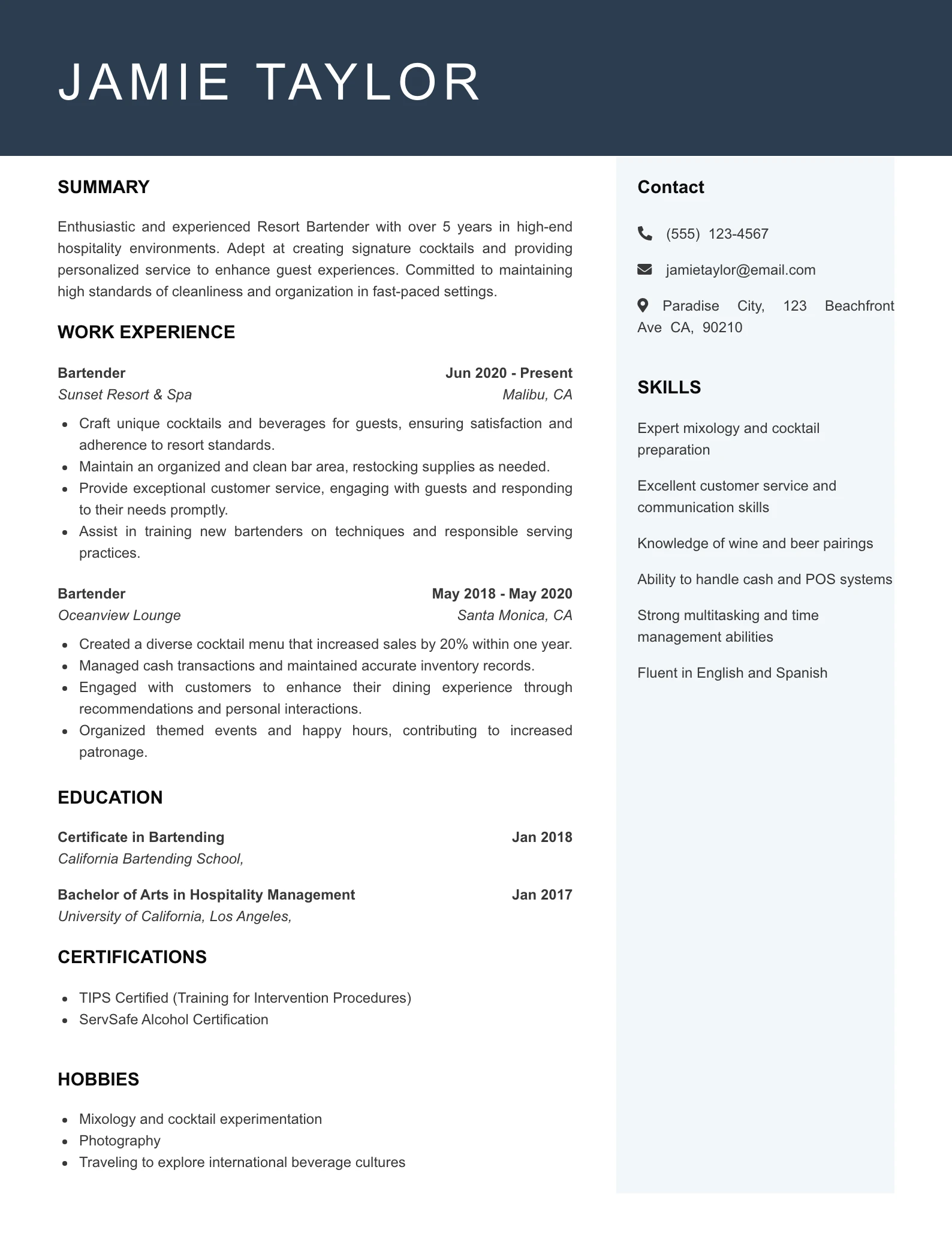
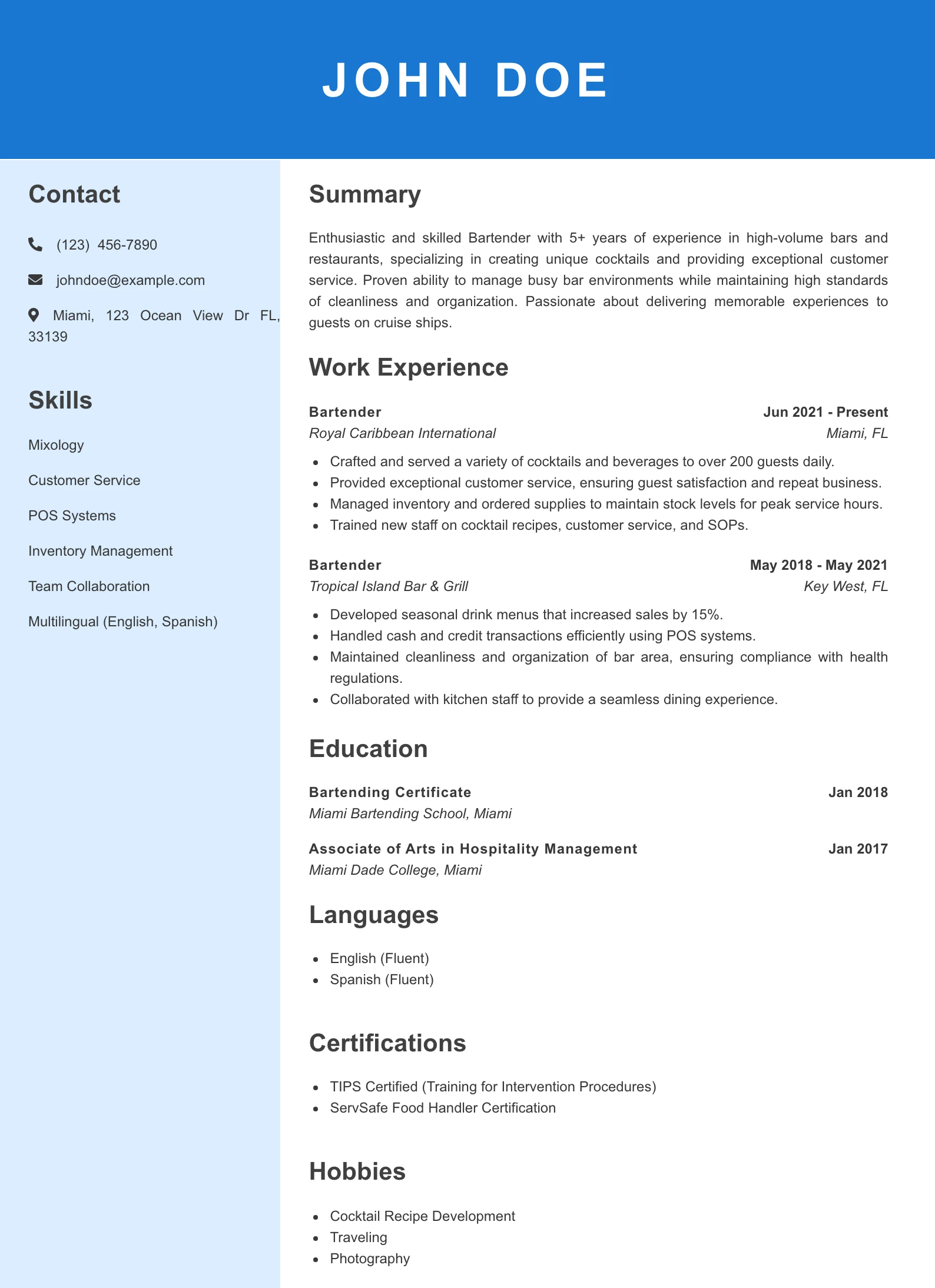
Below, you can choose from ten resume examples and view their
templates. You’ll also find help with describing your experience,
choosing your skills, and writing a short introduction—even
if you haven’t worked as a bartender before.
Start with the role closest to yours. Use its example for ideas, then add your own experience,
skills, and qualifications.
Pick a layout that gives your experience enough room.
Keep the text easy to read and follow any file instructions
in the job advertisement.
Bartender Job Description
A bartender prepares and serves drinks, takes orders,
and helps customers choose from the menu. They also
handle payments and keep the bar clean, stocked,
and ready for service.
Depending on the venue, their work may include:
Making cocktails and serving beer, wine,
and non-alcoholic drinks.
Answering questions about drinks and ingredients.
Taking payments, managing tabs, and closing the till.
Preparing garnishes and restocking bottles,
ice, and glassware.
Checking identification and following rules
for serving alcohol.
Working with servers and kitchen staff
to keep orders moving.
The setting changes the job. A restaurant bartender may prepare drinks for tables
as well as bar guests. An event bartender may set up
a temporary bar, while a bar manager may also handle
staff schedules, ordering, and training.
Bartender Resume Summary or Objective
A short introduction at the top of your resume helps an
employer understand your background. Keep it to two or
three sentences about what you can bring to the job.
Use a summary to introduce relevant
experience and skills.
Use an objective to explain the role
you want and the skills or training you bring when
moving into bartending.
Choose one. You don’t need both, and you can leave the
introduction out if it adds nothing useful.
How to Write a Bartender Resume Summary
Start with your role and experience. Add the type of
venue you know and a few details that fit the job.
These might include cocktail preparation, a payment
system you use, or experience training staff.
The examples below are starting points. Replace the years,
skills, systems, and qualifications with your own details.
Experienced Bartender
Bartender with five years of experience in busy bars
and restaurants. Skilled in preparing cocktails,
handling payments, and keeping the bar ready for service.
Also experienced in training new staff on house recipes
and closing routines.
Barback
Barback with two years of experience supporting a busy
restaurant bar. Keeps ice, glassware, bottles, and garnishes
ready throughout service. Experienced in setting up
stations, changing kegs, and helping bartenders close
the bar.
Restaurant Bartender
Restaurant bartender with four years of experience
serving bar guests and preparing drinks for tables.
Comfortable recommending wine and cocktails, taking
payments through Toast, and working with servers
to keep orders moving.
Club Bartender
Club bartender with four years of nightlife experience.
Prepares drinks, manages several orders at once, and
handles customer tabs during busy shifts. Works closely
with barbacks and security staff to support safe,
organized service.
Event Bartender
Event bartender with three years of experience at
weddings, private parties, and company events.
Sets up temporary bars, prepares drinks, and checks
supplies throughout service. Works with planners
to follow the menu and event schedule.
Bar Manager
Bar manager with seven years of hospitality experience,
including three years leading a team of eight.
Handles staff schedules, ordering, stock checks, and
training. Also experienced in planning seasonal menus
and reviewing sales with the owner.
Resort Bartender
Resort bartender with five years of experience in
poolside and restaurant bars. Prepares cocktails,
recommends drinks, and helps guests in English and
Spanish. Experienced in room-charge payments,
bar setup, and training seasonal staff.
Cruise Ship Bartender
Bartender with three years of onboard experience.
Prepares drinks, manages guest tabs, and keeps
supplies ready for busy service periods.
Comfortable working across different shipboard bars
and following onboard service procedures.
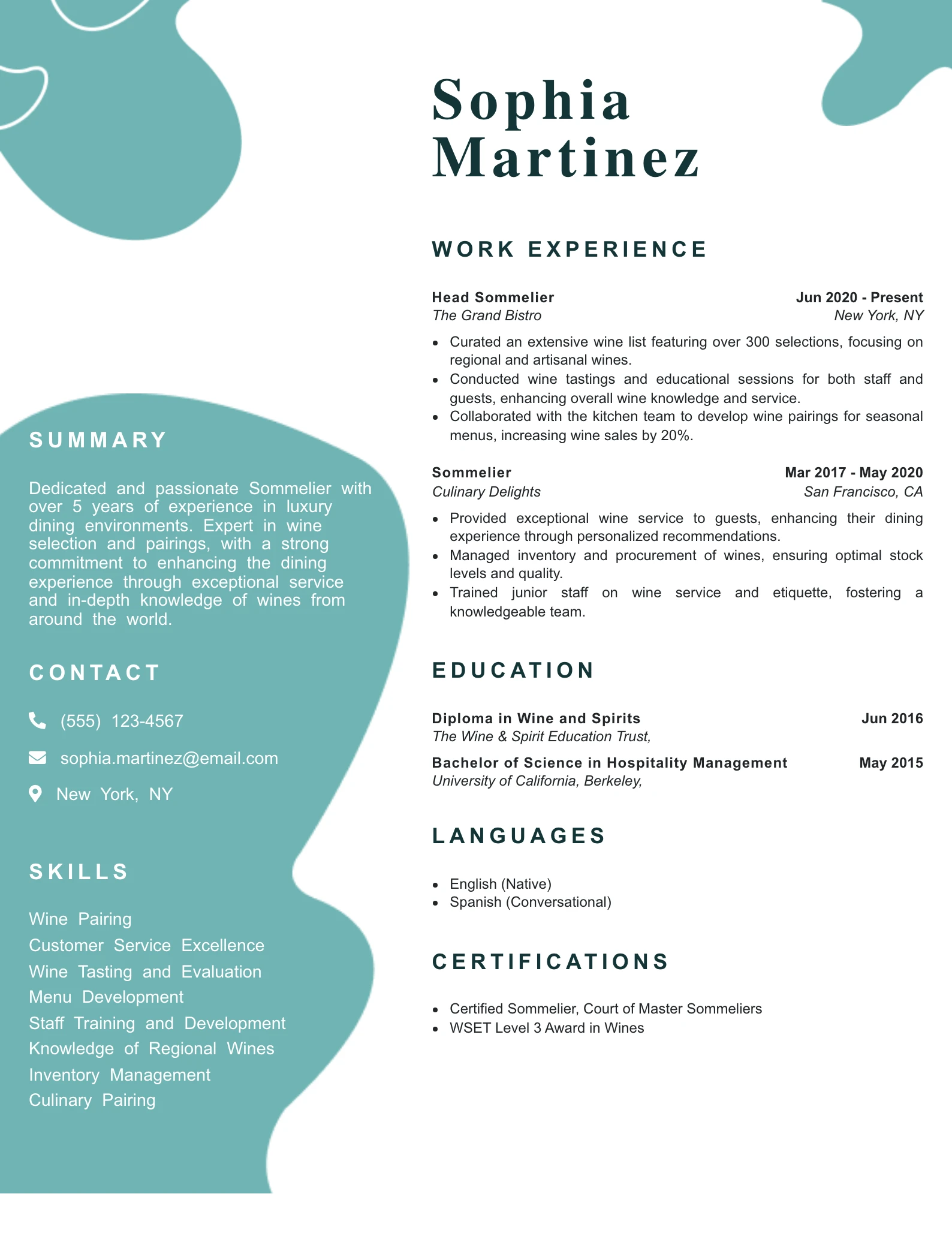
Sommelier
Sommelier with five years of fine-dining experience.
Helps guests choose wines, manages cellar stock,
and trains staff on wine service. Works with chefs
to recommend wines for seasonal dishes and tasting menus.
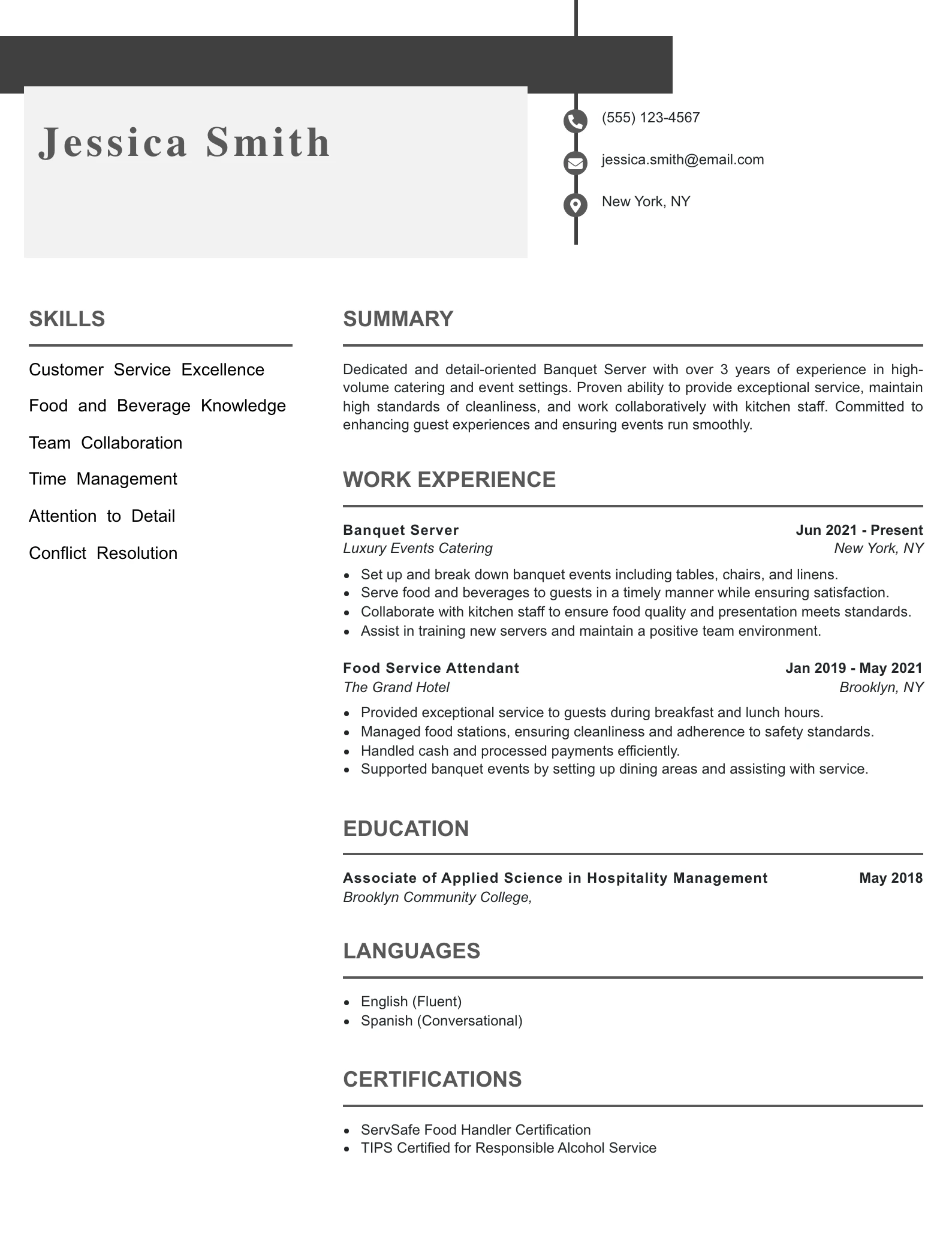
Banquet Server
Banquet server with three years of experience at
weddings and company events. Prepares dining areas,
serves food and drinks, and responds to guest requests.
Works with kitchen staff and event supervisors
to keep service on schedule.
Say which role you want and what you can already offer.
Draw on customer service work, barback experience,
volunteering, or training.
Avoid writing only “looking for an opportunity to grow.”
Give the employer a reason to consider you.
First Bartending Job
Seeking a first bartending role after completing
practical bartending training. Can prepare classic
cocktails, set up a bar station, and follow cleaning
routines. Ready to support an experienced bar team
and continue learning on the job.
Moving From Retail
Retail assistant seeking a bartender position.
Brings two years of experience helping customers,
handling cash and card payments, and checking stock,
along with recently completed bartending training.
Student or Part-Time Applicant
College student seeking a part-time barback role.
Brings customer service experience from campus events
and practice setting up and cleaning service areas.
Available for evening and weekend shifts.
Moving From Barback to Bartender
Barback seeking a bartender position after a year
supporting a busy restaurant bar. Experienced in
preparing garnishes, restocking stations, and closing
the bar. Has practiced house cocktail recipes
during supervised training.
Moving From Catering to Event Bartending
Catering assistant seeking an event bartender role.
Experienced in setting up service areas, helping guests,
and following event schedules. Recently completed
practical training in cocktail preparation and bar service.
Make sure your introduction agrees with the rest
of your resume.
Bartender Skills
Your skills section gives an employer a quick look at
what you can do. Choose skills that fit the job and
reflect your own experience.
The lists below give you options. You don’t need to
include everything or divide your own skills into
all these groups.
Making and Serving Drinks
Include the drinks you know how to prepare and the
service skills you have practiced. Be specific about
any special knowledge that matters to the job.
Preparing classic and house cocktails
Beer, wine, and spirits knowledge
Preparing garnishes, syrups, and mixers
Measuring pours and following recipes
Draft beer service and keg changes
Food and drink pairing
Creating seasonal drink menus
Example for Your Resume
Cocktail preparation, beer and wine knowledge,
garnish preparation, draft beer service,
and food and drink pairing.
Helping Guests and Working With Others
Bartending also involves explaining drinks, handling
requests, and working with a team. Choose skills
you can back up with examples from your work.
Explaining ingredients and recommending drinks
Handling complaints calmly
Checking identification and following service rules
Working with servers, barbacks, and kitchen staff
Keeping track of several orders
Training and supporting new staff
Helping guests in another language
Example for Your Resume
Drink recommendations, handling customer complaints,
team coordination, responsible alcohol service,
and conversational Spanish.
Keeping the Bar Running
Include your experience with payments, stock, equipment,
and daily routines. Name the ordering or payment system
you have used, such as Toast or Square.
Using ordering and payment systems
Opening tabs and splitting bills
Handling cash and checking the till
Counting stock and ordering supplies
Opening and closing the bar
Cleaning bar equipment
Setting up temporary bars for events
Example for Your Resume
Toast payment system, cash handling, managing tabs,
stock checks, bar setup, and opening and closing routines.
Skills for a Bar Manager
If you’re applying to manage a bar, include the skills
you use to organize the team and control supplies
and spending.
Planning staff shifts
Training and supervising staff
Working with suppliers
Ordering and checking stock
Tracking drink costs and waste
Reviewing sales and planning promotions
Example for Your Resume
Staff scheduling, team training, supplier ordering,
stock control, tracking drink costs, and reviewing sales.
Skills for Your First Bar Job
You may already have useful skills from retail,
serving, coffee shop work, or volunteering.
Include what you know without claiming experience
you haven’t had.
Helping customers and answering questions
Taking cash and card payments
Restocking supplies
Keeping work areas and equipment clean
Following instructions and checklists
Working with others during busy periods
Example for Your Resume
Customer service, cash handling, restocking supplies,
cleaning work areas, teamwork, and following
opening and closing checklists.
Support Your Skills With Experience
Your work history should help explain your skills.
If you list staff training, for example, you could
include this under the relevant job:
Experience Example
Trained two new bartenders on house recipes,
the payment system, and the closing routine.
Keep your list relevant. A cocktail bar may need drink-making knowledge,
while a management role may focus on training
and stock control. Put the skills that matter
most to the job first.
Before sending your resume, compare your skills with
the advertisement. Our guide to choosing words that match the job explains how to use the employer’s wording accurately.
Resume With No Experience
Applying for your first bartending job? This example
shows how to build a resume without paid work experience.
It uses education, volunteering, and school activities
to show what the applicant can already do.
This is a fictional example. Replace the names,
activities, dates, and skills with your own.
You can also select the resume text to copy it manually.
Alex Morgan
Entry-Level Bartender Applicant
Chicago, IL | (202) 555-0142 | alex.morgan@example.com
Objective
Seeking a first bartending role with experience
helping at community events and school fundraisers.
Brings practice preparing refreshment stations,
taking orders, handling cash, and cleaning service
areas. Ready to learn the venue’s drinks menu
and bar routines.
Skills
Greeting guests and answering questions
Taking orders and handling cash
Preparing and restocking refreshment stations
Cleaning service areas and equipment
Following instructions and working with a team
Volunteer Experience
Refreshment Volunteer — Riverside Community Center Chicago, IL | March–June 2026
Set up cups, water, juice, and other supplies
before community events.
Served non-alcoholic refreshments and answered
visitors’ questions.
Checked supplies during events and restocked
the serving area.
Cleaned tables and helped pack away equipment
with other volunteers.
School Activities
Fundraiser Team Member — Riverside High School Chicago, IL | September 2025–May 2026
Helped run a snack and drinks stall
at school fundraising events.
Took orders, accepted cash, and returned
change using the stall’s price list.
Helped count remaining supplies and
clear the stall after each event.
Education
High School Diploma Riverside High School, Chicago, IL Completed June 2026
Relevant coursework: Food Preparation;
Business Fundamentals
It gives the employer something concrete. Taking orders, handling cash, and keeping supplies
ready are useful experiences to describe.
It makes the setting clear. The applicant labels volunteering and school
activities accurately.
It leaves room to learn. The resume doesn’t claim cocktail-making
or alcohol-service experience the applicant
hasn’t gained.
What Should You Change?
Use your own activities, even if they look different
from this example. You might have helped at a sports
club, organized a school event, or completed practical
training. Describe your part and what you did.
Add relevant certificates or permits if you hold them.
If a course is still underway, label it as in progress.
Check the requirements for the role and location
before applying.
Already worked in a restaurant, shop, or café?
Use that work on your resume. The entry-level barback example shows how previous service jobs can support
a move into bar work.
Education and Certifications
Use this part of your resume to show your education,
relevant training, and any certificates or permits
you hold. Keep the details clear so an employer can
see what you have completed.
What to Put Under Education
List your qualification and the school or college.
If you’re still studying, show the expected completion
date. For a recent qualification, you can include
the year you finished.
Your education doesn’t have to be in hospitality.
List the qualification you actually hold.
High School Example
High School Diploma [School Name], [City, State] Completed [Year]
If you’re new to work, you can add relevant classes
or school activities. Choose details that connect
with the job, such as food preparation, customer
service, or helping run events.
How to Include Bartending Training
Completed a bartending or cocktail course? List its
name, the training provider, and when you finished.
You can add a short line about practical work
you completed.
A current alcohol-service permit relevant
to where you will work.
Food-handler training that is relevant to the role.
Wine or spirits qualifications for a wine-focused job.
Use the exact name shown on your document.
Add the issuing organization, completion date,
and expiry date where relevant.
Certification Example
[Exact Certificate or Permit Name] [Issuing Organization] Issued: [Month Year] Expires: [Month Year, if applicable]
A training certificate and a permit
are different things. Don’t describe a course as a license to work.
Check the employer’s instructions and the local
alcohol authority’s requirements before choosing
training.
What if You’re Still Taking the Course?
Label it as in progress and add an expected completion
date if you have one. Don’t list yourself as certified
before you have earned the qualification.
If your work experience is your strongest qualification,
place Education and Certifications after it.
If you’re applying for your first job, relevant
training may deserve a higher position.
Make any qualification specifically requested by
the employer easy to find. You can give it a separate
Certifications heading rather than burying it
in a paragraph.
Replace the brackets in these examples with your own
details. Remove any line that doesn’t apply.
Resume Format For Bar Tender
Put the details that show your fit for the bar near
the top. Someone hiring for a cocktail bar should
quickly find your cocktail experience. Someone hiring
a lead bartender should quickly find your training
and team responsibilities.
Choose the Order That Fits Your Background
Already a bartender? Contact details → Summary → Bar experience →
Skills → Certifications → Education
Applying for your first bar job? Contact details → Objective → Relevant training
and skills → Other work or volunteering → Education
Applying for a lead or manager role? Contact details → Summary → Experience leading
staff and running a bar → Skills →
Certifications → Education
These are starting points. If the advertisement
asks for a particular alcohol-service qualification,
make it easy to find. You could mention its exact
name in your introduction and give the dates
in Certifications.
Make the Type of Bar Clear
An employer may not recognize your previous venue’s
name. Add a short description when it helps explain
your experience, such as “restaurant bar,”
“live-music venue,” or “hotel lobby bar.”
Arrange Each Job Like This
Bartender — [Venue Name] [City, State] | [Month Year–Month Year] Restaurant bar serving bar guests and dining tables
Follow that with your experience points. You don’t
need a separate paragraph describing the business.
One useful line can give the reader enough context.
Group Event Work Without Making It Look Like Many Jobs
Worked at different weddings or private parties
through one catering company? List the catering
company as your employer. You don’t need a separate
job entry for every event.
Employed by a Catering Company
Event Bartender — [Catering Company] [City, State] | [Month Year–Month Year] Weddings, private parties, and company events
If you worked independently, label it clearly.
Use “Self-Employed Event Bartender” only if that
describes your arrangement.
Give Different Jobs Different Details
If you’ve worked at several bars, repeating
“prepared drinks and helped customers” under
every job uses space without showing much more.
Restaurant role: Show table drink orders, wine recommendations,
and work with servers.
Club role: Show busy service, tabs, and coordination
with barbacks or security.
Event role: Show setup, event menus, and packing away.
Lead role: Show training, stock checks, shift planning,
and the responsibilities you took on.
Before making the text smaller, remove anything
that doesn’t help explain your fit. A long list
of cocktail names, repeated customer service claims,
or a paragraph about your passion for hospitality
can crowd out useful experience.
Keep specific details such as the payment system
you used, the staff you trained, or the type of
bar you worked in. If your availability matches
shifts mentioned in the advertisement, a short
line such as “Available evenings and weekends”
may also be useful—provided it is accurate.
Yes. Include work that helps explain what you can
bring to a bar. Retail work can show payment handling
and stock checks. Serving and coffee shop work can
show customer service, drink preparation, and teamwork.
Keep your actual job title and describe the relevant
work. Don’t rename a previous job to make it sound
like a bartending role.
What if I don’t know my sales figures?
Describe the work clearly without inventing a number.
You could name the payment system you used, explain
the closing tasks you handled, or describe how you
helped train new staff.
If you know a figure, make its meaning clear.
Guests attending an event are not necessarily
guests you personally served.
How do I list a job where I was both a server and bartender?
Use your official title. If the title doesn’t explain
the combined work, add a short description beneath it,
such as “Combined table service and bar shifts.”
Include experience from both parts of the job:
taking table orders, preparing drinks, managing tabs,
and working with kitchen staff.
How should I show seasonal or short-term bar jobs?
Include the employer and accurate dates. Add
“Seasonal” or “Temporary” when that describes the
arrangement, so the short duration makes sense.
If a staffing agency employed you for several events,
list the agency and describe the assignments underneath.
Avoid presenting each event as a separate employer.
Should I list the cocktails I can make?
A long recipe list can take space away from your
experience. Describe the range of drinks you know
instead, and name particular drinks or techniques
when the advertisement asks for them.
If you created a menu, explain your contribution.
Include a link to a public menu or portfolio only
when you can share it and it helps show your work.
Do I need references on my bartender resume?
Leave references off unless the employer asks for
them on the resume. You can provide a separate list
when requested, after asking those people for permission.
You can also leave out “References available upon
request” and use that space for relevant experience.
Should I add a photo?
For a standard U.S. bartender resume, you can leave
the photo out and use the space for your experience,
skills, and qualifications. A template preview
doesn’t mean you need to include a photograph.
If you’re applying elsewhere, check the employer’s
instructions and local application practices.
Should I send a cover letter too?
Send one if the employer requests it. When it is
optional, a short letter can help explain a career
change or why your experience fits that particular bar.
Mention something relevant to the venue and one
or two details from your background. Avoid repeating
your whole resume.
How useful was this post?
Click on a star to rate it!
Average rating 4.9 / 5. Vote count: 72
Be the first to rate this post.
We are sorry that this post was not useful for you!
Sergio Barnett is a seasoned resume writer and career strategist with over 10 years of experience helping job seekers craft compelling resumes and cover letters. As a Certified Professional Resume Writer (CPRW), Sergio specializes in tailoring career documents for blue-collar and healthcare professionals, ensuring ATS compliance and recruiter appeal.


 Build Your Resume
 Build Your Resume
 Build Your Resume
 Build Your Resume
 Build Your Resume
 Build Your Resume
 Build Your Resume
 Build Your Resume
 Build Your Resume
 Build Your Resume