
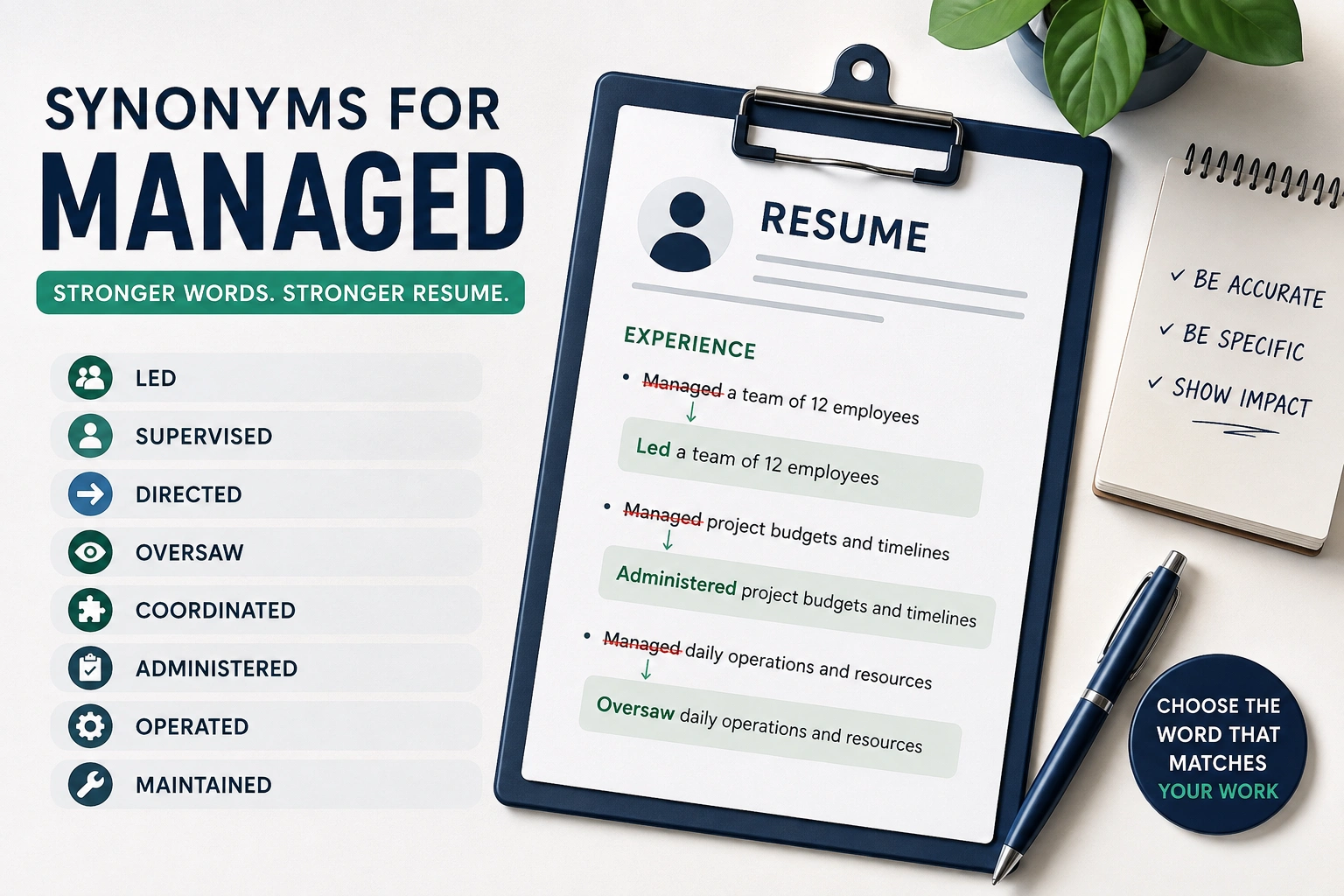
“Managed” is a useful resume word, but it can be too broad. It does not explain whether you were responsible for employees, a project, a budget, a schedule, or daily operations.
Good alternatives include led, supervised, directed, oversaw, coordinated, administered, operated, and maintained. The best choice depends on what you actually did. If you need to replace a different word, explore our complete resume synonyms guide.
Find the Right Synonym for What You Managed
“Managed” can describe responsibility for people, projects, money or daily work. Choose the situation closest to yours to find words that accurately explain what you did.
01 People and teams I managed employees or a team Supervised Led Directed Oversaw
Choose according to the level of responsibility you held.
- Supervised — you monitored employees and their daily work.
- Led — you guided a team toward a shared goal.
- Directed — you set priorities or made higher-level decisions.
- Oversaw — you remained accountable without completing every task yourself.
Resume example Supervised 12 retail associates across two shifts and prepared weekly performance reports.
02 Projects I managed a project Led Coordinated Oversaw
Select the word that reflects how you contributed to the project.
- Led — you were responsible for moving the project toward its goal.
- Coordinated — you organized people, deadlines and activities.
- Oversaw — you monitored progress and remained accountable for the outcome.
Resume example Coordinated a website redesign across marketing, design and development teams, completing the launch two weeks early.
03 Money and resources I managed a budget or funds Administered Controlled Allocated Monitored
Your authority over the money determines the correct word.
- Administered — you handled the budget according to an established plan.
- Controlled — you had authority over spending.
- Allocated — you decided where money or resources would be used.
- Monitored — you tracked spending without necessarily controlling it.
Resume example Administered a $450,000 annual department budget and reviewed monthly spending against forecasts.
04 Schedules and events I managed schedules or events Coordinated Scheduled Organized Arranged
Use the word that describes the part of the planning you handled.
- Coordinated — you brought people, times and activities together.
- Scheduled — you assigned specific dates or times.
- Organized — you planned the different parts of an activity or event.
- Arranged — you handled practical details such as meetings, appointments or travel.
Resume example Coordinated interview schedules for 20 candidates and six hiring managers.
05 Daily operations I managed daily operations Oversaw Operated Administered Maintained
Choose based on whether you directed, ran or maintained the work.
- Oversaw — you were accountable for the overall operation.
- Operated — you directly ran a system, facility or service.
- Administered — you handled a formal program or established process.
- Maintained — you kept something working correctly over time.
Resume example Oversaw daily front-desk operations across two clinic locations.
06 Clients and accounts I managed clients or accounts Maintained Supported Advised Oversaw
Select the word that reflects the service or responsibility you provided.
- Maintained — you handled ongoing client relationships or account records.
- Supported — you helped clients complete tasks or resolve needs.
- Advised — you provided professional recommendations.
- Oversaw — you were responsible for a group or portfolio of accounts.
Resume example Maintained a portfolio of 45 business accounts and coordinated contract renewals.
These examples are models, not statements to copy unchanged. Replace the numbers, responsibilities and results with details from your own work.
Compare the Closest Alternatives to “Managed”
These words differ in authority and type of responsibility. Check what each word tells the employer before adding it to your resume.
| Word | What it tells the employer | Best used for | Do not use it when |
|---|---|---|---|
| Led | You guided people or a project and helped move the work toward its goal. | Teams, projects, initiatives and change. | You only participated or completed assigned tasks. |
| Supervised | You directly monitored people, work quality or daily performance. | Employees, shifts, trainees and frontline teams. | You had no responsibility for another person’s work. |
| Directed | You set priorities, gave instructions or made important decisions. | Departments, strategies, campaigns and complex programs. | You followed a plan created by someone else. |
| Oversaw | You monitored the work and remained accountable for its quality or outcome. | Operations, compliance, vendors, projects and portfolios. | You contributed to the work but were not responsible for it. |
| Coordinated | You brought people, schedules or resources together. | Events, calendars, logistics and cross-team work. | You need to show that you made the final decisions. It may understate your authority. |
| Administered | You handled a formal process or resource according to established rules. | Budgets, programs, benefits, contracts and records. | The work was informal or mainly involved teamwork. |
| Operated | You directly ran a system, facility, machine or service. | Equipment, software systems, facilities and daily services. | You only monitored the people who performed the work. |
| Maintained | You kept something accurate, functional or in good condition over time. | Accounts, records, equipment, systems and relationships. | You created, launched or completely changed something. |
Before-and-After Examples of Replacing “Managed”
Open the situation closest to your work. Each card explains which word fits, why it fits and how it can improve the complete resume statement.
01 Employees Managing a team Managed → Supervised
Managed a team of customer service representatives.
Supervised 14 customer service representatives across two shifts, reviewed weekly quality scores and coached staff on recurring call issues.
Why it works: “Supervised” shows direct responsibility for employees. The revision also explains the team size and the work involved.
02 Projects Managing an implementation Managed → Coordinated
Managed the implementation of a new CRM system.
Coordinated CRM implementation across sales, support and IT, migrating 18,000 customer records without interrupting daily service.
Why it works: “Coordinated” shows that different teams and activities had to be brought together.
03 Budgets Managing department funds Managed → Administered
Managed the department budget.
Administered a $750,000 annual operations budget and reconciled monthly spending against departmental forecasts.
Why it works: “Administered” describes formal control of a budget. The amount shows the scale of the responsibility.
04 Schedules Managing staff coverage Managed → Coordinated
Managed employee schedules.
Coordinated weekly schedules for 35 nurses across three units, resolving coverage gaps before shifts began.
Why it works: “Coordinated” describes matching employees with times and locations while addressing coverage needs.
05 Operations Managing daily work Managed → Oversaw
Managed daily warehouse operations.
Oversaw daily warehouse operations for a 60-person shift, monitoring order accuracy, staffing coverage and safety checks.
Why it works: “Oversaw” signals responsibility for the wider operation rather than one individual warehouse task.
06 Clients Managing business accounts Managed → Maintained
Managed several client accounts.
Maintained a portfolio of 40 business accounts and coordinated renewals representing $1.2 million in annual contracts.
Why it works: “Maintained” communicates ongoing responsibility for the relationships. The revision adds account volume and value.
07 Systems Managing a work system Managed → Operated
Managed the inventory control system.
Operated the inventory control system across four distribution centers and corrected stock discrepancies before monthly close.
Why it works: “Operated” shows direct responsibility for using the system. The revision explains its reach and purpose.
08 Problems Managing customer complaints Managed → Resolved
Managed customer complaints.
Resolved an average of 25 escalated customer complaints per week, documented outcomes and identified recurring service issues.
Why it works: “Resolved” explains the outcome of handling the complaints instead of simply stating responsibility for them.
When “Managed” Is Still the Right Word
“Managed” is not a weak word. Keep it when it accurately describes broad responsibility and the rest of the sentence explains the scale or result of your work.
Keep “managed” when
- You had broad responsibility Your role covered several people, resources or activities, and no narrower word describes all of them.
- The sentence already provides useful detail It explains the team size, budget, location, result or scope of your responsibility.
- The word has not become repetitive One or two accurate uses are not a problem when nearby statements begin differently.
- The employer uses the same language The job posting uses “manage” or “management,” and the term honestly matches your experience.
Choose another word when
- A more precise word is available “Supervised,” “coordinated” or “administered” explains the responsibility more clearly.
- The sentence remains vague Phrases such as “managed tasks” or “managed various duties” do not tell the employer what you did.
- Several nearby statements repeat it Repeatedly beginning statements with “managed” makes different responsibilities sound the same.
- The word makes your role unclear The reader cannot tell whether you led people, controlled money, organized schedules or operated a system.
Managed a $1.2 million operating budget across four regional offices, reducing annual vendor costs by 9%.
Job-description wording also matters. If “manage” truthfully matches your experience, you do not need to remove it merely for variety. Learn how to select and place resume keywords without forcing them into your writing.
Common Mistakes When Replacing “Managed”
A different word does not automatically make a resume statement better. The replacement must describe the responsibility you actually held.
Making your role sound more senior
Directed the project.
Maintained project documentation and prepared weekly status updates for the project manager.
Why: “Directed” means you set the project’s direction. Do not use it when you supported someone who held the main responsibility.
Using a result word as a direct synonym
Improved the inventory process.
Operated the inventory tracking system and reconciled stock discrepancies before monthly close.
Why: “Improved” describes a positive change. It should replace “managed” only when you can explain what became better.
Forcing an impressive-sounding word
Spearheaded weekly staff schedules.
Coordinated weekly schedules for 28 employees across morning and evening shifts.
Why: “Spearheaded” means you initiated or strongly drove something. Routine scheduling is more clearly described by “coordinated.”
Changing the word but keeping the sentence vague
Oversaw various administrative tasks.
Coordinated vendor appointments, updated purchase orders and tracked delivery dates.
Why: Replacing “managed” with “oversaw” does not help when the reader still cannot tell what the tasks were.
Check the replacement before using it
- Does the word match the responsibility you actually held?
- Does it explain the work more clearly than “managed”?
- Could you comfortably explain the wording during an interview?
Manage, Managed, Managing or Management?
The correct form depends on where the wording appears and whether the work is current, completed or being described as a skill.
Use it for: Responsibilities you continue to perform in your current position.
Manage daily schedules for 18 field technicians and coordinate emergency coverage.
Use it for: A previous job, completed project or responsibility you no longer perform.
Managed a $500,000 project budget and completed the rollout within the approved spending limit.
Use it for: Sentences that describe ongoing experience, usually after words such as “experience” or “skilled in.”
Five years of experience managing regional sales teams across three states.
Use it for: A skill, professional field or area of responsibility. It should not normally begin a resume bullet.
Core skills: Project management, budget administration and vendor coordination.
Your current job can use both present and past tense
Use present tense for work you perform regularly. Use past tense for a completed project or achievement, even when it happened in your current position.
Manage weekly schedules for a 20-person maintenance team.
Coordinated a scheduling-system migration completed two weeks ahead of plan.
Frequently Asked Questions About “Managed” on a Resume
These answers address common concerns about repetition, accuracy, management experience and choosing the right replacement.
01 Is “managed” a weak word on a resume?
No. “Managed” is useful when it accurately describes broad responsibility. It becomes weak when the sentence does not explain what you managed, how much responsibility you held or what happened because of your work.
If the word appears repeatedly, compare more precise alternatives in our resume synonyms directory .
02 Is “led” better than “managed” on a resume?
Neither word is automatically better. Use “led” when you guided people or moved a project toward a goal. Use “managed” when you held broader, ongoing responsibility for people, money, operations or resources.
Choose according to the work—not according to which word sounds more senior.
03 Can I say I managed a team if I supervised interns or only one employee?
Yes, if you had genuine responsibility for assigning work, monitoring performance, giving feedback or approving decisions. State the size and type of team clearly rather than making the role sound larger.
If you only worked alongside them, use “collaborated with,” “supported” or “coordinated with” instead.
04 How many times can I use “managed” on my resume?
There is no fixed limit. Repetition becomes noticeable when several nearby statements begin with “managed” or when the word describes very different responsibilities.
Keep it where it is accurate. Replace other uses with words such as “supervised,” “coordinated,” “administered” or “maintained” when those words explain the work more precisely.
05 Do I need to add numbers after saying I managed something?
Numbers are helpful, but they are not required in every statement. Use accurate figures when they explain team size, budget, workload, frequency, revenue or results.
If you do not have reliable numbers, describe the scope in another truthful way—for example, “across three locations,” “during the annual enrollment period” or “for enterprise clients.” Never invent a number merely to make the statement appear stronger.
06 What should I write instead of “managed Microsoft Office tasks”?
Name the application and the work you completed with it. “Managed Microsoft Office tasks” does not show whether you created documents, analyzed data, prepared presentations or coordinated calendars.
Review our Microsoft skills for a resume to find specific Word, Excel, PowerPoint, Outlook and Teams skills that match your experience.
07 How can I check whether my management wording works in a complete resume?
Read the full work-experience section rather than judging one word alone. Check whether each statement explains a different responsibility and whether the most relevant work appears first.
You can compare your wording with role-specific resume examples and then place your content in one of our resume templates . Choose the content first; the template should organize it, not compensate for vague writing.
08 Is “managed” an action verb or a resume adjective?
At the beginning of a resume statement, “managed” is normally a past-tense action verb. It tells the reader what you did.
A resume adjective describes a quality, such as “analytical,” “organized” or “adaptable.” Adjectives and action verbs perform different jobs in a sentence. Read our resume adjectives guide to see how descriptive words can be used without relying on empty claims.