

These ten questions come up in almost every IT project manager interview. For each one, you get a full sample answer first, then a short breakdown of why it works.
Go through them one by one, or turn to the questions that scare you. Borrow each sample’s structure, but use your own projects — interviewers spot borrowed stories fast.
Key Takeaways
- Match the method to the project, not the fashion. Stable requirements suit a fixed plan; changing ones suit short cycles.
- Decide changes on paper, not in hallways. Every change gets its cost, its approver, and its place in the plan.
- Security and testing start early, not at the end. Late checks find problems too late to fix cheaply.
- Done means running well in users’ hands. Launch day is the middle of the story, not the end.
Learn From the Answer, Not Just the Words
Each question below hands you a complete sample answer first, told start to finish in the first person. Under it, a short breakdown names what makes it strong. Study both, then rebuild the answer from your own experience.
1. Tell Me About an IT Project You Managed From Initiation Through Transition
Hear a strong answer:
“I managed the replacement of our company’s aging email system for 400 staff. At initiation I wrote a one-page charter: why now, what success looked like, and what was out of scope. Planning took three weeks — I mapped every department’s needs, picked the new platform with IT security in the room, and set a phased rollout by department instead of a big-bang switch. During execution I ran a weekly thirty-minute review and kept a visible risk list. The finance department’s custom reports broke during their phase, so we paused, fixed the reports with the vendor, then continued. At transition I handed support a runbook and trained two support staff before closing the project. Email downtime across the whole migration was under two hours total.”
Why it works: the answer walks the full life cycle — charter, plan, execution, transition — with one concrete detail per phase. The finance-department pause shows judgment under pressure, and the runbook handoff proves the project truly ended.
Present your leadership experience with this technical project manager resume guide.
2. How Do You Choose Between Agile, Waterfall, and a Hybrid Approach?
Hear a strong answer:
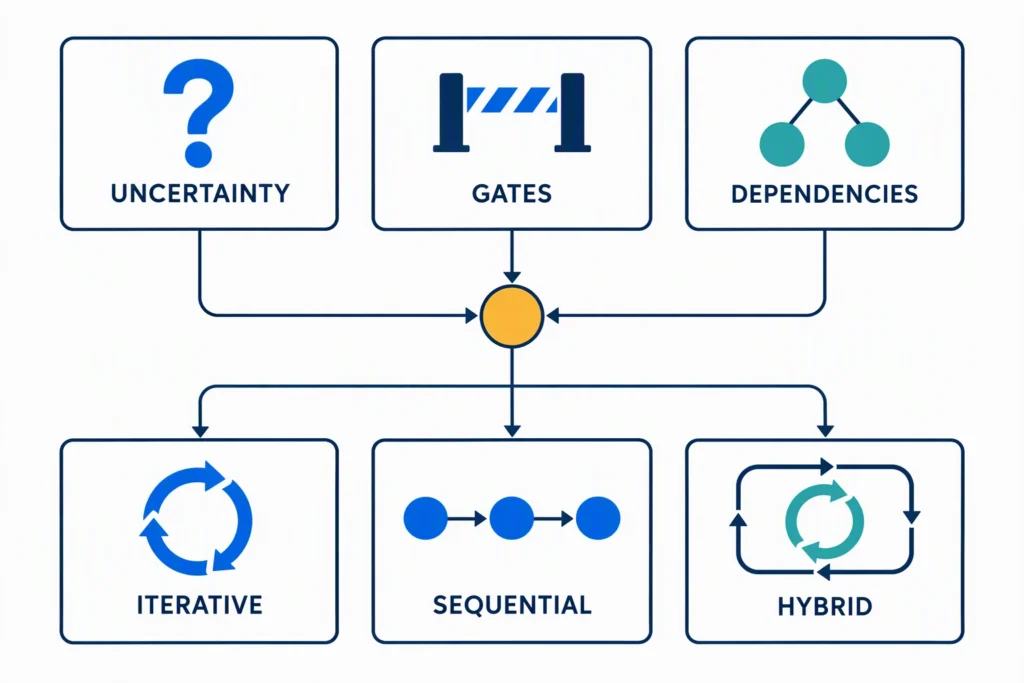
“I choose from the project’s nature, not from what is popular. When requirements are stable and the cost of changing course is high — like a data center move — I use a fixed plan with clear phases, because discipline beats flexibility there. When requirements will change as users see the product — like a new customer portal — I use short cycles with demos every two weeks, so feedback steers the work. Most of my projects end up hybrid: fixed milestones for the parts we know, short cycles for the parts we are discovering. I once ran a billing system upgrade with a fixed go-live date but two-week build cycles inside it. The date held because the cycles caught problems early. The method serves the project; the project never serves the method.”
Why it works: it gives a rule for deciding — stable versus changing requirements — instead of picking a side. The billing-system example proves hybrid is deliberate design, and the closing line is a principle the interviewer will remember.
Prepare clear answers with these quality assurance analyst interview questions.
3. How Do You Turn Unclear Business Needs Into an Executable Plan?
Hear a strong answer:
“I start by refusing to plan from vague words. I sit with the requesters and ask what decision this project should make possible, and what a good outcome looks like in plain language. Then I separate must-haves from nice-to-haves with them in the room — never alone. I turn each must-have into a testable result: not ‘better reports’ but ‘the sales lead can see weekly numbers without asking IT.’ I sequence the work so the riskiest unknowns get answered first, and I put one measurable checkpoint per month on the calendar. On a warehouse project, ‘modernize the system’ became twelve testable results this way, and the team stopped guessing. Clarity is not a document; it is a conversation that ends with things you can check.”
Why it works: it shows a repeatable method — plain outcomes, must-have sorting, testable results, riskiest first. The ‘better reports’ rewrite is vivid proof, and the closing line reframes clarity as an activity, not a document.
Practice explaining pipelines and databases with these data engineer interview questions and answers.
4. How Do You Prioritize Work and Manage Technical Dependencies?
Hear a strong answer:
“I prioritize by value and order by dependency — those are two different jobs. First I rank work by what it earns the business or what risk it removes. Then I map what depends on what, because the highest-value item may have to wait for plumbing underneath it. I keep this map visible and review it weekly, since dependencies shift quietly. In one project, the login upgrade everyone wanted depended on a database change nobody wanted to do first. I made that chain visible, got agreement to do the database work in sprint one, and the login work flowed after. When two teams need the same people, I bring both leads to the map and we sequence together. That shared picture settled our date arguments early.”
Why it works: the value-versus-dependency distinction shows real thinking, not a memorized template. The login-versus-database story is the concrete chain interviewers want, and the visible-map habit proves this is a system, not a one-time fix.
Explore forecasting and logistics scenarios in this supply chain analyst interview guide.
5. How Do You Manage Cybersecurity, Privacy, Integration, and Operational Risks?
Hear a strong answer:
“I treat these risks as choices I settle before the team builds, not as checks at the end. I bring the security team in early to name their non-negotiables: how data is locked, who can reach it, and what gets logged. For linked systems, I run a short early test to prove they can talk before I plan around the link. I also settle who supports the system at 2 a.m. before launch, not after. I keep one risk list, give each risk a lead and a next step, and review it every week. On a payment project, an early review I called found card data stored that nobody needed. I had it removed, and the compliance work fell by half. Catching that in week three, not month six, saved the timeline.”
Why it works: ‘choices settled before the team builds’ frames the philosophy in one line. Each risk type gets a concrete early action, and the card-data story shows the payoff of acting early.
Learn more about your potential team with these questions to ask a hiring manager.
6. How Do You Handle Scope Creep or a Major Change Request?
Hear a strong answer:
“I expect change and I channel it through one process, so it never sneaks in through side conversations. Every request goes into a change log with three facts: what is being asked, what it costs in time and money, and who approves it. Small changes within an agreed limit, I approve fast. Big ones go to the decision-maker with the trade-off spelled out — usually this or that, not this and that. On one rollout, ‘small’ requests kept arriving in weekly meetings and quietly added two weeks to the timeline. I pulled them into the log, showed the sponsor the grouped cost, and we approved two critical ones and moved the rest to phase two. The launch held its date. People accept no more easily when they can see exactly what yes would cost.”
Why it works: the change log with three facts is a concrete, copyable system. The rollout story shows the pattern every interviewer knows — death by small requests — and the closing line about yes-versus-no is a leadership insight.
Showcase your practical experience by learning how to list projects on a resume.
7. Tell Me About a Project That Went Off Track and How You Recovered It
Hear a strong answer:
“Six weeks into moving our payroll to a new provider, the work had stalled and nobody could say by how much. I stopped trusting the status reports and built the truth myself: I listed every task still open, checked each one against the plan, and timed how long the finished ones had really taken. The picture was plain — data cleaning from the old system was eating twice its planned time, and every later step waited on it. I moved two analysts onto cleaning full-time, cut three low-value reports from the move, and set a new go-live date with the sponsor. We went live five weeks later than planned, with payroll correct on the first run. Since then, I rebuild the remaining-work list myself whenever a project feels stuck.”
Why it works: it builds the truth from the work itself instead of trusting status reports, and the recovery has visible mechanics — extra hands on the blocking task, low-value work cut, a new date agreed with the sponsor. Admitting the five-week slip shows the honesty interviewers reward.
Practice discussing budgets and deadlines with these project manager interview questions.
8. How Do You Explain Technical Tradeoffs and Resolve Conflicts?
Hear a strong answer:
“I translate trade-offs into choices with prices, because nobody argues with a clear price tag. When engineers and business leads clashed over building a feature fast versus building it to last, I laid out both paths: fast meant delivery in six weeks with higher maintenance later; solid meant ten weeks with low maintenance. I put the numbers and risks side by side and asked the business lead which price she preferred to pay. She chose solid once she saw the maintenance cost. I never take sides in these fights — I make the options honest and let the decision-maker decide. Afterward I write the decision and its reasons where everyone can find them, so the argument does not reopen. My role is clarity, not victory.”
Why it works: ‘choices with prices’ is a memorable method beyond this story. The fast-versus-solid example shows facilitation, not authority, and the written-decision habit proves the conflict stays resolved.
9. How Do You Manage Budgets, Resources, and Third-Party Vendors?
Hear a strong answer:
“I run budgets like an early-warning system, not a history report. I track spend against plan every two weeks and forecast the landing point, so a drift shows up while there is still time to act. For resources, I confirm people’s real availability — not their theoretical capacity — before committing dates, and I protect a small reserve for surprises. With vendors, I write the acceptance criteria into the contract: what done looks like, tested how, by when. One vendor delivered a module that ‘worked’ but failed our acceptance tests; because the criteria were written down, the rework was theirs, not ours. I review vendor progress against milestones, not promises. Money, people, and vendors all get the same treatment: agreed expectations, checked early, corrected fast.”
Why it works: ‘early-warning system, not a history report’ reframes budget tracking as a skill. The vendor story shows why written acceptance criteria matter, and the closing triple gives the answer a clean, quotable shape.
10. How Do You Determine Release Readiness and Measure Success?
Hear a strong answer:
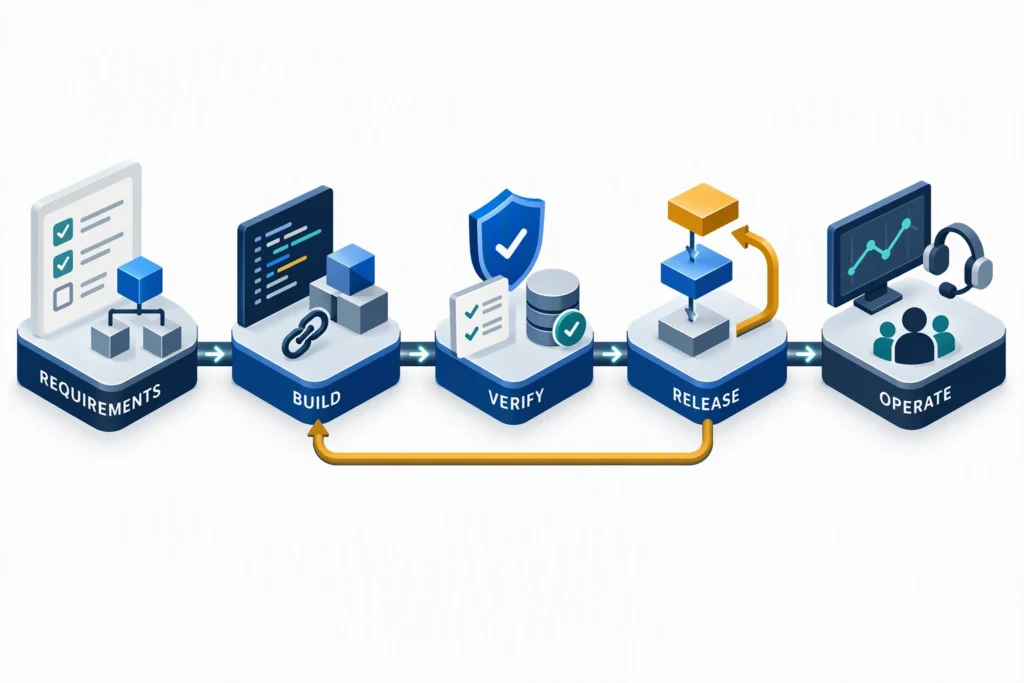
“A release is ready when it passes four gates: all critical tests green, security review signed off, support trained with a runbook in hand, and a rollback plan tested — not just written. I use a simple checklist the whole team can see, and any red gate stops the release; no exceptions, no matter who is pushing. After launch, I measure success against the charter’s original goals, not just on time and on budget. For the email migration, success meant downtime under four hours and support tickets staying flat — both held. I run a review thirty days after every launch to check the real numbers and capture lessons. Launch day is the middle of the story; the thirty-day check is the end.”
Why it works: the four gates are specific and checkable — a real readiness bar. Measuring against the charter’s goals rather than just time and budget shows maturity, and the thirty-day review proves the candidate thinks past go-live.
Explain a Project to a Non-Technical Friend
Pick a project you ran. Explain it to a friend outside tech in three minutes: what it was, the hardest decision you made, and how you knew it worked. If you can answer their “why did you do that,” you are ready. If their eyes glaze over, simplify once more — the interviewer is often non-technical too.
Questions IT Project Manager Candidates Ask
Agile or Waterfall — which should I learn first?
Both: learn Agile well since most IT work uses it, then learn enough Waterfall for fixed-date, fixed-scope projects. Interviews increasingly expect you to choose between them with reasons, not to pledge loyalty to one.
Do I need PMP certification to get hired?
It opens doors, especially at larger companies, but it never closes the interview alone. Every hiring manager will ask for stories of projects you actually ran. A certificate plus real stories wins; a certificate alone does not.
Can I move into IT project management without an IT background?
Yes, if you can learn the technology fast enough to ask good questions and spot risks. You do not need to code, but you need to understand what the engineers are telling you. Show one project where you ramped up on unfamiliar tech.
How do I talk about a project that failed?
Name your part in it plainly: what you missed, what you decided once you saw it, and what you changed afterward. Interviewers hire people who learn from failure in public, not people who pretend every project succeeded.