


These ten questions come up in almost every program manager interview. For each one, you get the wider view, the evidence to show, and a full sample answer.
Start with the first question and keep going, or open the page at the one that feels toughest. Shape every sample around work you actually did — program stories only convince when they are real.
Key Takeaways
- Start every answer with the program’s purpose. What the goal was and why it mattered.
- Show the links between projects, not just the projects. Dependencies are where programs win or lose.
- Influence is earned, not borrowed. Align people around the goal; do not lean on titles.
- A recovery story needs the decision, not just the drama. What you chose and why matters more than how bad it got.
Think Like a Program Manager First
A program is several projects pulling toward one goal. Interviewers want proof you think across all of them at once. Each answer below zooms out to that level, shows the evidence that backs you up, and ends with a full sample in the first person.
1. Tell Me About Your Program Management Experience
Zoom out: this is your headline — one goal, several projects, your role across all of them.
Show your work: name the goal, the projects under it, and what you personally owned.
Here is a full answer:
“I ran a program to move our customer support from phone-first to chat-first. Under it sat four projects: new chat software, retraining sixty agents, rewriting help articles, and new response-time targets. My job was the whole picture — the roadmap, the dependencies between the four, and the weekly decisions when they collided. The training project slipped by three weeks, so I moved the software launch back rather than launch with untrained agents. We went live two months later than first hoped, but complaint rates fell by a third in the first quarter. What I learned: a program manager’s real product is good decisions across projects, not any single project going well.”
Showcase your service skills and client-facing experience with these customer support resume examples.
2. How Do You Translate Business Strategy Into a Program Roadmap?
Zoom out: strategy is a direction; a roadmap turns it into sequenced work with dates.
Show your work: walk the chain — goal, outcomes, projects, milestones — and how you kept it honest.
Here is a full answer:
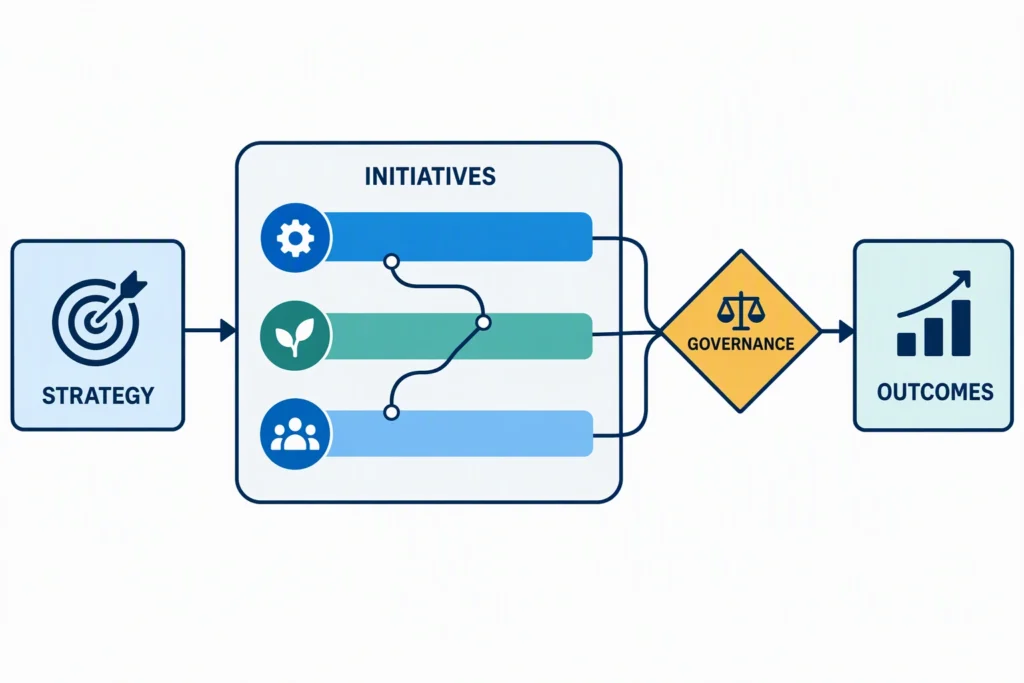
“I start by writing the strategy as one plain sentence everyone can repeat. For one program it was: cut order delivery time in half within a year. Then I defined the three outcomes that would prove it — faster warehouse handling, better delivery tracking, fewer failed drops. Each outcome became a project with a lead and a milestone per quarter. I put them on one page so anyone could see the order: warehouse first, because tracking means nothing if parcels leave late. Every month I checked each project against its outcome, not just its deadline. When the tracking project wanted extra features, I asked which outcome they served — none — so they waited. The roadmap is a promise about what matters most, in what order.”
Present your technical leadership and delivery achievements with this technical project manager resume guide.
3. How Do You Prioritize Projects and Manage Dependencies?
Zoom out: dependencies decide the order; everything else is negotiation.
Show your work: describe your dependency map and one hard call it forced.
Here is a full answer:
“I map every dependency on one page before anything starts: which project needs what from whom, and by when. Then I find the chain that decides the end date — the critical path — and protect it first. In one program, three projects all needed the same data team in the same month. I sat the three leads down with the map and we sequenced the work: the customer-facing project first, internal tools second, nice-to-haves third. One lead was unhappy, so I showed him the map and asked what he would move — he could not find a better order either. I review the map every week because dependencies shift silently. The rule I live by: argue about the map early, or argue about missed dates later.”
Prepare to discuss budgets, deadlines, and teamwork with these project manager interview questions.
4. Tell Me About a Time You Influenced Without Direct Authority
Zoom out: program managers rarely own the teams; they earn direction through trust.
Show your work: listen first, find the shared goal, bring facts — never pull rank.
Here is a full answer:
“Two team leads fought over the same engineers for a month — each claimed their project mattered more, and I had no authority over either. Instead of escalating, I met each one alone and listened. Both were under real pressure; neither was being difficult for fun. I brought them together around the one goal we shared: the company launch date neither could hit alone. Then I laid out the facts — who was needed where, and what slipped under each option. Seeing it plainly, they agreed to split the engineers by week, with a shared calendar so neither felt cheated. The launch hit its date. I learned that resistance usually hides a constraint I have not seen yet — so I listen before I push, every time.”
Highlight your educational initiatives and leadership experience with this education program manager resume guide.
5. How Do You Manage Program Risks, Issues, and Changes?
Zoom out: risks are future problems you can still shrink; issues are present ones you must face.
Show your work: show your list, your leads, and one risk you killed early.
Here is a full answer:
“I keep one visible list with three columns: risks that might happen, issues happening now, and changes requested. Every risk gets a lead, a likelihood, and one action to shrink it. Every issue gets a decision date — no issue sits undecided for more than a week. In one program our biggest risk was a vendor delivering late. Instead of hoping, I asked the vendor for weekly proof of progress and lined up a backup vendor quietly. The first vendor slipped by two weeks; the backup was ready and we lost only three days. Changes go through the same discipline: what changes, what it costs, who approves. The list is boring on purpose — boring means nothing is hiding.”
Organize your driving experience and passenger service skills with these ride share driver resume templates.
6. Describe a Program That Went Off Track and How You Responded
Zoom out: recovery is a decision process, not heroics — pause, diagnose, re-plan, recommit.
Show your work: name the decision you made and what you stopped doing.
Here is a full answer:
“I inherited a program six months in, over budget, with teams pulling in different directions and no shared definition of done. My first move was to pause new work for one week — unpopular, but we were digging the hole deeper. I interviewed every lead and found the real problem: requirements had never been written down, so everyone built a different thing. I ran a two-day session to define the must-haves, cut everything else, and got leadership to sign the smaller scope. We re-planned with honest dates and delivered the core in four months. The lesson I carry: when a program is lost, stop moving first. Speed without direction is just faster failure.”
Show employers your youth activity planning skills with this after-school program coordinator resume guide.
7. How Do You Handle Competing Priorities, Budgets, and Limited Resources?
Zoom out: your job is honest trade-offs, not magic — every yes has a price.
Show your work: show how you make the cost of each choice visible.
Here is a full answer:
“I make every trade-off visible so no one pretends we can do everything. I list the competing priorities with their costs — money, people, time — and what each choice delays. In one program, marketing wanted a launch event the same month engineering needed the budget for testing. I showed both leads the numbers: the event meant cutting test coverage in half, which risked a bad launch. They chose a smaller event and full testing — my job was making the cost clear, not making the choice for them. I also protect a small reserve, about one-tenth of the budget, because surprises are certain. Saying no early, with numbers, beats apologizing late without them.”
Find a clear layout for your administrative qualifications in these office resume templates.

8. How Do You Communicate Status to Executives and Delivery Teams?
Zoom out: one program, two languages — decisions for leaders, details for builders.
Show your work: describe both formats and how you keep them honest.
Here is a full answer:
“I give executives one page: are we on track, what needs their decision this week, and the top three risks. No project detail unless they ask — they need decisions, not updates. Delivery teams get the opposite: the full dependency map, what changed, and what I need from whom by when. Both come from the same facts, so the stories never contradict. I send the executive page weekly at the same time, even when the news is bad — especially then. Once I delayed a red status by a week hoping it would turn green; it turned redder, and I lost trust that took months to rebuild. Now bad news travels fast and plain. Different audiences, same truth.”
Present your model development experience and technical projects with this machine learning engineer resume guide.
9. Tell Me About Resistance From Key People or a Difficult Conflict
Zoom out: resistance is information — someone sees a risk you do not.
Show your work: show how you turned an opponent into a partner.
Here is a full answer:
“A senior director blocked our new reporting process for two months — skipped meetings, questioned every number, told his team to keep the old spreadsheets. Instead of fighting him, I asked for thirty minutes to understand his worry. He had been burned before by a ‘new system’ that lost his team’s data. So I ran the old and new reports side by side for a month, with his analyst checking every figure. When the numbers matched three weeks running, he became the loudest supporter of the switch. The conflict taught me that the strongest resistor often becomes the strongest champion — if you answer the real fear instead of the surface complaint. I never label people difficult; I ask what they are protecting.”
10. What Program Management Process Have You Improved?
Zoom out: pick a process whose pain everyone felt, and show the before and after.
Show your work: name the old pain, your change, and the measurable difference.
Here is a full answer:
“Status updates were chaos: five projects sent five different formats at five different times, and I spent Mondays stitching them into something leaders could read. I replaced it all with one shared template — three boxes: progress, blockers, next steps — due Friday noon, no exceptions. I also started a thirty-minute Monday program review where leads talk through blockers together instead of emailing me separately. Within a month, my Monday stitching time went from half a day to under an hour, and two blockers got solved in the review that would have taken a week of emails. The template was not the real win — the real win was leads hearing each other’s problems and offering help before I had to ask.”
Map a Program on One Page
Pick the biggest goal you have worked toward — at work, school, or in life. Draw every project, person, and dependency on one page, with arrows showing what waits on what. Now explain it out loud in two minutes without reading. If you stumble, your map is too complicated. Program interviews reward the person who can hold the whole picture and still point at the one thing that matters most.
Questions Program Manager Candidates Ask
What is the difference between a program manager and a project manager?
A project manager runs one project to its deadline. A program manager runs several related projects toward one bigger goal, managing the links between them. If you have only run single projects, talk about the times you coordinated across teams — that is program thinking.
Can I apply without the program manager title?
Yes, if you have done the work. Many people run programs under titles like lead, coordinator, or senior manager. Name the goal, the projects, and the decisions you made across them. The work convinces; the title does not.
Do I need a technical background?
It helps you ask better questions, but it is not required. Your job is connecting work to outcomes, not writing the code. Show you can learn enough to spot risks and earn engineers’ respect.
How do I talk about a program that failed?
Own your part plainly: what you missed, what you decided, what you would do differently. Interviewers promote people who learn from failure, not people who hide it. The decision you made under pressure is the story.