


Cloud teams ask these ten questions in interview after interview. Together they trace a path: learn a system, keep it safe and fix it when it breaks, then plan what it needs next. Each one spells out what the hiring team listens for, plus a complete answer in the candidate’s voice.
Tell stories from setups you have run, and be clear where your part ended. Never dress an answer up with a company name, traffic figure, or saving you cannot prove. New to the work? Say so, then lay out how you would handle it.
Key Takeaways
- Ask what it must do before choosing how to build it. Traffic, data rules, and budget decide the architecture, not your favorite service.
- Security is a design choice, not a patch. Identity, secrets, and network rules belong in the first sketch, not the last sprint.
- Every change needs a way back. If you cannot roll it back, you are not ready to ship it.
- Test the recovery, not just the backup. A backup you have never restored is a hope, not a plan.
Understand the System
These questions test whether you learn a workload deeply before touching it.
1. Tell Me About a Cloud Workload You Owned
What the interviewer needs to see: that you carried real responsibility and understand how the pieces fit.
Show your working: describe the workload, your role, and one hard problem you solved.
“I ran a customer-facing web application on the cloud for about two years. It served web traffic through a load balancer, ran on managed containers, and stored data in a managed database with daily backups. My role covered deployments, monitoring, and cost tracking. The hardest problem was a memory leak that caused slow crashes every few days. I added memory readings and alerts, traced the leak to a caching setting through the application logs, and fixed the configuration. Then I set resource limits so one bad deploy could never take down the whole service again. I also wrote a runbook so anyone on call could handle it. Owning a workload taught me that the cloud makes it easy to start things and hard to keep them healthy, and the second part is the real job.”
Highlight your infrastructure skills and cloud projects with these cloud engineer resume examples.
2. How Would You Design an Architecture From Incomplete Requirements?
What the interviewer needs to see: that you ask sharp questions instead of guessing.
Show your working: list what you must clarify, then sketch a simple starting design.
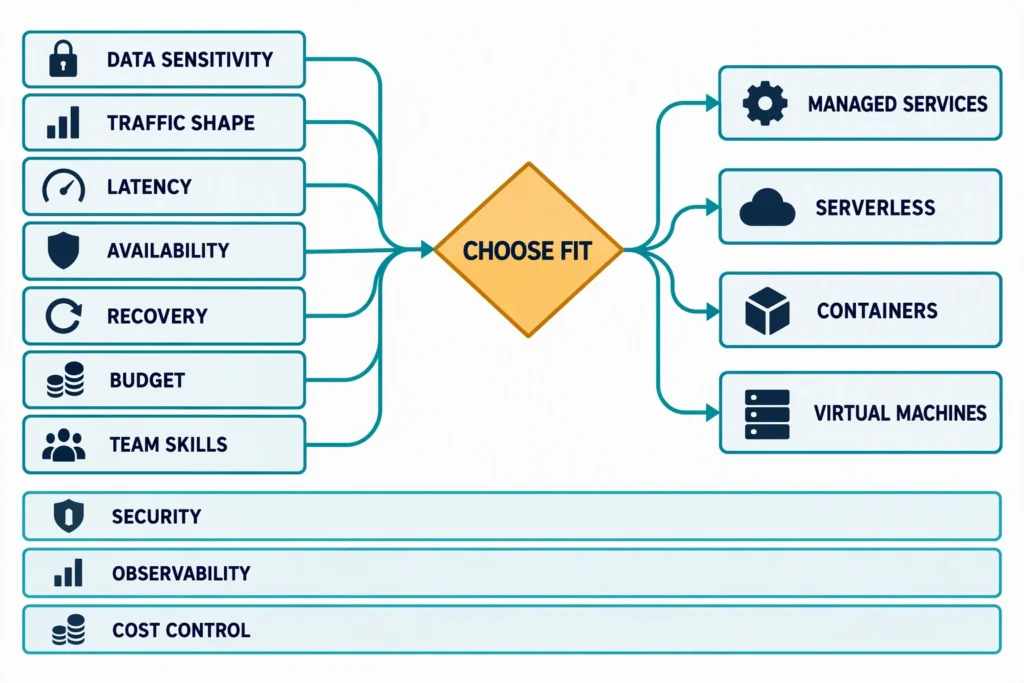
“I never design from guesses, so I start with questions. I ask about expected traffic and growth, what data the system holds and its rules, how much downtime is acceptable, and what the budget looks like. I also ask what the team already knows, because the best architecture is one the team can operate. With answers in hand, I sketch something simple: managed services where possible, separate public and private networks, and clear data storage. I document every assumption I made so it can be checked later. I present the design with its tradeoffs stated plainly: what it handles well and where it would strain. Then I propose building the smallest version that proves the risky parts. A good design process turns vague requirements into clear decisions, and the questions matter more than the diagram.”
Present sensitive assignments appropriately with this guide to describing confidential projects on a resume.
3. How Would You Troubleshoot a Connectivity or Latency Problem?
What the interviewer needs to see: that you work in layers instead of changing things at random.
Show your working: go outside-in, from DNS to network to application, checking evidence at each layer.
“I troubleshoot from the outside in, one layer at a time. First, I check whether the problem is global or limited: can I reproduce it, and do the health checks agree? Then I look at DNS, because a bad DNS change breaks everything downstream. Next, the network layer: security group rules, routing, and whether traffic reaches the load balancer. Then the application: error rates, response times, and recent deploys. At each layer I look at readings and logs before touching anything, because changing two things at once teaches you nothing. Once I find the layer, I fix it and watch the readings recover before declaring victory. I also write down the timeline while it is fresh. The discipline is simple: narrow it down with evidence, change one thing, and verify. Random fixes create new problems.”
Find inspiration for presenting your technical qualifications in these engineering and design resume examples.
Protect and Repair
These questions test whether you keep systems safe and fix them without making things worse.
4. How Would You Protect Identities, Secrets, Networks, and Data?
What the interviewer needs to see: that security is layered and practical, not a checklist you recite.
Show your working: cover who can access, where secrets live, how networks divide, and how data rests.
“I protect in four layers. First, identity: every person and service gets only the permissions it needs, nothing more, and I review those permissions regularly. Second, secrets: passwords and keys live in a managed secrets service, never in code or config files, and they rotate on a schedule. Third, networks: databases and internal services sit in private subnets with no direct internet path, and traffic between tiers passes through explicit rules. Fourth, data: encryption at rest and in transit, with backups encrypted too. I also turn on audit logging so we can see who did what. If someone asks me for wider access than their job needs, I sit with them, pin down the one task they must finish, and open only that part. Security that slows everyone down gets bypassed, so I aim for controls the team can actually live with.”
Showcase your retail leadership and operational achievements with this store manager resume guide.
5. How Do You Make Infrastructure Changes Safely?
What the interviewer needs to see: that no change goes out without a review, a test, and a way back.
Show your working: describe the pipeline from code to production, including the rollback plan.
“Every infrastructure change starts as code in version control, never as a manual click in the console. A teammate reviews it, automated checks validate the syntax and catch obvious mistakes, and then it deploys to a non-production environment first. For production, I roll out gradually: a small slice of traffic or servers first, watching error rates and key readings before continuing. Every change has a rollback plan written before it ships, and I make sure the rollback was actually tested, not just imagined. After deploy, I keep watching the dashboards for at least one full business cycle. I also log every change with who made it and why, so a future incident has a trail. The rule: if I cannot explain how to undo it, I do not ship it. Safe changes are boring, and boring is the goal.”
Explain your delivery experience and technical leadership with this technical project manager resume guide.
6. A Container Deployment Is Unhealthy. What Do You Check?
What the interviewer needs to see: that you read the signs the platform gives you before restarting things.
Show your working: check events, logs, resources, and recent changes in that order.
“I start with the platform’s own signs. I check the deployment events first, because they often say plainly what is wrong: a failed image pull, a crash loop, a probe failing. Then I read the container logs for the actual error, not just the symptom. Next, I check resources: is the container hitting its memory or CPU limit and getting killed? Then I look at the health probes, because a misconfigured probe can mark a healthy app as dead. I also ask what changed recently: a new image, a config change, a secrets rotation. Only after understanding do I act, whether that means rolling back, raising a limit, or fixing the probe. And I do not just restart it and walk away; an unhealthy deployment that recovers on restart will fail again at the worst time. Find the cause, fix the cause.”
Explore the measures used to evaluate support performance with these customer service key performance indicators.
7. Tell Me About a Production Incident You Helped Resolve
What the interviewer needs to see: that you stayed useful under pressure and left the system stronger.
Show your working: tell it as detect, communicate, mitigate, fix, prevent.
“Our checkout page started failing during a busy evening, and the alert reached me within minutes. I first confirmed the scope: the app servers were healthy, but the database was rejecting connections. I posted a short status update to the team channel so nobody duplicated my work, then checked recent changes and found a deploy that had doubled the connection count. I rolled back that deploy, which restored service, and then worked with the developer to fix the connection handling properly. Afterward, I wrote a timeline of what happened and led a short review. We added a connection-count alert and a load test step before deploys. The incident lasted under an hour, but the prevention work mattered more. What I learned: communicate early even when you have little to say, because silence makes incidents worse.”
Strengthen the presentation of your clinical experience with this dental assistant resume guide.
Prepare for What’s Next
The last questions test whether you plan beyond today: recovery, cost, and moving systems.
8. How Would You Design and Test Disaster Recovery?
What the interviewer needs to see: that recovery is a practiced routine, not a document nobody has opened.
Show your working: set targets with the business, build the mechanics, then prove it works.
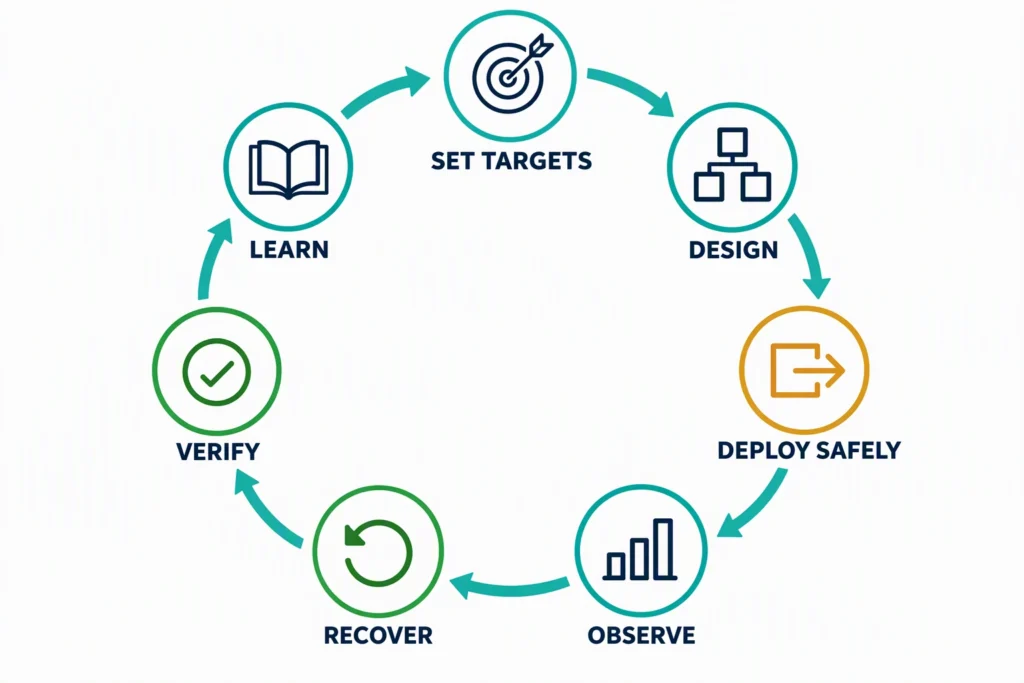
“I start by agreeing on two numbers with the business: how much data we can afford to lose and how long we can afford to be down. Those targets decide everything. Then I build the mechanics: automated backups with encryption, copies in a second region, and infrastructure code that can rebuild the environment from scratch. But the design is only half the job. I schedule regular restore tests, because a backup nobody has restored is just a hope. I run tabletop exercises where the team walks through the recovery steps, and full rehearsals at least yearly. I keep a runbook with exact commands and contact names, updated after every test. After each drill, I fix what was slow or confusing. Disaster recovery that lives only in a document will fail when you need it most.”
Make your application easy to read with this guide to cover letter font sizes and styles.
9. How Would You Reduce Spend Without Weakening the Workload?
What the interviewer needs to see: that you cut waste, not resilience.
Show your working: find the waste first with data, then right-size, then commit.
“I start with visibility: I tag every resource by team and workload so we know what the money actually buys. Then I look for pure waste: idle instances, unattached disks, old snapshots nobody needs, and oversized databases that were barely used. I right-size those to match real usage, using readings rather than guesses. For steady workloads, I use committed pricing to pay less for capacity we know we need. I set up auto-scaling so we pay for peak only during peak. What I never cut: redundancy the business asked for, backups, or monitoring. I report savings against the baseline each month so the team sees the trend. The principle: every dollar should buy either performance, reliability, or something the business chose. If it buys none of those, it goes.”
10. How Would You Plan a Migration and Explain the Tradeoffs?
What the interviewer needs to see: that you plan in waves, protect the data, and speak honestly about costs.
Show your working: assess, plan waves, rehearse the cutover, and name the tradeoffs out loud.
“I start with an honest inventory: every application, its dependencies, its data, and who owns it. Then I plan in waves, moving the simplest, least risky systems first so the team learns before touching anything critical. For each wave, I choose a strategy: rehost as-is for speed, or rework for the cloud where the payoff justifies it. Data migration gets its own plan with validation, because lost or corrupted data is the one failure you cannot undo. I rehearse the cutover, keep the old system ready to take over, and schedule moves outside business hours. I explain the tradeoffs plainly to leadership: faster moves mean more cleanup later, and zero downtime costs more than a short window. A migration is a business project with technical steps, not the other way around.”
Whiteboard It Without Slides
Pick a system you know well — a web app, a data pipeline, anything real. Draw it from memory: the network edges, the services, where data lives, and where it can fail. Talk through your drawing in five minutes, including one tradeoff you would change. Repeat with two more systems. Interviewers trust engineers who can sketch and reason live.
Frequently Asked Questions
Should I Learn One Cloud or Several?
Go deep on one first. Employers hire for judgment, and judgment transfers. Once you can design, secure, and troubleshoot on one cloud, learning a second is mostly vocabulary. Say which you know best and be honest about the rest.
Do I Need Certifications to Get Hired?
No certificate hires you. Some job posts ask for one, and it can get your name past the first screen. After that, what counts is proof: a small cloud setup you built, kept safe, broke, and fixed yourself.
How Much Coding Does a Cloud Engineer Need?
Enough to automate your work: scripting, infrastructure as code, and reading application logs. You do not need to be a software developer, but you must be comfortable in code. If you avoid it, say how you are learning.
What if I Have Never Been On Call?
Say so honestly, then show you think like someone who has: alerts that mean something, runbooks for common failures, and changes with rollback plans. Calm preparation counts for a lot.