

Grant writing interviews tend to return to the same topics, moving from choosing opportunities to writing honest proposals to owning the outcome. For each question, you get what your answer should prove and a full sample answer.
Use real examples from grants you have worked on. Never invent amounts, win rates, or funder names. If you are new, walk through what you would do and why.
Key Takeaways
- Fit first, writing second. A brilliant proposal for the wrong funder is wasted work. Check eligibility and mission fit before you type a word.
- Every dollar in the budget needs a sentence in the story. If the narrative describes an activity, the budget must pay for it.
- Truth is not negotiable, even at 11 p.m. Deadlines never justify inflated claims. Flag the problem and fix it honestly.
- You own the draft; the team owns the facts. The team supplies the facts. Your job is to shape them, not invent them.
Start With Fit
These questions test whether you choose the right opportunities.
1. Tell Me About Yourself and Why You Chose Grant Writing.
Your answer should prove: that you care about the mission behind the money, not just the writing.
Give the steps you follow: connect your background to the work, then say what keeps you in it.
“I started as a program assistant at a small nonprofit, where I watched good projects stall for lack of funding. I began helping with grant reports, then full proposals, and I found I loved the work: learning a program deeply, then explaining it so clearly that a stranger wants to fund it. I moved into grant writing full time because it matches my strengths: careful research, plain writing, and respect for deadlines. What keeps me in it is watching a funded program start serving people. I read the funder’s guidelines three times before drafting, call program staff to check a fact instead of guessing, and treat every budget line as a promise. I want to write proposals where every claim is true and every dollar is accounted for.”
Strengthen your bullet points with these alternatives to “responsible for” on a resume.
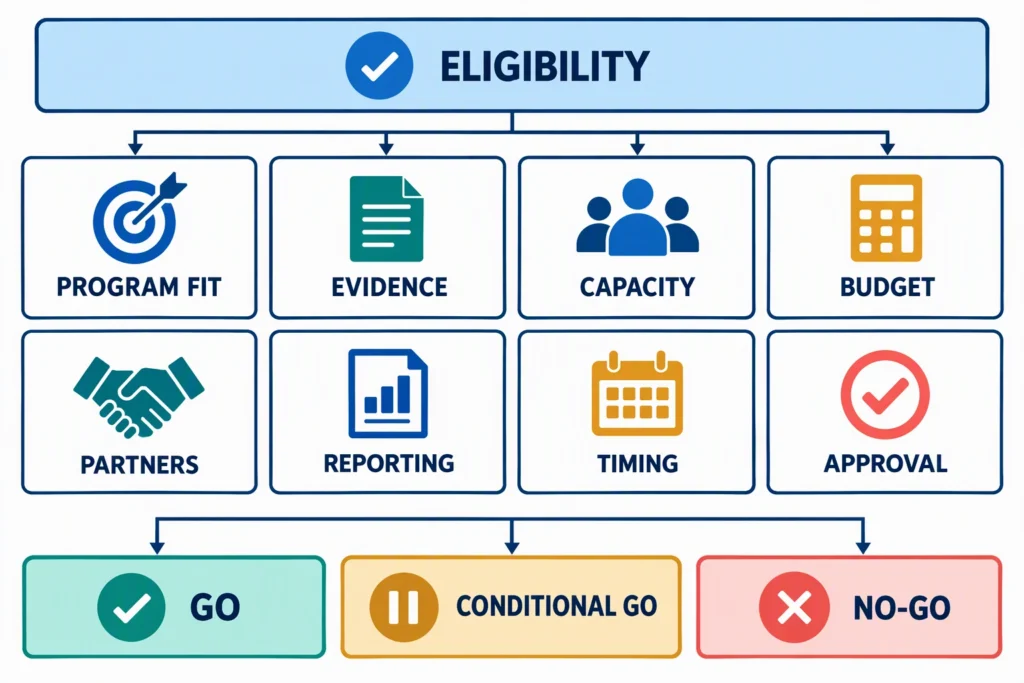
2. How Do You Decide if a Funding Opportunity Is Worth Pursuing?
Your answer should prove: that you say no to bad fits, which saves everyone time and protects your win rate.
Give the steps you follow: run a go or no-go check on eligibility, fit, capacity, and time.
“I run every opportunity through the same four checks before I recommend it. First, eligibility: I check whether we meet every hard requirement, like budget size, location, and applicant type. One miss and it is a no. Second, mission fit: I ask whether this funds work we already do or plan to do, not work I would have to invent for the money. Third, capacity: I judge whether our staff can deliver the program and handle the reporting rules. Fourth, time: I check whether the deadline is realistic given our other work. I write the answers in a short note and share it with my supervisor. Saying no early is a skill. I once advised against a large grant because the reporting demands would have swallowed our small team. Chasing the wrong money costs more than it pays.”
Highlight your proposal writing experience and funding successes with this grant writer resume guide.
The Proposal Itself
These questions test the core craft: true facts, a clear story, and a matching budget.
3. How Do You Turn Program Information Into a Persuasive Proposal?
Your answer should prove: that you build proposals from real facts, organized around what the funder asked for.
Give the steps you follow: study the guidelines, gather facts from the people doing the work, then write to the funder’s questions.
“I start by reading the funding notice twice: once for the big picture, once with a highlighter for every requirement, limit, and scoring criterion. Then I meet the program staff who do the actual work. I ask how the program runs day to day, who it serves, and what results they have seen, and I take notes in their words. I pull the numbers from our records, never from memory. When I write, I follow the funder’s order and answer each question directly, in plain language. The story flows from need to plan to expected results, and every claim points to a fact I gathered. I never write the narrative first and hunt for facts later. A persuasive proposal is just the truth, organized so well that the funder can see themselves in it.”
Give independent client work a clear place in your application with this guide to listing freelance work on a resume.
4. How Do You Develop a Budget and Budget Narrative?
Your answer should prove: that your numbers and your story always match, down to the last line.
Give the steps you follow: build the budget with finance, tie each line to the narrative, and explain every cost in plain words.
“I build the budget side by side with the narrative, never after it. I sit with our finance person and list every cost the program needs, using real figures from our books. For each line, I check the funder’s rules on what costs are allowed. Then I write the budget narrative, which explains each cost in plain words: what it is, why the program needs it, and how I calculated it. I read the narrative against the proposal draft line by line. If the story mentions three workshops, the budget shows the cost of three workshops. If the budget lists a cost, the story explains the activity behind it. Before submission, finance reviews the numbers and I review the words. A budget the funder trusts is one where nothing is hidden and everything adds up.”
Explore these customer service performance indicators to understand how teams evaluate their results.
When It’s Messy
These questions test how you handle crowded calendars and confusing instructions.
5. How Do You Handle Several Deadlines and Contributors?
Your answer should prove: that nothing slips because you plan backwards and ask early.
Give the steps you follow: one master calendar, backwards timelines, early requests, and weekly check-ins.
“I keep one master calendar with every grant deadline, and I plan each proposal backwards from its due date. I set the internal deadline a full week before the real one, because something always needs fixing. For each proposal I list every contributor, what I need from them, and when. I ask early: program staff get their questions two weeks out, finance gets budget questions with time to check figures. I send short weekly updates so no one is surprised. If two deadlines collide, I tell my supervisor at once and we decide priority together. The habit that saves me most: I never assume a contributor remembers. A polite reminder three days before I need something has rescued more proposals than any writing trick.”
Present your accounting qualifications in a clear layout with these accountant resume templates.
6. What Do You Do With a Complex or Unclear Funding Notice?
Your answer should prove: that you never guess at requirements when you can ask.
Give the steps you follow: read it three times, list every unclear point, ask the funder, and write down the answers.
“I read the notice three times: first for the overall story, second to mark every requirement and deadline, third to catch what I missed. I make two lists: what is clear and what is not. For anything unclear, I check whether the funder offers an information session or a contact for questions, and I ask. I write down each answer with the date, because guidance given verbally still counts. If the funder will not clarify, I choose the stricter reading of the rule and note my reasoning in our files. I never guess silently and hope. I also share a short summary of the key requirements with the team. An unclear notice is normal. Submitting a proposal built on guesses is a choice, and I do not make it.”
Keep your application introduction concise with these short cover letter examples for email applications.
Truth and Teamwork
These questions test your ethics and your teamwork.
7. Tell Me About a Time Someone Asked You to Strengthen a Claim That the Evidence Did Not Support.
Your answer should prove: that you refused clearly, offered an honest alternative, and protected the record.
Give the steps you follow: say no plainly, suggest what the evidence does support, and escalate if pressed.
“A program director once asked me to describe our pilot as serving twice as many people as our records showed, to look stronger to the funder. I said I could not write that, because the funder would check and our credibility would be gone either way. I offered what I could honestly say: the pilot served the smaller number, the waiting list showed real demand, and we had a clear plan to scale. I put my concern in an email to my supervisor so the request and my response were on record. The director was unhappy for a day, but the proposal went out with true numbers. Months later, the funder’s site visit confirmed our figures matched our claims, and the director thanked me. Inflated claims are a short-term win and a long-term disaster. I will not trade one for the other.”
Show employers what you have accomplished with this guide to listing academic, personal, and professional projects on a resume.
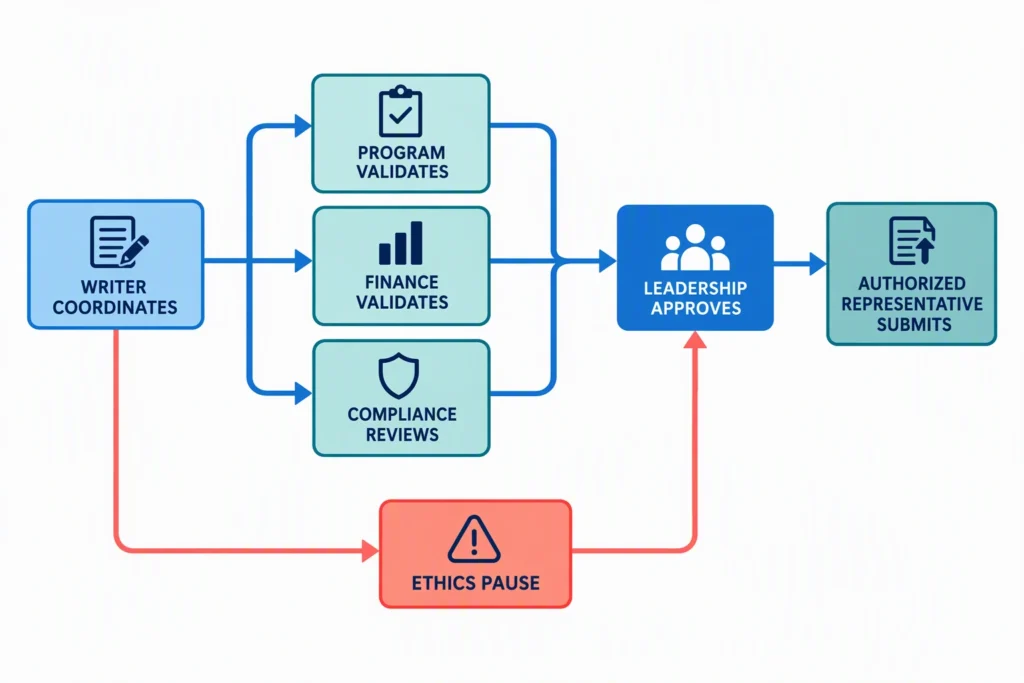
8. How Do You Coordinate Program, Finance, Compliance, and Leadership Review?
Your answer should prove: that busy experts still give you what you need, because you make it easy.
Give the steps you follow: one kickoff, clear asks with dates, a shared list, and ordered review rounds.
“I start each proposal with a kickoff: what the grant is for, what I need from each person, and by when. Program staff give me the facts and stories. Finance gives me the real costs and checks which costs are allowed. Compliance confirms we meet the funder’s rules. Leadership reviews the final draft for tone and strategy. I keep one shared list showing who owes what and when. Reviews happen in order: facts first, then budget, then compliance, then leadership, so each round builds on a draft. I send reviewers only the pages they need, with two or three questions, because a busy director will answer three questions but not read forty pages. When someone is late, I follow up once politely, then escalate to my supervisor. Clear asks get clear answers.”
Owning the Outcome
The last questions test whether you take responsibility for results, good and bad.
9. How Do You Measure Success as a Grant Writer?
Your answer should prove: that you look beyond wins and losses to the quality of the work.
Give the steps you follow: track outcomes, study feedback, and improve the next submission.
“I track more than the win rate, though I track that too. I record every submission, the decision, and any feedback the funder shares. When a proposal is declined, I read the reviewer comments and note what to fix. I also track process measures: how many proposals went out on time, how many needed last-minute rescues, and whether resubmitted proposals do better the second time. I keep a file of funder relationships, because a declined proposal with warm feedback is often a future win. Success to me is a pipeline of honest, on-time proposals that get stronger each round. Anyone can get lucky once. A good grant writer builds a system where strong applications are the normal result, not the exception.”
10. What Would You Do if You Found an Error Near the Deadline?
Your answer should prove: that you stop, tell the truth, and fix it properly instead of hoping no one notices.
Give the steps you follow: assess the error, alert your supervisor at once, fix and recheck, and never submit what you know is wrong.
“I would stop and look at exactly what is wrong and how long an honest fix takes. Then I would tell my supervisor immediately, with the facts: what the error is, where it appears, and what fixing it requires. I would not quietly patch it and hope. If the fix is quick, like a wrong date in the narrative, I would correct it, recheck every place the same fact appears, and have one more person review the changed pages. If the error is serious, like a budget total that does not add up, I would say so plainly and ask whether we can still submit something truthful on time. If we cannot fix it honestly before the deadline, I would rather miss the deadline than submit a proposal I know is wrong. One late submission hurts. One dishonest submission ends trust.”
Practice With a Real Notice
Pick a real funding notice from a foundation you admire. Explain its three hardest requirements out loud in plain words, as if to a new colleague. Then draft a one-page outline answering each one. Do this twice. You will walk in thinking like a working grant writer, not a student.
Frequently Asked Questions
Can I Become a Grant Writer Without a Nonprofit Background?
Yes. Strong writing, research skills, and care with detail transfer from many fields. Learn how nonprofits plan programs and track money, and volunteer to help with one real proposal.
How Do You Handle Rejection After Weeks of Work?
Read the feedback, save what is reusable, and resubmit a stronger version elsewhere. Rejection usually means fit or timing, not failure. A proposal you can honestly reuse is never wasted work.
Should I Use AI Writing Tools for Proposals?
Only as a starting helper, never as the author. Check every fact yourself and follow the funder’s rules on disclosure.
Is Freelance Grant Writing Very Different From Staff Work?
The writing is the same, but you must learn each client’s programs fast and set clear terms about facts, deadlines, and review rounds. Ask for source documents up front. Never let a client rush you past checking the truth.