
A Guide of Special Skills for Acting Resume

Want More Auditions? Learn Which Special Skills for an Acting Resume Can Give You a Competitive Edge.

  • Free MS Word Downloadable Resume
  • Free Resume Samples
  • ATS Friendly Resume Examples
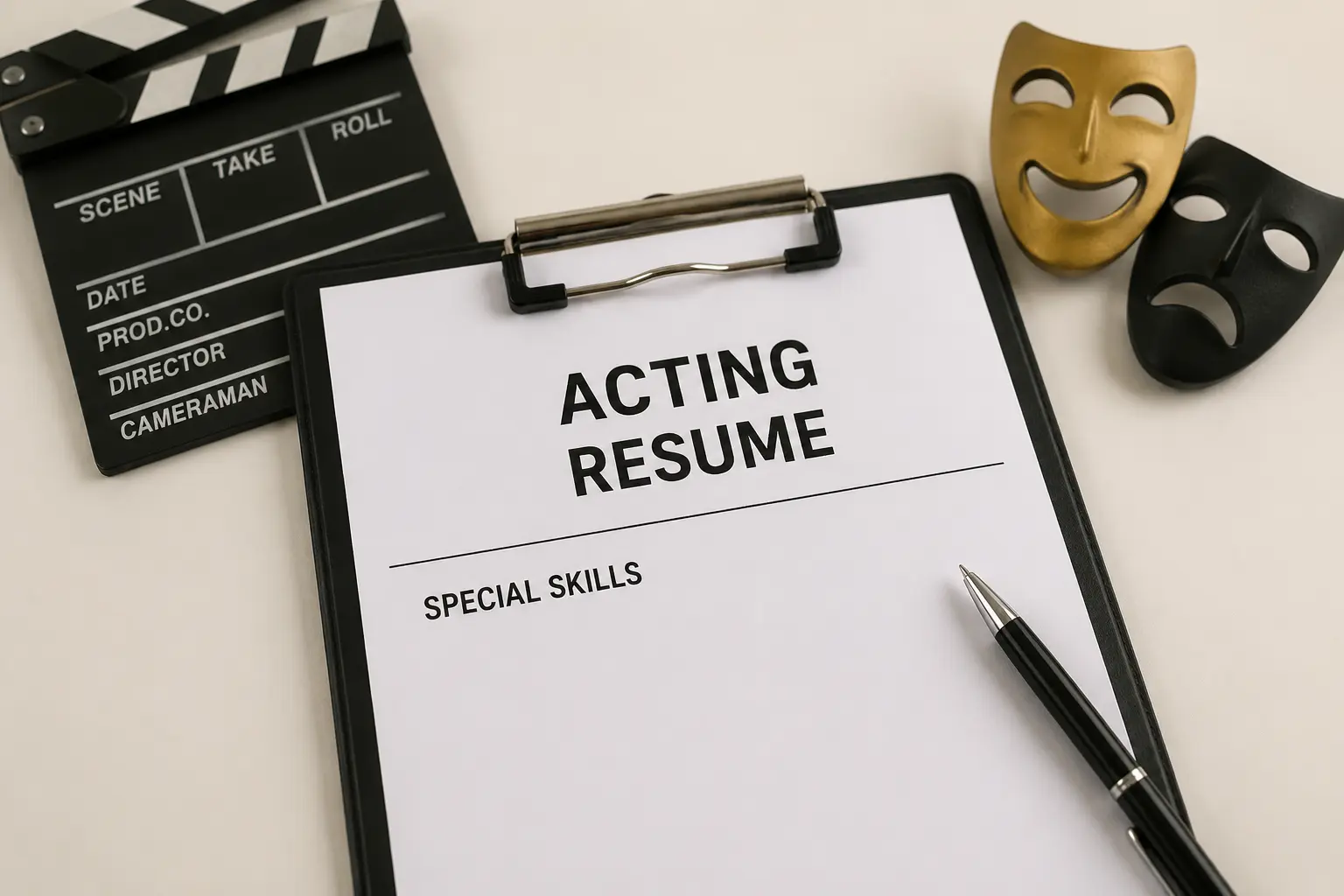
Special skills for acting resume featuring an acting resume on a clipboard with a film clapperboard, theater masks, and a pen, representing the unique talents and qualifications actors can showcase on their resumes.

An acting resume is more than a list of roles and training; it’s an opportunity to showcase the unique abilities that make you the right fit for a character. A well-written Special Skills section highlights practical talents, such as languages, accents, dance, stage combat, sports, or musical abilities, that can help you stand out during the casting process.

This guide explains what special skills are, which ones are worth including, how to present them professionally, common mistakes to avoid, and examples of strong and weak entries. Whether you’re building your first acting resume or updating an existing one, you’ll learn how to create a Special Skills section that strengthens your overall application.

Key takeaways

  • Be honest and specific. List only the special skills you can confidently demonstrate during auditions or on set.
  • Focus on relevant abilities. Include skills that support your acting career, such as languages, accents, dance, stage combat, sports, or technical expertise.
  • Keep your resume updated. Add new training, certifications, and skills while removing outdated or irrelevant entries.
  • Present your skills professionally. Organize them into clear categories and use concise, easy-to-read formatting.
  • Use your Special Skills section strategically. A strong, well-crafted list can help you stand out, match casting requirements, and increase your chances of landing auditions.

Examples of Special Skills for Acting Resumes

Not sure what to include in your Special Skills section? The examples below can help you identify abilities that are relevant to your experience and the types of roles you’re pursuing.

Remember, only list skills you can confidently demonstrate during an audition or on set. Casting directors may ask you to perform any skill on your resume, so accuracy and honesty are essential.

Sports and Athletic Skills:

These physical abilities are gold for productions that need action, competitive authenticity, or just plain physical stamina. Here are some of the most sought-after athletic skills:

Column 1Column 2Column 3Column 4
BasketballFootballCyclingKickboxing
BaseballVolleyballBMXStage combat
SoftballHockeyMountain bikingFencing
SoccerCricketSkateboardingYoga
RugbyTennisRoller skatingBowling
BadmintonSwimmingIce skatingBilliards
DivingArcherySkiingDarts
SurfingRock climbingHorseback ridingMartial arts

Tip: Include only sports or athletic skills you’ve practiced consistently or received formal training in.

The right skills can instantly make your resume more competitive. Explore our comprehensive Unique Skills for Resume guide to discover job-specific hard and soft skills that employers value most.

Vehicle and Driving Skills:

If you have experience operating specialized vehicles, these skills can make you a stronger candidate for certain productions.

Column 1Column 2Column 3
Valid driver’s licenseBoatingHeavy equipment operation
Commercial driver’s license (CDL)KayakingAirplane piloting
Manual transmission (stick shift)CanoeingHelicopter piloting
Motorcycle ridingSnowmobiling

Performance Skills:

Performance-based abilities can expand the range of roles you’re qualified to play.

Column 1Column 2Column 3
BalletChoreographyMime
Ballroom danceGymnasticsClowning
Tap danceAcrobaticsPuppetry
Jazz danceCheerleadingVentriloquism
Hip-hop danceImprovisationMagic
Contemporary danceVoice-over actingJuggling
BreakdancingStand-up comedyBaton twirling

Music Skills:

Music-related abilities are highly valued in theater, musicals, commercials, and film productions.

Column 1Column 2
SingingBass guitar
Musical theaterUkulele
Choir performanceBeatboxing
GuitarRapping
PianoConducting
ViolinSongwriting
DrumsBand performance

Tip: If you sing, include your vocal range (such as soprano, alto, tenor, or bass) whenever applicable

Showcase your dance training and stage experience with confidence. Explore our Dance Resume Examples for ATS-friendly templates, industry-specific guidance, and practical resume-writing tips.

Language and Accent Skills:

Being multilingual or performing authentic accents can significantly expand your casting opportunities.

Column 1Column 2
Native language proficiencyRegional accents
Fluent in multiple languagesInternational accents
Conversational language skillsDialect coaching experience

Tip: Only list accents you can perform naturally and consistently without extensive preparation.

Other Special Skills:

Unique abilities can help you stand out for niche or character-specific roles.

Column 1Column 2
Animal handlingCooking
Horse handlingBartending
KnittingFirst Aid or CPR certification
PaintingScuba diving
PhotographyFirearms safety training
CalligraphyMotion capture performance
WoodworkingTeleprompter operation

Tip: Your Special Skills section should reflect your genuine strengths rather than every hobby you’ve ever tried. Focus on skills that are relevant, practical, and valuable for casting decisions.

Create a standout resume for your next performance opportunity with our Musician Resume Examples, featuring job-specific templates, writing tips, and examples for musicians across different genres.

What are special skills?

Special skills are unique abilities that go beyond your acting experience and training. They showcase talents that can make you a stronger candidate for specific roles and help casting directors quickly identify whether you meet a production’s requirements.

These skills can include languages, regional or foreign accents, singing, dance, musical instruments, stage combat, sports, martial arts, driving, horseback riding, improvisation, voice-over work, motion capture, and other specialized abilities. They demonstrate your versatility and may open the door to roles that require skills beyond acting alone.

The key is to include only skills you can perform confidently and consistently. Casting directors may ask you to demonstrate any skill listed on your resume, so accuracy is just as important as variety. A well-organized and honest Special Skills section strengthens your acting resume and increases your chances of being shortlisted for auditions.

Illustration showcasing special skills for acting resume examples, including singing, dancing, musical instruments, sports, martial arts, photography, painting, multilingual communication, and performance arts.

Top 3 Demonstrations of Acting resume With Skills

Whether you’re creating your first resume or updating an existing one, reviewing strong examples is one of the best ways to understand what employers expect.

Explore the top three resume examples below to see how an effective layout, compelling content, and ATS-friendly formatting can help you create a resume that stands out and lands more interviews.

Whether you’re auditioning for plays, musicals, or stage productions, our Theatre Resume Examples provide ATS-friendly templates and practical guidance to help you impress casting directors.

Example 1: Skills In Professional Actor Resume

Michael Carter
Los Angeles, CA
(323) 555-0187 | michael.carter@email.com

Summary

Versatile film and stage actor with 7+ years of professional experience in television, commercials, and live theater. Skilled in dramatic and comedic performances with a proven ability to adapt quickly to diverse roles and production environments.

Work Experience

Lead Actor | Silver Line Productions | Los Angeles, CA

2022–Present

  • Performed leading roles in 28 commercial and independent film productions, maintaining a 98% on-time attendance record throughout filming schedules.
  • Memorized and delivered scripts averaging 18–22 pages within production deadlines, reducing rehearsal time by 20%.
  • Collaborated with directors and production teams across 50+ filming days, consistently receiving positive performance evaluations.

Supporting Actor | West Coast Theatre Company

2019–2022

  • Appeared in 45 live stage performances, maintaining consistent audience engagement throughout sold-out productions.
  • Adapted to 15 last-minute script revisions without delaying scheduled performances.
  • Assisted in promotional events that increased average show attendance by 25%.

Training

  • Meisner Technique – Stella Adler Studio
  • Camera Acting Workshop – Acting Center LA
  • Voice & Movement Training – American Academy of Dramatic Arts

Special Skills

  • Languages: English (Native), Spanish (Conversational)
  • Accents: General American, Southern American, British RP
  • Dance: Contemporary, Jazz, Hip-Hop
  • Music: Guitar (Intermediate), Piano (Basic), Tenor Vocals
  • Sports: Basketball, Swimming, Tennis, Horseback Riding
  • Performance: Improvisation, Stage Combat, Voice-Over, Motion Capture
  • Technical: Teleprompter, Green Screen Performance, Basic Video Editing
  • Licenses & Certifications: Valid U.S. Driver’s License, CPR Certified

Not sure how to summarize your experience? Explore our comprehensive Resume Summary Examples for Multiple Jobs guide to find job-specific summaries you can customize for your own resume.

Example 2: Skills In Child Actor Resume

Sophia Bennett
Los Angeles, CA
Parent Contact: (310) 555-0142
parent@email.com

Summary

Energetic child actress with experience in commercials, television, and voice-over projects. Confident on camera with excellent memorization skills and the ability to take direction effectively.

Acting Experience

Child Actor | Bright Star Productions

2023–Present

  • Appeared in 16 national and regional commercials, completing every production without schedule delays.
  • Memorized scripts containing 40–60 dialogue lines with a 100% accuracy rate during principal photography.
  • Worked alongside production teams on 75+ filming hours while consistently following on-set safety guidelines.

Featured Performer | Children’s Theatre Workshop

2021–2023

  • Performed in 24 live theater productions, maintaining strong audience engagement throughout each performance.
  • Learned choreography for 12 musical performances, reducing rehearsal time by 15% through consistent preparation.
  • Participated in community outreach performances attended by 3,000+ audience members annually.

Training

  • Children’s Camera Acting Workshop
  • Musical Theatre Program
  • Beginner Ballet
  • Voice Coaching

Special Skills

  • Languages: English (Native), Basic Spanish
  • Dance: Ballet, Jazz
  • Music: Piano (Intermediate), Singing (Soprano)
  • Sports: Gymnastics, Swimming, Cheerleading
  • Performance: Improvisation, Musical Theatre, Voice-Over
  • Other: Excellent Script Memorization, Comfortable Working with Animals

Help young performers make a strong first impression with our Child Actor Resume Examples, featuring ATS-friendly templates and practical guidance for film, television, theatre, and commercial auditions.

Example 3: Skills In Creator / Content Creator Actor Resume

Ethan Brooks
Austin, TX
(512) 555-0135 | ethanbrooks@email.com

Summary

Digital creator and on-camera actor specializing in short-form video content, commercial performances, branded campaigns, and social media productions. Experienced in both scripted and improvised performances.

Acting & Creator Experience

Content Creator & Commercial Actor | Freelance

2021–Present

  • Produced and starred in 420+ short-form videos, generating over 18 million total views across multiple platforms.
  • Collaborated with 38 national and regional brands, delivering 100% of campaign content before scheduled deadlines.
  • Maintained an average audience engagement rate of 9.4% through consistent on-camera storytelling and performance.

Commercial Actor | Bright Frame Media

2022–Present

  • Appeared in 32 digital advertising campaigns, completing production schedules with a 99% on-time attendance rate.
  • Delivered scripts averaging 2–5 minutes in a single take for 80% of recorded scenes.
  • Worked with directors and creative teams on 140+ production days, consistently meeting brand performance expectations.

Training

  • Commercial Acting Intensive
  • On-Camera Performance Workshop
  • Voice-Over Fundamentals
  • Improvisation Training

Special Skills

  • Languages: English (Native)
  • Accents: General American, New York
  • Performance: Commercial Acting, Improvisation, Voice-Over, Podcast Hosting
  • Content Creation: UGC Creation, Livestream Hosting, On-Camera Presenting
  • Technical: Teleprompter, DSLR Camera Operation, Video Editing (Premiere Pro & CapCut)
  • Sports: Basketball, Cycling
  • Licenses: Valid U.S. Driver’s License

Planning to switch industries? Read our Resume Summary & Objective Examples for Career Changers guide to learn how to highlight transferable skills and create a resume that appeals to employers in your new field.

Strong and Weak Skills

Good vs bad skills for acting resume examples showing how to list acting, voice, dance, and special performance skills on a resume
Good vs. Bad Example of Special Skills on an Acting Resume

The way you present your special skills can significantly impact how casting directors perceive your qualifications.

A strong Special Skills section focuses on relevant, specific, and verifiable abilities that support your acting career, while a weak one relies on vague or generic statements.

The examples below illustrate the difference between an effective and ineffective Special Skills section, helping you understand what to include and what to avoid on your acting resume.

“Don’t be afraid to fail. It’s not the end of the world, and in many ways, it’s the first step toward learning something and getting better at it.” — Jon Hamm

Good Example

  • Uses specific, role-relevant acting skills.
  • Includes measurable achievements, training, or experience.
  • Highlights professional acting abilities and certifications.
  • Demonstrates credibility with real-world examples.
  • Helps casting directors quickly evaluate qualifications.
  • Uses concise, professional resume language.
  • Focuses on skills that add value to acting roles.
  • Creates a strong first impression.

Bad Example

  • Uses vague and generic skill descriptions.
  • Lacks numbers, achievements, or supporting details.
  • Lists basic traits instead of specialized skills.
  • Makes unsupported claims without evidence.
  • Provides little value for casting decisions.
  • Uses informal and unprofessional wording.
  • Includes irrelevant or common skills that don’t stand out.
  • Fails to differentiate the candidate from others.

How to audit your skills 

Before adding a skill to your acting resume, take a few minutes to evaluate whether it truly belongs there. A skill is only valuable if you can demonstrate it confidently during an audition or on set.

Start by making a list of every skill you have, then separate them into three categories: expert, proficient, and beginner. Include only the skills that are relevant to acting and accurately reflect your current ability.

Next, ask yourself these questions:

  • Can I perform this skill without additional coaching?
  • Would I feel comfortable demonstrating it during an audition?
  • Have I practiced or trained in this skill within the last few years?
  • Is this skill relevant to the types of roles I want to book?
  • Can I perform this skill safely and consistently?

If the answer to any of these questions is no, it’s usually better to leave the skill off your resume.

Finally, review your Special Skills section every few months. Add new abilities you’ve developed, update your proficiency levels, and remove skills that are no longer relevant.

Keeping your resume current ensures casting directors see an accurate representation of your abilities and helps you present yourself as a reliable professional.

Example:

Before Auditing

  • Horseback Riding
  • Martial Arts
  • French
  • Guitar
  • Stage Combat

After Auditing

  • Guitar (Intermediate)
  • Stage Combat (Advanced)
  • French (Conversational)
  • Horseback Riding (Beginner)

In this example, the actor removed Martial Arts because they could no longer perform it confidently, while Horseback Riding remained on the resume with an honest proficiency level.

Illustration showing how to list special skills for acting resume, featuring an actor reviewing a resume alongside icons for acting, singing, dancing, sports, martial arts, music, and communication skills.

Tips for Listing Special Skills on an Acting Resume

A well-written Special Skills section can strengthen your acting resume, but only if it’s accurate and relevant. Keep these best practices in mind before adding skills to your resume.

Be Honest About Your Abilities

Only include skills you can confidently perform without additional coaching or preparation. Casting directors may ask you to demonstrate any skill listed on your resume during an audition or on set. Exaggerating your abilities can damage your credibility and reduce future opportunities.

Highlight Your Strongest Skills First

Place your most valuable or distinctive skills at the beginning of the list. Since casting professionals often scan resumes quickly, leading with your strongest abilities helps create a positive first impression. Prioritize skills that align with the types of roles you want to book.

Think Like a Casting Director

Consider how casting professionals search for talent. Include skills that are specific, relevant, and easy to identify, such as languages, accents, musical instruments, certifications, or specialized performance abilities. Using clear and recognizable descriptions makes it easier for casting teams to find actors who match their casting requirements.

Keep Your Skills Relevant

Focus on abilities that add value to your acting career. Specialized talents, professional certifications, athletic abilities, and performance-related skills are far more effective than generic hobbies or personality traits.

Update Your Resume Regularly

Review your Special Skills section whenever you complete new training, earn certifications, or develop additional abilities. Keeping your resume current ensures casting directors always see an accurate representation of your qualifications.

Pair your resume with a professional Cover Letter for Actor to showcase your acting experience, training, and passion while making a strong first impression during auditions.

Do’s

  • List only skills you can confidently perform.
  • Be specific with every skill you mention.
  • Mention your proficiency level when appropriate.
  • Organize your skills into clear categories.
  • Keep the most relevant skills at the top.
  • Update your resume as you gain new skills.
  • Include certifications for specialized skills.
  • Tailor your skills to the role you’re applying for.
  • Proofread your resume before submitting it.

Don’ts

  • Don’t exaggerate or lie about your abilities.
  • Avoid vague entries like Sports or Good Singer.
  • Never leave casting directors guessing about your experience.
  • Don’t create one long, cluttered list.
  • Don’t prioritize irrelevant or outdated skills.
  • Don’t keep skills you no longer practice.
  • Don’t claim certifications you haven’t earned.
  • Don’t use the exact same skills list for every audition.
  • Don’t submit a resume with spelling or formatting mistakes.

New Skills to Learn in 2026

The entertainment industry continues to evolve, and actors are expected to bring more than strong performances to the table. Learning modern, in-demand skills can make your resume more competitive and open doors to a wider variety of roles.

1. UGC Content Creation

Brands and production companies increasingly cast actors who can create authentic user-generated content for social media campaigns and digital advertisements.

2. Motion Capture Performance

Motion capture is becoming more common in films, television, and video games. Training in body movement and performance capture can expand your opportunities.

3. Virtual Production

Familiarity with green screen work, LED volume stages, and virtual production environments can help actors adapt to modern filmmaking techniques.

4. Voice-Over Performance

Voice acting remains in high demand for animation, video games, commercials, audiobooks, and AI-assisted media. Developing vocal versatility is a valuable investment.

5. Self-Tape Production

Casting directors often request self-taped auditions. Learning proper lighting, framing, audio setup, and basic editing can improve the quality of your submissions.

6. Intimacy and Movement Training

Many productions now use intimacy coordinators and movement specialists. Training in these areas helps actors perform safely and professionally.

7. Improvisation

Strong improv skills improve spontaneity, adaptability, and confidence during auditions, callbacks, and live performances.

8. Digital Content Presentation

Skills such as livestream hosting, podcast presenting, and on-camera interviewing are becoming increasingly valuable for commercial and branded content projects.

9. Accent and Dialect Coaching

Expanding your range of authentic accents can make you eligible for a broader variety of domestic and international roles.

10. Stage Combat Certification

Professional training in unarmed combat, sword work, or stunt fundamentals can strengthen your resume while demonstrating a commitment to safety and performance.

Pro Tip: Focus on learning skills that align with the roles you want to book. A few well-developed, verifiable abilities are far more valuable than a long list of beginner-level skills.

Looking for inspiration before updating your resume? Browse our Actor Resume Examples to explore professionally crafted templates, expert writing tips, and ATS-friendly formats designed for aspiring and experienced actors alike.

Infographic highlighting common mistakes to avoid in special skills for acting resume, including exaggerating abilities, using vague descriptions, listing irrelevant skills, and failing to update proficiency levels.

Common Mistakes to Avoid When Listing Special Skills

Even experienced actors can weaken their resumes by making avoidable mistakes in the Special Skills section. Avoid these common errors to present yourself as a credible and professional candidate.

1. Exaggerating Your Abilities

Never list a skill you can’t confidently perform. If you’re asked to demonstrate it during an audition, you’ll need to deliver without additional coaching.

2. Including Irrelevant Hobbies

Generic hobbies like reading, watching movies, or traveling don’t add value to your acting resume. Focus on skills that can support a role or production.

3. Using Vague Descriptions

Avoid broad terms such as good singer or sports. Instead, be specific by writing Tenor Vocalist, Jazz Dance, or Basketball.

4. Forgetting Proficiency Levels

For languages, accents, instruments, and technical skills, indicate your proficiency whenever possible. This helps casting directors understand your actual capabilities.

5. Listing Outdated Skills

If you haven’t practiced a skill in years or can no longer perform it confidently, remove it from your resume.

6. Overloading the Section

Adding every skill you’ve ever learned can make your resume look cluttered. Prioritize the abilities that are most relevant to the roles you’re seeking.

7. Ignoring Formatting

A disorganized list is difficult to scan. Group similar skills into categories such as Languages, Dance, Music, Sports, and Performance for a cleaner presentation.

8. Skipping Regular Updates

Your resume should evolve with your career. Review your Special Skills section regularly and add new training, certifications, or performance abilities as you gain experience.

A well-organized education section can strengthen your application. Explore our How to List Your Education on a Resume guide to learn the best formatting practices and see real resume examples.

Special skills for acting resume submission checklist featuring a completed acting resume checklist with theater masks, a clapperboard, actor headshots, and a pen for final review before auditions.

Before submitting your acting resume, take a final look at your Special Skills section to ensure it’s accurate, professional, and ready for casting directors.

Checklist Item
I included only skills I can confidently demonstrate.
My proficiency levels are accurate and honest.
The most relevant and impressive skills appear first.
My skills are organized into clear categories.
I removed outdated or irrelevant skills.
I included any recent training or certifications.
All languages and accents reflect my actual proficiency.
My resume is free of spelling, grammar, and formatting errors.
My Special Skills section matches my casting profile.
I’ve reviewed the resume one final time before submitting it.

Final Tip: A polished Special Skills section should be honest, easy to scan, and tailored to the roles you’re pursuing. A quick review before submitting can help you avoid mistakes and leave a stronger impression on casting directors.

Special skills for acting resume final tips illustration highlighting how to present relevant acting skills, stay updated, and prepare a casting-ready resume for future opportunities.

Make Your Special Skills Count

Your Special Skills section is more than just the final part of your acting resume; it’s an opportunity to showcase abilities that can set you apart from other performers.

“The actor has to develop his body. The actor has to work on his voice. But the most important thing the actor has to work on is his mind.” – Stella Adler

Keep your skills current, organize them clearly, and only include abilities you can confidently demonstrate. Combined with strong acting credits and training, a well-crafted Special Skills section can make your resume more professional, memorable, and casting-ready.

Want to make your experience stand out? Explore our Work Experience Section for Resume guide to learn how to write impactful bullet points, highlight measurable achievements, and impress recruiters.

Special skills for acting resume illustration showing an actor deciding which acting skills to include, with common questions about relevant skills, hobbies, proficiency, and resume content.

Frequently Asked Questions

Can I Include Soft Skills in the Special Skills Section?

No. The Special Skills section should focus on practical, role-specific abilities rather than personality traits. Qualities like “team player,” “punctual,” or “hardworking” are expected from every professional actor and don’t help you stand out. Save those qualities for interviews, and use this section to highlight skills that casting directors can actually use for specific roles.

How Should I Organize My Special Skills?

Group similar skills together to make them easy to scan. For example, list languages, accents, musical abilities, dance styles, sports, certifications, and technical skills under separate categories. A well-organized section helps casting directors quickly identify the abilities they’re looking for without reading through a long, unstructured list.

Should I Remove Outdated Special Skills?

Yes. Review your acting resume regularly and remove skills you no longer practice or can’t confidently perform. At the same time, add any new training, certifications, or abilities you’ve gained. Keeping your resume updated ensures it accurately reflects your current capabilities and prevents awkward situations during auditions.

Can Special Skills Help Me Get More Auditions?

Absolutely. Many casting directors search for actors with specific abilities, such as horseback riding, martial arts, singing, or bilingual fluency. A detailed and accurate Special Skills section can make your profile appear in more casting searches and improve your chances of being considered for niche or specialised roles.

Should I Include Technical Skills on an Acting Resume?

Yes, if they’re relevant to the roles you’re pursuing. Skills like teleprompter proficiency, motion capture performance, voice-over recording, green screen acting, or livestream hosting can be valuable, especially for commercial, digital, and film productions. Only include technical skills you can confidently demonstrate.

What’s the Biggest Mistake to Avoid in the Special Skills Section?

The biggest mistake is exaggerating or inventing skills. Casting directors may ask you to demonstrate any ability listed on your resume during an audition or on set. Be honest about your experience and proficiency level, and only include skills you’re comfortable performing professionally. An accurate resume builds trust and protects your professional reputation.

How useful was this post?

Click on a star to rate it!

Average rating 0 / 5. Vote count: 0

Be the first to rate this post.

We are sorry that this post was not useful for you!

Let us improve this post!

Tell us how we can improve this post?

  • Seema Rohilla

    Results-driven Content Writer with 4 years of experience in producing high-quality, engaging content. Adept at thorough research, developing compelling narratives, and precise editing. Strong collaborator with excellent grammar skills and proficiency in Microsoft Word, Office, and WordPress. Expertise in SEO optimization to enhance search engine rankings and drive web traffic.

Resume Template Preview

Build Your Resume in Minutes

Use Our tools to build an outstanding resume