

You open your resume after a layoff and change one word: “Present.” Then you wonder whether the next line needs to explain everything that happened.
Usually, it doesn’t. List the job with its accurate end date and keep the accomplishments. A brief note such as “Position eliminated during restructuring” is optional when it helps explain the history. If an application asks why you left, answer directly with the reason that actually applies.
The difficult part is deciding how much each document needs. Your resume shows what you bring to the next role. A required application field asks for a particular fact. Giving both the same long explanation rarely helps.
Decide whether a short note would help
Look at the question your work history leaves unanswered. Four years in a relevant role may need no explanation. A position that lasted three months before a site closure may benefit from one factual sentence.
Western Governors University’s career guidance treats a layoff note as optional. That is a better starting point than assuming every gap needs a label after a certain number of months. There is no single resume rule that turns on at a universal deadline.
If you include a note, put it with the affected job. Keep your actual job title and give your work most of the space. Here’s a fictional example; the company, dates, and accomplishments are illustrative:
Harborline Supply, Cleveland, OH
Operations Coordinator | October 2022–April 2026
- Built a shared order-exception tracker that gave sales and warehouse teams one place to check delayed shipments and assigned follow-ups.
- Standardized shift-handoff notes so unresolved delivery issues carried an owner and next action into the following shift.
Position eliminated during a company restructuring.
The final line explains the departure. The bullets give the next employer something to assess. If the note adds no useful context to your own history, remove that line and keep the rest.
For a very short tenure, describe completed work at its real scale: a finished handoff guide, an analysis you delivered, or a process you helped run. Don’t claim the results of a project that continued after you left unless you can accurately establish your contribution and the outcome.
Separate the employment end date from the payment dates
A notification date, last working day, official separation date, and final payment can be different. Don’t pick whichever makes the gap look smallest.
Check the separation letter or ask HR which date marks the end of employment. If you stopped performing duties earlier but remained employed during a notice period, confirm that distinction. Likewise, receiving money afterward doesn’t by itself establish that you still work there. The U.S. Department of Labor describes severance as pay often granted upon termination.
This fictional timeline shows why the dates need separate labels:
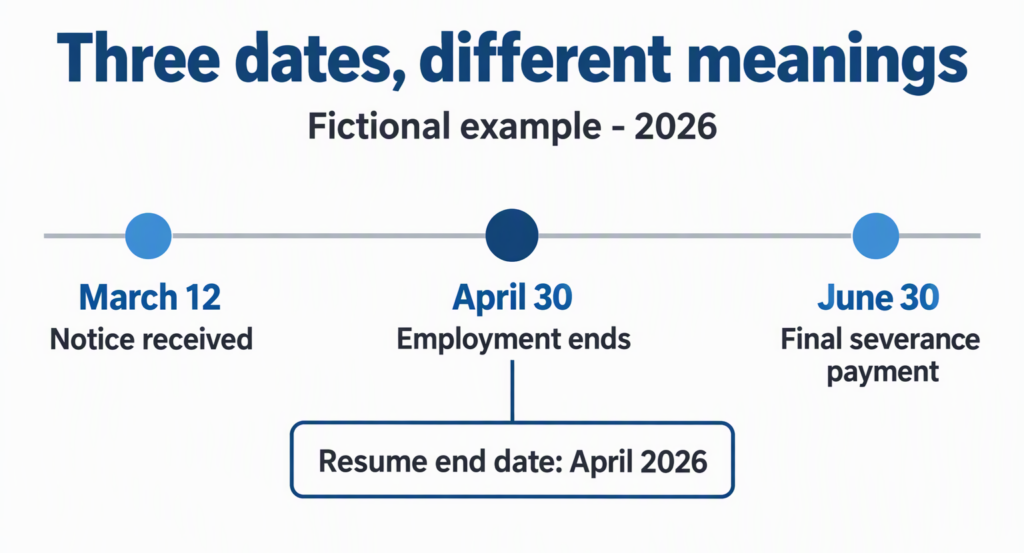
For that example, the resume entry ends in April 2026. A form requesting the exact employment end date gets April 30, 2026. Neither the March notification nor the June payment replaces it.
A useful question for HR is: “What employment end date will your records show, and who handles verification requests?” Keep the response with your job-search records. If a form separately asks for your last day performing work, answer that specific question too.
Write the reason for leaving in plain language
“Seeking new opportunities” describes what you’re doing now. It doesn’t explain why the previous employment ended.
Use the shortest accurate explanation that answers the field. These examples are alternatives for different circumstances, not interchangeable ways to soften the same event:
| What actually happened | Possible wording | Check before using it |
|---|---|---|
| Your role was cut in a restructuring | Laid off during organizational restructuring. | The employer identified restructuring as the reason. |
| Your workplace closed | Position ended when the Cleveland location closed. | The location closed; don’t imply the whole company did. |
| Your position alone was eliminated | Position eliminated. | You don’t need to invent a wider round of cuts. |
| A fixed-term assignment ended as scheduled | Fixed-term contract completed. | This was the agreed end of an assignment, not a layoff you are relabeling. |
If the form offers “Layoff” or “Position eliminated” and that accurately describes the event, select it. Use an explanation box when the category alone leaves a material ambiguity. If none of the options fits, follow any help text or ask the recruiting contact how to record the situation.
Avoid guessing at finances, blaming a manager, or borrowing a layoff percentage from a news story about a different division. If the only confirmed information is that your position was eliminated, that is enough to say.
You also don’t have to add “not performance-related” automatically. Include it only when you know it is accurate and it answers the question being asked. A dismissal for performance or misconduct needs its own truthful explanation.
Read “terminated” questions before choosing an answer
“Why did you leave?” and “Have you ever been dismissed for misconduct?” ask different things. An application may also define terms or specify a period of time. Read the entire question, including its help text, before applying a generic yes-or-no answer.
The federal OF 306 declaration, for example, combines several separation situations in one question and gives a specific lookback period. That wording should not be treated as identical to a private employer’s dropdown.
If a form uses “terminated” without explaining its scope, don’t assume it means only misconduct, or that the word decides how to describe a layoff. Ask for clarification when the distinction affects your answer. Keep the wording and any written response so you can answer consistently later.
Once the question is clear, provide the requested facts. A brief explanation can distinguish a position elimination from an accusation about your conduct without changing what happened.
Connect the explanation to the work you want next
A cover letter can address the transition when that context helps the reader. It doesn’t need to become a second account of the separation. Lead with a relevant qualification, add the context briefly, and connect your experience to a responsibility in the vacancy.
For the fictional coordinator above, an excerpt might read:
At Harborline Supply, I built an order-exception tracker that connected sales and warehouse follow-up. My position ended during an April restructuring. Your operations role’s emphasis on shipment coordination is a close match for that work.
In an interview, you have room to answer a follow-up. Prepare a natural response rather than a memorized defense:
My position was eliminated during the company’s April restructuring. Before that, I coordinated order exceptions and improved our shift handoffs. I’m looking for a role where I can keep solving those day-to-day coordination problems, which is what interested me in this opening.
If the interviewer asks about a particular project, move into the example. If they ask about the separation, answer the additional question directly. You don’t need to keep returning to the layoff once the conversation has moved to your work.
Prepare for verification if the employer is hard to reach
A closed office or inactive HR inbox creates a practical problem: who can confirm the job? Keep records you are entitled to retain, such as your employment and separation letters and relevant pay documents. Don’t take client files or proprietary project material to prove you worked there.
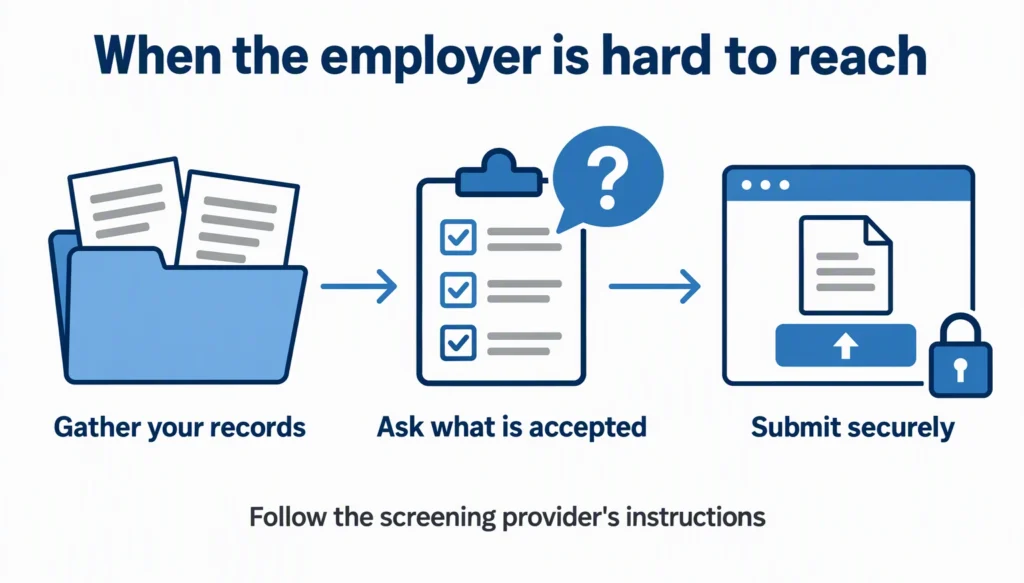
Checkr’s U.S. guidance explains that, when other verification methods fail and document collection is enabled, it may review records such as W-2s or pay stubs. That is one provider’s process, not a universal document list. Ask the hiring team or its screening provider what it needs and where to submit it securely. A tax form may support employment in a year without proving the exact final day.
If the report contains an error, respond to the reporting company with the disputed detail and copies of supporting evidence; tell the recruiter as well. The Consumer Financial Protection Bureau recommends this written dispute process. Don’t change an accurate resume merely to match an inaccurate report.
Make the next application easier
Before submitting, put your resume beside the completed application and check the affected role once: title, dates, and any explanation. Save that version with the vacancy. You’ll then have a clear record to work from when an interview invitation arrives.
FAQ
These situations call for a little more judgment than choosing a phrase from a dropdown.
What if I’ve been laid off more than once?
Treat each event separately. A site closure and a later restructuring can have different explanations; don’t compress them into one sweeping claim about the industry. Add brief notes only where they help interpret individual roles, and keep the progression in responsibilities visible. If asked about the pattern, explain both events without inventing a promise that your next employer will never cut jobs.
Should I add “Unemployed” as my current job?
You generally don’t need a placeholder job on the resume. If you’ve been looking for work, don’t create a consulting role or course entry to cover that time. Include actual relevant projects, study, or paid work under accurate labels when you have them. An application or screening form may separately require gap dates and explanations; complete those fields as instructed.
What if I already submitted a resume with the wrong end date?
Correct the file and contact the recruiter with a short factual update, identifying the role and corrected date. If a background check is underway, ask how to correct the submitted history through that provider’s process; don’t assume uploading a new resume updates it. Keep a copy of the correction and use the accurate date in future applications.
Can I apply after receiving notice but before my employment ends?
Yes. If you are still employed, “Present” can accurately describe the current role. When asked why you’re looking, explain that you’ve received notice of an upcoming position elimination. Give the confirmed future end date if it’s relevant, and discuss your realistic availability rather than promising an immediate start. Update the resume and any ongoing application where needed once your employment status changes.