

“Calm under pressure” sounds right for emergency communications. But on a resume, it leaves the most useful question unanswered: what have you actually done that shows it?
Build your application around specific evidence of listening, accurate documentation, sound judgment, and clear communication. Include a short profile, relevant work history, technical skills, education, and any applicable credentials. Experienced applicants should identify their call-taking and dispatch responsibilities; beginners can show the related habits they’ve developed in other work.
You don’t need a dramatic rescue story. A precise account of how you collect information and follow procedures gives the reader something useful to assess.
Read the posting before choosing your strongest evidence
Two jobs can use similar titles and ask for different experience. A call-taker receives and records information; a radio dispatcher assigns or communicates with response units. Some positions combine these functions. Read the duties to see which work the employer needs.
O*NET’s occupational profile includes questioning callers, documenting incidents, interpreting maps, monitoring unit availability, and relaying messages. Use that as a way to recognize relevant experience, then narrow your resume to the actual vacancy.
| If the posting emphasizes… | Look for evidence of… | Keep the wording honest |
|---|---|---|
| Call-taking | Clarifying locations, asking focused questions, recording details | Customer calls can show listening skills without becoming emergency-call experience. |
| Radio dispatch | Unit status, radio traffic, field updates | Name the services you actually supported. |
| Computer-aided dispatch (CAD) | Entering and updating incident records | List systems you’ve used; a customer database is not CAD. |
Separate requirements needed when applying from qualifications that must be earned after hire. The National 911 Program notes that agencies may have their own educational standards. Before paying for a course, check the employer’s training arrangements and any applicable state requirements.
Prepare the full application
Know what the employer needs beyond the resume. As you put the application together:
- Check any typing requirement against the posting. Portland specifies 40 net words per minute with 90% accuracy; other employers may differ. If you list a result, use a recent timed test and identify the test/date when requested. A practice score doesn’t replace an employer’s assessment.
- Complete the employment-history and supplemental fields. Don’t substitute “see resume” when details are requested. Reconcile job titles and dates with your records, and follow any requirement to disclose a fuller history than the resume contains.
- Make relevant skills specific. Give your actual language proficiency and software experience. Avoid rating bars or a long list of unsupported traits.
- Keep the layout straightforward. Use readable text and consistent dates. One page is a sensible target for a beginner; relevant experience may justify a second. Check the final file for typos, cut-off text, and missing contact details.
Two examples you can adapt
These condensed samples use fictional people, employers, schools, dates, and accomplishments. Borrow their structure, then replace the content with your own verifiable history. Each profile gives the reader context; the experience section supplies the evidence.
Example one: an experienced telecommunicator
This applicant is seeking a role involving police call-taking and radio dispatch. The sample keeps that scope clear instead of implying experience across every emergency service.
Morgan Ellis
Richmond, VA | morgan.ellis@example.com | 804-555-0142
Profile
Public safety telecommunicator with experience receiving police service requests, maintaining incident records, and communicating updates to field units. Supports continuity between shifts through clear documentation and handoffs.
Experience
Public Safety Telecommunicator | Example County Emergency Communications
Richmond, VA | September 2022–Present
- Question emergency and non-emergency callers to confirm locations and clarify the nature of incidents.
- Enter call details into CAD and relay changing information to responding police units under agency procedures.
- Monitor radio traffic and unit status, recording updates for active incidents.
- Help two new colleagues practice incident documentation during supervised training sessions.
Customer Service Representative | Example Service Center
Richmond, VA | July 2019–August 2022
- Resolved account inquiries and documented unresolved issues for the next representative.
Technical Skills
CAD record entry; radio communications; map reading; incident-log maintenance.
Training
Agency call-taking and police radio dispatch program — completed March 2023.
Education
Example High School, Richmond, VA
High School Diploma
June 2019
Replace the generic CAD wording with your platform’s name if you can accurately describe your experience with it. If you’ve held a formal trainer or supervisory assignment, identify that role rather than leaving the reader to infer it from a mentoring bullet.
Example two: moving from customer service into a trainee role
This applicant hasn’t worked in emergency communications. The value comes from specific experience handling calls, clarifying information, and passing unresolved matters to the right person.
Jordan Lee
Portland, OR | jordan.lee@example.com | 503-555-0168
Profile
Customer service representative seeking a public safety communications trainee position. Experienced in telephone support, accurate account notes, and escalating concerns under established procedures.
Experience
Customer Service Representative | Example Home Services
Portland, OR | September 2023–Present
- Confirm customer addresses and callback numbers before scheduling service visits.
- Ask focused questions to clarify complaints and record the details while speaking with customers.
- Explain next steps to frustrated callers and escalate unresolved concerns to the duty supervisor.
- Keep appointment changes and follow-up notes current for colleagues handling later calls.
Volunteer Information Assistant | Example Community Center
Portland, OR | September 2022–August 2023
- Answered visitor questions and directed requests to the appropriate staff member.
- Maintained attendance records and reported discrepancies to the program coordinator.
Skills
Multi-line telephone systems; customer-record software; Microsoft Word; accurate data entry.
Education
Example High School, Portland, OR
High School Diploma
June 2023
For a first job, relevant volunteer work or a school responsibility can take the place of paid experience. Keep its real title and setting. A short, truthful example is more useful than claiming “crisis management” because you once dealt with an unhappy customer.
Turn a duty into a bullet the reader can picture
“Handled calls” tells the reader very little. Add the task, the information involved, and its purpose. UC San Diego’s Career Center recommends an action verb plus a specific task and a purpose or result.
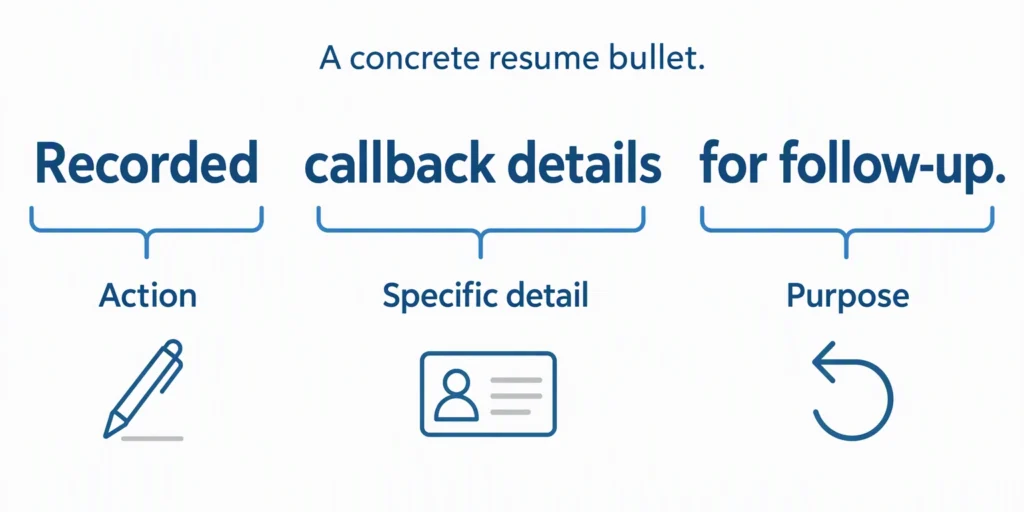
For example, replace “Good at multitasking” with “Updated incident notes while monitoring radio traffic and relaying new information to field units.” Use it only if those tasks were part of your job. Someone who handled call intake without radio duties needs a different bullet.
Add numbers when they clarify your contribution
Useful measures might include a documented call-volume range, the number of trainees you supported, or results from a defined quality review. Give the period and context: “Averaged [number] calls per [shift length] during [period].” Don’t borrow the total for the entire center.
Be especially careful with response-time claims. An ambulance’s arrival depends on more than the person answering the phone. If you helped improve call-processing time, identify that measure and your contribution instead of claiming you made all emergency responses faster. Without reliable figures, describe the procedure, scope, or documented improvement.
Make education and training easy to verify
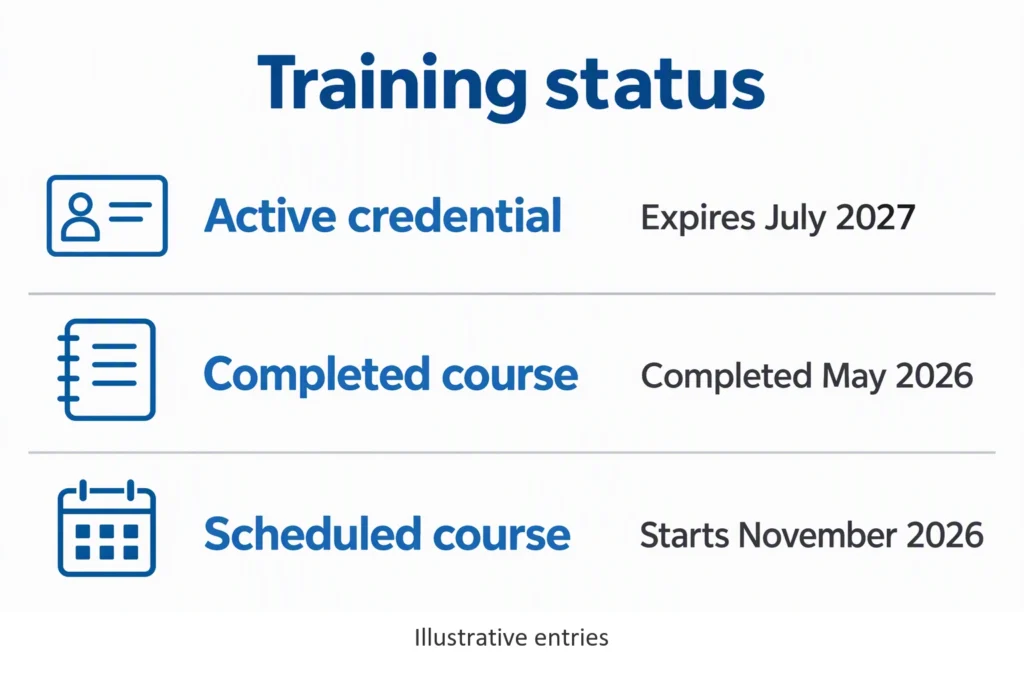
A certificate name is a factual claim. Copy its exact title and issuing organization, then include its completion date or current expiration date as appropriate. Keep completed training separate from professional certification.
For example, the International Academies of Emergency Dispatch requires an approved course, a passing exam, and CPR certification for its Emergency Medical Dispatcher credential. Attending the course alone does not establish that you hold the certification.
A credential entry could read “Emergency Medical Dispatcher (EMD) — International Academies of Emergency Dispatch; expires [Month Year].” If training is booked but unfinished, put it under Training as “[Course name] — scheduled [Month Year],” provided you’re actually enrolled. An expired credential must not look current.
For education, name the school, the qualification earned, and the completion date. If a program is unfinished, state its actual status. Relevant college study can help describe your preparation, but don’t assume a criminal justice degree is required: both Portland and Montgomery County list a high school diploma or equivalent among their qualifications.
Leave yourself ready for the interview
Save a copy of the submitted application and choose a real example behind each major claim. Be ready to explain what happened, what you did, and how you knew the next step to take. That preparation turns the document into a useful starting point for the conversation.
FAQ
These questions cover details that may need a different place in the hiring process.
Should I include a CritiCall result as a certification?
No. CritiCall is a skills assessment used in hiring, not a professional dispatcher credential. Provide a score or test record if the employer requests it, and check whether it accepts prior results. Don’t label yourself “CritiCall-certified.”
Can I include an observation or job-shadowing visit?
Yes, if it’s relevant and space allows. Label it as observation, with the agency, date, and what you learned. Watching an employee take calls does not establish that you performed those duties yourself.
Where should I mention night or weekend availability?
Use the application’s availability questions or a requested cover letter. If the posting specifically asks for it on the resume, add a short, accurate line. Don’t promise unrestricted availability unless you can meet it; training hours may also differ from the eventual shift schedule.