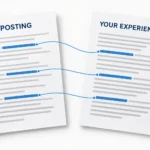

“Assisted with clinical trials” hides almost everything useful about your work. Did you schedule participant visits, prepare regulatory documents, resolve data queries, or do all three?
A strong application makes that work visible. Identify your study setting, describe the tasks you handled, name the systems you used, and list your education and current qualifications. An experienced coordinator can lead with study operations; someone entering the field can lead with relevant research, clinic, or academic experience.
You don’t need to sound like the principal investigator. You need to show what the team could trust you to handle.
Read beyond the job title
“Coordinator II” doesn’t mean the same thing everywhere. Emory’s classification accepts several education-and-experience combinations. A current Michigan Medicine intermediate posting requires directly related experience and certification within six months of hire, with exam eligibility at hire. Read the actual minimum requirements before choosing a template.
Check the required attachments, too. That Michigan posting asks for the cover letter as the first page of the resume file. Follow the vacancy’s submission instructions, including any specified file format.
Then identify the kind of work the vacancy emphasizes:
| Posting emphasis | Evidence to bring forward | Detail that adds context |
|---|---|---|
| Participant visits | Scheduling, approved recruitment, screening support, follow-up | Population, visit schedule, language skills |
| Regulatory coordination | IRB submissions, amendment tracking, essential documents | Your submission role and review process |
| Study data | Source documentation, data entry, query follow-up | System used and checks performed |
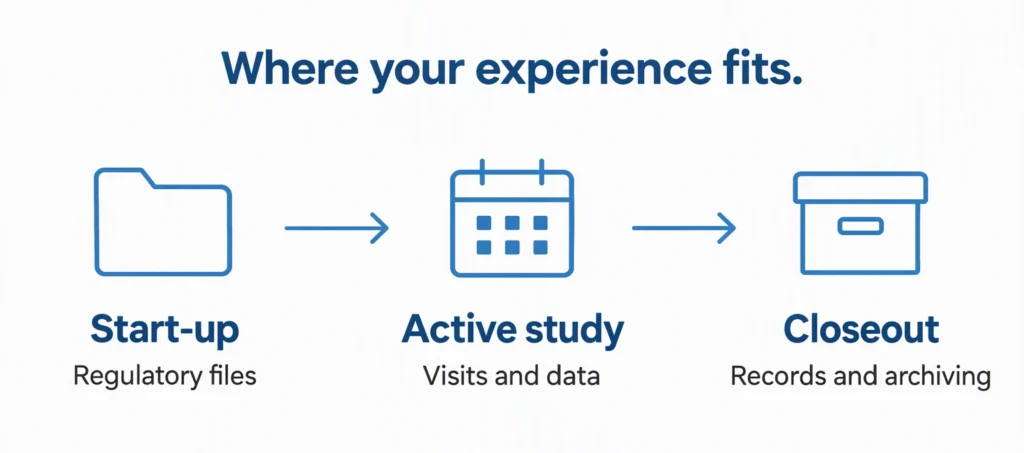
| Site operations | Start-up, supplies, monitor visits, closeout | Study type and stages you supported |
An institutional review board (IRB) reviews human-subjects research. Spell out unfamiliar abbreviations when they first appear in your application, then use the abbreviation naturally.
Clinical duties also vary. Describe consent discussions, specimen collection, or safety reporting only within your actual training and delegated responsibilities. Preparing records for investigator review is valuable work; don’t turn it into a claim that you independently made medical decisions.
Two examples to build from
These condensed examples use fictional people, organizations, dates, and experience. Adapt the structure with your own facts. Keep roles newest first within each section; give the most relevant work the most space.
Use straightforward section labels, readable type, and a simple single-column layout. Start with one page for a newer applicant; use a second when relevant study experience earns the space.
An experienced coordinator
This applicant emphasizes visit coordination and data quality for an outpatient research site. The summary establishes the setting; the bullets supply the evidence.
Jordan Lee
Durham, NC | jordan.lee@example.com | 919-555-0142
Summary
Clinical research coordinator with four years of experience supporting outpatient studies in endocrinology. Coordinates protocol visits, maintains study records, and follows data queries through documented resolution with investigators and study teams.
Experience
Clinical Research Coordinator | Example Research Center, Durham, NC
August 2022–Present
- Coordinate follow-up visits across four active studies, checking protocol windows and arranging required laboratory appointments.
- Maintain screening logs and assemble eligibility documentation for investigator review.
- Enter visit data in Medidata Rave, compare entries with source records, and resolve queries with documented clarification from the study team.
- Prepare amendment materials for IRB review and track approved consent versions in study files.
- Organize records for monitoring visits and track assigned follow-up items through completion.
Skills
Medidata Rave: data entry and query response; Epic: authorized chart review; Excel: visit trackers; participant scheduling; regulatory document control.
Education
Example University, Durham, NC
Bachelor of Science in Biology
May 2022
Training
Good Clinical Practice course | Example Research Center | Completed February 2026
An applicant moving into research
This applicant has clinic experience and a relevant class project. Keeping them in separate sections makes the evidence easy to assess without presenting coursework as employment.
Taylor Morgan
Columbus, OH | taylor.morgan@example.com | 614-555-0168
Summary
Public health graduate with outpatient scheduling experience and academic training in research methods. Brings careful record handling, patient communication, and experience checking datasets to an entry-level study support role.
Education
Example State University, Columbus, OH
Bachelor of Science in Public Health
May 2026
Relevant Experience
Patient Services Assistant | Example Community Clinic, Columbus, OH
June 2024–Present
- Schedule appointments and relay preparation instructions supplied by clinical staff.
- Check registration records for missing information and route corrections through the clinic’s established process.
- Send patient messages to the appropriate care team without offering clinical advice.
Academic Project
Research Methods Capstone | Example State University
January–May 2026
- Reviewed a public health dataset in Excel, flagged missing values, and maintained a log of cleaning decisions.
- Presented findings and study limitations in a team report, identifying personal contributions to the analysis.
Skills
Appointment scheduling; medical terminology; Excel filters and data checks; confidential record handling.
If you have no clinical experience, use relevant research-assistant work, volunteering, or projects that demonstrate comparable tasks. A literature review can show research skills; it doesn’t establish experience obtaining consent or coordinating a trial. Check that the vacancy accepts your background.
Write bullets that hold up in an interview
Start with action + specific work + purpose or result. “Maintained study documents” leaves questions. “Tracked protocol amendments and replaced superseded materials in active study files after approval” shows what you maintained and how.
Choose evidence that fits your responsibilities:
- Scope: Concurrent studies, therapeutic areas, participating sites, or the study stages you supported.
- Workload: Visits scheduled per month, records reviewed, or submissions prepared over a stated period.
- Quality work: Discrepancies investigated, missing documentation followed up, or a checklist adopted by the team.
Use numbers you can explain. Distinguish people approached, screened, and enrolled; those counts measure different activities. If you claim faster query resolution, know the comparison period and how turnaround was measured. If you don’t have that evidence, describe the work plainly.
Avoid “ensured 100% compliance” and “achieved zero adverse events.” Neither explains your contribution, and an absence of adverse events is not a coordinator performance measure. A credible safety-related bullet might read: “Documented participant-reported symptoms and promptly escalated them to the investigator according to study procedures.” Use it only if it reflects your assigned work.
Make software skills specific
A list of platform names doesn’t tell an employer what you can do inside them. An electronic health record (EHR), an electronic data capture (EDC) system, and a clinical trial management system (CTMS) serve different purposes. Name the product and the tasks you’ve performed.
For example, “OnCore CTMS: maintained participant visit status” is more informative than “OnCore proficiency.” Someone who entered data in REDCap shouldn’t imply they designed its databases.
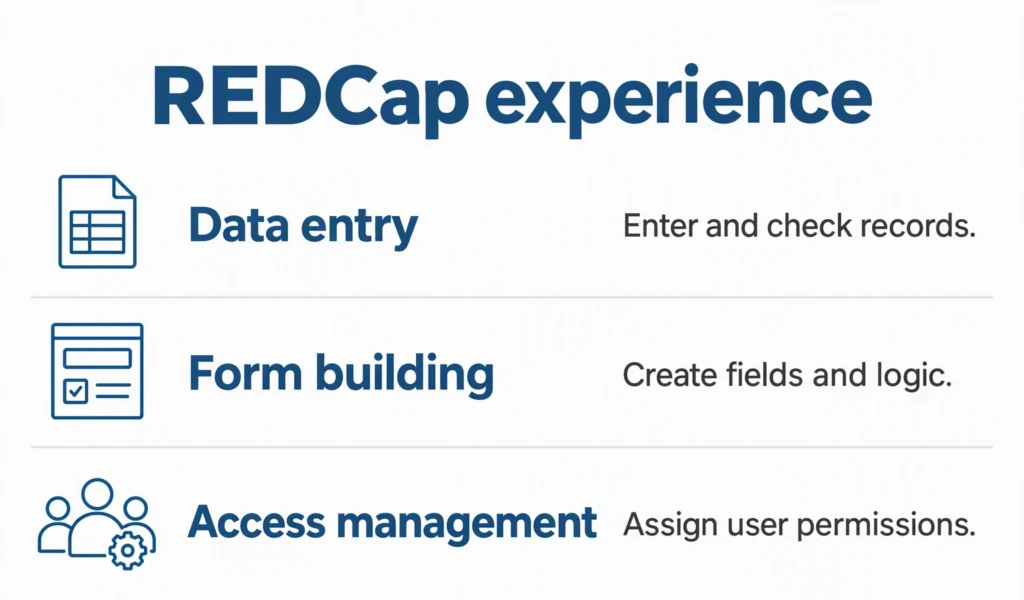
Use the posting’s terminology where it accurately describes your experience. Separate a completed software course from hands-on workplace use. Skip star ratings and percentage bars; a short task description is easier to interpret.
Give education and credentials their own space
List the institution, location, exact degree, and completion date. For a degree underway, use “Expected” with the anticipated graduation month and year. Relevant coursework can help a newer applicant; an experienced coordinator usually has stronger evidence in their work history.
Use separate Certifications and Training sections when you have both. ACRP awards the Certified Clinical Research Coordinator (CCRC) credential; SOCRA awards the Certified Clinical Research Professional (CCRP) credential. Both have eligibility and examination requirements. Completing a Good Clinical Practice (GCP) course does not, by itself, earn either credential.
For an active certification, include its full name, issuer, and accurate validity information. For training, copy the course title and provider from your completion record, followed by the completion date. Don’t change an older course’s label to “E6(R3)” unless that version was actually covered.
List nursing or other clinical licensure when relevant to the posting, with its accurate status and jurisdiction. A coordinator job title alone doesn’t establish clinical authorization.
Make the final version easy to trust
Read the finished document aloud once, then open the exact file you’ll upload. Fix any line you couldn’t explain confidently in an interview, and check that the exported version is as easy to read as the draft.
Frequently Asked Questions
The following situations need a little extra judgment when deciding what to include.
Should I name the trials or sponsors I worked with?
Use public, permitted information only. A therapeutic area, study type, and your responsibilities may provide enough context. Leave out participant identifiers, confidential protocol details, and internal sponsor documents; check employer obligations before naming a study or sharing work samples.
What if my experience is in observational research?
Describe it as observational research. Cohort follow-up, participant communication, records, and data checks can be relevant. Don’t add a drug-development phase to a study that doesn’t have one; explain the design and your contribution in ordinary language.
Should I include publications or posters?
Include selected relevant work when you are a credited author or presenter, using the correct citation and status. Keep a submitted manuscript distinct from an accepted publication. If your contribution did not earn authorship, describe the work under the relevant position instead.
Can I reuse this application for a clinical research associate role?
Use it as a starting point, then rebuild it around that vacancy’s duties. Supporting a monitor’s visit at your site differs from independently monitoring other sites. Make that distinction clear instead of changing your job title or claiming monitoring experience you haven’t gained.