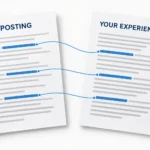

You’ve started the job. You haven’t finished onboarding. Now someone wants your resume, and the newest entry feels almost empty.
If the role helps explain your experience or current situation, you can include it now. Put it first within the appropriate experience section, using your actual title, employer, and start month and year–Present. Add a short description of work you’ve genuinely begun or completed. If there isn’t any yet, a simple entry is better than borrowing achievements from the job posting.
The question isn’t whether you’ve earned enough weeks to mention the job. It’s what the entry helps this particular reader understand.
Decide what the new role contributes
Start with the vacancy you’re responding to. Does your new job show relevant work, a move into the field, or a qualification the reader would otherwise miss? Even a small amount of closely related experience can be useful.
MIT’s career guidance recommends choosing experiences that demonstrate the skills required by the target position. That gives you a better selection rule than “include everything” or “leave off anything under three months.”
For example, a recent support role may strengthen an application for another customer-facing position. A brief unrelated weekend job might add little when several years of directly relevant work already fill the page. You can keep that weekend job in your private master history without giving it space in every application resume.
Consider the overall story, too. If leaving out the new role would make your current situation confusing, a compact entry can clarify it without dominating the document. Don’t extend the previous job’s dates to conceal the transition.
When an application asks for all employers during a specified period, follow that request separately. Checkr’s U.S. guidance illustrates how screening requirements can vary by the employer’s chosen lookback period and number of positions. Read what your actual form asks, including questions about current employment.
Write the entry for the stage you’re actually at
The following examples are fictional. They show how the same role could look at different stages, not a schedule you must follow.
If you’re still in orientation
You can stop at the basic entry when you haven’t begun meaningful assignments:
Ridgeway Software, Boise, ID
Customer Support Associate | September 2026–Present
There is no need to fill the space with “learning company systems,” “attending meetings,” or a promise to improve customer satisfaction. Routine onboarding may not tell the next employer much. A completed training project can be worth mentioning if it demonstrates a relevant skill, but identify it as training rather than production work.
If you’ve started handling real assignments
Once you have something specific to show, add it. UC San Diego’s resume guide recommends describing your own contribution and using an action, a specific task, and its purpose or result.
Ridgeway Software, Boise, ID
Customer Support Associate | September 2026–Present
- Respond to account-access questions through the support queue and document unresolved cases for technical escalation.
- Drafted a password-reset reply template that the team lead approved for use in customer responses.
The first bullet describes ongoing work. The second records a finished contribution. Neither needs an invented percentage or a claim that the employee transformed the department.
If the template is still awaiting review, the second bullet should say “Drafted a password-reset reply template for team-lead review.” Approval is a fact to verify, not a stronger verb you can choose for effect.
Turn early work into evidence, not promises
A small finished task can be more informative than a big responsibility you’ve only been assigned. Look for an output someone can understand: a documented process, a resolved issue, a checked dataset, or a draft handed over for review.
This visual shows the questions to ask before turning a work note into a bullet:
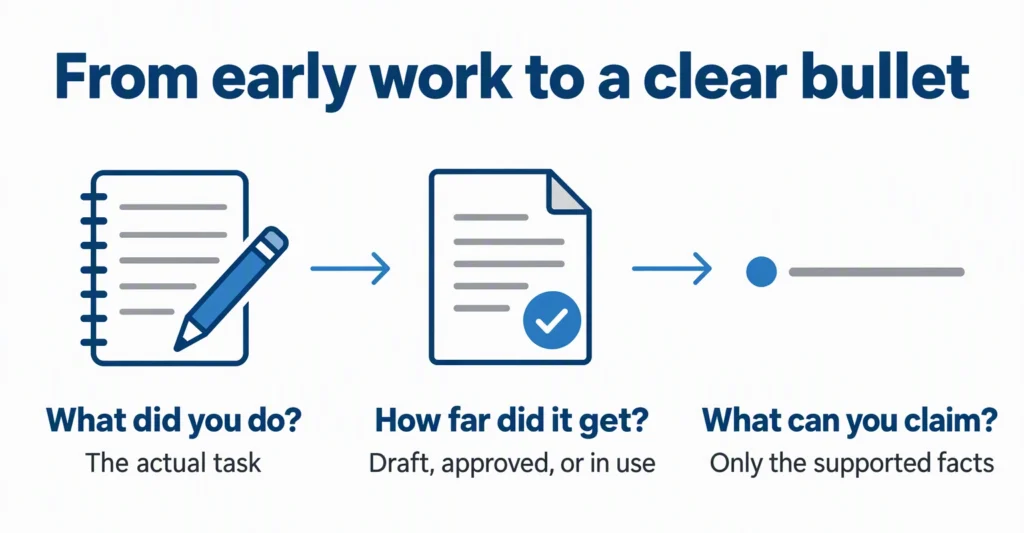
Use the distinction below to edit a draft. These are illustrative wording choices; only use one that matches your work.
| What you know | Useful wording | What would overstate it |
|---|---|---|
| You completed a practice task during training | Completed a training exercise using the ticket-escalation process. | Managed technical escalations independently. |
| You are preparing a draft for review | Draft a troubleshooting checklist for supervisor review. | Introduced a new company-wide troubleshooting system. |
| A team approved and uses your output | Created an approved checklist for new-account support calls. | Reduced call times without supporting measurements. |
Don’t copy your current employer’s job description and change the verbs. It describes the position’s intended scope, which may include work you haven’t touched. Start with your own work notes instead.
Keep a short private log as you settle in: the task, your part, the date, and the status. “Prepared the first draft; manager reviewing” is useful raw material. Later, you can update it when approval or a result actually happens. Keep the notes free of customer data, credentials, and confidential company material; a resume does not need those details.
Keep dates, titles, and verbs accurate
Use the month your employment actually started. The offer date, first interview, and date you added the entry aren’t substitutes. If your paid orientation and first regular shift fell in different months, check the official start date rather than guessing.
Use “Present” only while the role is current. Give the previous position its actual end date, even if both dates fall in the same month. There is no need to invent a gap between jobs to make the timeline look tidy.
For ongoing duties, use present-tense verbs such as “respond,” “prepare,” or “maintain.” Use past tense for a completed contribution such as the approved template above. A current job can contain both when the verbs accurately distinguish ongoing work from finished work.
If you just moved into a different role at the same company, show the new title and its own start date above the earlier position. Don’t apply the company’s original hire date to the new title: that would exaggerate how long you’ve held it. Keep relevant achievements with the role in which they happened.
Explain why you’re looking without writing a defense
Adding the job may lead to a reasonable question: why consider another move so soon? Prepare an answer, but don’t make the resume a long explanation of workplace disappointment.
Describe the specific issue truthfully and connect it to what you’re looking for. In this fictional example, the employee’s required schedule changed after hiring:
I started in September, and the position now requires regular overnight coverage that I can’t sustain. I’m looking for a daytime support role where I can use my customer-service experience. Your posted schedule is one reason this opening caught my attention.
That answer gives the interviewer something concrete to discuss. “The culture was terrible” leaves much more unexplained. Don’t borrow the schedule explanation if it isn’t your reason; choose the facts of your own situation.
The next conversation should help you assess the new opportunity. Ask about the hours, responsibilities, or working arrangement that matters to your decision. A clearer understanding now is more useful than polishing a vague “better fit” explanation after another mismatch.
Set expectations about contacting your employer
If your current employer doesn’t know you’re searching, raise contact preferences with the recruiter before reference or verification outreach begins. Listing a company is not the same as choosing your current manager as a reference.
Keep these three steps separate:
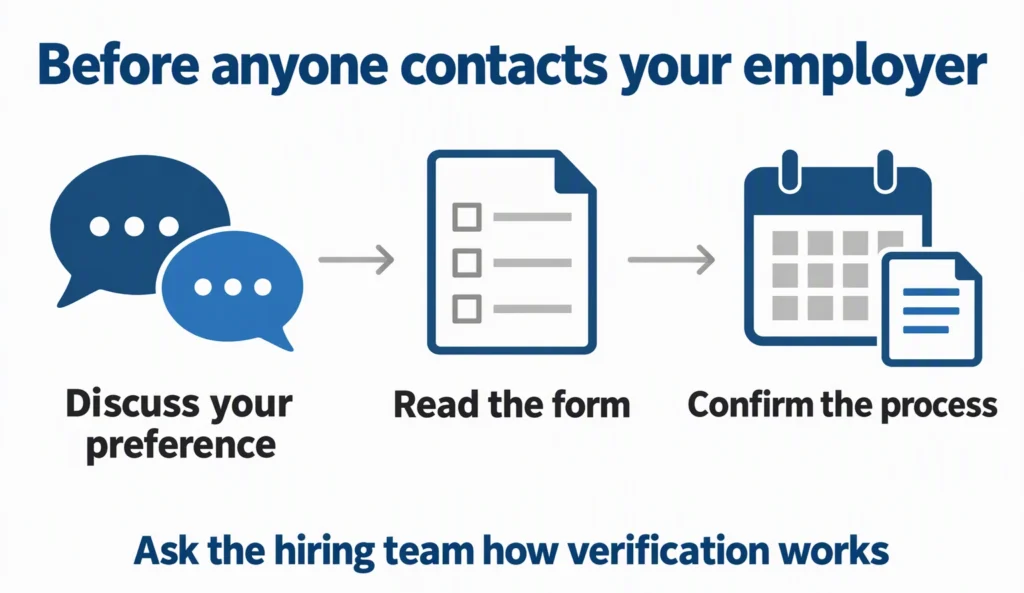
Checkr, for example, offers candidates a “Do not contact this employer to verify my employment” option for current employers. That is a specific provider’s feature, not a universal rule. Read your invitation and ask the hiring team how it handles confidential searches and any alternative evidence.
A short request is enough: “My current employer isn’t aware of my search. Please discuss any contact with me in advance.” Confirm the arrangement; don’t assume that writing this sentence on a resume controls every later screening step.
Give the entry room to grow
Save the version you submit, then revisit the new role after your next meaningful assignment. Add stronger evidence as it becomes available and remove early details that no longer earn their space. Your resume can grow with the job without pretending the experience arrived on day one.
FAQ
These timing questions need a different treatment from an ordinary current-job entry.
What if I’ve accepted the offer but haven’t started?
Don’t use “Present” or describe duties as experience. If the confirmed future role is relevant enough to include, label it clearly, such as “Incoming Customer Support Associate — starting November 2026.” Leave out accomplishment bullets. An offer alone doesn’t show that you’ve performed the work, and you can omit the future entry if it doesn’t help the application.
What if the job starts and ends in the same month?
If you include it, show the accurate month and year, such as “September 2026,” rather than implying it’s ongoing. A form may request exact dates, which you should provide there. Describe only work you actually completed; a short tenure doesn’t turn promised responsibilities into achievements.
Do I need to resend a resume after starting a job?
If you’re already speaking with a recruiter, a brief update can keep that conversation current. Ask whether they’d like the revised file and explain what changed. Don’t assume replacing an attachment in an account updates every submitted application or a screening form already in progress.
Should I write “probationary” beside the job title?
Usually, you can use the actual job title without an extra label. Don’t replace an official “trainee,” “intern,” or temporary designation with a more senior title, though. If an application specifically asks about employment status or probation, answer that question as requested.