
Two resumes land in the same inbox on the same Tuesday morning. Same person, honestly — same job, same eight years, same company logos in the same order. The only difference is the words.
The first one opens with this: “Hardworking, detail-oriented team player with a passion for excellence and a proven track record of results-driven performance.”
The second one opens with this: “Accounts payable specialist who cut invoice errors 31% by rebuilding a reconciliation checklist nobody had touched since 2019.”
You already know which one got the call. And here’s the part that stings a little — the first candidate wasn’t lying. They are hardworking. They are detail-oriented. Every word in that sentence is true.
It just doesn’t land, because the recruiter has read that exact sentence four hundred times this year and it has stopped carrying any meaning at all. It’s become white noise in a nice font.
So let’s get the thesis out of the way early, because the rest of this guide hangs off it: adjectives aren’t the problem. Unearned adjectives are.
There’s a whole genre of career advice out there that tells you to strip every adjective from your resume and write nothing but cold verbs and colder numbers. That advice is wrong, and following it makes you sound like a spreadsheet. Adjectives are how you tell someone what kind of worker you are — not just what you did, but the texture of how you did it.
A “methodical migration” and a “scrappy migration” are two very different projects, and a recruiter reading between the lines learns something real from that one word.
The trick is that every adjective on your resume is a claim. And every claim on your resume is a promise that you can defend it in an interview.
Write “meticulous” and you’d better have a story about the time your meticulousness caught something expensive. Write “strategic” and someone is going to ask you what strategy you set and what it cost. The adjective you choose is, quite literally, the question you’re inviting.
That’s the frame. Adjectives are seasoning — they make the dish taste like something. But nobody has ever ordered a plate of salt.
Over the next several thousand words, we’re going to walk through what a resume adjective actually is and how it differs from an action verb (they’re not the same thing, and confusing them is the single most common mistake I see), the uncomfortable truth about whether adjectives help you with applicant tracking software, a one-sentence test you can run on any line of your resume in about ten seconds, a bank of more than three hundred adjectives sorted by what they actually signal, industry-by-industry and stage-by-stage recommendations, a graveyard of twenty-five words you should probably delete tonight, and a gallery of before-and-after rewrites you can steal shamelessly.
Grab your resume. Open it in another window. This works best if you’re editing as you read.

Key Takeaways
- An adjective is a claim, and a claim needs evidence. If you can’t name the moment that proves the word, the word is decoration — cut it or earn it.
- Adjectives and action verbs do different jobs. The verb says what you did. The adjective says how you did it. The number says it actually happened. You need all three.
- Applicant tracking systems mostly don’t care about your adjectives. They score hard-skill nouns — tools, certifications, job titles, named methodologies. Bare adjectives like “team player” score close to nothing. Write adjectives for the human, not the robot.
- Density matters more than vocabulary. Roughly one earned adjective per two or three bullet points reads as confident. One per line reads as insecure. Zero in your skills list, always.
- Twenty-five words are doing you active harm. Hardworking, results-driven, passionate, self-starter, synergistic, rockstar — and nineteen more we’ll bury properly later.
- Match the job posting’s own language. If the description says “collaborative,” use “collaborative,” not “synergistic.” Mirroring is free and it works on both the human and the software.
- Simple beats fancy. “Efficient” outperforms “efficacious” every single time. Thesaurus inflation is the fastest way to sound like you’re hiding something.
What Is a Resume Adjective, Really?
Let’s define this properly, because the term gets used loosely enough that half the advice on the internet is answering a different question than the one you’re asking.
A resume adjective is a descriptive word that modifies a noun on your resume — usually you, your work, your approach, or a thing you built. Analytical analyst. Cross-functional team. Scalable architecture. Meticulous records. It answers the question what kind? rather than what happened?
That distinction sounds academic until you see what happens when people get it wrong. Here’s a bullet point I’ve seen some version of a hundred times:
Responsible for hardworking and dedicated management of the client portfolio.
There’s no verb doing any work in that sentence. “Responsible for” is a placeholder, not an action. “Hardworking” and “dedicated” are adjectives that have been shoved into the position where the evidence should be. The sentence describes an attitude and calls it an accomplishment. Compare:
Managed a 40-account client portfolio and renewed 92% of it through a quarterly check-in cadence I designed and ran solo.
Same job. The second version has one adjective doing precise work (“quarterly”), a real verb (“managed,” “renewed,” “designed”), and a number that makes the whole thing checkable. It’s shorter, too.
Adjective vs. Adverb
An adverb modifies a verb — it’s the -ly word describing how the action happened. Consistently delivered. Independently managed.
Adverbs are weaker than adjectives on a resume, as a rule, because they almost always signal a missing number. “Consistently exceeded targets” is just a fuzzy way of saying “exceeded targets in 11 of 12 quarters.”
If you catch yourself reaching for an adverb, check whether a number is hiding behind it. Usually one is.
Adjective vs. Action Verb
An action verb is the engine of a bullet point — built, launched, negotiated, migrated, reduced, trained, rebuilt. Every strong bullet should start with one.
Adjectives can’t do this job; a bullet that opens with an adjective (“Detail-oriented professional who…”) has already surrendered its most valuable real estate to a word that proves nothing.
Action verbs and adjectives are teammates, not substitutes — and the most common failure mode on a weak resume is trying to make the adjective do the verb’s work.
Adjective vs. Keyword
A keyword is usually a noun: Python, Salesforce, CPA, Kubernetes, HIPAA, Six Sigma, stakeholder management.
These are the things software actually looks for and the things a recruiter scans for when they’re filtering fifty candidates down to eight. Adjectives are rarely keywords.
This matters enormously and we’ll spend a whole section on it, because most articles about resume adjectives quietly imply the opposite.
Put simply: verbs and resume keywords get you found. Adjectives get you remembered. Both jobs are real. They just aren’t the same job, and the words that do one aren’t the words that do the other.
Adjectives vs. Action Verbs vs. Keywords — Who Does What
Here’s the whole thing laid out side by side, since seeing the four columns next to each other tends to make it click faster than any amount of explanation.
| Aspect | Action Verb | Adjective | Adverb | Keyword (Noun) |
|---|---|---|---|---|
| What it does | Names the action you took | Describes the quality or manner | Modifies the action, usually vaguely | Names a tool, skill, cert, or method |
| Grammatical job | The engine of the sentence | Modifies a noun | Modifies a verb | The thing being searched for |
| Example | Rebuilt, negotiated, migrated | Methodical, scalable, client-facing | Consistently, efficiently, successfully | Tableau, PMP, Agile, GAAP |
| Where it belongs | Start of every experience bullet | Sparingly, inside the bullet or summary | Almost nowhere — replace with a number | Skills section, bullets, headline |
| Does ATS score it? | Weakly | Barely, if at all | No | Yes — this is the main event |
| Does a human notice it? | Yes, strongly | Yes — this is where it earns its keep | Rarely, and often negatively | Yes, when scanning for fit |
| Fails when | It’s passive (“responsible for”) | It’s unearned (“hardworking”) | It’s used at all, usually | It’s stuffed or irrelevant |
The mental model I’d hand you is a three-legged stool. The verb is what you did. The adjective is how you did it. The number is proof that any of it happened. Knock out any one leg and the whole thing wobbles.
A bullet with only a verb and a number is accurate but flavourless: “Reduced ticket backlog 40%.” Fine. Forgettable. A bullet with only a verb and an adjective is warm but weightless: “Thoughtfully reduced the ticket backlog.” Nice, but why should I believe you? All three together is where it works: “Cleared a 6-week ticket backlog in 11 days by triaging on impact rather than arrival order — a scrappy fix that stuck and became the team’s default.” You’ve got the action, the quality of thinking, and the receipts.
Notice that in that last example, the adjective isn’t sitting in front of your name describing your personality. It’s describing the work. That’s the shift most people never make, and it’s most of the game.

The Uncomfortable Truth About Adjectives and ATS
Now for the part that most articles on this keyword won’t tell you, because it undercuts the premise they’re selling.
Roughly 97% of Fortune 500 companies run applications through an applicant tracking system before a human being ever opens the file.
That statistic gets quoted constantly, and it’s usually followed immediately by a list of “powerful adjectives to beat the ATS.” Those two things do not connect the way the article implies. Here’s what’s actually happening inside that software.
What an ATS Actually Scores
Applicant tracking systems rank resumes primarily by matching them against the language of the job description — and the language they match on is overwhelmingly nouns. Concrete, nameable, checkable things:
- Tools and platforms — Salesforce, Figma, SAP, Snowflake, AutoCAD
- Languages and frameworks — Python, React, SQL, Terraform
- Certifications and credentials — PMP, CPA, RN, CISSP, Series 7
- Job titles — the exact title from the posting, ideally word for word
- Named methodologies — Agile, Scrum, Lean, Six Sigma, HACCP, GAAP
- Domain terms — HIPAA, SOC 2, revenue recognition, prior authorization
Notice what isn’t on that list. “Hardworking” is not a search term any recruiter has ever typed into a candidate database. Nobody has ever filtered a talent pool by “passionate.”
When a resume optimization tool tells you your match score went up after you added “results-driven,” what almost certainly happened is that the phrase appeared in the job description too — and the system rewarded the overlap mechanically, not because the word means anything.
Vague adjectives match almost nothing. That’s not a criticism of adjectives; it’s just a description of what the software is built to do.
Where Adjectives *Do* Earn Their Keep With Software
There is a genuine exception, and it’s worth understanding precisely because it’s where most of the confusion lives.
Some terms look like soft skills but are actually named frameworks — and those absolutely score. “Cross-functional” appears in thousands of job descriptions as a literal requirement. “Stakeholder management,” “client-facing,” “customer-obsessed,” “data-driven,” “OKR-aligned,” and “agile” all straddle the line between adjective and industry keyword.
If the posting uses one of those phrases, mirroring it is genuinely worth doing, because the system is looking for that exact string.
The rule of thumb: if the adjective is a hyphenated compound that a hiring manager could plausibly search for, it might score. If it’s a personality trait your grandmother could apply to herself, it won’t.
Cross-functional — probably scores. Client-facing — probably scores. Data-driven — probably scores. Cheerful — no. Dedicated — no. Dynamic — absolutely not.
There’s also a frequency dimension worth knowing. Most systems weigh how often a term appears, not just whether it appears. Mentioning something important two or three times across your resume — once in the summary, once in a bullet, once in the skills list — genuinely helps.
But there’s a hard ceiling on this. Modern systems flag unnatural repetition, and recruiters spot it instantly. Two or three natural placements is the whole strategy. Beyond that you start reading like spam.
The Six-Second Human Read
Here’s why adjectives still matter enormously, even after everything above.
The ATS doesn’t hire anyone. It just decides which twenty resumes reach a human. Once you’re in that pile, the software’s opinion is irrelevant and a tired person with a coffee is scanning your document in a handful of seconds. That’s the moment your adjectives are working — or failing.
And that person is exhausted by the same vocabulary you are. Something like 73% of recruiters report fatigue from encountering the same phrases over and over.
When they hit “results-driven professional with a passion for excellence,” they don’t consciously think this is a cliché — they just stop absorbing information, the way your eyes slide off a terms-of-service page. Your resume becomes texture instead of text.
So the real strategic split is this: write your nouns for the machine and your adjectives for the human. Load your skills section and bullets with the concrete, checkable, searchable terms that get you through the filter. Then spend your adjectives carefully, in the two or three places where a real person is going to feel them.
That’s a much more useful instruction than “here are 200 powerful adjectives to beat the ATS,” and it happens to be true.

The Evidence Test: The One Rule That Fixes Almost Everything
If you take one thing from this entire guide, make it this. It’s a single question, it takes about ten seconds per line, and it will do more for your resume than any word bank ever could.
Delete the adjective and reread the sentence. Did you lose any information? If no, the adjective was decoration. Cut it or earn it.
That’s it. Run it on every adjective in your document.
Let’s watch it work. Take this line:
Hardworking project coordinator who managed multiple complex projects.
Delete “hardworking”: “Project coordinator who managed multiple complex projects.” Lost nothing. Delete “complex”: “Project coordinator who managed multiple projects.” Lost nothing — “complex” was doing zero work because you haven’t said what made them complex. Delete “multiple”: “Project coordinator who managed projects.” Still nothing lost.
Three adjectives, zero information. That sentence was a paragraph-shaped hole.
Now the same person’s actual job, written honestly:
Coordinated 14 concurrent client builds across three time zones, holding a 96% on-time delivery rate through a shared blocker log the whole team could edit.
Try the test again. Delete “concurrent” and you lose something real — 14 sequential projects is a completely different job from 14 at once. Delete “shared” and you lose the mechanism that made it work. These adjectives survive the test, because they carry information nothing else in the sentence carries.
The Claim → Evidence → Result Pattern
Once you’ve found an adjective worth keeping, there’s a reliable shape for making it land. I’d call it C-E-R: make the claim, show the evidence, name the result. You don’t need all three in every bullet — but the adjectives you care most about should have all three somewhere on the page.
Walkthrough one — a customer support rep who wants to claim “patient.”
- Claim only: “Patient customer service professional.” → Says nothing. Everyone claims patience.
- Claim + evidence: “Handled escalated accounts other reps had de-escalated unsuccessfully.” → Better. Now patience is implied by the assignment, not asserted.
- Full C-E-R: “Owned the escalation queue for accounts two or more reps had already failed to resolve — held a 4.8/5 satisfaction score across 300+ of those calls.” → The word “patient” never appears, and yet you are unmistakably patient. That’s the goal.
Walkthrough two — an engineer who wants to claim “meticulous.”
- Claim only: “Meticulous software engineer with strong attention to detail.”
- Full C-E-R: “Introduced a pre-merge checklist that caught 40+ config errors in its first quarter and cut rollback incidents from roughly two a month to zero.”
Walkthrough three — a teacher who wants to claim “student-centered.”
- Claim only: “Student-centered educator passionate about learning outcomes.”
- Full C-E-R: “Restructured a 9th-grade algebra unit around diagnostic pre-tests, moving 22 of 28 students up at least one proficiency band in a single semester.”
See the pattern? In every case, the strongest version either drops the adjective entirely or keeps just one — and the evidence does the persuading. That’s not a coincidence. A well-evidenced sentence needs fewer adjectives, and a poorly-evidenced sentence needs infinite ones and still fails. If you find yourself piling on descriptors, that’s a signal you’re missing a fact, not a signal you need a better thesaurus.
Keep the adjectives that survive the Evidence Test. Kill the rest without ceremony. You will end up with a shorter, faster, more believable resume, and a much easier interview, because every word left on the page is one you can talk about for two minutes without flinching.

The Master Adjective Bank — 300+ Words by Category
Here’s the reference section. Twelve categories, and every entry gets three columns rather than the usual undifferentiated list, because a word dumped on a page without context is how people end up describing themselves as “synergistic.”
Read the middle column carefully. What a word signals to a recruiter is often not what it means in the dictionary — “seasoned” technically means experienced, but it reads as old, and “aggressive” technically means assertive, but it reads as someone I’d have to manage. That gap is where resumes go to die.
Use these as a shortlist, not a shopping list. You need maybe six of these words on your entire resume.
Leadership & Ownership
The trap in this category is claiming authority you didn’t have. Recruiters are unusually good at spotting inflated leadership language, because they read it every day. Pick the word that matches what you actually held.
| Adjective | What it signals | Use it when |
|---|---|---|
| Accountable | You own outcomes, including bad ones | You held a number you couldn’t hide from |
| Decisive | You move without waiting for consensus | You can name a fast call that worked out |
| Strategic | You think in quarters, not tasks | You set direction, not just executed it |
| Visionary | You saw something before others did | Rarely — this word is heavily inflated; earn it hard |
| Influential | You moved people without authority over them | Cross-team wins with no reporting line |
| Directive | You give clear instruction | Ops, safety, clinical, or high-tempo environments |
| Mentoring | You build people, not just output | You can name who you developed and where they went |
| Delegative | You scale through others | You grew a team past what you could do alone |
| Steady | You’re the calm one in a crisis | Incident response, clinical, aviation, frontline |
| Principled | You hold a line under pressure | Compliance, audit, legal, safety |
| Empowering | Your people make their own calls | You reduced approval bottlenecks |
| Resolute | You finish unpopular things | Turnarounds, restructures, migrations |
In practice: “Steady under a Sev-1: led the incident bridge for a 4-hour outage affecting 11,000 users, ran comms every 20 minutes, and delivered the post-mortem inside 48 hours.”
Analytical & Problem-Solving
This is the category where precision pays best, because vague analytical claims are the easiest to disprove in an interview.
| Adjective | What it signals | Use it when |
|---|---|---|
| Analytical | You reason from data | Almost any role — but always pair it with a tool |
| Data-driven | Your decisions cite numbers | You changed a decision because of a dataset |
| Diagnostic | You find root causes, not symptoms | Support, engineering, clinical, ops |
| Discerning | You tell signal from noise | Research, investment, editorial, QA |
| Logical | You reason in sequence | Engineering, law, finance |
| Methodical | You work in a repeatable order | Audit, lab, QA, compliance |
| Quantitative | You’re comfortable in the numbers | Finance, analytics, actuarial, research |
| Investigative | You dig past the first answer | Journalism, audit, fraud, security |
| Systematic | You build process around the problem | Ops, manufacturing, clinical |
| Hypothesis-driven | You test rather than assume | Product, growth, R&D, consulting |
| Root-cause | You don’t accept surface fixes | Reliability, manufacturing, healthcare quality |
| Empirical | You trust measurement over opinion | Research, data science, experimentation |
| Astute | You read situations quickly | Sales, negotiation, leadership |
| Perceptive | You notice what others miss | UX, clinical, investigative, design |
In practice: “Hypothesis-driven pricing work: ran 6 structured tests across two segments and landed on a tier change worth $340K in annualized revenue.”
Communication
The cruel irony of this category is that claiming to be a strong communicator is itself weak communication. The resume is the proof. Use these words sparingly and let the writing carry it.
| Adjective | What it signals | Use it when |
|---|---|---|
| Articulate | You make complexity plain | Client-facing, teaching, technical writing |
| Persuasive | You change minds | Sales, fundraising, policy, negotiation |
| Diplomatic | You handle friction without escalation | HR, partnerships, client management |
| Concise | You respect people’s time | Executive comms, briefing, editorial |
| Bilingual / Multilingual | Literal, verifiable, valuable | Whenever true — name the languages and level |
| Presentation-ready | You’re comfortable in front of a room | Training, sales, exec reporting |
| Narrative | You structure information as a story | Marketing, comms, fundraising, brand |
| Candid | You say the hard thing early | Leadership, consulting, project rescue |
| Tactful | You deliver bad news well | Client service, HR, healthcare |
| Cross-functional | You translate between disciplines | Product, program management — and this one scores with ATS |
| Client-facing | You’re trusted in front of customers | Consulting, agency, account management — also ATS-relevant |
| Documentation-first | You write things down so others don’t have to ask | Engineering, ops, compliance |
In practice: “Cross-functional by necessity — translated between a 12-person engineering team and a non-technical clinical board every sprint for two years.”
Collaboration & Teamwork
The single most devalued category on the entire resume. “Team player” has been used so many times it now reads as a confession that you have nothing more specific to offer. Everything below is more informative.
| Adjective | What it signals | Use it when |
|---|---|---|
| Collaborative | You default to working with, not around | Fine — but always attach it to a specific pairing |
| Cooperative | You yield when someone else is right | Clinical, safety, regulated environments |
| Consensus-building | You get agreement before you move | Policy, non-profit, academic, committee-heavy orgs |
| Supportive | You make teammates more effective | Team lead, senior IC, teaching |
| Inclusive | You widen who gets a voice | Facilitation, DEI, education, management |
| Peer-reviewed | Your work gets checked and holds up | Research, engineering, editorial, clinical |
| Cross-departmental | You work outside your own function | Ops, program management, finance business partnering |
| Facilitative | You run the room without dominating it | Workshops, retros, discovery sessions |
| Coachable | You take feedback and change | Early career — genuinely valuable here |
| Reciprocal | You give as much as you take | Partnerships, alliances, vendor management |
| Unifying | You bring split groups together | Post-merger, restructure, turnaround |
| Trust-building | People bring you the bad news early | Management, clinical, client service |
In practice: “Facilitative rather than directive — ran biweekly retros for three squads and turned the two most-repeated complaints into shipped tooling changes.”
Adaptability & Resilience
The category that quietly won the last five years. Employers now screen for this explicitly, which means the vocabulary is worth getting right.
| Adjective | What it signals | Use it when |
|---|---|---|
| Adaptable | You handle changing requirements | Startups, agencies, consulting |
| Agile | Ambiguous — can mean flexible or the framework | Only when you mean the framework; otherwise use “adaptable” |
| Resilient | You keep going through setbacks | Sales, frontline, healthcare, non-profit |
| Versatile | You cover multiple functions competently | Small teams, generalist roles |
| Composed | You don’t rattle | Emergency, clinical, executive support, aviation |
| Flexible | You’ll shift priorities without friction | Ops, scheduling, hospitality |
| Ambiguity-tolerant | You start before the brief is finished | Early-stage product, research, zero-to-one work |
| Improvisational | You solve with what’s available | Field work, production, live events |
| Self-directed | You don’t need to be assigned work | Remote roles, senior IC |
| Multilingual (situationally) | You shift register by audience | Client-facing and technical hybrid roles |
| Fast-ramping | You get productive quickly | Contract, consulting, interim |
| Unflappable | Nothing visibly shakes you | Frontline, crisis, live broadcast, security |
In practice: “Fast-ramping by design: joined a legacy .NET codebase with no documentation and shipped my first production fix in nine days.”
Creativity & Innovation
Beware this category. It contains more inflated language per square inch than any other. “Revolutionary” and “groundbreaking” on a resume almost always describe something that was neither.
| Adjective | What it signals | Use it when |
|---|---|---|
| Inventive | You build new things that work | You can name the thing and what it replaced |
| Original | Your output isn’t derivative | Portfolio work, editorial, design, R&D |
| Conceptual | You think at the idea level | Brand, strategy, architecture |
| Experimental | You test unusual approaches | Growth, R&D, product |
| Pioneering | You were first | Only if genuinely first — this is checkable |
| Resourceful | You get it done without the budget | Startups, non-profit, public sector |
| Design-led | Aesthetics and usability drive your decisions | Product, UX, brand |
| Prototyping | You build to learn | Product, hardware, innovation teams |
| Iterative | You improve in cycles, not big bangs | Product, engineering, content |
| Lateral | You solve sideways | Consulting, strategy, creative direction |
| Craft-obsessed | Quality of execution matters to you | Design, writing, front-end, trades |
| Reimagining | You rebuild rather than patch | Only with a real before-and-after to show |
In practice: “Resourceful on a zero budget — replaced a $40K/yr reporting vendor with a Sheets-and-Apps-Script pipeline the ops team still runs.”
Work Ethic & Drive
The most dangerous category in the guide, because it’s where every cliché lives. Almost everything here is safer shown than said. I’ve included the words anyway, along with honest notes on when they’re survivable.
| Adjective | What it signals | Use it when |
|---|---|---|
| Committed | You stay through the hard part | Long tenure, turnaround, mission-driven work |
| Consistent | Your output doesn’t swing | Sales quotas, production, service levels |
| Disciplined | You do the boring parts properly | Trading, safety, compliance, athletics-adjacent |
| Diligent | You don’t skip steps | Audit, legal, clinical documentation |
| Tenacious | You don’t drop things | Collections, recruiting, enterprise sales |
| Self-motivated | You start without being asked | Remote work — and even then, prove it |
| Industrious | High output, sustained | Trades, manufacturing, warehouse |
| Persistent | You come back after “no” | Sales, fundraising, business development |
| Hardworking | Nothing. Genuinely nothing. | Never. Show the work instead. |
| Dedicated | Very little | Only inside a specific context, never standalone |
| Driven | Very little, and can read as abrasive | Rarely — pair with a number or drop it |
| Purposeful | You choose what to work on | Strategy, non-profit, senior IC |
In practice: Don’t write “hardworking.” Write “Held the on-call pager 1 week in 3 for two years and closed 94% of incidents without escalation.” That’s what hardworking looks like on paper.
Organisation & Precision
Underrated category. These words are unusually easy to prove, which makes them unusually persuasive.
| Adjective | What it signals | Use it when |
|---|---|---|
| Meticulous | You catch small errors before they cost money | Finance, legal, QA, clinical, editing |
| Precise | Your outputs are exact | Engineering, lab, machining, accounting |
| Systematic | You build repeatable process | Ops, manufacturing, compliance |
| Structured | Your work has visible order | Program management, curriculum, audit |
| Thorough | You finish the whole thing | Research, investigation, due diligence |
| Detail-oriented | Overused to the point of invisibility | Replace with a specific catch you made |
| Audit-ready | Your documentation survives scrutiny | Finance, healthcare, pharma, government |
| Reconciled | Your numbers tie out | Accounting, inventory, payroll |
| Traceable | Your decisions can be followed | Regulated industries, safety, quality |
| Prioritised | You know what to drop | Ops, support, project management |
| Deadline-driven | You ship on the date | Publishing, agency, construction, events |
| Version-controlled | Nothing gets lost or overwritten | Engineering, design, documentation |
In practice: “Audit-ready throughout — closed four consecutive quarters with zero material adjustments and a documentation trail external auditors cleared in under a week.”
Results & Performance
This is where numbers do most of the work. The adjectives here should be doing the small job of framing, not the large job of persuading.
| Adjective | What it signals | Use it when |
|---|---|---|
| Quota-surpassing | You beat the target, repeatedly | Sales — and always attach the percentage |
| High-performing | You’re in the top band | Only with the ranking to back it |
| Measurable | Your work has a number attached | When the number is the whole story |
| Revenue-generating | You touch the top line | Sales, partnerships, growth |
| Cost-reducing | You touch the bottom line | Ops, procurement, finance, engineering |
| Scalable | What you built handles growth | Engineering, ops, process design |
| Repeatable | It works more than once | Process, playbooks, training |
| Sustained | It didn’t regress after you left | Powerful and rare — use it if true |
| Outcome-focused | You measure the end, not the effort | Non-profit, healthcare, education, policy |
| Benchmarked | You compare against a standard | Analytics, quality, performance management |
| Compounding | Gains stack over time | Growth, content, ops efficiency |
| Results-driven | Nothing. It’s the most-flagged phrase on resumes. | Never. Just state the result. |
In practice: “Sustained, not spiked — the churn reduction I shipped in Q2 held for six straight quarters after I moved teams.”
Customer & Client-Facing
Words here should communicate what kind of customer relationship you can hold, which varies enormously between a retail counter and a $2M renewal conversation.
| Adjective | What it signals | Use it when |
|---|---|---|
| Client-facing | You’re trusted in front of external stakeholders | Consulting, agency, enterprise — and it scores with ATS |
| Consultative | You diagnose before you sell | Complex B2B sales, advisory |
| Empathetic | You read what people actually need | Support, healthcare, social work, UX |
| Responsive | You come back fast | Support, account management, hospitality |
| Retention-focused | You keep customers, not just win them | Customer success, subscription businesses |
| De-escalating | You calm hostile situations | Support, security, healthcare, retail |
| Relationship-driven | You play a long game | Enterprise sales, partnerships, private banking |
| Service-oriented | You default to helping | Hospitality, retail, healthcare |
| Trusted-advisor | Clients call you before they call anyone | Senior consulting, wealth management, agency leads |
| Patient | You outlast a difficult conversation | Support, education, elder care |
| Bilingual | Verifiable and directly valuable | Whenever true — always name the languages |
| Accessible | People find you easy to reach and understand | Public service, education, healthcare |
In practice: “De-escalating by assignment — took the accounts two other reps had already lost patience with and recovered 71% of them.”
Technical & Craft
Half of this category is really keywords wearing an adjective’s coat, which makes it one of the few places where adjectives genuinely help you with software.
| Adjective | What it signals | Use it when |
|---|---|---|
| Full-stack | You work across the whole system | Engineering — verifiable and searchable |
| Scalable | Your builds survive growth | Architecture, infrastructure, process |
| Production-grade | Your work ships, not just demos | Engineering, data, ML |
| Automated | You removed the manual step | Ops, finance, engineering, QA |
| Instrumented | You can see what’s happening | Reliability, analytics, product |
| Secure-by-default | Security isn’t an afterthought | Engineering, infrastructure, fintech |
| Compliant | You meet the standard | Healthcare, finance, aviation, food |
| Certified | Literal and checkable | Trades, clinical, project management, IT |
| Hands-on | You still do the work, not just manage it | Engineering leadership, trades, lab |
| Cross-platform | Your work runs everywhere it needs to | Mobile, hardware, design systems |
| Documented | Someone else can pick it up | Engineering, ops, knowledge work |
| Fault-tolerant | It survives things going wrong | Infrastructure, manufacturing, logistics |
In practice: “Production-grade, not proof-of-concept — the recommendation model I built has served live traffic for 19 months at 40ms p99.”
Learning & Growth
Especially valuable if you’re early career, changing fields, or coming back after time away — because in those cases your trajectory is a bigger part of the story than your track record.
| Adjective | What it signals | Use it when |
|---|---|---|
| Self-taught | You closed a gap without being sent on a course | Career changers, engineers, designers |
| Curious | You ask past the brief | Research, product, journalism — pair with evidence |
| Coachable | Feedback actually changes your behaviour | Early career, internships, apprenticeships |
| Certified | You did the formal thing | Whenever true — name the certification |
| Reflective | You review your own work honestly | Teaching, clinical, coaching, leadership |
| Fast-ramping | You reach productive speed quickly | Contract, interim, consulting |
| Cross-training | You’ve learned adjacent functions | Ops, manufacturing, small teams |
| Upskilling | You’re actively adding capability now | Career changers, returners |
| Apprenticed | You learned under someone credible | Trades, craft, clinical |
| Continuously-certified | You keep credentials current | Nursing, aviation, safety, finance |
| Peer-learning | You learn from and teach the people beside you | Engineering, clinical, teaching |
| Evidence-updating | You change your mind when the data does | Research, medicine, policy, analytics |
In practice: “Self-taught in SQL and Power BI on nights and weekends, then rebuilt the department’s manual Excel reporting into a refreshing dashboard the whole floor now uses.”

Adjectives by Industry — Fifteen Fields
Here’s where it gets practical, because the same word can be an asset in one field and a liability in the next. “Aggressive” is a compliment in commodities trading and a red flag in paediatric nursing. “Creative” is the whole job in advertising and a genuinely worrying thing to read on an accountant’s resume.
The table below gives you three things per industry: the adjectives that land, the adjectives that quietly work against you, and one sample line showing the good words doing actual work in context.
| Industry | Adjectives that land | Adjectives that backfire | Sample line in context |
|---|---|---|---|
| Software & IT | Full-stack, scalable, production-grade, documented, secure-by-default, pragmatic | Rockstar, ninja, guru, revolutionary, disruptive | Rebuilt a fragile deploy pipeline into a documented, fault-tolerant process that cut release time from 3 hours to 12 minutes. |
| Data & Analytics | Hypothesis-driven, quantitative, instrumented, reproducible, benchmarked | Data-obsessed, guru, wizard, cutting-edge | Hypothesis-driven throughout: designed 14 A/B tests in 18 months, six of which shipped and held their lift past 90 days. |
| Marketing | Narrative, brand-led, performance-focused, audience-first, iterative | Passionate, dynamic, thought-leading, disruptive | Audience-first content rebuild: mapped 40 posts to three buyer stages and lifted organic sessions 148% in eight months. |
| Sales | Consultative, quota-surpassing, relationship-driven, persistent, territory-building | Aggressive, hungry, killer, closer, hunter | Consultative rather than transactional — grew average deal size 34% by leading with a discovery framework I wrote for the team. |
| Finance & Accounting | Meticulous, audit-ready, reconciled, compliant, forecast-accurate | Creative (never), aggressive, innovative | Audit-ready close every month: reduced the close cycle from 11 days to 4 with zero material adjustments across eight quarters. |
| Healthcare & Nursing | Compassionate, composed, evidence-based, patient-centered, credentialed | Aggressive, efficient (about patients), fast | Composed under load: managed a 6-patient ICU assignment through two rapid responses in a single shift without a documentation gap. |
| Education | Student-centered, differentiated, evidence-based, inclusive, reflective | Passionate, inspiring, life-changing | Differentiated instruction across three reading levels in one class — moved 22 of 28 students up at least one proficiency band. |
| Engineering (non-software) | Precise, certified, spec-compliant, safety-first, tolerance-aware | Creative, disruptive, visionary | Spec-compliant and safety-first: delivered a 14-month structural package with zero RFIs escalated to the design authority. |
| Design & Creative | Craft-obsessed, systems-minded, user-led, iterative, accessible | Artistic, quirky, edgy, out-of-the-box | Systems-minded designer: replaced 60 one-off screens with an accessible 24-component library now used by three product teams. |
| Human Resources | Confidential, diplomatic, policy-fluent, inclusive, trust-building | Friendly, people-person, approachable (alone) | Diplomatic and confidential by requirement — handled 30+ employee relations cases with zero escalations to external counsel. |
| Legal | Diligent, precedent-aware, precise, discreet, deadline-driven | Aggressive, creative, passionate | Precise and deadline-driven: drafted and filed 90+ commercial agreements with zero missed statutory deadlines. |
| Customer Service | De-escalating, responsive, empathetic, resolution-focused, patient | Bubbly, friendly, people-person | Resolution-focused, not deflection-focused — held a 95% first-contact resolution rate across 4,000+ tickets. |
| Operations & Logistics | Systematic, throughput-focused, cost-reducing, contingency-planning | Fast, efficient (alone), hardworking | Contingency-planning saved the quarter: built a dual-carrier fallback that absorbed a port closure with 2 days of delay instead of 11. |
| Skilled Trades & Blue-Collar | Certified, safety-first, hands-on, punctual, precision-focused | Motivated, hardworking, dedicated | Safety-first and certified: 6 years, zero recordable incidents, OSHA 30 and forklift certification maintained continuously. |
| Hospitality & Retail | Service-oriented, upsell-capable, shift-flexible, guest-focused, unflappable | Friendly, energetic, fun, bubbly | Unflappable through peak season — ran a 200-cover Saturday service with a 4.7 guest score and no walkouts. |
A few patterns worth naming, because they repeat across the whole table.
Regulated industries want words that imply a paper trail. Healthcare, finance, aviation, legal, pharma — in all of these, compliant, documented, credentialed, audit-ready, traceable are the adjectives that signal you understand the stakes. Creativity language actively hurts you here. Nobody wants an innovative anaesthetist.
Creative industries want words that imply taste and systems. Notice that the design row rewards systems-minded over artistic. Employers assume you can make something pretty; what they’re anxious about is whether you can make forty things that look like they came from the same company. The adjective that reassures them on that is worth ten that describe your aesthetic.
Customer-facing industries want words that imply composure. Across support, hospitality, retail, and healthcare, the highest-value adjectives are all about what happens when things go wrong — de-escalating, unflappable, composed, patient. Anyone can be friendly on a slow Tuesday.
Physical and skilled trades want words that imply reliability and certification. Punctual, certified, safety-first, hands-on. These read as soft or obvious in an office context and as genuinely load-bearing in a trades context, because on a job site they map directly to whether the crew loses a day.

Adjectives by Career Stage
Your years of experience change which adjectives are available to you — and, more importantly, which ones are believable coming from you. A twenty-two-year-old who describes themselves as “seasoned” has told the reader something unfortunate. A vice president who describes themselves as “coachable” has done the same thing in the opposite direction.
Here’s how to pitch it at each stage.
Student, Fresher & Entry-Level
You don’t have a track record yet, so your adjectives should point at trajectory and reliability rather than mastery. The good news is that recruiters hiring at this level know exactly what they’re getting; what they’re actually screening for is whether you’ll show up, learn fast, and not need managing twice.
Reach for: coachable, self-taught, curious, punctual, cross-training, fast-ramping, collaborative, evidence-updating
Avoid: seasoned, expert, visionary, strategic, results-driven, proven
“Self-taught in Python outside coursework — built and shipped a class-scheduling tool that 140 students used for two semesters.”
“Coachable and fast-ramping: went from zero restaurant experience to training two new servers within four months.”
Early Career (1–3 Years)
You now have receipts, but not many, so each one has to work harder. The adjectives that serve you here describe how you work, because your output volume is still modest and your working style is the thing a hiring manager is actually betting on.
Reach for: methodical, responsive, documented, collaborative, self-directed, detail-catching, reliable
Avoid: strategic (usually too early), visionary, transformational
“Documented as I went — wrote the runbook for a process three people had been doing from memory, which cut new-hire onboarding from two weeks to four days.”
Mid-Level (4–8 Years)
This is the stage where you can start claiming ownership language honestly. You’ve held a number, you’ve run something end to end, and you’ve probably cleaned up after at least one disaster. Your adjectives should shift from how I work toward what I own.
Reach for: accountable, cross-functional, systematic, scalable, mentoring, consultative, root-cause
Avoid: coachable (you’ve outgrown it), enthusiastic, eager
“Accountable for the number, not just the work: owned a $2.1M renewal book for three years and held net retention above 104% each of them.”
Senior & Executive
At this level, tactical adjectives actively shrink you. Describing a VP as “detail-oriented” is a demotion in one word. Your vocabulary should operate at the level of direction, judgment, and people.
Reach for: strategic, decisive, principled, empowering, unifying, sustained, delegative, influential
Avoid: hardworking, detail-oriented, motivated, punctual, coachable, hands-on (unless deliberately signalling a player-coach role)
“Decisive on an unpopular call: sunset two profitable but strategically dead product lines, redeployed 14 engineers, and grew core ARR 61% in the following 18 months.”
Career Changers
Your challenge isn’t proving competence — it’s proving transfer. The adjectives that work here are the ones that name a portable quality and then immediately show it operating in your old field so the reader can imagine it in the new one.
Reach for: self-taught, upskilling, cross-training, adaptable, evidence-updating, systems-minded, translatable
Avoid: anything that leans on your old job title as if it explains itself
“Twelve years of restaurant management is twelve years of systematic scheduling, inventory, and de-escalation — the same three problems I now solve in workforce operations software.”
That’s the move: don’t apologise for the pivot, and don’t overclaim the new field. Name the transferable quality explicitly, then prove it with something from the old life.
Returning After a Career Gap
Do not lead with the gap, and do not lead with an apology. Lead with current capability and recency of skill — that’s the only thing anyone is actually worried about.
Reach for: current, recertified, upskilling, fast-ramping, self-directed, continuously-certified
Avoid: rusty (obviously), eager to return, re-entering, ready to get back
“Current and recertified: completed the AWS Solutions Architect Associate in March 2026 and rebuilt two personal projects on the current stack before applying.”
One extra note for this group, because it comes up constantly: you do not owe a resume any explanation of the gap. A single neutral line in the experience section — “Career break — family caregiving, 2023–2025” — is complete, professional, and closes the question. Your adjectives should all be pointed at right now.

Where Adjectives Belong on the Page
Same word, different section, completely different effect. Placement is at least half of this.
The Professional Summary
This is the one place where adjectives are genuinely at home, because it’s the only section of a resume that’s allowed to be a coherent piece of writing rather than a list. Two to four sentences, and I’d budget two adjectives, maximum three.
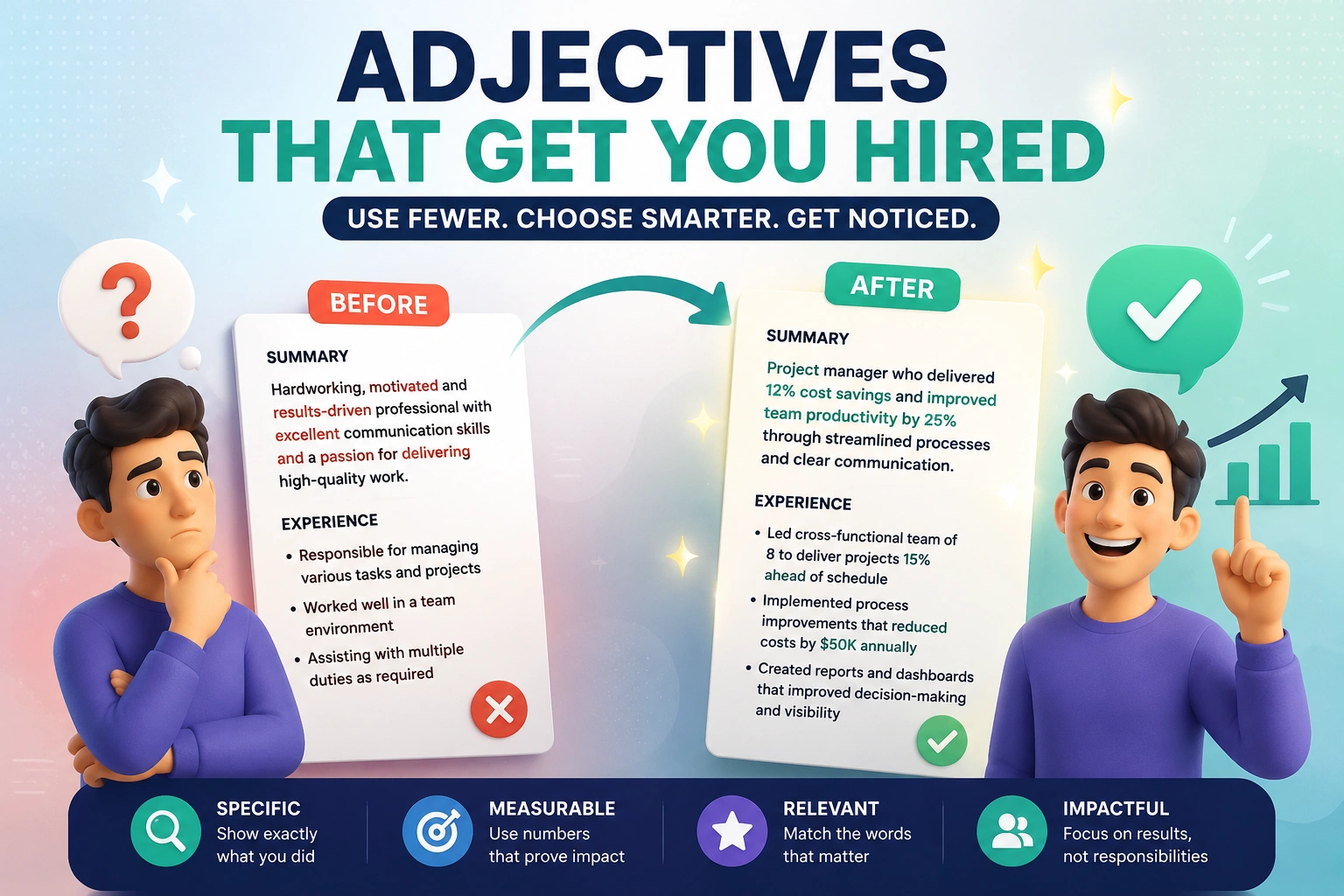
Weak: “Dynamic, results-driven, detail-oriented operations professional with a passion for process improvement and a proven track record of success.”
Strong: “Operations lead with eight years in high-volume fulfilment. Systematic by instinct — I’ve twice rebuilt a warehouse process that was running on tribal knowledge, most recently cutting pick errors 44% in a quarter.”
The second version has one adjective. It’s more memorable, more specific, and about the same length.
Work Experience Bullets
Adjectives here should be doing technical work, not personality work. The right shape is strong verb + specific adjective + number, and the adjective should describe the thing you made rather than the kind of person you are.
“Built an automated reconciliation script…” — good; “automated” describes the artefact
“Hardworking approach to reconciliation…” — bad; describes your attitude, proves nothing
Aim for roughly one adjective per two or three bullets. Any denser and the whole section starts reading as though you’re arguing rather than reporting.
The Skills Section
Here’s the single most common mistake on the entire resume, and I want to be blunt about it: do not put bare adjectives in your skills section.
A skills list is a scannable inventory of nouns. A recruiter’s eye moves through it looking for tools, languages, certifications, and named methods. When they hit “Hardworking · Team Player · Detail-Oriented · Motivated,” two things happen. The eye stops, because those items don’t parse as skills. And the credibility of everything around them drops, because those four words are a well-known signal that a candidate has run out of real ones.
Your skills section should read: Python · SQL · dbt · Snowflake · Tableau · Airflow · Git · Experiment design. If you want to communicate that you’re collaborative, do it in a bullet where you can prove it. The skills section is not the place.
The Resume Headline
Your headline — the one line under your name — has room for exactly one adjective, and only if it’s carrying weight. “Full-Stack Developer | 6+ Years | Payments & Fraud Systems” is stronger than “Dynamic, Results-Driven Full-Stack Developer.” If you’re building or refining a headline, the same logic applies: exact job title first, evidence second, personality last if at all.
Cover Letters & LinkedIn
These two are where you get to relax, and most people don’t take the permission.
A cover letter is prose written by a human to a human. You’re allowed warmth, voice, and a little more descriptive colour than a resume can carry.
The evidence rule still applies — every adjective still needs a story behind it — but you have room to actually tell the story, which is a luxury a bullet point doesn’t give you.
Your LinkedIn About section is even looser. First person is fine and expected. Personality is an asset there, because LinkedIn is a networking surface as much as a hiring one, and people reach out to people who sound like people.
Just remember that the same recruiter may read both documents on the same day, so the person in the About section should recognisably be the person in the resume.

The Overused Twenty-Five — And What to Write Instead
Time for the graveyard. These are the words that have been used so relentlessly that they’ve inverted in meaning: instead of describing a quality, they now signal an absence of specifics.
I want to be fair to these words. Most of them are perfectly good English and several describe genuinely valuable traits.
The problem isn’t the words — it’s that they’ve been claimed by everyone, which means they now distinguish nobody. When 73% of recruiters report fatigue at seeing the same phrases repeatedly, this table is roughly what they’re tired of.
| Overused word | Why it fails | Write this instead |
|---|---|---|
| Hardworking | Everyone claims it; it’s the baseline, not a differentiator | Name the hard thing you did and how long you did it |
| Detail-oriented | The most-used and least-proven claim on any resume | Name one specific error you caught and what it saved |
| Results-driven | Says you like results, which is true of all humans | Just state the result |
| Team player | Reads as “I have nothing more specific to say” | Name the team, the function, and what you jointly shipped |
| Passionate | Unverifiable, and reads as junior above entry level | Show tenure, side projects, or depth of domain knowledge |
| Proactive | Buzzword with no observable behaviour attached | “Flagged X before it happened” — show the anticipation |
| Self-starter | Almost always appears without evidence | Name something you began that nobody asked you to |
| Dynamic | Means nothing at all; pure filler | Delete. There is no replacement because there was no content |
| Synergistic | Corporate-speak; ages the resume by a decade | Cross-functional, or just name the two teams |
| Seasoned | Reads as “older” more than “experienced” | State the number of years and let it speak |
| Responsible for | Passive; describes a job description, not a person | Replace with an action verb: built, ran, owned, cut |
| Motivated | Assumed of anyone who applied for the job | Show what the motivation produced |
| Go-getter | Dated, vague, faintly exhausting | Persistent — and attach a number |
| Thought leader | Self-appointed titles undercut themselves | Name the talks, articles, or standards you actually authored |
| Ninja / Rockstar / Guru | Reads as unserious; screens out of senior roles instantly | Just say what you do: “Senior Backend Engineer” |
| Excellent communicator | The resume itself is the evidence; claiming it is weak | Show it — write clearly, then cite a presentation or doc |
| Strategic thinker | Thinking isn’t an accomplishment | Name the strategy you set and what it changed |
| Innovative | Overclaimed constantly; rarely survives an interview probe | Describe the thing you built and what existed before it |
| Dedicated | Interchangeable with hardworking; equally empty | Show tenure through a hard period |
| Versatile | Vague unless you list the range | Name the three functions you actually covered |
| Meticulous | Fine in principle, but usually unproven | Attach it to an audit, a defect rate, or a reconciliation |
| Exceptional | You don’t get to grade yourself | Cite the ranking, the award, or the percentile |
| World-class | Same problem, larger | Cite the benchmark you were measured against |
| Track record of success | Filler that delays the actual record | Show the record. Skip the preamble |
| Out-of-the-box thinker | The most inside-the-box phrase in existence | Describe the unusual approach and why it worked |
A useful gut check on any of these: would the opposite ever appear on a resume? Nobody writes “lazy,” “careless,” “indifferent to results,” or “difficult to work with.” If the opposite is unthinkable, the word carries no information — it’s just the cost of entry, and stating it wastes a line.
That test disqualifies most of the table above in about two seconds.
One caveat worth stating, because context matters: if a job posting itself uses one of these words prominently, mirroring it once is defensible. Systems match on exact strings, and a hiring manager who wrote “we’re looking for a self-starter” will not be annoyed to see “self-starter” come back.
Use it once, in the summary, and make sure the surrounding sentence supplies the evidence the word doesn’t.

Before & After — Twelve Real Rewrites
Theory’s cheap. Here’s the same principle applied twelve times across different fields and seniority levels, so you can find yourself in at least one of them and steal the pattern.
Individual Contributors
| Before | After |
|---|---|
| Hardworking customer service representative with excellent communication skills and a passion for helping people. | Customer support rep on the escalation queue — held a 95% first-contact resolution rate across 4,000+ tickets and wrote the de-escalation script the team still uses. |
| Detail-oriented accountant responsible for various accounting duties and month-end close. | Cut month-end close from 11 days to 4 by automating three reconciliations in Excel Power Query — eight consecutive quarters with zero material adjustments. |
| Innovative graphic designer who thinks outside the box to create eye-catching designs. | Replaced 60 one-off marketing screens with a 24-component design system now used by three product teams — new campaign pages ship in a day instead of a week. |
| Dynamic sales professional with a proven track record of exceeding targets. | Beat quota nine of twelve quarters, averaging 118% — grew average deal size 34% by leading with a discovery framework I wrote and then trained the team on. |
What changed: every rewrite deleted the personality adjectives and replaced them with a mechanism (“automating three reconciliations,” “a 24-component design system,” “a discovery framework”) plus the number it moved. The reader now knows how you’re good, not just that you claim to be.
Technical & Analytical
| Before | After |
|---|---|
| Results-driven software engineer with strong problem-solving skills and experience in multiple technologies. | Backend engineer specializing in payments — rebuilt a fragile deployment pipeline into a documented, fault-tolerant process, cutting release time from 3 hours to 12 minutes. |
| Analytical data professional passionate about turning data into insights. | Ran 14 A/B tests over 18 months; six were implemented and sustained their lift beyond 90 days, including a pricing-tier change worth $340K annualized. |
| Experienced IT support specialist who is a fast learner and works well under pressure. | Sole IT support specialist for 220 staff across two sites — cut average ticket age from 3 days to 7 hours by prioritizing requests based on business impact rather than arrival order. |
| Meticulous QA analyst with attention to detail. | Introduced a pre-merge checklist that caught 40+ configuration errors in its first quarter and reduced rollback incidents from about two per month to zero. |
What changed: the adjectives that survived are all describing the work product — “documented,” “fault-tolerant,” “pre-merge” — rather than the person. Notice that “meticulous” disappeared entirely from the last one and the rewrite is far more convincing about meticulousness than the original was.
People, Care & Frontline
| Before | After |
|---|---|
| Compassionate and dedicated registered nurse with a passion for patient care. | ICU nurse with 10 years of experience — managed six-patient assignments through two rapid responses in a single shift while maintaining a complete documentation trail, and precepted 14 new graduates onto the unit. |
| Passionate teacher committed to inspiring students and making a difference. | Restructured a 9th-grade algebra unit around diagnostic pre-testing, moving 22 of 28 students up at least one proficiency band in a single semester. |
| Hardworking warehouse associate, motivated and reliable team player. | Forklift-certified warehouse associate with six years of experience and zero recordable incidents — trained the night shift on a new pick sequence that increased throughput by 18% without additional headcount. |
| Friendly and energetic restaurant manager with excellent people skills. | Managed 200-cover Saturday services with a 4.7 guest score and no walkouts — reduced server turnover from 60% to 22% in one year by rebuilding the scheduling system around employees’ stated availability. |
What changed: in every case, the warm adjective (“compassionate,” “passionate,” “friendly”) was replaced by a situation that could only be handled by someone with that quality.
This is the single highest-leverage move in the whole guide — stop asserting the trait and start describing the moment that requires it.
Take twenty minutes and run this on your own top five bullets. It’s the highest-return editing you will ever do on a resume, and unlike most resume advice, you can tell immediately whether it worked: read the new version out loud, and if it sounds like a specific person did a specific thing, you’re done.

How Many Adjectives Is Too Many?
There’s a real answer to this, and it’s lower than most people expect.
Roughly one earned adjective per two or three bullet points. Two in the summary. Zero in the skills section. Six to ten across the entire document.
That’s it. If you’re above fifteen, you’re arguing instead of reporting, and the effect on a reader is the opposite of what you intend: heavy adjective density reads as insecurity, not confidence.
Think about how a genuinely senior person describes their own work in conversation. They understate it. “Yeah, we rebuilt the billing system, took about eight months, cut disputes by a third.” No adjectives at all, and completely convincing. The people who oversell in conversation are the ones you end up trusting least — resumes work identically.
The Adjective Stack
Watch out for this specific failure mode, because it’s endemic:
“Dynamic, results-driven, detail-oriented professional…”
Three adjectives in a row, before the noun, none of them earned. This is the most recognisable pattern in bad resume writing, and it appears in an astonishing proportion of first drafts. The fix isn’t to pick the best of the three — it’s to delete all three and start the sentence with what you did.
Any time you see two adjectives joined by a comma before a job title, delete both and see what’s left. Usually it’s a better sentence.
A Five-Minute Self-Audit
Run this on your current resume right now:
1. Highlight every adjective in the document. Physically — use the highlighter tool. People consistently underestimate their own count by half.
2. Count them. Over fifteen means cut. Over twenty-five means start the summary from scratch.
3. Run the Evidence Test on each one. Delete it, reread, and ask whether you lost information.
4. Check your skills section. Any adjective in there gets deleted, no exceptions.
5. Find your adjective stacks. Any place two or more sit in a row, keep at most one.
6. Read the whole thing aloud. Anywhere you feel slightly embarrassed saying a phrase out loud is a phrase a recruiter will feel slightly embarrassed reading. Trust that reaction — it’s remarkably accurate.
7. Check the survivors against the job posting. The adjectives you kept should overlap with the language the employer used. If they don’t, you’re describing a different job than the one you’re applying for.
The read-aloud step is the one people skip and the one that catches the most. Something about hearing “dynamic, results-driven professional with a passion for excellence” in your own voice makes the problem immediately, physically obvious in a way that reading silently never does.

Honesty, Tone, and the Thesaurus Trap
Two failure modes that almost nobody writes about, and both of them cost people jobs.
Every Adjective Is an Interview Question You Just Volunteered
Here’s a thing experienced interviewers do that candidates rarely anticipate: they read your adjectives and build questions from them.
Write “strategic” and you will be asked what strategy you set, who disagreed, and what it cost. Write “meticulous” and you’ll be asked about the last significant mistake you caught — and if you can’t name one within about five seconds, the word has actively worked against you, because now you look like someone who describes themselves in terms they can’t support.
Write “resilient” and someone is going to ask about the hardest stretch of your career, in detail, and follow up.
This is why the Evidence Test matters beyond the page. The adjective you can’t defend is worse than no adjective at all — a blank space is neutral, but an unsupported claim is a small credibility loss, and small credibility losses compound across a forty-minute conversation.
So before you finalise the document, do one last pass: for each remaining adjective, say out loud the story you’d tell if asked about it. If you can’t produce a specific one — a real week, a real project, a real number — cut the word. You’ll feel the resume get lighter and, oddly, stronger.
Thesaurus Inflation
The second trap is the one that catches careful, conscientious people, and it catches non-native English speakers hardest — often precisely because they’re being more diligent about word choice than native speakers are.
The logic seems sound: this word is common, so let me find a more impressive one. “Efficient” becomes “efficacious.” “Hardworking” becomes “assiduous.” “Careful” becomes “punctilious.” “Helpful” becomes “munificent.” Every one of those upgrades makes the resume worse, for three separate reasons.
It reads as unnatural. Native-speaker business English is plainer than people expect. “Efficacious” appears in pharmacology papers, not on resumes, and a recruiter’s reaction isn’t impressive vocabulary — it’s this was written with a thesaurus open, which raises a quiet question about what else was assembled rather than earned.
It’s less searchable. If a hiring manager scans for “efficient” and you wrote “efficacious,” you’ve optimised yourself out of the match. Rare words are, by definition, not the words in the job description.
It sometimes means the wrong thing. “Munificent” means generous with money, not helpful. “Fastidious” carries a whiff of fussy and hard to please. “Sophisticated” applied to yourself reads as pretentious rather than technically advanced. Near-synonyms carry connotations that dictionaries don’t flag, and getting one wrong is more damaging than using a plain word would have been.
The rule: use the word a competent colleague would use in a meeting. Not the fanciest available synonym — the natural one. Plain English reads as confidence. Elaborate English reads as compensation.
There’s a related point about tone worth making, particularly for anyone applying across borders. American resume convention tolerates more self-promotion than British, Australian, or much of European convention does.
A summary that reads as appropriately confident in New York can read as boastful in Berlin or Melbourne. If you’re applying internationally, dial the adjectives down rather than up, and lean harder on numbers — figures translate cleanly across cultures in a way that self-description simply doesn’t.
Advanced Tips & Best Practices
Everything below assumes you’ve already done the basic pass. These are the refinements that separate a good resume from one that gets a callback.
- Mirror the posting’s own adjectives, exactly. If the job description says “collaborative,” write “collaborative” — not “synergistic,” not “team-oriented,” not “cooperative.” Many systems match on literal strings and don’t recognise synonyms, and the human who wrote that posting chose that word on purpose. Mirroring costs nothing and works on both audiences at once. Read the posting twice and highlight every descriptive word that appears more than once; those are the ones the employer actually cares about.
- Use the two-mention rule, and stop there. For a term that genuinely matters, place it two or three times across the document — once in the summary, once inside a bullet where you prove it, and once in the skills list if it’s a noun. That’s enough to register with keyword-frequency scoring without tipping into the repetition patterns that modern systems flag and recruiters notice instantly.
- Rewrite the adjectives for every single application. Not the whole resume — just the summary and the two or three adjectives in it. It takes about four minutes and it’s the difference between a document that was clearly written for this job and one that was clearly written in general. Recruiters can tell, every time.
- Pair every adjective with a verb, never with your own name. “Methodically rebuilt the reporting stack” beats “methodical professional.” The moment an adjective attaches to you rather than to the work, it stops being evidence and starts being a personality claim — and personality claims are exactly what the reader has been trained to discount.
- Kill every adjective stack on sight. Two or more descriptors in a row before a noun is the single loudest signal of an unedited resume. Keep one at most. Usually keep zero and let the verb open the sentence.
- Prefer compound adjectives that double as keywords. Cross-functional, client-facing, data-driven, full-stack, production-grade, safety-first, audit-ready. These sit in the rare overlap where the word describes a real quality and appears in job descriptions as a searchable term. They earn their space twice.
- Give your senior-most claim the strongest evidence. Whatever the biggest adjective on your resume is — strategic, transformational, decisive — attach it to your most quantified accomplishment. Readers calibrate the credibility of your whole document on how well your largest claim is supported. Get that one right and they’ll extend trust to the smaller ones.
- Cut the adjective before you cut the number. When you’re fighting for space on a one-page resume — and most people are — adjectives are the first thing to go. A bullet with a number and no adjective still works. A bullet with an adjective and no number doesn’t.
Do’s and Don’ts
| Do | Don’t |
|---|---|
| Use the exact descriptive words from the job posting | Substitute a fancier synonym you found in a thesaurus |
| Attach every adjective to a verb and a number | Attach adjectives to yourself as personality claims |
| Keep six to ten adjectives across the whole document | Stack two or three in a row before a job title |
| Put nouns, tools, and certifications in your skills section | Put “hardworking · team player · motivated” in your skills section |
| Describe the work — “automated pipeline,” “documented process” | Describe your attitude — “dedicated approach,” “passionate about” |
| Choose words you can defend with a story in an interview | Claim traits you can’t produce a specific example for |
| Show composure by describing the situation that required it | Assert “calm under pressure” and leave it unproven |
| Rewrite the summary’s adjectives for each application | Send the same generic summary to forty employers |
| Read the resume aloud before you send it | Trust a silent read to catch cliché |
| Dial adjectives down when applying internationally | Assume American self-promotion norms travel |

Final Thoughts
Adjectives get treated as the fun part of resume writing — the vocabulary game, the part where you get to reach for the thesaurus and describe yourself in flattering terms. That framing is exactly backwards, and it’s why so many resumes end up sounding identical.
Adjectives are the seasoning. The meal is the evidence: what you built, what it replaced, what number moved, who it helped. Season a good meal well and it’s memorable. Season an empty plate and you’ve just got a pile of salt, and no recruiter has ever been persuaded by a pile of salt.
So here’s the whole guide compressed into a single working instruction: write down what you actually did, in plain language, with the numbers attached. Then add back only the adjectives that tell the reader something the facts didn’t. That’ll usually be six or eight words across a whole page. Those six or eight will do more for you than fifty ever could, because each one will be carrying real weight and the reader will feel it.
Your resume doesn’t need to sound impressive. It needs to sound specific. Specific is what impressive actually feels like from the other side of the desk — and specific is the one thing nobody else applying can copy from you, because it belongs to your career and no one else’s.
Glossary
A handful of terms come up repeatedly throughout this guide. Here’s a quick reference for each.
| Term | Definition |
|---|---|
| Adjective | A word that modifies a noun, describing quality or manner — methodical process, scalable system. On a resume, it answers “what kind?” rather than “what happened?” |
| Adverb | A word that modifies a verb, usually ending in -ly — consistently delivered. Weak on resumes, because an adverb almost always marks the spot where a number should be. |
| Action Verb | The verb that opens a strong bullet point — built, launched, negotiated, migrated, reduced. The engine of the sentence; adjectives can’t do this job. |
| ATS (Applicant Tracking System) | Software companies use to collect, parse, and rank resumes before a human opens them. Roughly 97% of Fortune 500 companies use one. It scores mostly on nouns, not adjectives. |
| Keyword Match | The degree to which your language overlaps with the job description. The primary ranking signal in most tracking systems, and driven almost entirely by nouns — tools, titles, certifications, methods. |
| Parsing | The process by which software reads your document and extracts structured fields. Poor formatting — tables, columns, text in headers or footers — causes parsing failures that lose your content entirely. |
| Semantic Matching | A newer ATS approach that recognises related terms and meaning rather than exact strings. Platforms like Greenhouse and Lever lean this way; older systems like Taleo often don’t, which is why exact mirroring stays the safer default. |
| Hard Skill | A concrete, teachable, verifiable capability — Python, GAAP, phlebotomy, forklift operation. These are what tracking systems score and what recruiters filter on. |
| Soft Skill | An interpersonal or behavioural capability — communication, collaboration, adaptability. Real and valuable, but nearly worthless as a bare claim; must be demonstrated through outcomes. |
| Buzzword | A word so widely used that it has stopped conveying information — results-driven, synergistic, thought leader. Signals an absence of specifics rather than a presence of quality. |
| Quantification | Expressing an accomplishment as a number: percentage, dollar figure, headcount, time saved, error rate. Numbers are the evidence adjectives borrow their credibility from. |
| Evidence Test | The rule at the heart of this guide: delete the adjective and reread the sentence. If nothing was lost, the adjective was decoration — cut it or earn it. |
| C-E-R (Claim → Evidence → Result) | The rewrite pattern for turning an unearned adjective into a persuasive line: make the claim, show what you did, name the number it moved. |
| Adjective Stacking | Placing two or more descriptors in a row before a noun — “dynamic, results-driven, detail-oriented professional.” The most recognisable marker of an unedited resume. |
| Resume Summary | A two-to-four sentence paragraph beneath your headline giving context on your background. The one section where adjectives are genuinely at home — budget two. |
| Skills Section | A scannable inventory of your capabilities. Should contain nouns only: tools, languages, certifications, methodologies. Adjectives here actively damage credibility. |
| Compound Adjective | A hyphenated descriptor like cross-functional, client-facing, audit-ready. Valuable because it often functions as both a genuine quality and a searchable industry keyword. |
| Thesaurus Inflation | Replacing a plain word with a rarer synonym to sound more impressive — “efficient” becoming “efficacious.” Reads as unnatural, matches fewer searches, and sometimes means the wrong thing. |
Conclusion
Your resume adjectives have one job: to tell a reader something the facts alone didn’t. Most resumes fail this test on nearly every adjective they contain, which is good news — it means the fix is deletion, not vocabulary. Highlight every descriptive word you’ve written, delete each one and check whether the sentence lost anything, and keep only the survivors. You’ll finish with six or eight words, each attached to a real verb and a real number, each one something you’d happily talk about for two minutes in an interview. That’s a stronger resume than any word list can give you, and you can be done with it before dinner.
Frequently Asked Questions
Use adjectives that describe the work rather than your personality, and that you can prove with a specific story. The safest and strongest options tend to be compound and concrete — cross-functional, client-facing, data-driven, audit-ready, production-grade, systematic, documented. Pull the exact descriptive words from the job posting first, check them against what you’ve genuinely done, and keep the overlap. If a word appears in the posting and you can prove it, that’s your shortlist. Everything else is optional.
Six to ten across the entire document. Two in the summary, roughly one per two or three experience bullets, and zero in the skills section. If you’re above fifteen you’re overselling, and the effect on a reader is the opposite of what you want — dense adjective use reads as insecurity, not confidence. Highlight every adjective in your current draft and count them; almost everyone is surprised by the number.
Mostly, no — and this is the biggest misconception on this topic. Applicant tracking systems score primarily on hard-skill nouns: tools, platforms, certifications, job titles, and named methodologies. Words like “hardworking” and “passionate” match essentially nothing, because no recruiter has ever searched a candidate database for them. The exception is compound terms that double as industry keywords — cross-functional, client-facing, data-driven, full-stack — which do appear in job descriptions as literal requirements and therefore do score. The strategy that actually works: write your nouns for the software and your adjectives for the human who reads you afterwards.
Point at trajectory and reliability rather than mastery. Coachable, self-taught, curious, punctual, fast-ramping, and cross-training all read as honest and valuable coming from someone early in their career, and recruiters hiring at entry level are specifically screening for those qualities. Avoid seasoned, expert, strategic, visionary, and proven — they don’t fit and the mismatch is obvious. Then prove the words with coursework, projects, volunteering, internships, or part-time work: “Self-taught in Python outside coursework — built a class-scheduling tool 140 students used for two semesters” is a genuinely strong line from someone with no professional history at all.
You can, but you shouldn’t, and this is one of the cheapest wins available. You don’t need to rewrite the whole resume — just the two or three adjectives in your summary. Four minutes per application. A hiring manager can tell instantly whether a document was written for their role or written in general, and the tell is usually whether your descriptive language matches theirs.
On a resume, no — the convention is implied first person with the pronoun dropped (“Rebuilt the pipeline,” not “I rebuilt the pipeline”), and breaking that convention reads as unfamiliarity with the format. In a cover letter, first person is expected and correct. In your LinkedIn About section, first person is not just fine but preferable, because that surface is a networking tool as much as a hiring one and sounding like a human is the point.
No. This is the most common resume mistake I encounter and it’s genuinely costly. A skills section is a scannable inventory of nouns — languages, tools, platforms, certifications, methodologies. When a recruiter’s eye hits “Hardworking · Team Player · Detail-Oriented” in that list, two things happen: the scan stalls, and the credibility of the surrounding items drops, because bare adjectives in a skills list are a well-known signal that a candidate ran out of real ones. If you want to communicate that you’re collaborative, prove it in a bullet where you have room to.
Mirror them once, in the summary, and immediately supply the evidence the word doesn’t carry. If the posting asks for a “self-starter,” write a summary sentence that includes “self-starter” and names something you began that nobody asked you to. You get the string match, the hiring manager sees their own language reflected back, and you avoid the trap of using an empty phrase emptily. What you shouldn’t do is import the whole buzzword vocabulary — mirroring six clichés reads as parroting.
Point every adjective at the present. Current, recertified, upskilling, fast-ramping, self-directed. The only thing a hiring manager is genuinely uncertain about after a gap is whether your skills are current, so answer that question before it’s asked — a recent certification, a rebuilt project, a refreshed tool stack. Handle the gap itself with one neutral line in your experience section (“Career break — family caregiving, 2023–2025”) and move on. You don’t owe an explanation, and apologetic language in a summary does far more damage than the gap ever would.
Yes, and the difference is essentially how much room you have to prove things. A resume is the strictest — minimal adjectives, maximum evidence, no first person. A cover letter gives you prose, so you can afford more warmth and colour because you have space to tell the story behind the word. LinkedIn is the loosest: first person, personality, and voice are all assets there. Interviews invert the whole thing — never volunteer an adjective about yourself, just tell the story and let the interviewer draw the conclusion. Saying “I’m very resilient” is weak; describing the eight months you spent holding a project together is strong, and they’ll supply the word themselves. That’s always better than claiming it.