“Managed clinical trial data” could describe one database or a global program. It says nothing about study phase, sites, external data, query work, systems, deadlines, or your authority.
A useful resume replaces that blank space with a clear operating picture. For example: “Led data management for two Phase II studies across 34 sites, coordinated six external data feeds, and met both interim-lock dates.” The numbers are illustrative, but the pattern is the point: scope, action, control, and a supportable outcome.
Key Takeaways
- Show the study lifecycle, not a list of software. Connect protocol review, case report form design, database testing, cleaning, reconciliation, transfer, and lock.
- Quantify scope before claiming impact. Studies, sites, subjects, forms, vendors, data feeds, queries, and lock milestones are useful when your records support them.
- Separate leadership from participation. “Led,” “approved,” “reviewed,” and “supported” describe different levels of ownership.
- Name standards in context. EDC platforms, CDISC standards, coding dictionaries, SQL, and SAS matter most when a bullet shows how you used them.
Turn the posting into proof
O*NET describes the role as applying health care and database-management knowledge to analyze clinical data and report trends. Its task list includes database design and validation, query generation, data-management plans, quality-control audits, technical specifications, controlled documentation, and staff supervision. A posting may combine several of those duties or divide them among a sponsor, contract research organization (CRO), vendor, and programming team.
| Posting language | Evidence to use | Wording boundary |
|---|---|---|
| Study startup | Protocol review, eCRF design, edit-check specifications, user acceptance testing | Do not claim database design if you only tested assigned forms |
| Data cleaning | Listings reviewed, queries managed, aging monitored, discrepancies reconciled | Avoid a “zero errors” claim unless a defined audit supports it |
| Vendor oversight | External sources, transfer schedules, issue logs, acceptance checks | State whether you managed the vendor or coordinated one deliverable |
| Database lock | Readiness reviews, open-item tracking, coding, reconciliation, sign-offs | Name the lock type and milestone only when you can verify it |
| Standards | CDASH, SDTM, controlled terminology, SOPs, ICH GCP | Tie each standard to a real task instead of listing it as decoration |
The Society for Clinical Data Management’s Good Clinical Data Management Practice resource covers data-collection design, data-management plans, software development, EDC selection and conduct, vendor management, and related quality practices. Use that breadth to check your evidence, not to imply experience you do not have.
Showcase your study operations, participant coordination, and research experience with our clinical research coordinator resume guide.
Follow the data lifecycle
Recruiters need to see where you worked in the study and what moved forward because of you.
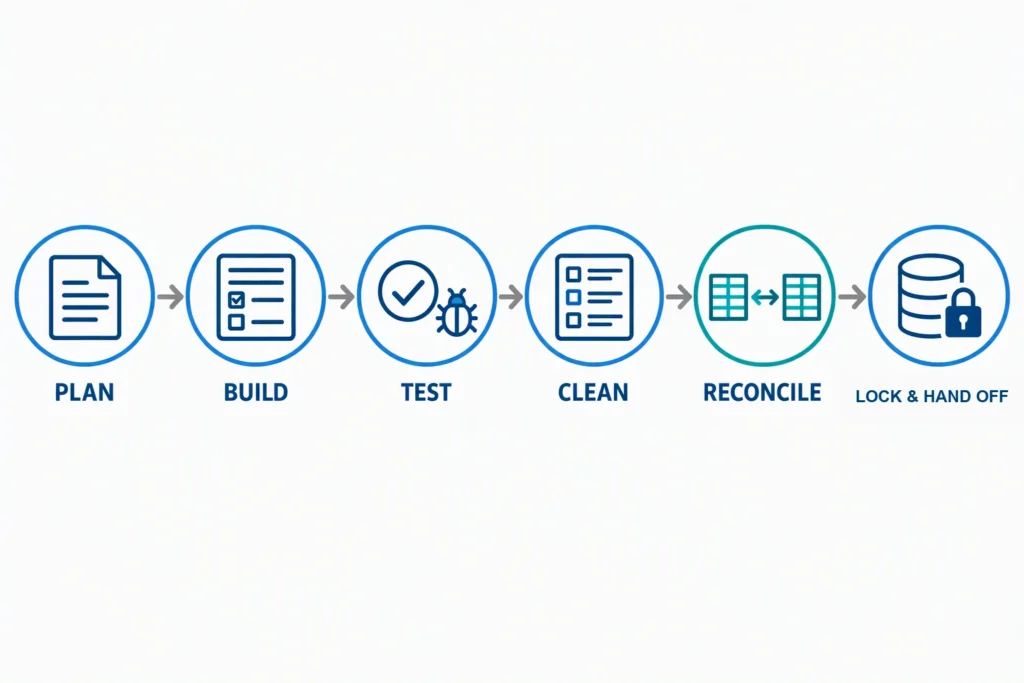
1. Plan: Translate the protocol into the data-management plan, roles, review rules, transfers, and milestones.
2. Build: Develop or review eCRFs, specifications, edit checks, coding conventions, and external-data requirements.
3. Test: Execute user acceptance testing, document defects, and confirm approved corrections.
4. Clean: Review data, issue and close queries, track aging, and communicate recurring problems.
5. Reconcile: Compare safety, laboratory, imaging, randomization, and other external sources under the study plan.
6. Lock and hand off: Clear required items, document approvals, lock or freeze the database, and deliver agreed outputs.
This sequence also exposes weak wording. “Responsible for EDC” becomes useful only after you identify whether you configured forms, wrote specifications, tested the build, administered users, reviewed data, or supported lock.
Decide which attachment best suits your application with our resume PDF vs. Word guide.
Build bullets from records
Start with documents you can defend: study trackers, issue logs, query reports, data-transfer schedules, UAT evidence, milestone plans, inspection findings, training records, and performance reviews. Never copy subject-level details or screenshots into a job-search file.
| Weak wording | Stronger fictional example |
|---|---|
| Cleaned clinical data | Reviewed listings and managed query follow-up for a 420-subject Phase II study, reducing queries older than 30 days from 86 to 19 before interim lock. |
| Worked with vendors | Coordinated transfer specifications, test files, and issue resolution for central laboratory, ECG, and ePRO vendors across 28 sites. |
| Helped build databases | Wrote 120 edit-check specifications and completed risk-based UAT for 18 eCRF modules before production release. |
| Ensured data quality | Reconciled safety and clinical databases weekly, documented discrepancies, and cleared required items before two planned lock milestones. |
Use a percentage only when the numerator, denominator, period, and source are clear. If the outcome belongs to a team, claim your contribution: “coordinated,” “reviewed,” or “closed assigned items” is more credible than taking sole credit for an entire database lock.
Plan a focused introduction, persuasive supporting paragraphs, and professional closing with our cover letter outline guide.
Adapt an experienced example
This fictional candidate targets a sponsor-side role that combines study leadership, vendor oversight, and delivery.
Morgan Lee
Boston, MA | (617) 555-0148 | morgan.lee@example.com
Clinical data manager with experience leading Phase I–III studies from startup through lock. Coordinates EDC builds, external transfers, query strategy, coding, reconciliation, and CRO deliverables across cross-functional teams.
Experience
North Harbor Therapeutics, Boston, MA
Senior Clinical Data Manager | April 2023 – Present
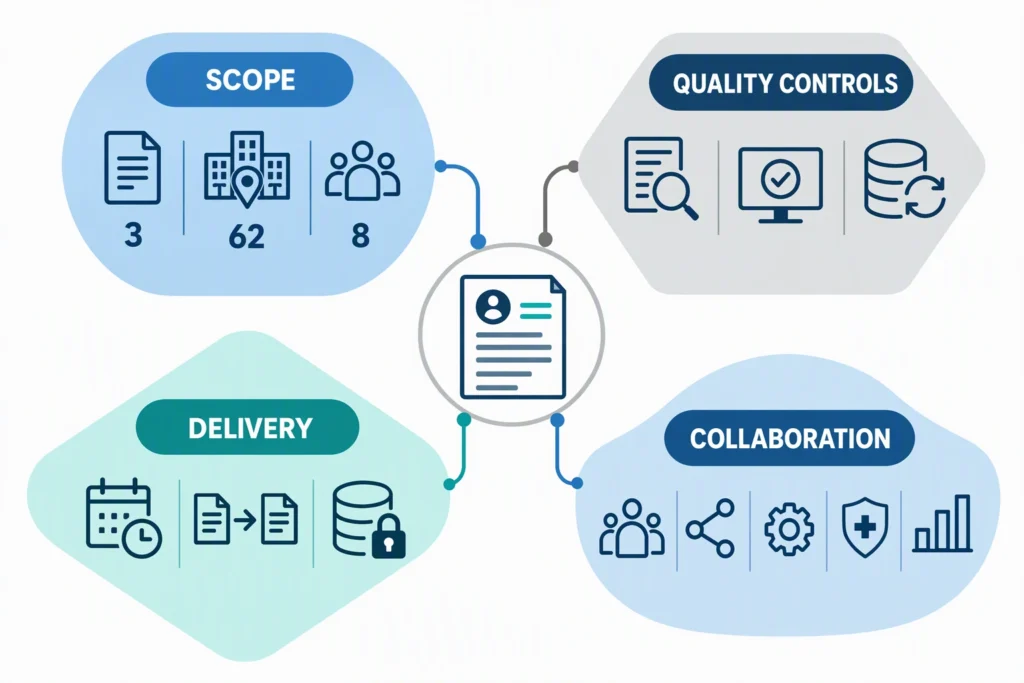
- Lead data-management delivery for three oncology studies across 62 sites and approximately 780 enrolled subjects.
- Approve data-management plans, eCRF specifications, edit checks, transfer plans, and lock checklists in partnership with clinical operations, safety, statistics, and programming.
- Track query aging, missing pages, coding status, and eight external data feeds; escalate recurring issues through documented owners and due dates.
- Direct CRO and vendor review meetings and complete acceptance checks for scheduled transfers, interim cuts, and final lock packages.
HarborPoint CRO, Cambridge, MA
Clinical Data Manager | June 2020 – March 2023
- Managed database conduct for four Phase II studies in Medidata Rave, including listings review, query resolution, coding follow-up, and safety reconciliation.
- Executed UAT scripts, documented defects, and verified corrections for study builds and mid-study changes.
- Prepared weekly status reports covering enrollment, data entry, open queries, external reconciliation, and milestone risk.
Education
University of Massachusetts Boston, Boston, MA
Bachelor of Science in Biology
Completed May 2020
Technical Skills: Medidata Rave; EDC administration; eCRF and edit-check specifications; UAT; query management; MedDRA and WHODrug workflows; CDASH and SDTM awareness; SQL; SAS listings review; data transfers; database lock
Position an early-career candidate
Clinical research coordination, data entry, laboratory data, health informatics, quality assurance, and database testing can provide relevant evidence. Preserve your actual title and show the bridge.
Clinical Data Coordinator, Westlake Research Institute, Chicago, IL
July 2025 – Present
- Review eCRFs and source-document discrepancies for three investigator-initiated studies under approved procedures.
- Enter and verify de-identified study data, issue clarification requests, and maintain an audit-ready correction trail.
- Test revised forms in the training environment and document results for manager approval before release.
Training projects can support a skills section, but they are not production experience. Label a sample database, SDTM exercise, or SQL portfolio project clearly and keep real participant data out of it.
Preserve a website-ready experience entry
Clinical Data Manager
HarborPoint CRO | Cambridge, MA
June 2020 – March 2023
- Managed database conduct for four Phase II studies in Medidata Rave.
- Executed UAT scripts and verified corrections before release.
Check the final file
Match terminology to the posting without turning the skills section into a tool dump. Spell out a term such as electronic data capture (EDC) on first use when the audience may include a general recruiter. Keep present tense for current work and past tense for completed work.
Confirm every phase, subject count, site count, platform, standard, dictionary, and milestone. Remove protocol numbers, subject identifiers, unpublished results, proprietary screenshots, and confidential vendor information. Reopen the submitted file and check that employer and job-title text is bold, locations are plain, and each complete date range is italicized.
Make the workflow visible
Your strongest evidence is the controlled path from protocol requirements to analysis-ready data. When each bullet identifies your part of that path and the records behind it, the resume shows both technical depth and dependable judgment.
Frequently Asked Questions
These answers cover standards, metrics, and confidential study information.
Should I list every EDC system I have used?
List platforms you can discuss confidently and prioritize the ones named in the posting. A bullet showing how you used a system for build review, UAT, cleaning, administration, or lock is stronger than a long software list.
Can I include query-closure percentages?
Yes, when the report, date range, and denominator are available. State the measure precisely, such as queries older than 30 days or assigned queries closed before a milestone, rather than using a broad “improved quality” claim.
How much study detail is safe to share?
Use public or de-identified scope: phase, therapeutic area, approximate subjects, sites, regions, data-source types, and your responsibilities. Exclude participant information, unreleased results, protocol identifiers, screenshots, and contract terms.