


A baseball coach resume should show the team you coached, the players you worked with and the responsibilities you handled. Running infield stations for a youth team is different from managing a varsity program or preparing scouting reports for a college coaching staff. Make that difference clear.
Start with the four resume templates below: baseball coach, assistant baseball coach, high school baseball coach and college baseball coach. Each example includes a template image and text you can adapt to your own experience.
If you coach several sports, our athletic coach resume guide explains how to present a broader coaching background.
Baseball Coach Resume Examples
Choose the example closest to your coaching role. Each includes an existing MyResumeStar template image and an adaptable text version. The text versions are new writing examples, not transcriptions of the images.
Replace every bracketed detail with your own information. Include only duties you performed, results you can support and credentials you actually hold. Credential labels in the images are illustrative; use the exact name and issuer shown on your own credential.
Youth and club programs
Baseball Coach Resume Template
Show the age group you coached and how you organized instruction. Youth coaching can provide useful evidence of teaching, practice planning and communication with families.
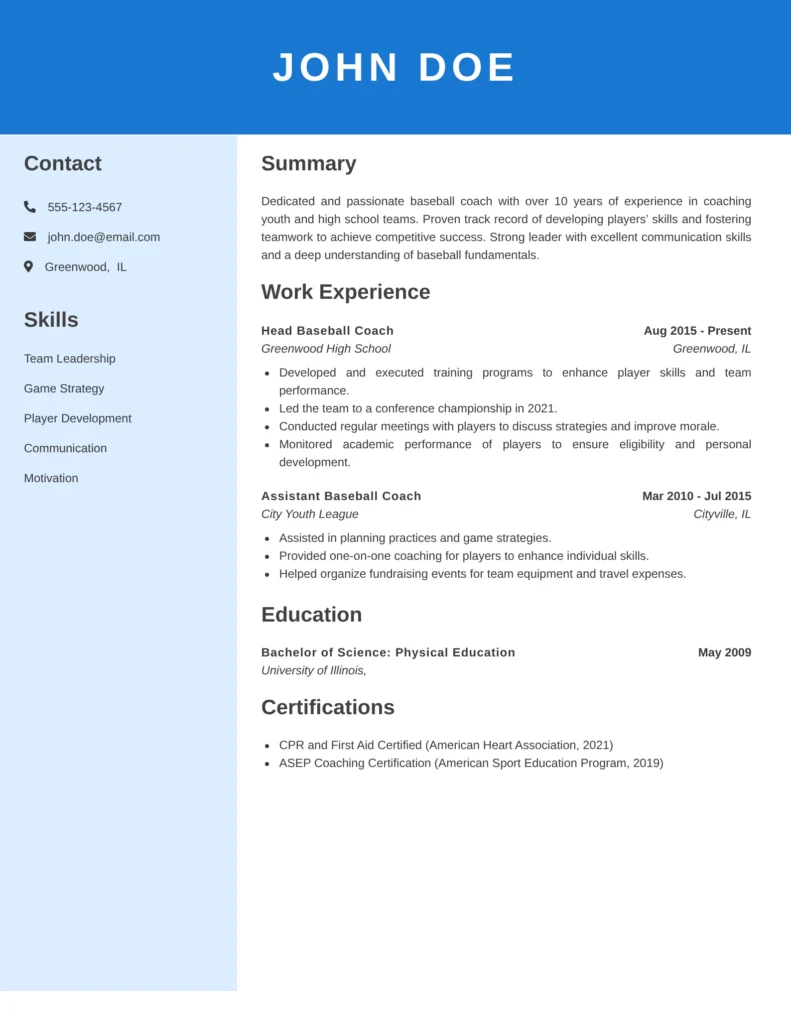
Adaptable resume text
A defined role within the coaching staff
Assistant Baseball Coach Resume Template
Be specific about your assigned work. An assistant who leads infield instruction should describe that contribution rather than claim responsibility for the whole program.
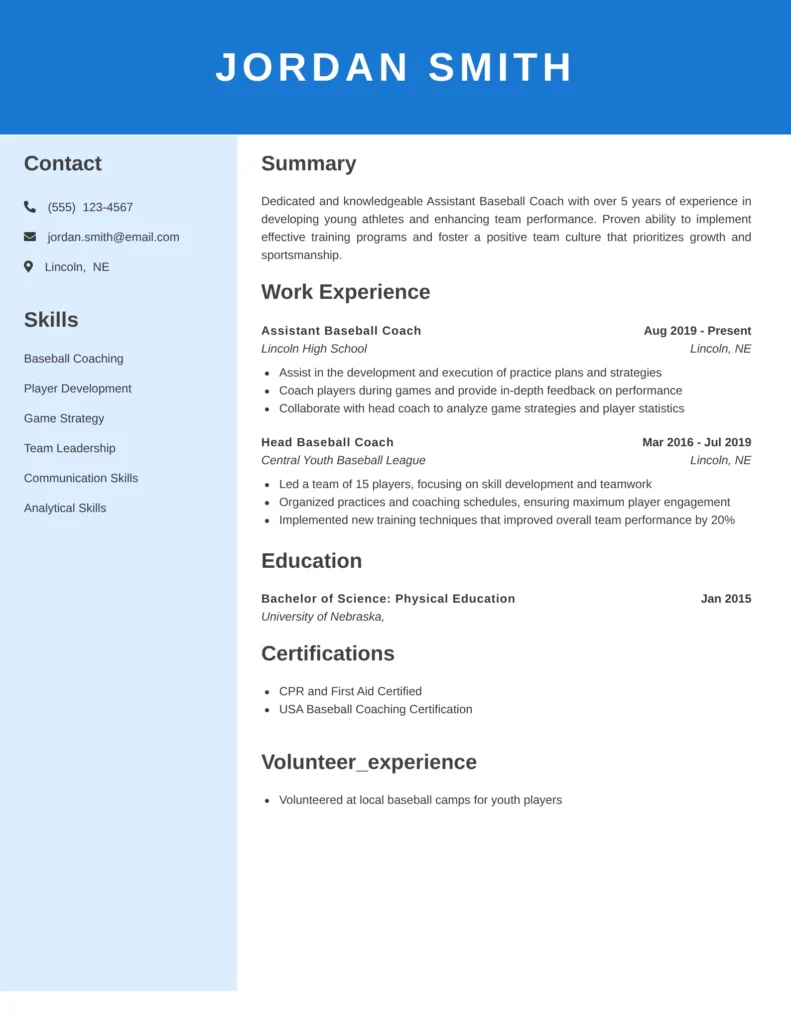
Adaptable resume text
School teams and student-athletes
High School Baseball Coach Resume Template
A school coaching resume should explain both on-field instruction and coordination with the athletic department. Include teaching duties only if they were part of your job.
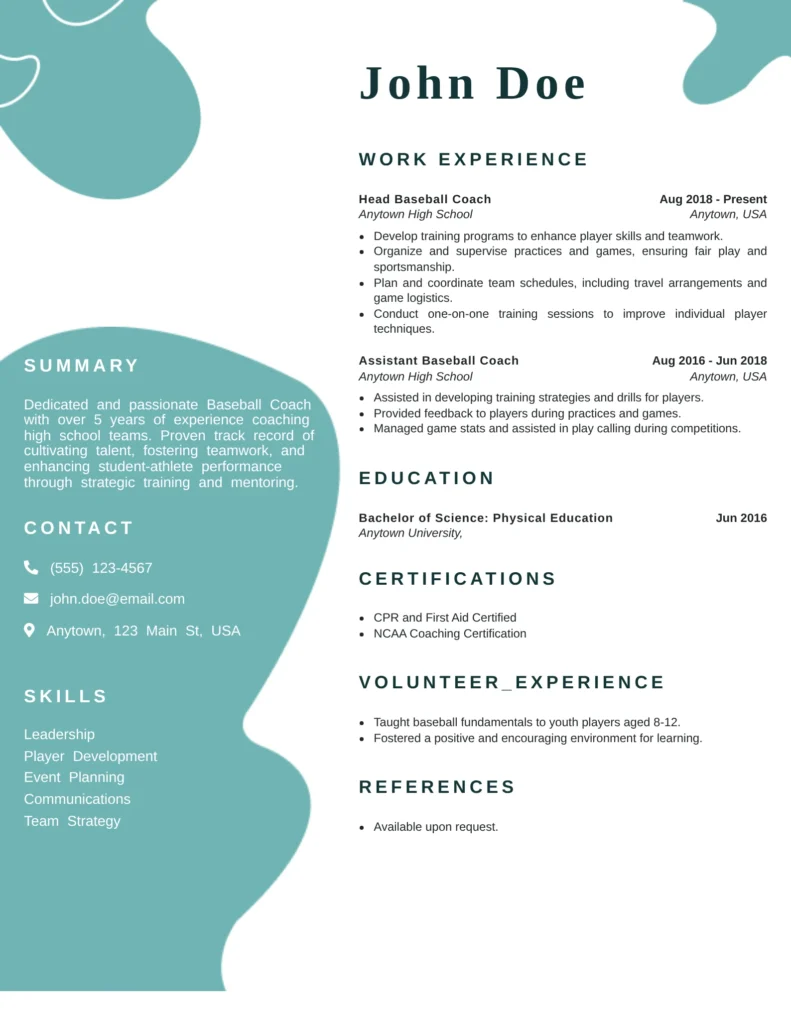
Adaptable resume text
Collegiate coaching programs
College Baseball Coach Resume Template
Show the level of competition and the parts of the program you managed. Recruiting, staff supervision and administrative work should reflect your actual position.
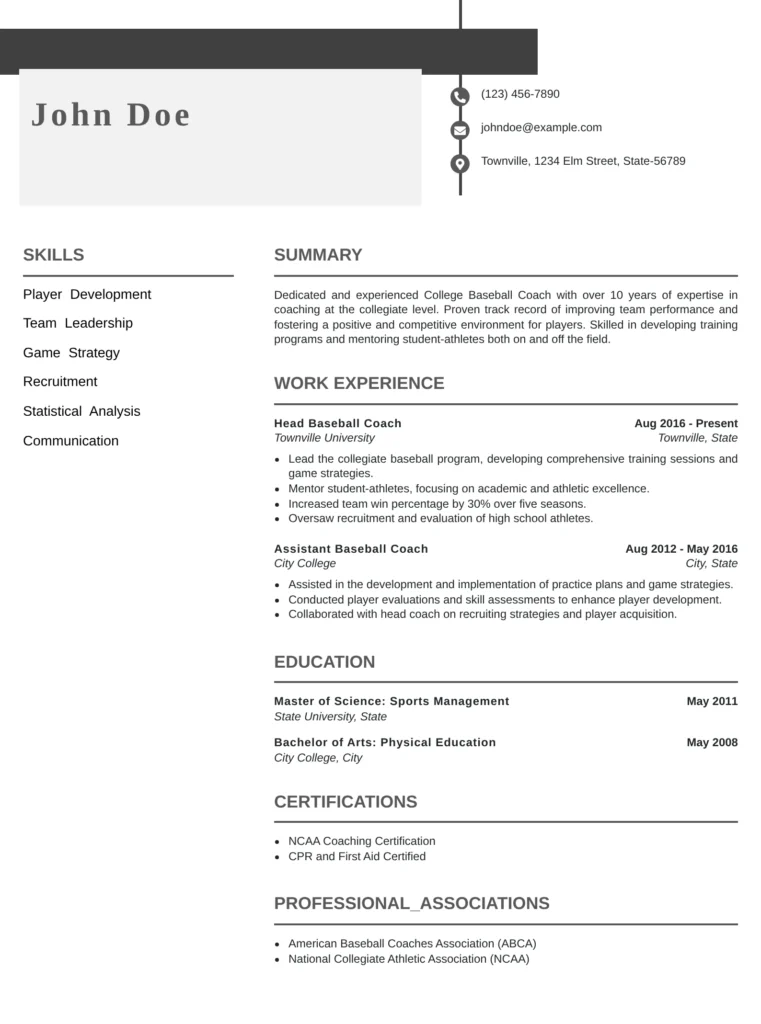
Adaptable resume text
What to Include on Your Resume
Show where you coached, who you worked with and what you handled. The short examples below explain what each resume part can look like.
These are illustrative examples and formats. Replace bracketed details and keep only statements that match your own experience.
Your Contact Details and Coaching Role
Include your name, city and state, phone number and professional email. Use a role label that fits your background. Keep your actual job titles accurate in the experience section.
Contact example
[Your Name] Assistant Baseball Coach [City, State] | [Phone] | [Professional Email]A Short Coaching Summary
Name your coaching setting, main area of instruction and a relevant strength. Choose details that fit the position you want.
Summary example
Assistant baseball coach with experience leading infield stations for a high school team. Prepares ground-ball and double-play drills, gives individual feedback and shares player observations with the head coach.For more opening-profile examples, see our resume summaries for sports jobs.
Your Coaching Experience
List your title, team, location and dates. Add the age group or competition level when the team name does not make it clear. Label unpaid roles as volunteer experience.
Volunteer coaching entry
Volunteer Assistant Baseball Coach | [League] | [City, State] Spring [Year] | 12U recreational team • Led throwing and ground-ball stations while the head coach supervised batting practice. • Prepared cones, bases and balls before each session and helped players move between stations.Replace 12U and the spring season with your actual team level and dates.
Baseball Skills You Have Used
Choose skills you can explain through real coaching work. Make the list specific to your assignment rather than filling it with broad labels such as “leadership.”
Skills example
Infield footwork; double-play instruction; practice station setup; defensive video review; player feedback.This list fits an infield coaching role. A pitching coach should choose different skills.
Education and Current Credentials
List your education and relevant completed training. Use the exact credential name and issuer. Add an expiration date when current status matters.
Education and credential format
EDUCATION [Degree or Diploma] | [Institution] | [Year] COACHING AND SAFETY TRAINING [Exact credential name] | [Issuing organization] Earned [Month Year] | Expires [Month Year, if applicable]Remove fields that do not apply. Do not describe an unfinished course as a completed credential.
Relevant Playing or Camp Experience
Use playing experience to explain your position knowledge. Include camp instruction when it shows how you helped others learn. Keep playing and coaching roles clearly labelled.
Playing experience example
PLAYING EXPERIENCE Shortstop | [College or Club] | [Years] • Served as team captain and helped new infielders learn defensive positioning during practice.Use this only if you played that position and performed that role. Personal playing statistics should not replace evidence of coaching.
How to Describe Your Coaching Experience
Start each role with your title, team, location and dates. Then choose a few bullets that show what you taught, prepared or managed. Give the reader enough detail to understand your contribution.
Role heading
Assistant Baseball Coach | [Team or School] | [City, State]
[Month Year–Month Year] | [Age group or competition level]
“Helped with practice” leaves your work unclear. Explain the drill or assignment, who you worked with and how you delivered it. If you supported another coach, make that shared responsibility clear.
The following bullets are illustrative. Adapt only the details that reflect your own work.
Hitting Instruction
For a coach responsible for batting practice.
Why it works: Identify what you taught. A list of drills becomes more useful when the reader can see the instruction behind them.
Catcher Development
For a coach who worked directly with catchers.
Why it works: This explains the position focus and how you followed up. It does not require an invented improvement percentage.
Opponent Scouting
For an assistant who prepared information for the coaching staff.
Why it works: Describe what you supplied to the staff. Do not claim you set the game plan if that decision belonged to the head coach.
Baseball Camp Coordination
For a coach or volunteer with camp responsibilities.
Why it works: Organization belongs on a coaching resume when you show the work involved. Label the camp role as volunteer if it was unpaid.
How to Show Player and Team Progress
A season record, player milestone or documented skill improvement can strengthen your resume. Name the result, give its context and explain your part in the work. Team success is a shared result; your bullet should identify your own contribution.
Start with records you can check.
Use official season statistics, scorebooks, practice logs or confirmed awards. If you cannot verify an improvement, describe the instruction or responsibility instead.
The numbers below are illustrative, not results to claim as your own. Replace them with verified information from your program.
A Team’s Season Record
Include the season and competition level. Make your role clear.
Keep it accurate: This connects your assignment to a team result without claiming that you alone produced it. Use the team’s actual record and playoff stage.
A Documented Baseball Statistic
Show the starting and ending values rather than an unexplained improvement percentage.
Keep it accurate: Check that the statistics cover comparable seasons or periods. A roster change or different competition can affect the result. Do not present the change as proof that one drill caused it.
Useful Evidence Without Statistics
Describe a specific change in how you coached or organized player development.
Keep it accurate: This shows a practical development process. It is stronger than claiming “improved every player” when you did not measure that outcome.
Baseball Coach Resume Skills
Choose your coaching focus to see a short skills list. Keep only skills you have used and that fit the job posting.
Baseball instruction
Choose the position skills you have actually taught.
- Hitting instruction
- Infield footwork
- Throwing mechanics
- Base-running fundamentals
- Drill demonstration
Youth coaching
Focus on teaching beginners and organizing age-appropriate sessions.
- Age-appropriate instruction
- Practice station planning
- Skill demonstration
- Player feedback
- Parent communication
Game preparation
Choose tasks you handled in scouting or game planning.
- Opponent scouting
- Game video review
- Defensive positioning
- Situational practice planning
- Scorebook analysis
Program management
Use these when you held the corresponding operational responsibilities.
- Season planning
- Staff coordination
- Equipment management
- Travel scheduling
- Program budgeting
Support your strongest skills with an experience bullet. Add software names only if you used the tools; put completed safety credentials in your training section.
Education and Coaching Credentials
List your degree or diploma with the institution and year. For coaching and safety training, use the exact title, issuer and completion date. Add an expiration date when the credential must remain current.
Adaptable example: Keep only the education and completed training you actually have.
A completed course is not automatically a coaching license or a broader coaching credential. If you hold a USA Baseball certification, include your actual level. Requirements vary by school, league and location; check the vacancy and the relevant organization’s instructions.
For placement and unfinished or expired credentials, see how to list certifications on a resume.
Moving From Player to Coach
Your playing background can explain your knowledge of a position. Coaching evidence shows how you used that knowledge to teach someone else. Keep the two roles separate.
Include relevant camps, clinics, volunteer sessions or teammate mentoring. Explain what you demonstrated, how you gave feedback and who you worked with.
Illustrative example: Use this structure only if you performed the instruction described.
If you have not coached yet, describe your playing experience accurately. Do not rename a captaincy or playing role as a coaching job. Relevant training and genuine mentoring can support a first coaching application.
Our baseball player resume guide helps you organize your playing background. For a coaching application, give more space to instruction and player support.
Baseball Coach Cover Letter
Use this letter as a starting point. Replace the placeholders and choose coaching details that fit your experience and the vacancy.
[Your Name]
[City, State]
[Phone] | [Email]
[Month Day, Year]
[Recipient’s Name]
[Athletic Director or Hiring Manager]
[School or Club Name]
[City, State]
Dear [Recipient’s Name],
I am applying for the [Baseball Coach / Assistant Baseball Coach] position at [School or Club]. My experience with [team and age group] includes planning practice stations, teaching defensive fundamentals and giving players individual feedback.
In that role, I led [specific instruction, such as infield footwork sessions] and used [practice notes or game observations] to plan follow-up drills. I also worked with [the head coach or program staff] to keep sessions organized and communicate expectations clearly.
Your posting emphasizes [a genuine priority from the job description]. I would bring a coaching approach built around clear demonstrations, consistent practice routines and respectful feedback. My resume includes my relevant experience and current training.
I would welcome the opportunity to discuss how I could support your players and coaching staff. Thank you for considering my application.
Sincerely,
[Your Name]
For an email application, use our short email cover letter guide to adapt the letter into an email body.
Keep your supporting details focused. Our guide to cover letter length explains how much to include.
Before You Send Your Resume
Review these details against the coaching vacancy and your own records.
0 of 5 checks reviewed.
Frequently Asked Questions
How long should a baseball coach resume be?
Use one page when your relevant coaching experience fits comfortably. Two pages can be appropriate for a longer coaching history, recruiting responsibilities or program leadership. Follow any page limit in the application instructions.
What should I include if I have never held a coaching job?
Include relevant camp instruction, volunteering, teammate mentoring and completed training. Explain what you taught or organized, and label each role accurately. Playing experience can support your application, but it should not be presented as a coaching job.
Should I include my baseball playing experience?
Yes, when it helps explain your position knowledge or competition background. Keep it brief and separate from coaching experience. Prioritize examples of teaching, feedback and player support when applying for a coaching role.
Do all baseball coaches need the same certifications?
No. Requirements depend on the school, league, location and position. Check the employer’s instructions. List the exact credentials you hold and their current status; completing a course does not automatically mean you hold a coaching license.
Should I put references on my coaching resume?
Include references if the application asks for them. Otherwise, prepare a separate reference sheet and obtain each person’s permission before sharing their contact details. You can usually omit the phrase “References available upon request.”
Should I include my coaching philosophy?
A brief, practical statement can fit in your summary or cover letter. Explain how you teach or support players rather than using a slogan. Provide a longer coaching philosophy or portfolio only when requested or clearly relevant.
For help deciding what fits on one page, see our one-page resume guide.