


Imagine coming across a job posting that appears to be just what you have been searching for your entire life.
You invest countless hours fine-tuning your application papers and submit your application only to be left in silence: no interviews, no decline notices, no feedback.
While this phenomenon can be explained in a number of ways, in some cases it turns out that there was no open position to apply for at all.
Ghost job postings are listings that are published to look like an attractive offer but are no longer relevant. The positions might have already been taken; the hiring process might be temporarily paused, or just outdated listings may remain on job sites.
This term has become popular recently, thus knowing how these things work and how to recognize the signs of a ghost job posting will greatly help job hunters in their never-ending pursuit of jobs that do not really exist.
“Posting jobs without an intent to hire erodes trust.” — Andrew Fink, recruiting expert
Key Takeaways
- The term ” ghost job” refers to job offers that are considered active by the applicant, while the employer is not hiring for the position.
- It is still unclear whether some agencies list ghost jobs intentionally, or they appear because jobs are outdated, employers changed their minds about finding the employee, or the jobs are posted there by a third party.
- Firms may need to post these jobs to build their future talent pools, evaluate the best talents, or make a show of their growth.
- Ghost jobs take away applicants’ time and create false hopes and additional frustrations during the hiring process.
- It is hard to give an accurate estimate of the ghost jobs number, but experts say that they can make up a substantial number of all jobs posted on the Internet.
- The knowledge of the characteristics of ghost jobs can help employment seekers focus on real job offers.
Ghost Job vs. Real Job: Key Differences
A ghost job may appear to be similar to a legitimate job opportunity, which is what makes it tough to detect. The most significant difference, however, is whether the employer truly intends to hire someone at that moment.
| Ghost Job | Real Job |
|---|---|
| The company has no immediate plan to fill the position. | The company is actively looking for someone. |
| The listing may remain unchanged for months. | The listing is usually updated or removed as hiring progresses. |
| Applications may receive little or no response. | Qualified candidates are more likely to move through the hiring process. |
| The position may already be filled, paused, or only planned for the future. | There is an actual current vacancy or approved hiring need. |
| The hiring timeline may be unclear. | The company can generally provide some information about the hiring process or timeline. |
How to Spot a Ghost Job
While you cannot tell for sure if a job listing is a ghost job prior to applying, there might be warning signs that you can check to tell if it is worth your time.

1. The Job Listing Has Been Posted for Months
If a job listing seems to be up for an unusually long time without any real indication of hiring, it is reasonable to be suspicious about it.
2. The Job Keeps Getting Posted Again and Again
If you keep seeing the same job listing repeatedly during the past months with little or no changes, it is possible that there has been no real hiring happening.
3. The Job Posting Is Vague
A job listing that consists of vague details about its responsibilities and requirements makes the posting harder to trust.
4. There Are No Signs of Hiring Activity
If you do not see any signs of interviews or any recruiting communication while the job listing is still active, you may want to focus on other openings.
5. The Company Situation Is Not Consistent with the Job Posting
When a company announces layoffs or that there are hiring freezes or making larger budget cuts at the same time as advertising multiple urgent job vacancies, it may be worth taking a closer look.
6. Candidates Share Similar Stories
Look to see if there are reviews or discussions of the job from applicants. It is said that multiple people report the same sequence of events where they have applied multiple times without receiving a reply.
But bear in mind that one red flag does not necessarily make the job posting a ghost job. It is important to look for a pattern before making a choice.
| Warning Sign | What It May Mean |
|---|---|
| Posted for months | The company may not be actively hiring for the role. |
| Reposted repeatedly | Active hiring may not actually be taking place. |
| Very vague description | The role or its responsibilities may not be clearly defined. |
| No response | The position may be inactive, paused, or no longer available. |
| Hiring freeze or layoffs | The job may no longer be an immediate hiring priority. |
| Same listing everywhere | The posting may be outdated, duplicated, or automatically syndicated. |
Quick Tip
Check the posting date before applying. If a role has been sitting online for months or has been reposted repeatedly, consider prioritizing newer opportunities first.
Why Companies Shouldn’t Post Ghost Jobs
Even if firms have justifiable reasons for maintaining job opportunities online, publishing job opportunities with no intention to hire can bring problems to both the applicants and the companies.
- Wasting applicants’ time
Candidates may waste hours perfecting their CVs, taking tests, and preparing for interviews for jobs that do not exist.
- loss of trust
When applicants notice a job posting that was active for months, they may become skeptical about the company’s recruitment process.
- Damage to the employer’s reputation
Candidate experience can impact how people perceive a company as a potential employer.
- Dissatisfaction of employees
Posting open positions while not hiring creates unrealistic expectations of support to be provided by the managers.
- Misrepresentation of the labor market situation.
Many inactive job postings create an impression that labor demand is high.
- Creating unnecessary legal risks.
Lawmakers are actively promoting a concept to introduce transparency into job postings, which may lead to further implications for the companies.
Nonetheless, firms have the possibility to establish talent pools and prepare for future hiring. Instead, the best approach is just to tell people whether the position is currently available or may be available in the future.
The Legal Debate Around Ghost Jobs
Ghost jobs are currently legal under the federal law of the USA. But the problem has begun arousing interest among legislators, who are thinking of making companies more transparent about their job ads.
Some states have initiated or considered initiatives making companies clarify whether the vacancy they advertise is a current one or a chance for a future job opportunity. New York legislature passed a bill in 2026 regulating transparency of job publications, and Pennsylvania wrote the Ghost Job Postings Prevention Act.
These actions are not directed towards stopping the businesses from planning their hiring processes, but instead, towards making applicants understand whether the position they are applying for is available.
With raising interest to misleading publications, businesses will have to be more precise, indicate time frames for hiring, and eliminate the active positions from their listings.
How Ghost Jobs Affect Job Seekers
Ghost jobs complicate job searching. Candidates go through the process of applying for jobs that have already been taken without knowing about it.
Some of the consequences that may occur are the following:
- Lost time: Modifying resumes, writing cover letters, and applying for the position takes much time that could be spent on a real job opportunity.
- False hopes: The job ad may get the candidates thinking they have found the job of their dreams, while no such position exists.
- Disappointment: Applying for jobs many times with no response may lead to despair about job search.
- Unpleasant interview preparation: Some candidates go through some stages of hiring prior to finding out that the position is closed for hiring.
- Distrust: Many encounters with dubious ads can make candidates doubt the online ads.
Finally, it is essential to mention that the silence after applying for the job does not mean the candidate is not qualified for the position. The problem may actually be related to the position itself.
Keep This in Mind
Silence after applying does not always mean you were rejected because of your qualifications. The position may have been filled, paused, or inactive. Avoid taking every unanswered application personally.
How Job Seekers Can Avoid Ghost Jobs
While recognizing a fraudulent job listing may not always be possible before applying, there are steps you can take to avoid wasting time and find better opportunities.

1. Focus on jobs that have been advertised recently.
Old job ads are not necessarily scams, but a posting that has been up for weeks or even months requires more scrutiny.
2. Verify using the company’s career page
If you see a job posting on a website, try to check the company’s own career page to see if the job is still being advertised.
3. Get in touch with someone from the company
If you know someone that works at the company or a recruiter, ask them to confirm that the position is still hiring.
4. Monitor Your Applications
Make a straightforward record of your application history. If you find a company constantly posting the same job openings without any activity regarding those openings, you can pinpoint that trend.
5. Don’t Depend on Just One Job Board
Search through company websites, reliable job boards, professional networking sites, and referrals. The more places you look, the more chances you will have to avoid relying too much on dubious job board listings.
6. Don’t Take No Response to Applications Personally
If you do not hear back after applying for a job, do not jump to the conclusion that your resume or qualifications are lacking. The position may not have been filled externally or might not even have been available to begin with.
Quick Tip
Check out the company’s career page. If you find a job on a third-party job board, compare it with the company’s official careers page to see whether the position is still being advertised directly.
“Candidates are customers, too.”
— Marcel Schwantes
How Ghost Jobs Work
A ghost job can be understood as a fictitious or false job that looks like a real job but does not have an intention to fill this position. In such a situation, the job may have been already filled up, kept on hold, canceled, or created for a future hire. In this case, the company can forget to delete an old job posting.
The most important aspect is that not all old or inactive job openings are purposely misleading. Companies may need to keep such jobs open for a valid reason. Nevertheless, a job combination becomes an issue when it continues accepting applications, although it has no particular intention to hire someone.
Ghost jobs represent a big problem, and this is even more frustrating due to the reason that it is hard for applicants to understand what is happening with the job. The posting may look like any other job, including the job description, requirements, salary, and application process.
The important thing for the job seekers is to comprehend that a job post does not automatically indicate that a company is hiring for that post. The time of the posting, whether it was updated and the other signs of recruitment by the company can serve as useful indicators.
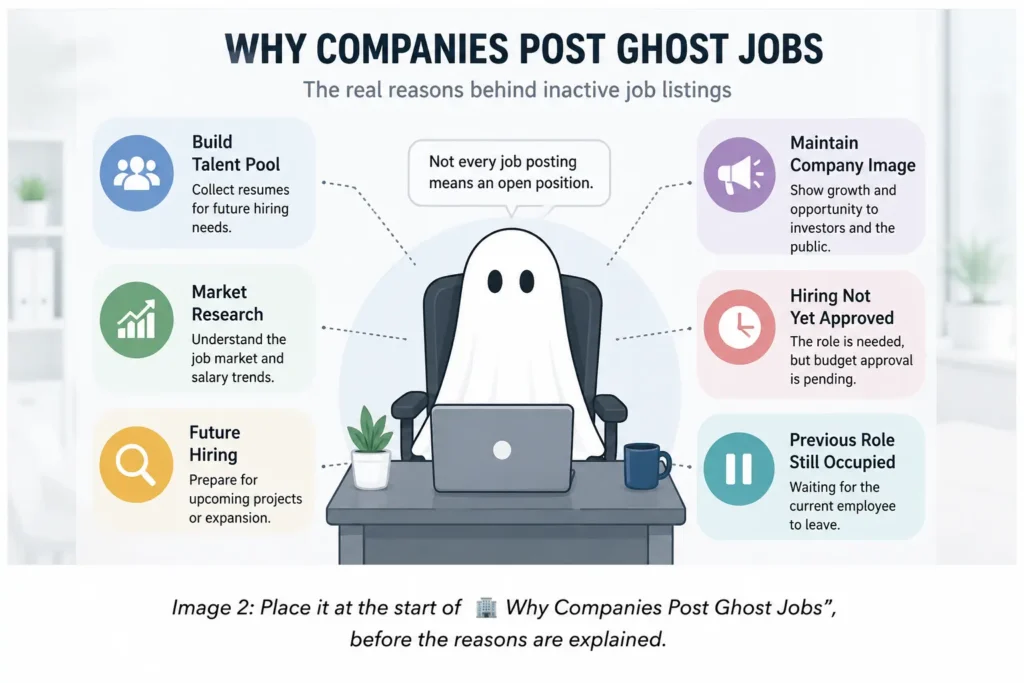
Why Companies Post Ghost Jobs
Here’s a quick look at the key reasons companies may keep these listings active:
| Reason | Purpose |
|---|---|
| Talent pipeline | Collect potential candidates |
| Market research | Understand available talent |
| Future hiring | Prepare for upcoming hiring needs |
| Growth signaling | Create an impression of company expansion |
| Employee pressure | Make current workers feel replaceable |
| Changed plans | The position or hiring plan changed, but the listing was never removed |
There are many factors that may shape an employer’s decision to keep a job advertisement online even when there is no active hiring process. There are some cases when the advertisement is part of a clear strategy while there are other instances when the employer’s plans changed, and they no longer need this position.
Below you will find the most common reasons for a job posting to exist in the absence of real hiring efforts:
1. Formulating a List of Candidates
This means that the employer wants to collect resumes of potential candidates before they need to hire. Keeping the position open gives them more options in terms of candidates in the future.
The reasons why this might be important vary. Some roles might be very challenging to staff, and getting applications from jobseekers may be useful.
2. Evaluating the Talent Market
In other words, the company takes this opportunity to see what kind of talent is available at that moment.
When looking through the applications, companies can see whether their requirements are realistic and appropriate or not.
3. The Illusion of Growth
Having multiple vacancies can give an impression of company growth, even though the company may not fill all the vacancies.
Some companies have admitted that they take advantage of job postings for job seekers, staff, investors, or business partners to create an impression that the company is growing.
4. Making Provision for Future Hiring
In certain cases, the company realizes that there will be a need for a particular position, even though there are no open vacancies.
Recruiters may start advertising the position and collecting applications before the actual need arises. Rather than rushing through hiring, it is always better to clarify that the hiring procedure for this future vacancy is taking place.
5. Managing Employee Perceptions
There are organizations that advertise their vacancies with a view to shaping employee perceptions of their job roles. In some instances, it might signify that assistance may arrive soon and that the already overburdened employees can expect that someone will be hired and help lessen their workload.
Conversely, indicating the availability of the same position can suggest to employees that they can be easily replaced, which can create an invisible obligation for them to do their jobs better.
In either case, the vacancy is doing psychological work within the company rather than indicating that this position is necessary to be filled.
6. Changes in Plans for Hiring
Not every ghost job is created intentionally.
A firm could initially intend to hire for the position and alert the public about it, only to freeze the hiring process afterwards because of a budgetary shift or company decision. Sometimes, the job remains posted because the company always does that — even when it has already hired someone internally or is in the process of hiring someone else.
Even if the job remains available on job boards after all such changes happen, someone might still look at the job posting and think that the company is hiring. This is why job posting is not enough to conclude that the company is the creator of ghost jobs.
Good to Know
Not every old job posting is a ghost job. Some listings remain online simply because a company forgot to remove them, or its hiring plans changed. Look for multiple warning signs before assuming a posting is fake.
How Common Are Ghost Jobs?
Ghost jobs seem to be relatively prevalent, yet lacking is a reliable number on how many postings are ghost jobs. Different definitions and techniques among studies make it hard to have comparability in the results.
According to Greenhouse, around 18-22% of jobs listed on Greenhouse fall under the category of ghost jobs. Other studies claim much higher numbers. However, other studies measure how many companies claim to have posted ghost jobs but not indicate its position in the total amount of jobs.
So while it is wrong to point to specific number of ghost jobs in job listings, the evidence suggests that ghost jobs are significant in quantity in the online listings.
Why Is It Difficult to Measure?
- There isn’t a universal definition of ghost job.
- Some job postings are outdated by mistake while some are kept active intentionally.
- Plans of hiring can change after the job is posted.
- Different studies measure different things.
Overall, it can be concluded that ghost jobs are common enough to be aware of but the exact number of them still remains unknown.
Conclusion
In today’s job market, ghost jobs are often a source of frustration for job applicants, particularly if they have difficulty differentiating a genuine opportunity from listings that have been proven to be false. While certain listings may simply be old job postings, others could continue to exist even if the company does not have any plans to conduct immediate hiring.
To deal with ghost postings, a job candidate should not necessarily assume that every old listing or unresponsive job posting is a ghost job; rather, he should look for patterns such as the same postings being reposted repeatedly, vague descriptions, long time frames without any updates, and low levels of activity in regard to hiring.
Additionally, companies can assist job seekers by ensuring their postings are valid and keeping them informed about hiring opportunities. Keeping an accurate distinction between active and potential job offers can support both job seekers and employers.
Frequently Asked Questions
Not always. There are occasions when a ghost job posting is still present even if that particular job posting was never removed.
Some indications that show a job listing might be a ghost job might include being posted for a long period of time with no hiring activity, being reposted multiple times, and having vague or no job description.
Companies might create ghost job postings in order to create or build a talent pool to assess the talent pool available. They might also want to prepare for future job postings.
Currently, there is no federal law against ghost job postings. However, certain states are starting to create laws to regulate ghost job postings and push for transparency on job postings.
Although it is not a good idea to disregard the applications for ghost jobs completely, it is prudent to first apply to the latest job postings, which have been made recently.