


These ten questions are the ones data hiring teams ask again and again. The first five cover building a pipeline; the last five cover keeping one running. Each one shows the point your answer must land and a full example to adapt.
Draw on systems you have truly worked on, and say plainly which parts were yours. Never make up company names, sizes, or figures. New to this work? Say so, then set out the steps you would take and why.
Key Takeaways
- Start from what the business needs. Ask about freshness, volume, and users before you pick any tool.
- Make every run repeatable. A job you can safely rerun is a job you can trust.
- Build checks into the pipeline, not after it. Catch bad rows where they enter, not in a dashboard a week later.
- Say what broke and what you changed. Honest incident stories with real fixes beat perfect records
How You Build It
These five test your design thinking: requirements, structure, and the right tool.
1. Walk Me Through Your Background and a Pipeline You Owned
What this answer must show: that you have carried a real pipeline end to end and can explain your part clearly.
Talk through your thinking: start with your path, then go deep on one pipeline you truly owned.
“I studied computer science and started as a backend developer, where I kept getting pulled into data problems: slow reports, mismatched numbers, jobs that failed overnight. I moved into data engineering because I liked owning the whole flow from source to dashboard. The pipeline I owned most deeply moved order data from our production database into our warehouse every hour. I designed the ingestion, wrote the transformations that cleaned and joined the data, and built the checks that compared row counts at each stage. When the source schema changed without warning, I added schema checks that failed loudly instead of silently loading bad data. I also cut load time by reworking the partitioning of the largest table. What I learned: owning a pipeline means owning its 3 a.m. failures too, so I documented everything and made every step rerunnable.”
Present your pipeline development and database expertise with this data engineer resume guide.
2. How Would You Design a Reliable Source-to-Warehouse Pipeline?
What this answer must show: that you design from requirements, in stages, with failure in mind.
Talk through your thinking: requirements first, then raw, clean, and modeled layers, then monitoring.
“I would start by asking what the data is for: how fresh it must be, how much there is, and who will query it. Those answers drive every later choice. Then I would build in three layers. First, a raw layer that copies source data exactly as it arrives, so we always have the original. Second, a clean layer that fixes types, removes duplicates, and applies the business rules. Third, a modeled layer shaped for reporting, with clear table names and documented columns. Each step would be idempotent, meaning rerunning it gives the same result, so failures are safe to retry. I would add checks at every stage: row counts, null rates, and schema checks, with alerts when something looks wrong. Finally, I would document the whole flow so anyone can understand and fix it.”
Learn how to describe work experience on your resume with clear responsibilities and achievements.
3. How Would You Return the Latest Valid Record for Each Customer?
What this answer must show: that your SQL is deterministic and you think about edge cases.
Talk through your thinking: filter to valid rows, rank by time within each customer, and break ties deterministically.
How to answer: Define a valid row and its business key. Filter invalid records, rank rows within each key by event time plus a stable tie-breaker, and retain rank one. Test duplicates, equal timestamps, nulls, and late events before tuning storage or indexes.
| Customer ID | Status | Event Time |
|---|---|---|
| C001 | Active | 2026-10-20 14:30:00 |
| C002 | Inactive | 2026-10-20 11:15:00 |
| C003 | Pending | 2026-10-19 16:45:00 |
Illustrative results using fictional data. Each row shows a customer’s most recent valid status. If two valid events have the same event time, the event with the higher ingestion sequence is selected.
“I would first agree on what valid means with the business: which statuses count and what a complete record looks like. In the query above, I filter out the invalid rows before ranking, so they can never win. I partition by customer, order by event time newest first, and add an ingestion sequence number as a second sort key so ties always resolve the same way, keeping only row number one. I would test edge cases: a customer with no valid rows, two rows with identical timestamps, and late-arriving data. I would also run it twice on the same input to confirm the result is stable. Deterministic means the same input always gives the same answer, and that is what makes this safe to use in production.”
Make your next interview more informative with these questions to ask a hiring manager.
4. How Would You Model Orders, Customers, and Products for Reporting?
What this answer must show: that you think in terms of what each row means and how tables join.
Talk through your thinking: define the grain of each table, then connect them with clean keys.
“I would start by asking what questions the reports must answer, then set one clear meaning for each table’s rows. The orders table gets one row per order line, with the order date, quantity, price, and keys pointing to the customer and the product. Customers get one row per customer with their current details, and products get one row per product. Measurements live in the orders table and descriptions in the customer and product tables, so each fact lives in exactly one place. Every table gets a primary key, and I document what each column means in plain words. For history, I would ask whether reports need to see a customer’s old address or just the current one, and design accordingly. The test: a new analyst can write a correct report on the first try without asking what a column means.”
Find a layout for presenting administrative experience in these office clerk resume templates.
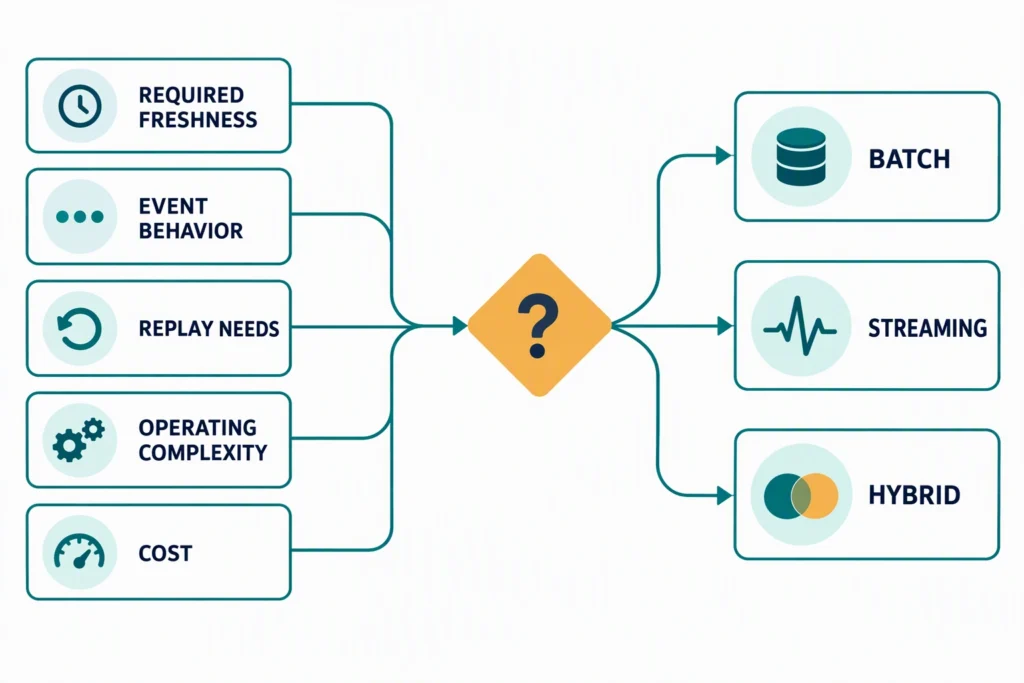
5. When Would You Choose Batch, Streaming, or Both?
What this answer must show: that latency needs drive the choice, not fashion.
Talk through your thinking: match the freshness requirement to the simplest tool that meets it.
“I choose based on how fast the business needs the data, because streaming costs more to build and run. If a daily sales report is fine arriving each morning, batch wins: it is simpler, cheaper, and easier to fix when something breaks. I would use streaming only when waiting hurts, like fraud alerts or live inventory, where minutes matter. Sometimes the answer is both: streaming for the urgent alert and batch for the complete, corrected picture the next day. I once kept a dashboard on batch while adding a streaming path just for alerts, instead of rebuilding everything. I also weigh team skill: a streaming system nobody can debug at night is worse than a batch job everyone understands. The right choice is the simplest one that meets the freshness the business actually needs.”
Explore this guide to describing confidential projects on a resume while protecting sensitive information.
How You Keep It Running
These five test your operations judgment: quality, cost, safety, security, and honesty.
6. How Do You Build Data Quality Into a Pipeline?
What this answer must show: that checks live inside the pipeline and bad data never flows silently downstream.
Talk through your thinking: check at entry, check between stages, and quarantine what fails.
“I put checks at three points. First, at entry: does the incoming data match the expected schema, and are required fields present? Rows that fail get quarantined with a reason, not dropped silently. Second, between stages: I compare row counts in and out, check for unexpected duplicates, and watch null rates on key columns. Third, on the final tables: I run the same sanity queries a business user would, like checking that totals reconcile with the source. When a check fails, the pipeline stops and alerts a human instead of publishing bad data. I also track quality over time, so a slow rise in nulls gets noticed before it becomes a crisis. The principle: a pipeline that fails loudly on bad data is working correctly. The dangerous pipeline is the one that loads everything and says nothing.”
Discover key performance indicators for customer service teams to understand how support performance is measured.
7. A Job Becomes Slower or More Expensive. What Do You Check?
What this answer must show: that you diagnose in order instead of guessing.
Talk through your thinking: rule out data change first, then look at skew, then the query itself.
“I check in order, starting with what changed. First, did the data grow or change shape? A sudden doubling of rows or a new skewed key explains most slowdowns. Second, I look for skew: is one worker doing most of the work while others sit idle? Third, I check whether a configuration or code change went in recently. Only then do I look at the query itself: full scans that used to be cheap, joins on the wrong keys, or a sort that no longer fits in memory. For cost, I break it down by stage to find which step burns the most. I fix the biggest lever first and measure before and after, so I know the change helped. I write down what I found, because the same pattern tends to return. Guessing wastes hours; checking in order usually finds it in one.”
8. How Do You Make Retries and Backfills Safe?
What this answer must show: that rerunning a job can never corrupt the data.
Talk through your thinking: make writes idempotent, track progress, and test on a slice first.
“I design every job so rerunning it produces the same result as running it once. For loads, I write to a staging area and swap it in only when the full job succeeds, so a failed run never leaves half-written data. I track exactly what has been processed, using offsets or watermarks, so a retry picks up where it stopped instead of starting over blindly. For backfills over old dates, I run one small slice first and validate the output before launching the rest. I also run backfills with lower priority so they do not starve the daily jobs. After any retry or backfill, I rerun the quality checks and compare counts against the source. The rule I follow: if I cannot explain exactly what a retry will do, I do not run it. Safe retries are designed, not hoped for.”
Highlight your reporting tools and analytical achievements with these data analyst resume examples and writing tips.
9. How Do You Protect Sensitive Data?
What this answer must show: that protection covers the data’s whole journey, not just one system.
Talk through your thinking: classify first, then limit who can see it, mask what they do not need, and log access.
“I start by finding where sensitive fields live: names, emails, payment details, and anything else the business flags. Then I apply three layers. First, access: only the people and jobs that truly need the data get it, and everyone else sees masked or tokenized values. Second, masking: in non-production environments, sensitive fields are replaced with realistic fakes so developers never touch real customer data. Third, encryption in transit and at rest, plus audit logs showing who accessed what. I also keep sensitive data out of logs and error messages, which people forget. When someone asks for broader access, I ask what decision they need to make and offer the smallest slice that answers it. Protection is not one tool; it is the habit of asking whether each person and system truly needs to see the real values.”
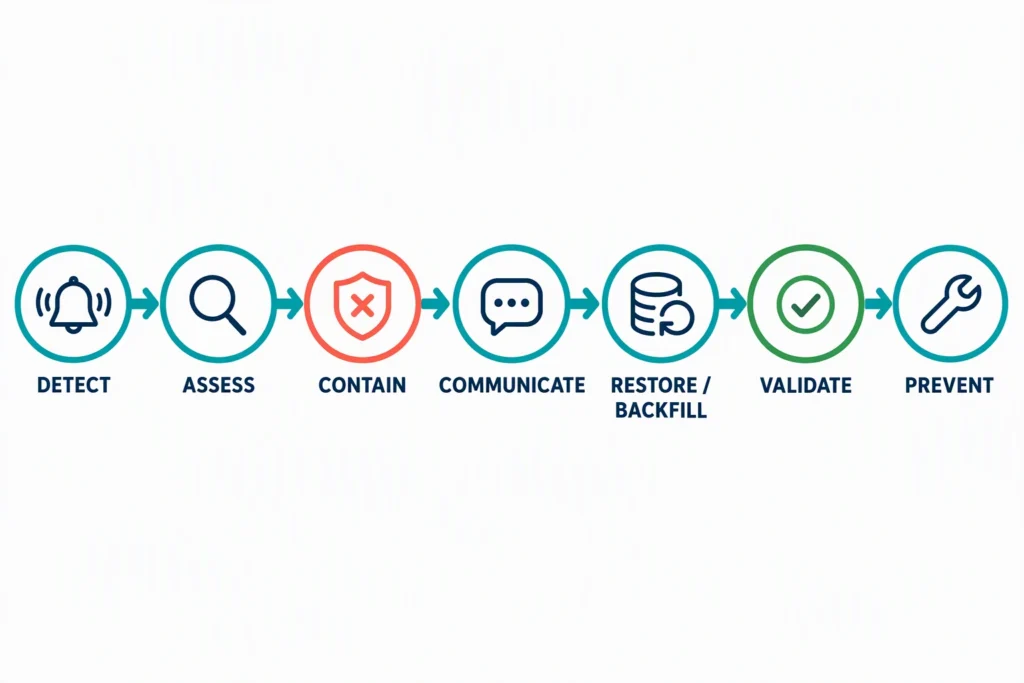
10. Tell Me About a Production Data Incident You Handled
What this answer must show: that you stayed calm, fixed it properly, and made sure it cannot happen again.
Talk through your thinking: detect, assess impact, stop the damage, fix, then prevent.
“Our morning revenue dashboard showed numbers far lower than expected, and the business team noticed before our alerts did, which was embarrassing. I first checked whether the source data was actually missing or just delayed, and confirmed an upstream feed had stalled overnight. I told the business team what I knew and when I would update them next, instead of going silent. Then I worked with the upstream team to restart the feed, validated the recovered data against the source counts, and reran the pipeline. Once the dashboard was correct, I wrote up what happened: the feed had no freshness alert, so nobody knew it stalled. I added that alert and a dashboard-level sanity check the same week. The fix took hours; the prevention took days but mattered more. I learned that the incident is not over when the numbers are right; it is over when the cause cannot recur.”
Explain a Pipeline You Know Out Loud
Pick a pipeline you have worked on or studied. Explain it out loud in five minutes: where the data comes from, what each stage does, where the checks are, and what breaks most often. Then have a friend ask what-if questions until you can answer without pausing. Interviewers hire engineers who reason out loud.
Frequently Asked Questions
Should I Focus More on SQL or Python?
SQL first. Most interviews test it deeply: joins, window functions, duplicates. Python matters for pipeline code. If short on time, master SQL, then show clean Python.
How Do I Answer Design Questions With No Work Experience?
Talk through a project you built, even a personal one. Explain your requirements, your choices, and what you would change. Interviewers want to see structured thinking, not a famous company name. A well-reasoned small project beats a vague big one.
Do I Need to Know a Specific Tool Like Spark or Airflow?
Know the ideas behind the tools: scheduling, retries, and distributed processing. Tools change; concepts last. If a job asks for a tool you lack, show you understand what it does and how you would learn it fast.
How Do I Handle On-Call and Night Failures in Interviews?
Be honest about your experience and show you design to avoid them: alerts, idempotent reruns, and clear runbooks. Say what you would check first at 3 a.m. Calm, ordered thinking is exactly what on-call needs.