


These ten questions come up in almost every Scrum Master interview. For each one, you get what it reveals about you, the coaching move to describe, and a full sample answer.
Work through the questions from the top, or skip ahead to whichever one worries you most. Shape every sample around something you actually did — coaching stories only work when they are real.
Key Takeaways
- You serve the team; you do not run it. Decisions stay with the team. Your job is to make good decisions easier
- .Protect the sprint goal; bend on the rest. Urgent work goes through the Product Owner, not around the team.
- Make the work visible, then step back. A board everyone can read beats a status meeting.
- Fix the system behind the conflict, not the people in it.
What Makes a Strong Scrum Master Answer
Interviewers listen for coaching, not ceremony definitions. Each answer below shows what the question reveals, the coaching move that answers it, and a full sample you can adapt — told start to finish in the first person.
1. How Do You Explain What a Scrum Master Is Responsible For?
What this reveals: whether you see yourself as a servant-leader or as a boss with a new title.
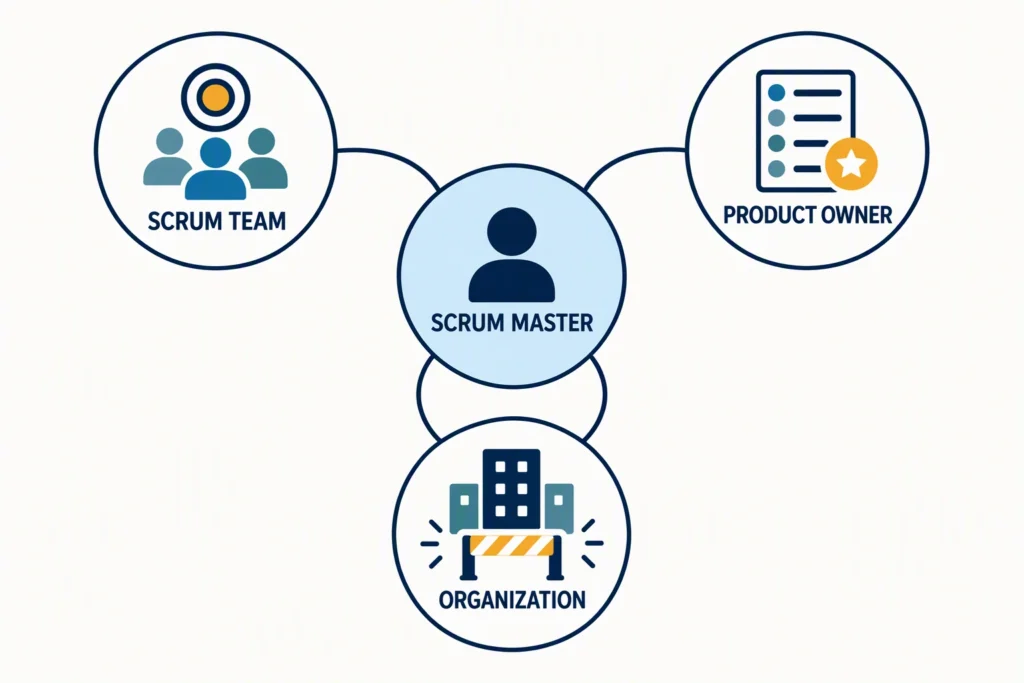
Your move as coach: name your accountabilities — the team’s effectiveness, impediment removal, real understanding of Scrum — while making clear the team decides its own work.
In the interview, say:
“I am responsible for how well the team works, not for telling people what to do. That means I remove whatever blocks them, I make sure everyone truly understands how we work, and I help the team get better at deciding for itself. I do not assign tasks, I do not run the meetings for them, and I never speak for the team to outsiders. When I started, one manager kept asking me for individual performance updates. I explained that my job is the team’s health, not tracking people, and I pointed him to our shared board instead. A good Scrum Master becomes less needed over time — if the team cannot function without me, I am doing it wrong.”
Make your duties more specific with these resume alternatives to “responsible for”.
2. How Would You Help a Team Plan a Realistic Sprint?
What this reveals: whether you plan from evidence or from hope.
Your move as coach: bring past facts into the room — capacity, holidays, support load — and frame the plan as a forecast, not a promise.
In the interview, say:
“I start planning with two numbers on the table: how much the team finished in the last few sprints, and how many working days we actually have this time, minus holidays and support duty. Then the team picks work to match, not to impress anyone. I keep a small buffer — about one day in ten — for the surprises that always come. When someone pushes for more, I ask what we should drop to make room, because adding without removing is just pretending. I also make sure every item is clear enough to start; vague items wait for the next sprint. One team I coached went from missing the goal three sprints in a row to hitting it five straight, just by planning from facts instead of wishes.”
Find ideas for presenting your service experience in these customer support resume examples.
3. What Would You Do When Urgent Work Appears Mid-Sprint?
What this reveals: whether you protect the team or let every emergency rewrite the plan.
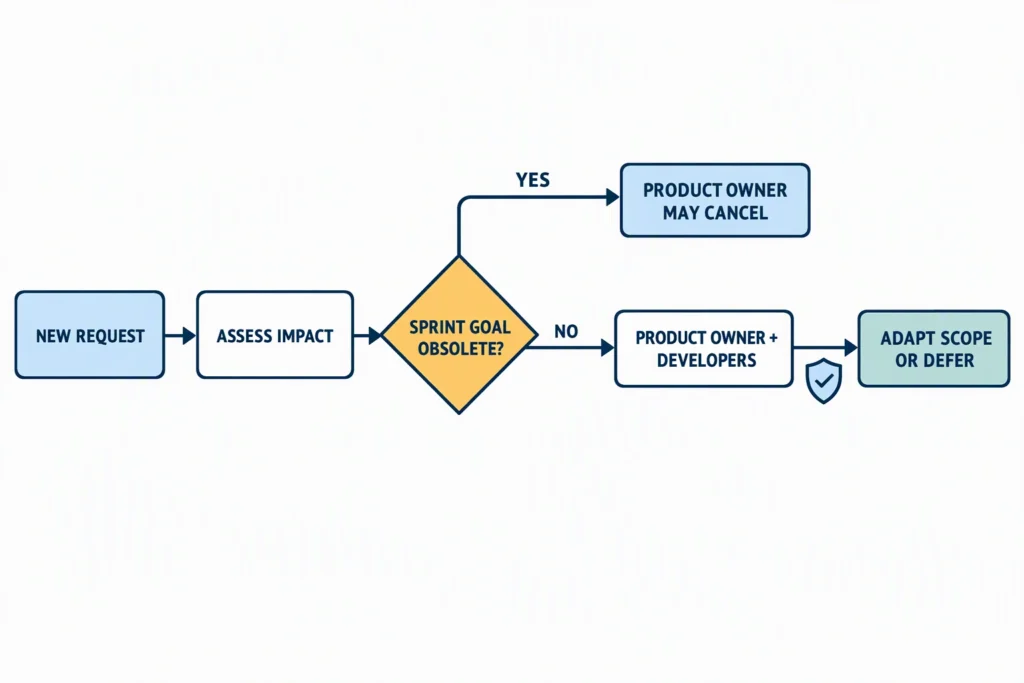
Your move as coach: route it through the Product Owner, weigh it against the sprint goal, swap work instead of stacking it.
In the interview, say:
“I do not let urgent work jump the queue on its own. First I ask the Product Owner to decide: is this more important than what the team already committed to? If yes, we pick something of equal size to remove — we swap, never stack. If no, the urgent item goes to the top of the next sprint. I once watched a team take on four ‘urgent’ items in one sprint without removing anything; they finished none of them and the sprint goal died. After we started the swap rule, urgent work still got done, but the team stopped drowning. My line to anyone pushing is simple: everything is possible, but not everything is possible this week.”
Practise discussing testing decisions with these quality assurance analyst interview questions.
4. How Would You Keep the Daily Scrum From Becoming a Status Meeting?
What this reveals: whether you understand the event belongs to the developers, not to you.
Your move as coach: refocus it on the sprint goal and today’s plan, move long talks out, never collect reports.
In the interview, say:
“The daily scrum is for the developers to plan their day together, not to report to me. When it turns into status updates, I step in gently. I remind the team of the one question that matters: what should we do today to hit the sprint goal. If two people need a longer talk, I move it to right after — we call it the parking lot — so the fifteen minutes stay short. I never ask people to report to me, and I stand at the side, not the center. On one team the meeting had stretched to forty minutes of round-robin updates. Within two weeks of the parking-lot rule and the goal-first question, it was back to twelve minutes and the developers said it was useful again.”
Showcase your drink preparation and guest service skills with this bartender resume example and writing guide.
5. Describe an Impediment You Helped Remove
What this reveals: whether you chase root causes or just move tickets around.
Your move as coach: show the trail — how you found it, who you talked to, what changed for good.
In the interview, say:
“My team waited two days every time they needed a test environment, because only one operations engineer could create them and he was always busy. Developers started working around it with shared logins, which was risky. I first asked the engineer what blocked him — he was afraid of breaking production with a wrong click. So I worked with him to write a one-page safe setup guide with clear guardrails, and I got his manager to approve the team creating their own test environments. Wait time dropped from two days to twenty minutes. The deeper fix was trust: once the engineer saw the guardrails worked, he stopped being the bottleneck by choice. I keep a visible list of top impediments so the team sees progress, not just promises.”
Build a clear application around your salon experience with this salon assistant resume guide.
6. How Do You Handle Conflict Within a Scrum Team?
What this reveals: whether you mediate fairly or take sides.
Your move as coach: hear both sides separately, bring them together on the work (not personalities), agree on a rule going forward.
In the interview, say:
“Two developers on my team fought for weeks over code review style — one wanted strict rules, the other called it nitpicking, and reviews stalled. I spoke to each one alone first, just listening, no judging. Both cared about quality; they just defined it differently. I brought them together with one question: what rule would let reviews move fast without letting bugs through. They agreed on a short checklist of must-check items and left style comments optional. I wrote it down where everyone could see it, and review time dropped by half. I did not decide who was right. My job was to turn a personal fight into a shared rule. When conflict is about the work, a clear rule ends it; when I sense it is personal, I talk to each person privately first.”
Present your professional credentials clearly by learning how to list certifications on a resume.
7. How Do You Work with a Product Owner When Backlog Items Are Unclear?
What this reveals: whether you coach the Product Owner or just complain about vague tickets.
Your move as coach: teach with questions and examples until items are clear enough to start.
In the interview, say:
“Vague backlog items poison sprints, so I treat this as a coaching opportunity, not a complaint. I sit with the Product Owner and ask the questions developers will ask: who is this for, what does done look like, how will we test it. I ask for one concrete example per item — a real user doing a real thing. We keep refining until each item is small and clear enough that the team can start without guessing. I once worked with a Product Owner whose items were one-line wishes; the team spent half of every planning meeting guessing. After three weeks of short refinement sessions, items arrived clear and planning time halved. I never rewrite the backlog myself — the Product Owner owns the what. I just make the unclear parts visible early.”
Explore these customer service performance indicators to understand how support results are measured.
8. How Would You Improve an Ineffective Sprint Review?
What this reveals: whether you know the review is for feedback on the product, not a demo show.
Your move as coach: bring the right people, show working software, ask for honest reactions.
In the interview, say:
“Most bad reviews are slide shows with no users in the room. I fix that in three moves. First, I invite the people who will actually use the product, not just managers. Second, the team shows working software — clicked live, not screenshots — even if it is rough. Third, I ask the guests one direct question: what would stop you from using this. On one team the review had become five developers presenting to each other. I invited three customer support reps who hear complaints daily. Their reactions killed two features we were about to polish and reshaped a third. The developers were nervous at first, then loved it — real feedback beats polite applause. I keep the review to one hour and end with what we learned, not what we built.”
Decline an opportunity professionally with this guide to turning down a job offer.
9. How Do You Turn a Retrospective Into Lasting Improvement?
What this reveals: whether your retrospectives produce change or just venting.
Your move as coach: one small action per retro, with one person responsible and a visible check next sprint.
In the interview, say:
“A retrospective without a change is just a complaining session. I run ours to produce exactly one improvement the team truly wants. We pick the single most painful issue, agree on one small experiment to fix it, name one person responsible, and write it on the board where everyone sees it daily. Next retrospective starts by checking: did it work. One team kept complaining about broken builds but never acted. We agreed on one rule — no merging without a green build — with one person responsible for enforcing it for two weeks. Broken builds dropped to nearly zero, and the team started trusting the process. I also vary the format so it never goes stale: sometimes silent writing first, sometimes pairs. But the rule never changes — one action, one person responsible, checked next time.”
10. How Do You Measure Your Impact Without Misusing Velocity?
What this reveals: whether you understand velocity is a planning tool, not a performance score.
Your move as coach: use velocity only for forecasting; show your impact through team health signs instead.
In the interview, say:
“I never use velocity to judge people — the moment it becomes a target, teams game it and it stops meaning anything. I use it for one thing only: forecasting how much work fits in a sprint. My impact shows up elsewhere. Are impediments getting removed faster. Is the team hitting sprint goals more often. Do retrospectives produce real changes. Are conflicts resolved instead of festering. I track these quietly and share trends with the team, never with managers as report cards. When a manager once asked me to rank developers by velocity, I refused and showed him our sprint goal hit rate instead — it told the real story without turning teammates into competitors. A Scrum Master’s success is a team that needs them less, and that never fits on a velocity chart.”
Coach a Friend Through a Standup
Ask a friend to describe their workday — any job will do. Run a five-minute standup: what did you do yesterday, what is next, what is in your way. Your only job is to ask questions, never give answers. If you catch yourself solving their problem, stop and ask what they think they should try. That restraint is the whole Scrum Master skill in one exercise.
Questions Scrum Master Candidates Ask
Do I need a Scrum Master certification to get hired?
A certificate can get your name on the interview list. What wins the job is proof you can coach: a team you helped plan better, argue less, or ship more calmly. No stories yet? Volunteer to run standups for a group near you and note what changed. That record speaks louder than any certificate.
What if I have never held the Scrum Master title?
Talk about times you helped any group work better — unblocking people, running a useful meeting, calming a conflict. The title matters less than the coaching instinct. Name the moments plainly and say what changed because of you.
What if the team refuses to follow Scrum?
Do not force it. Find the one pain they complain about most and fix that first with a tiny Scrum practice. Teams adopt what helps them. Pushing all of Scrum at once on a doubtful team just builds resistance.
How do I talk about a team that failed?
Honestly. Say what you tried, what did not work, and what you learned. Interviewers trust candidates who own failures far more than ones who claim every team thrived. The learning is the point.