

Learn what employers want, prepare honest examples, and adapt ten clear sample answers for your administrative assistant interview.
Almost every administrative assistant interview asks these same ten questions. For each one below, you will see what the person across the desk really wants to hear, the main points to cover, and a complete example answer.
The best answers are simple and honest. Say what happened, what you did, and how it turned out.
Key Takeaways
- Show proof, not nice words. Give an example of something you do or a clear choice you made. That says more than calling yourself organized.
- The same strengths come up in every answer. Planning well, writing clearly, keeping things private, and staying calm matter in every answer.
- Short answers sound stronger. Give the answer first, add one detail, then stop.
- Use examples from anywhere in your life. School, volunteering, or customer service all work when the skill fits the job.
When Everything Is Due at Once
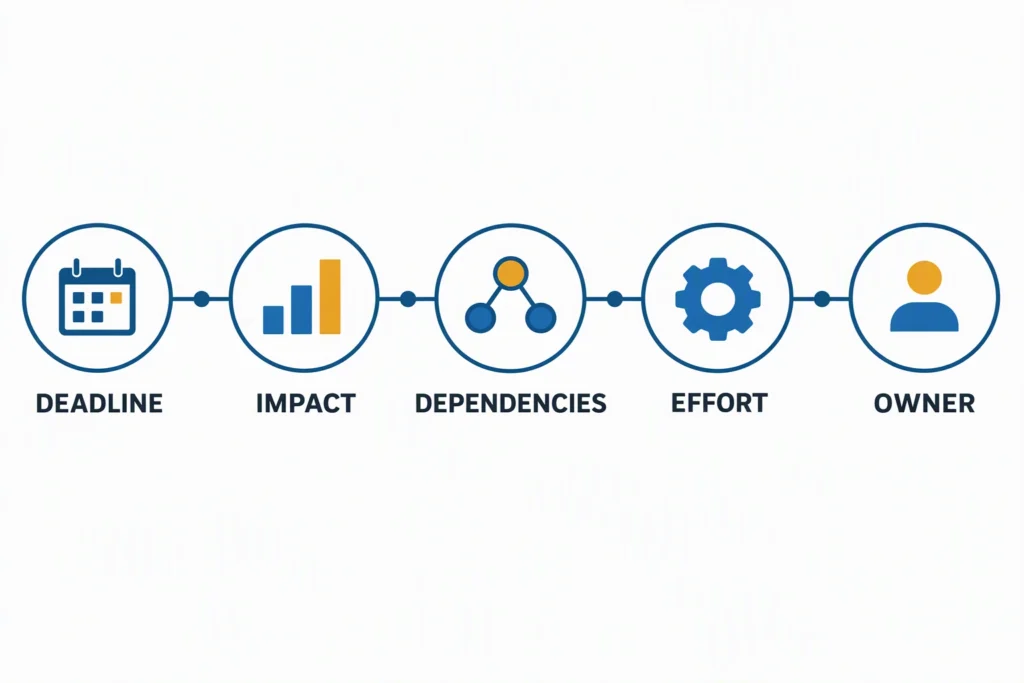
Much of the job is deciding what happens first. These two questions test that.
1. How Do You Organize Work with Competing Deadlines?
The interviewer wants to know if you have a clear method for ranking tasks when everything feels urgent.
Say where you keep requests and how you set the order.
“I once had three managers ask for things on the same Friday. One needed a report, one needed travel booked, and one needed a meeting set up. I wrote all three down in one list with their deadlines and asked myself: what happens if this waits? The travel had to be booked first because prices go up. The report was next because the manager needed it for a Monday meeting. The meeting could be set up last. I told each manager the order and when they would get their work. I finished the travel and report by Thursday, and the meeting was set for Friday morning. Nothing was late. Now I start every day by listing my tasks and ranking them by deadline and impact. I speak up early if two urgent things clash, because a quick chat beats a missed deadline.”
Find ways to highlight reliability, customer care, and workplace contributions in our collection of service resume examples.
2. Tell Me About a Difficult Scheduling Problem.
The interviewer wants to see how you handle moving parts: people, times, and places that all have to line up.
Answer it in three steps: 1. Say who had to be there and what could not move: time zones, travel, fixed meetings. 2. Offer a few times that work rather than asking everyone to figure it out. 3. Confirm the choice and send the correct details to each person.
“I had to set up a meeting with people in three time zones while our director was traveling. I started by listing who had to be there and what could not move: the director’s flight, a fixed team meeting, and the time differences. I found two one-hour windows that worked for everyone and sent both options to the group, asking them to pick one. I got an answer within the hour. Then I sent one clear invite with the video link, the agenda, and the time written in each person’s time zone. I also sent a reminder the day before. Everyone joined on time, and no one had a clash. Now I always offer two or three times instead of asking people to figure it out, and I put the time zone in every invite.”
Prepare for a useful conversation about the role with these questions to ask a hiring manager.
Handling People and Private Details
These questions cover what you keep private and how you treat people.
3. How Do You Handle a Difficult or Unrealistic Request?
The interviewer wants to know if you can say no without damaging the relationship.
Do: find out what the person really needs, explain the limit without blaming anyone, and suggest a workable next step. Don’t: promise what you cannot deliver, and do not refuse without giving them something else to try.
“My manager once asked me to prepare a full board report by the next morning, but half the numbers were not ready. I did not say yes right away. I asked what the report was for and what mattered most. She needed the sales numbers for a call, not the full report. I told her plainly: I can have the sales section ready by morning, but the full report needs two more days because I am waiting on finance. I suggested we do the sales part first. She agreed. I stayed late to finish the sales numbers, sent them with a short summary, and delivered the full report two days later. She thanked me for being honest about the timeline. Now when I get a tough request, I find out what is really needed, say what I can do, and offer a clear alternative.”
Introduce your qualifications without a lengthy message using these short cover letter examples for email applications.
4. How Do You Protect Confidential Information?
The interviewer wants proof that you have real habits, not just good intentions.
Focus on this: talk about what you do every day, not good intentions. Anyone can say they are trustworthy. Few can say what they do step by step.
“In my last role I handled salary details and performance reviews. I treated every private file the same way. I only saved them in our approved system, never on my desktop or in email drafts. Before I shared anything, I checked that the person was allowed to see it. I double-checked every email address before I hit send. I locked my screen every time I stood up, even for a minute. Once, a coworker asked me about someone else’s pay. I said I could not share that and offered to connect them with HR instead. My manager trusted me with sensitive work because I was consistent. Keeping things private is not a promise I make. It is a set of habits I follow every day.”
Present your scheduling, recordkeeping, and administrative abilities with these office support specialist resume examples.
5. How Do You Adjust Your Communication for Different People?
The interviewer wants one clear example of how you change your style for the person in front of you.
Name one clear way you adjust for different people.
“I support three managers, and each one wants updates differently. One likes a short email with just the decision needed. Another wants the background and the deadline. The third prefers a quick chat. I learned this by watching what they responded to fastest. For the first manager, I now send two-line emails: what I need and by when. For the second, I add the context and the timing. For the third, I stop by their desk. With visitors, I use simple words and explain what happens next. The facts never change. Only the shape changes. When I started adjusting, I got faster answers and fewer follow-up questions. Now I pick the style that fits the person, not the style that is easiest for me.”
Identify relevant practical abilities and safety knowledge with our guide to skills for blue-collar jobs.
Showing How You Work and Learn
These questions ask for something real: a thing you improved, learned, or fixed.
6. Tell Me About an Administrative Process You Improved.
The interviewer wants to see that you notice problems and fix them without being asked.
Cover these three things: 1. Say what the old problem was in one sentence. 2. Say what you changed and who you showed it to. 3. End with the result and how you kept the change going.
“Our office supply requests kept getting lost in long email threads. People would ask for things, but no one tracked them, and orders were late. I made a simple shared form where anyone could list what they needed. I set one day a week for placing orders and shared the form with the team. I showed my manager first and got her approval. Then I wrote down the steps: fill the form by Thursday, I order on Friday, supplies arrive the next week. Within a month, no requests went missing. People knew when to expect their items. I still use that form today, and I check it every Thursday. I also added a column for urgent requests so nothing critical waits. A small clear process beats a messy inbox.”
Showcase your product knowledge, styling abilities, and client relationships with these personal shopper resume examples.
7. How Do You Learn New Software?
The interviewer wants to see that you can learn without breaking anything.
Show your steps in order.
“When my team switched to a new scheduling tool, I had never used it before. I started with the official training videos and took notes on the steps for our most common tasks: booking rooms, sending invites, and checking calendars. I practiced in the test account, not with real meetings. When I got stuck, I asked our IT person right away instead of guessing. I also asked a coworker to watch me book my first three real meetings and point out mistakes. Within two weeks I was comfortable. I kept my notes and shared them with the next new hire. Now I learn every new tool the same way: training first, practice safely, ask early, and write down the steps.”
Describe your results more precisely with these synonyms for “achieved” on a resume.
8. Tell Me About a Mistake and How You Fixed It.
The interviewer wants honesty and proof that you fix the cause, not just the symptom.
What matters here: be honest and brief. Say how you spotted it, what you did, and what changed after.
“I once sent a meeting invite with the wrong video link. An attendee emailed me ten minutes before the start, saying the link did not work. I felt my stomach drop. I found the right link, sent it to everyone at once with a quick apology, and joined the call early to make sure people could get in. Everyone made it. After the call, I figured out what went wrong: I had copied the link from an old invite. Now I test every link before I send it, and I keep a checklist for new invites. I also told my manager what happened so she heard it from me. Owning a mistake fast and fixing the process matters more than being perfect.”
Planning Ahead and Wanting the Job
The last two questions are about planning ahead and wanting the work.
9. How Do You Plan a Meeting or Event?
The interviewer wants to hear your planning steps in order, not just that you are organized.
Walk through these three parts: 1. Settle the purpose, the guest list, the date, and the budget first. 2. Make a checklist and give each item to one person to handle: the place or link, materials, access needs, equipment, and a backup plan. 3. Go over it all, test what could break, and share a brief summary after.
“I planned our team’s quarterly offsite for twenty people. I started with the basics: the goal was planning, the date had to avoid month-end, and the budget was set. I booked a room that fit everyone and had good video for remote joiners. I made a checklist: agenda, materials, lunch order, name tags, and a backup plan if the video failed. I gave each item a deadline and checked them off. The day before, I visited the room, tested the screen and the sound, and laid out the materials. On the day, everything ran on time. After, I sent notes with what we decided. The team said it was our smoothest offsite. Now I plan every event the same way: purpose first, checklist second, test everything third.”

10. Why Do You Want This Administrative Assistant Role?
The interviewer wants to know if you actually want this work, not just any job.
Keep this in mind: link what you enjoy to what the job actually involves. One fact from the job ad shows you read it.
“I like work where good planning helps everyone around me do their best. In my last job, I supported a team of fifteen, and I loved being the person who kept things running: the calendars, the travel, the details no one else wanted to handle. When I read your listing, I saw you need someone to support a growing team and keep the office organized. That is exactly where I do my best work. I am good at juggling priorities, I stay calm when things change, and I care about getting the small things right. I want a role where I can use those strengths every day, and this one fits. I have done this work for three years, and I want to keep doing it for a team that values it.”
How to Turn This Guide Into Practice
Pick the three hardest questions. Answer each out loud for about two minutes, then adjust one line to fit the job posting.
Frequently Asked Questions
What If I Have No Office Experience?
Talk about the work, not the job title. If you set up shifts, tracked orders, or kept records somewhere else, say so. Those jobs use similar skills.
How Should I Answer a Question About Weaknesses?
Name one small thing you are working on and what you are doing about it. Never pick careless handling of private details.
What Should I Ask at the End?
Have two or three ready: what a normal day looks like, what is giving the team the most trouble, and how they will judge your work in the first months.
Is It Okay to Bring Notes to the Interview?
Yes. Bring your questions and a few quick reminders. Glance down, then look back at the person. Do not read full answers off the page.
When Should I Follow Up After the Interview?
Send a thank-you email before the day ends. Mention one thing you talked about. If they gave a timeline, wait until it passes before you check in.