
“Worked with clients and collected data” leaves an employer guessing. It does not show which procedures you implemented, how you measured behavior, when you escalated concerns, or whether your credential is active.
A stronger resume makes the service setting, supervisor-directed work, measurement methods, and documentation habits visible. It also protects client privacy and avoids claiming assessment, treatment design, or outcomes that were outside your role.
Key Takeaways
- State credential status exactly. Training, an approved application, exam eligibility, and active Registered Behavior Technician (RBT) certification are different stages.
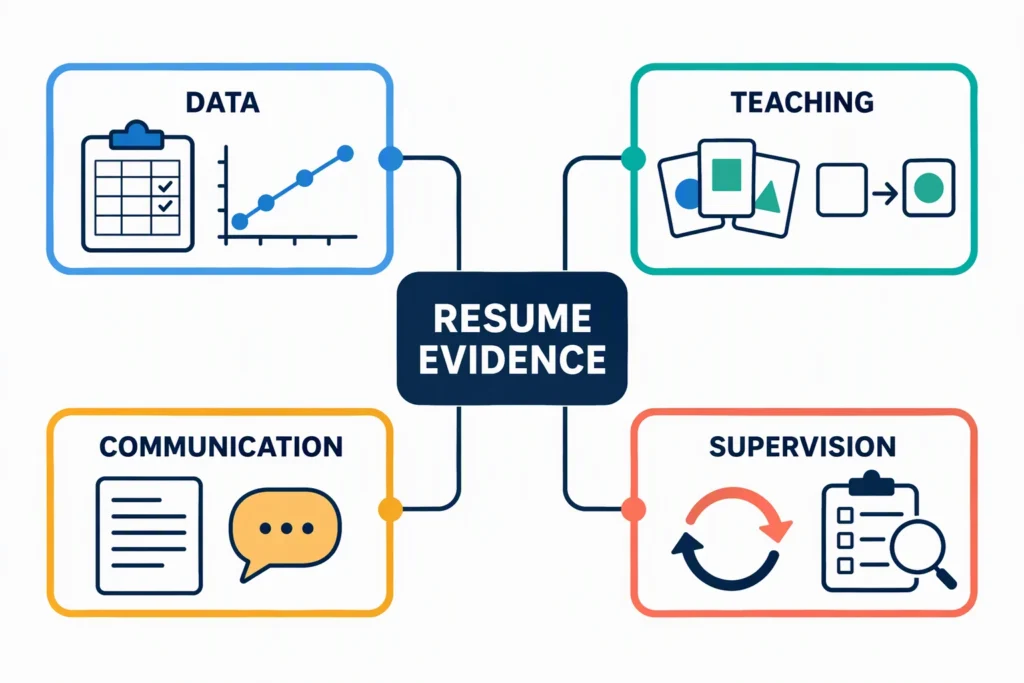
- Use the service cycle as evidence. Connect preparation, plan implementation, measurement, session notes, and supervisor communication.
- Show scope without exposing clients. Use de-identified settings, age groups, session counts, teaching procedures, and data methods.
- Keep supervision visible. Describe clinical direction and feedback without presenting supervisor decisions as your own.
Translate the posting into evidence
One employer may deliver early-intervention services in homes; another may need school support, clinic-based teaching, caregiver communication, or evening availability. Match the setting and population honestly, then look for proof behind each requirement.
| Posting language | Evidence to use | Wording boundary |
|---|---|---|
| Data collection | Frequency, duration, interval, permanent-product, or skill-acquisition data | Name only methods you used accurately |
| Skill acquisition | Discrete-trial, naturalistic, prompting, chaining, or reinforcement procedures | Say “implemented,” not “designed,” when following a plan |
| Behavior reduction | Antecedent strategies, differential reinforcement, crisis protocol training | Do not diagnose behavior functions independently |
| Documentation | Same-day notes, data entry, incident reporting, schedule changes | Exclude names and identifiable case details |
| Supervision | Direct observation, feedback, competency practice, escalation | Do not imply unsupervised clinical authority |
The Behavior Analyst Certification Board (BACB) describes the RBT as a paraprofessional who works under close, ongoing supervision. Its current test content outline covers data collection, assessment participation, behavior acquisition, behavior reduction, documentation, reporting, and ethics. Those domains can help you recognize evidence, but your resume must stay within the duties you actually performed.
Find a layout that suits your experience in our collection of resume templates for service jobs.
Follow the service cycle
The most useful bullets show what happened before, during, and after a session.
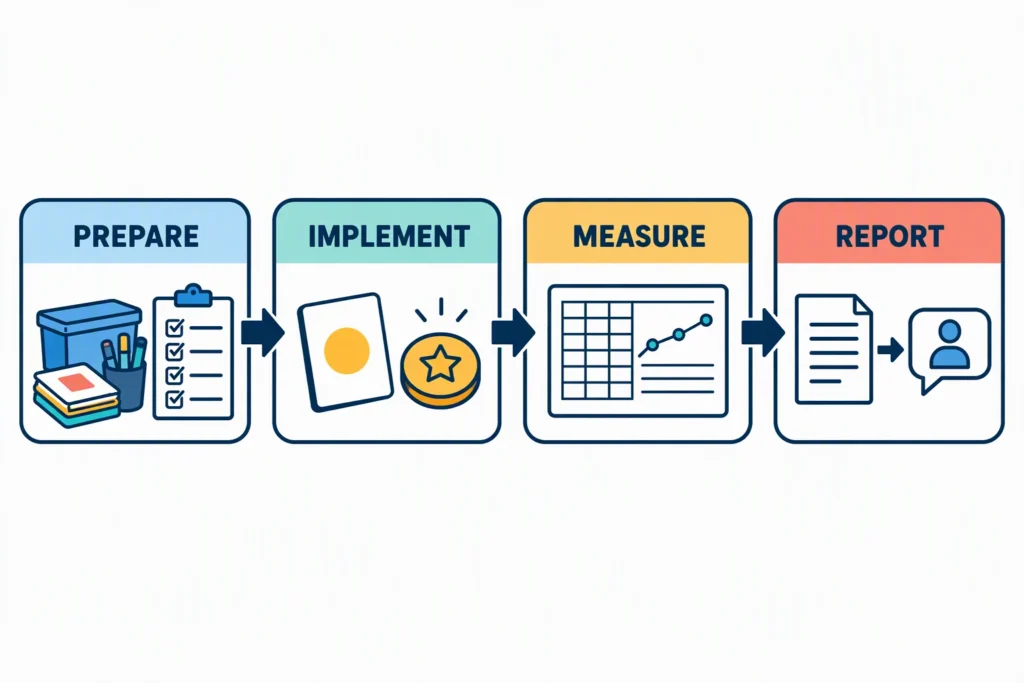
1. Prepare: Review assigned programs, organize materials, confirm data sheets, and note setting changes.
2. Implement: Follow the written plan and current supervisor direction for teaching and behavior-support procedures.
3. Measure: Record observable responses using the assigned definitions and measurement system.
4. Report: Complete objective notes and bring irregular data, new risks, or implementation questions to the supervisor promptly.
This sequence separates responsible implementation from clinical authorship. It also gives an interviewer a clear path for asking how you respond when data, behavior, or environmental conditions change.
Explore these service resume examples for ideas on presenting your strengths and workplace achievements.
Build bullets from supportable records
Use session schedules, data systems, note-completion reports, competency records, material-preparation logs, or documented feedback. Numbers should explain scope rather than suggest that speed replaced accuracy.
| Weak wording | Stronger fictional example |
|---|---|
| Collected behavior data | Recorded frequency, duration, and skill-acquisition data across 20–24 weekly sessions and entered completed records before shift close. |
| Helped clients learn skills | Implemented assigned prompting, reinforcement, and task-analysis procedures during clinic and community-based programs. |
| Communicated with the team | Reported data irregularities, schedule changes, and implementation questions to the supervising behavior analyst before the next session. |
| Improved client behavior | Maintained procedural steps and objective notes during a supervisor-reviewed program update, without attributing the clinical outcome to one staff member. |
Use group-level workload numbers only when they describe your own assignments. Avoid percentages of “behavior reduction” unless the baseline, period, program change, and your contribution are documented and appropriate to disclose.
Organize your introduction, supporting examples, and closing before drafting with our cover letter outline guide.
Adapt an experienced RBT example
This fictional candidate targets a clinic role that values reliable data, program implementation, and timely communication.
Taylor Brooks
Austin, TX | (512) 555-0182 | taylor.brooks@example.com
Registered Behavior Technician experienced in clinic and community-based services, continuous and discontinuous measurement, skill-acquisition programs, and objective session documentation. Uses supervisor feedback to maintain procedural consistency and escalate concerns promptly.
Experience
Bright Path Learning Center, Austin, TX
Registered Behavior Technician | March 2024 – Present
- Implement assigned skill-acquisition and behavior-support programs across 20–24 weekly sessions under behavior-analyst supervision.
- Record frequency, duration, interval, and task-analysis data in the electronic system and complete objective session notes before shift close.
- Prepare individualized teaching materials and visual supports from current program instructions, checking version dates before sessions.
- Bring data irregularities, setting changes, and implementation questions to supervision and apply documented performance feedback.
Behavior Technician | June 2023 – February 2024
- Supported naturalistic and structured teaching sessions after completing employer training and demonstrated competencies.
- Organized materials, recorded assigned measures, and followed escalation procedures for safety or program concerns.
Certification
Registered Behavior Technician (RBT) — Behavior Analyst Certification Board (BACB)
Active; recertification date March 2028
Education
Austin Community College, Austin, TX
Associate of Applied Science in Human Services
Completed May 2023
Technical Skills: Frequency and duration measurement; interval recording; data entry; graph review; discrete-trial teaching; naturalistic teaching; prompting and fading; task analysis; reinforcement procedures; objective session notes
Choose the right attachment for your application with our resume PDF vs. Word guide.
Write an entry-level version accurately
Coursework, supervised practicum, education support, direct care, youth programs, and structured data collection can provide relevant evidence. Preserve the original setting and do not use the RBT title unless your BACB status supports it.
Behavior Technician Trainee, Northside Family Services, Phoenix, AZ
August 2026 – Present
- Completed a 40-hour RBT training program aligned with the 2026 requirements and retained the completion certificate.
- Practice operational definitions, measurement procedures, and teaching trials during supervised competency preparation.
- Prepare de-identified sample data sheets and receive feedback on objective documentation.
The June 2026 RBT Handbook requires applicants to meet age, education, background-check, abuse-registry, training, and initial competency requirements. The 40-hour course alone is not certification. Copy the status and recertification date from your BACB account or the certificant registry instead of estimating them.
Make your professional credentials easy to identify by learning how to list certifications on a resume.
Preserve a website-ready credential block
Certification
Registered Behavior Technician (RBT)
Behavior Analyst Certification Board (BACB)
Active; recertification date March 2028
Verify the application before submitting
Confirm your title, employer, setting, dates, certification status, measurement methods, procedures, and every number. Reopen the submitted file and check that employer and job-title text is bold, locations are plain, and each complete date range is italicized.
Remove client names, initials, birth dates, school names, screenshots, and distinctive case stories. A de-identified description of the procedure, record, and escalation is enough to demonstrate judgment.
Prepare for a more informative interview with these questions to ask a hiring manager about the role, expectations, and team.
Show dependable implementation
An RBT resume becomes credible when it connects direct service with accurate measurement, objective documentation, and timely supervisor communication. That pattern shows how you support the plan while respecting the limits of the role.
Frequently Asked Questions
These answers address certification status, metrics, and supervisor information.
Can I put RBT on my resume before I am certified?
Use your actual job title, such as “Behavior Technician” or “Behavior Technician Trainee,” and list completed certification steps separately when relevant. Do not represent yourself as an active RBT before your BACB status supports that claim.
Should I include client progress percentages?
Only when the measure, period, and source record are clear and disclosure is appropriate. Program-level progress usually reflects a team and clinical decisions, so individual workload, data accuracy, documentation timeliness, or demonstrated competencies may be safer evidence.
Should I name my supervising BCBA?
Usually, the supervision relationship and duties are enough. Name a Board Certified Behavior Analyst (BCBA) only when the posting requests it, the information is relevant, and you have permission to use that person as a reference.