

You spend an hour trying to make the gap on your resume less noticeable. Then you open the program’s requirements: applicants must have taken an extended career break.
The detail you were hiding is part of what makes you eligible.
For these applications, make two things easy to see: that your background meets the program’s criteria, and that your experience fits the work. Use a short professional summary, a clearly dated break, relevant employment history, and honest evidence of current skills. You don’t need an apology, an invented consulting business, or a resume that makes an experienced professional look like a new graduate.
Key Takeaways
- A returnship is a hiring pathway, not just a training course. Your application still needs evidence that you can contribute to the advertised role.
- Older relevant experience deserves space. A long break can push your strongest work beyond a standard look-back window; don’t delete it automatically.
- Program completion doesn’t necessarily guarantee a permanent job. Check whether you’re applying for a fixed-term placement or a direct hire with transition support.
Check the program before rewriting your resume
“I’ve been away for two years” may answer only half the eligibility question. Employers can also specify previous experience, professional level, location, and availability.
These official program pages illustrate the differences, checked in October 2026:
| Program | Published break requirement | Other details to check |
|---|---|---|
| IBM Tech Re-Entry | One or more years | Technical background and skills matching available roles; full-time paid program |
| JPMorganChase ReEntry | Two or more years | Relevant experience at Associate/VP level or equivalent before departure; paid 15-week fellowship |
| Goldman Sachs Returnship | Two or more years outside the full-time workforce | At least three years of previous work experience; paid 12-week full-time commitment |
Treat these as starting points. Read the current posting for your location and role before applying. A program overview can remain online while applications are closed, and a full-time commitment can apply even when the placement is temporary.
Separate required conditions from preferred qualifications. JPMorganChase, for example, describes previous financial-services experience as preferred, not required. That doesn’t remove its experience or break requirements.
If you’re close to a minimum break length, check whether the employer measures it at application or program start. When the wording doesn’t say, ask the program contact instead of choosing the more favorable date yourself.
If you’re returning to a different kind of role
A break and a career change are two separate things to explain. The program may accommodate the first while still expecting a close match for the second.
Connect transferable work to an actual responsibility. A QA analyst applying for a business-analysis track might emphasize clarifying acceptance criteria, investigating discrepancies, and discussing requirements with product teams. Keep the real QA job title. Don’t relabel testing experience as years of business-analysis employment.
Then identify what’s missing. Experience reviewing requirements may transfer; a required license or a specific technical prerequisite needs its own evidence. Path Forward advises career changers to compare required and preferred skills carefully and consider how previous work translates. Choose a track where you can explain that connection with examples, rather than sending the same generic “returner” resume everywhere.
Make the timeline clear, including work during the break
The label needs to describe what happened. “Career Break — Family Caregiving” works when accurate; “Career Break — Personal Reasons” may be enough when details are private. Check any program-specific reason requirement separately.
Use month and year so the duration is clear. If the break is ongoing, use “Present”; applying for work doesn’t mean you’ve already returned. One factual sentence beneath the dates is usually sufficient.
Paid work during that period needs more precision. Path Forward notes that freelance, consulting, or part-time work may still be compatible with eligibility, but the employer decides. Don’t remove real work to qualify, or stretch a small engagement across the whole break.
An illustrative timeline might look like this:
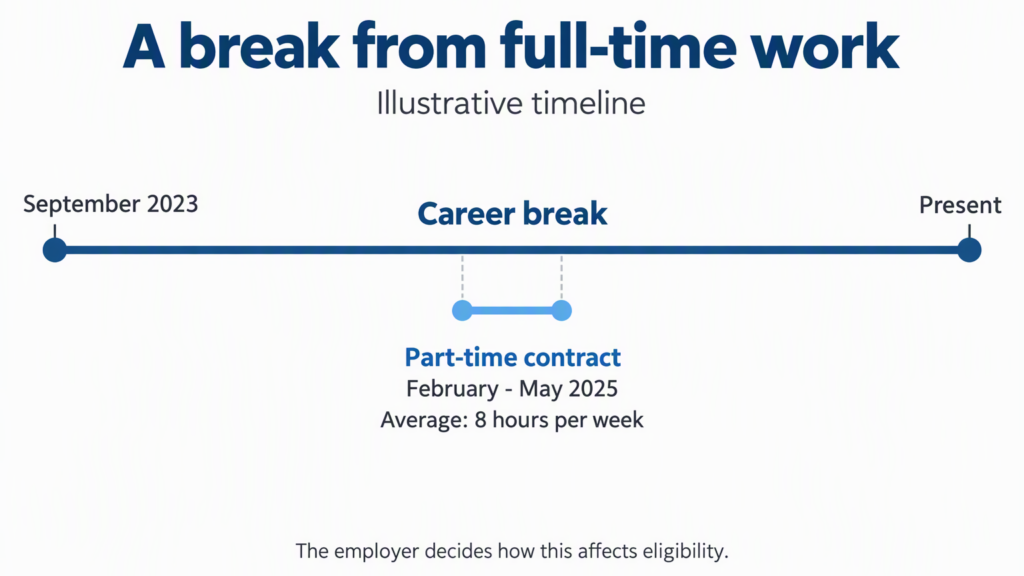
For an ambiguous case, a focused question is more useful than “Do I qualify?”:
I left full-time employment in September 2023. During February–May 2025, I completed a contract averaging eight hours a week. Does that affect eligibility for this cohort?
Use your actual dates and workload. Keep the same facts in the resume and application answers, even if their formats differ.
A complete example for a returning QA professional
This fictional applicant is targeting software-testing roles after caregiving. The example puts a recent project before earlier employment because it supplies useful evidence of current practice. All names, organizations, dates, and achievements below are illustrative.
MAYA PATEL
Columbus, OH | maya.patel@example.com | (614) 555-0146
Professional Summary
Software quality assurance professional with nine years of experience in regression testing, defect reporting, and release support. Returning after a family-caregiving break, with recent independent practice in browser-test automation. Seeking a QA returnship supporting reliable customer-facing software.
Career Break — Family Caregiving
September 2023–Present
Took time away from full-time employment to provide family care.
Recent Project
Web Form Testing — Independent Project
April–May 2026
- Built Playwright tests for account-registration flows in a demo application, covering valid entries, missing required fields, and invalid email formats.
- Documented setup instructions, expected results, and a reproducible validation defect in a short test report.
Professional Experience
Lakefront Software, Columbus, OH
Quality Assurance Analyst | September 2017–August 2023
- Planned regression coverage for account-management releases and reviewed acceptance criteria with developers and product owners.
- Introduced a defect-report template with reproduction steps and environment details, giving developers a consistent starting point for investigation.
- Coordinated release-test status across web and mobile teams, highlighting unresolved issues before launch decisions.
Elmbridge Systems, Columbus, OH
Software Test Associate | September 2014–August 2017
- Executed manual test cases for customer-service applications and verified fixes against the original reported behavior.
- Used SQL queries to compare test records with expected database values.
Skills
Professional experience: regression testing, test-case design, defect reporting, SQL.
Recent independent practice: Playwright with JavaScript.
Education
Lakeview State University, Columbus, OH
Bachelor of Science in Computer Information Systems
Graduated May 2014
Maya’s earlier work establishes professional depth; the small project answers a different question about recent practice. Notice that the new tool isn’t presented as nine years of automation experience.
Your section order can change. If your previous role provides the strongest evidence and you have no recent project, put employment history directly after the break. Keep entries newest-first within each section and avoid filling an empty category just because a template includes it.
Show current skills without overselling a refresh
A course title says what you studied. A piece of work shows what you can do with it. Use the strongest evidence you actually have, with enough context for someone to judge its scope.
Distinguish three situations:
- Used professionally: identify the job and work that relied on the skill. Don’t imply it was recent if it wasn’t.
- Practiced recently: label the project, course, or volunteer assignment and give its dates.
- Planning to learn: leave it out of your skills list. An intention isn’t a capability yet.
You don’t need a large portfolio. Pick one task tied to the vacancy and finish it well: a reconciled spreadsheet, a test report, a short campaign analysis, or a documented design revision. Explain the problem, your contribution, and any limitations.
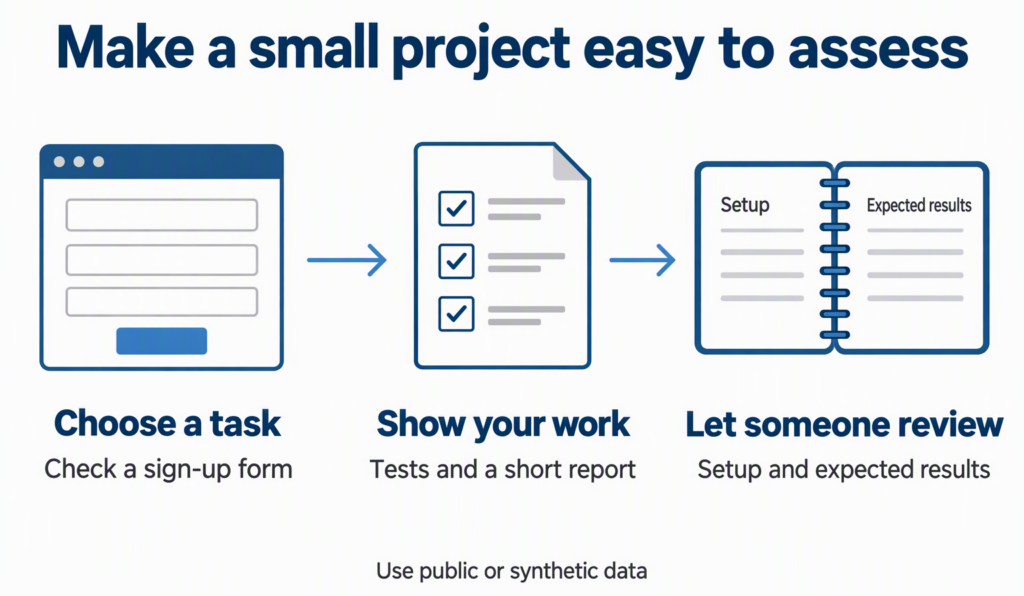
Before linking the result, ask someone to open it without your login and follow the explanation. For Maya’s example, that means clear setup steps and expected test outcomes. Use public or synthetic data; a former employer’s private files don’t belong in a portfolio.
If you haven’t refreshed anything yet, use your real experience. Identify the specific requirement you need to address rather than inventing months of “professional development.” Some programs provide substantial skills training; that doesn’t mean every prerequisite is taught from scratch.
Make sure the resume reaches an actual application
A talent-network sign-up can get you updates without entering you into selection. Path Forward explicitly distinguishes its newsletter registration from an employer application. Follow the live vacancy’s application route and check for a submission confirmation.
If you must choose a function or track, make the resume support that choice. For a general program intake, follow its instructions about preferred divisions instead of naming an unrelated vacancy.
Before submitting:
- Use the requested file type and a simple, readable layout. The shaded examples and diagrams in this guide are teaching aids, not elements to copy into your application resume.
- Review any automatically populated employment fields. Confirm that a career-break entry hasn’t been treated as an employer or that separate roles haven’t been merged.
- Save the posting and the exact resume version you submitted, so you can prepare for the interview after the listing disappears.
If the application asks why this program interests you, explain what its particular work and support would help you do. “I want to return” gives less information than a clear link between your background, the role, and the transition you’re making.
Give someone a clear application to assess
Ask a reviewer to identify your relevant experience, your break dates, and the work you’re targeting without an explanation from you. Any hesitation points to a specific revision you can make before submitting.
FAQ
These questions address choices beyond the resume’s wording and layout.
Are these programs only for mothers returning after childcare?
No. Program audiences differ, and Path Forward’s guidance welcomes people of all gender identities. Breaks can involve eldercare, personal circumstances, or other reasons. Read the employer’s criteria rather than assuming a program name tells you who can apply.
Should I also apply for regular jobs?
Yes, when they fit your skills and availability. You don’t need to wait for a cohort to open if a suitable vacancy is available now. For ordinary applications, keep the history accurate while emphasizing the role you want rather than eligibility for a program you aren’t applying to.
Does a long break mean I should apply at entry level?
Not automatically. Compare the work’s scope with what you can handle and where you need support. An experienced specialist may need a tool refresh without needing to restart an entire career. Use role requirements and evidence, rather than elapsed time alone, to choose your level.
What if my professional references are from years ago?
An older reference may still be useful if the person can discuss your work. iRelaunch co-founder and executive recruiter Vivian Steir Rabin recommends reconnecting with former managers and asking whether they’re willing to serve. A recent volunteer supervisor can also be relevant.
Before sharing anyone’s details, get their agreement and send your current resume and target role. Confirm that they remember the projects you’re emphasizing. Keep the reference list separate from the resume and follow the employer’s instructions about when to provide it. Choose people who know your work, rather than assuming a familiar name is enough.