


Three clients, two short contracts, and a delivery app. That’s a work history. On the page, though, it can look like six unrelated starts and stops—or disappear into one vague line labeled “Freelancer.”
Put relevant work in your Experience section, name the role and working arrangement, and give accurate dates. Group similar projects when separate entries would bury the useful details. Give a substantial, relevant contract its own entry when that makes the work easier to understand.
You don’t need to make the experience look like a permanent job. You need to make it clear what you did and who you did it for.
Key Takeaways
- A work arrangement isn’t a job title. “Freelance Illustrator” or “Delivery Driver” identifies a skill; “Freelancer” or “Gig Worker” leaves the reader guessing.
- Short-term work isn’t automatically self-employment. A fixed-term employee, an agency employee, and an independent contractor can all work on temporary projects.
- Your resume can be selective. Prioritize relevant experience, but provide the fuller history if a separate application or screening form requests it.
Choose the structure that makes your work easiest to follow
Start with the relationship behind the work, rather than the number of invoices you sent. These are practical options, not rules tied to a minimum project length or client count.
| Your situation | A useful structure | What to make visible |
|---|---|---|
| Similar projects for several clients | One freelance entry with selected projects | Your service, overall work period, and strongest examples |
| A substantial direct contract | A separate role entry | The client, contract relationship, and engagement dates |
| Assignments while employed by a staffing agency | Agency entry with placements underneath | The employer, client assignments, and their dates |
| Similar gigs through several platforms | One entry for that type of work | The role, platforms used, and any seasonal or part-time pattern |
Keep entries in reverse chronological order within each experience section. If you use a separate “Relevant Projects” or “Additional Experience” section, choose it because it helps the reader find useful qualifications. Freelance work doesn’t need a separate section simply because you were paid differently.
Four examples you can adapt
The names, dates, and work details below are fictional. Each example solves a different presentation problem; copy the structure and replace the facts with your own.
Several clients, one freelance practice
If you provide a consistent service, one entry can show the practice without turning every brief into a new job. Use your actual business name if you have one, or write “Self-employed.” There’s no need to invent a company.
Freelance Content Writer | Self-employed
Remote | January 2025–September 2026
Wrote customer-facing content for software and education clients.
- Fieldnote Software, selected client: Wrote onboarding emails and help articles for a new scheduling feature, working with the product and support teams.
- Juniper Learning, selected client: Turned instructor interviews into course descriptions and an email series for the fall program launch.
“Selected client” makes clear that these are examples within your freelance work. If a project’s timing matters, add its own dates beside the client name. Avoid repeating the same engagement as a second full job elsewhere on the resume.
One direct contract worth highlighting
A relevant engagement can stand alone even if it lasted only a few months. Identify the company as a client when you worked independently for it, rather than implying you joined its staff.
Business Analyst (Independent Contract)
Client: Alder Works | Remote | February–July 2026
- Interviewed purchasing staff and mapped the purchase-approval process, identifying duplicate review steps.
- Delivered requirements and acceptance criteria for a replacement request form; supported user testing before rollout.
If you were hired directly as a fixed-term employee instead, name the company as your employer and use an accurate label such as “Business Analyst (Fixed-term).” Don’t change your employment relationship to fit a template.
Several placements through one staffing agency
When the agency employs you, show that employer relationship and place the client assignments underneath it. Being registered with an agency isn’t itself employment; use the dates that describe your actual work relationship.
Accounts Payable Clerk (Temporary Assignments) | Harbor Staffing
January–November 2025
Shoreline Supply — client assignment | June–November 2025
- Matched supplier invoices to purchase orders and worked with purchasing staff to resolve discrepancies before payment approval.
Birch Health Services — client assignment | January–May 2025
- Reviewed vendor records for missing payment details and followed up with suppliers to complete the records.
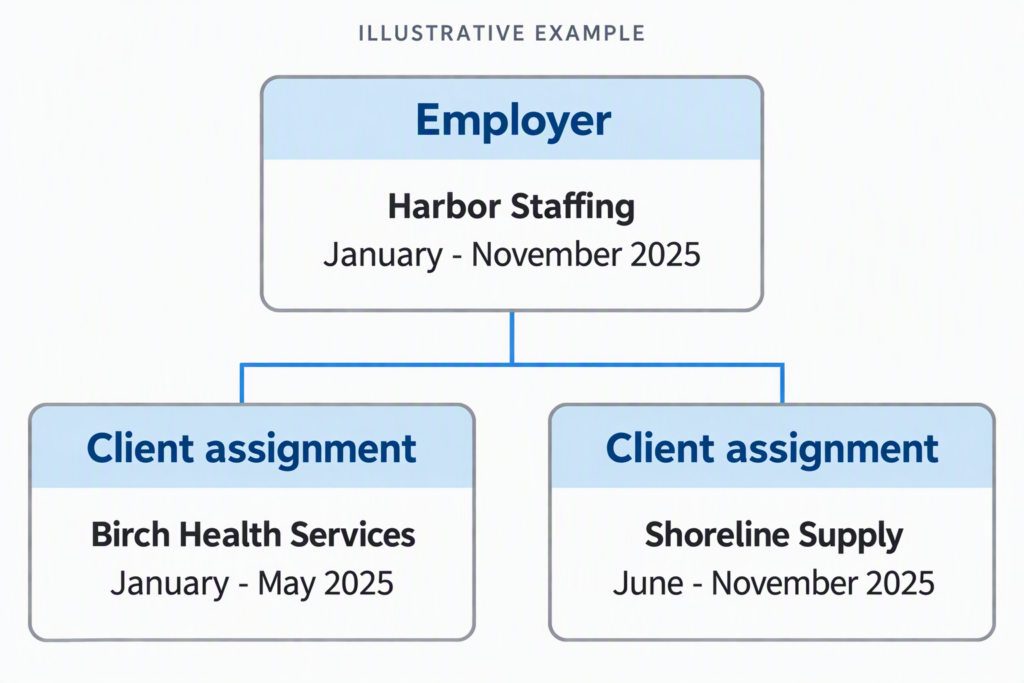
For one placement, a compact line such as “Harbor Staffing — assigned to Shoreline Supply” can do the same job. If a recruiter only introduced you to a company that hired you directly, list that company as the employer.
Occasional work through delivery platforms
Group platforms when the work is essentially the same. Show the type of service and the actual schedule, rather than presenting every app as a separate employer.
Independent Delivery Driver (Weekends and College Breaks)
Self-employed; platforms used: DoorDash and Uber Eats
Austin, TX | August 2024–May 2026
- Coordinated restaurant pickups and customer deliveries, communicating about substitutions, access instructions, and delays.
- Resolved missing-item reports through the appropriate platform support process and maintained delivery records.
This example assumes the person worked independently. Use wording that matches your own arrangement. For a logistics or service role, the work may deserve useful detail; for an unrelated role, a shorter entry under “Additional Experience” may be enough. A brief, irrelevant gig can be omitted from a selective resume.
Make overlapping dates understandable
Two jobs can occupy the same months. If you freelanced while employed elsewhere, retain the actual dates and add “Part-time,” “Evenings and weekends,” or another accurate description where it clarifies the commitment.
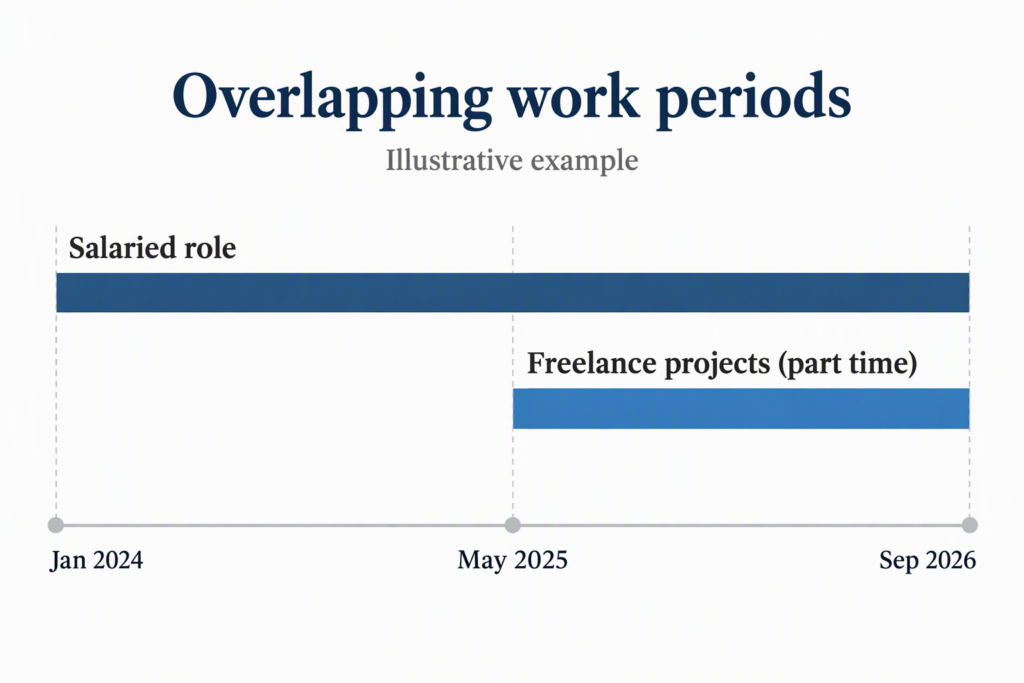
List both periods as shown, rather than moving the freelance start date to manufacture a sequence. Don’t add overlapping periods together as though they were consecutive years of experience.
When the work was intermittent
An overall date range can describe a genuine freelance practice with changing clients. It shouldn’t turn two isolated projects into years of continuous work. If you completed a project in 2023 and another in 2026, label the entry “Selected Freelance Projects” and give each project’s dates. “Occasional projects” can clarify the pattern.
Use “Present” when the work or practice is genuinely ongoing. An old platform account that remains open doesn’t establish current work.
Give the reader evidence beyond the label
After the entry is organized, use the bullets to show the work that matters for the next role. Name the deliverable, problem handled, tools used, or people you coordinated with. Include a measured result when you can support it; a finished project or specific responsibility can also be useful evidence.
For creative or technical work, a link to a relevant portfolio sample can provide detail that won’t fit on the page. Check that the link opens and that you have permission to share the work.
If you include a platform rating, give its scale and context, such as “4.9/5 across 40 client reviews,” only if those details are accurate. A rating from one platform shouldn’t be presented as an average across all your clients.
Let the work history stand on its own
Ask someone unfamiliar with your background to read the finished section. Can they follow who hired you, what you contributed, and when you worked? If so, use the remaining space for qualifications that support your next move.
FAQ
A change of employer, a rigid application form, or a confidentiality agreement can complicate an otherwise straightforward entry.
What if a temporary assignment became a permanent job?
List the permanent role under the company with its own dates. Below it, show the earlier assignment as “Contract via Harbor Staffing,” with the agency-employment dates. This makes the transition clear without implying you worked directly for the client throughout.
What employer name should I enter in an application form?
Follow the field’s instructions and your actual arrangement. For agency employment, use the agency when the form asks for your employer; identify the client in an assignment or description field if available. For independent work, use your business name or the form’s self-employment option. If the form doesn’t accommodate your situation, ask the recruiter how to enter it.
Can I list a confidential client?
Only disclose what you’re permitted to share. An allowed description such as “regional retailer” can provide context without a name, but even the industry, dates, or project details may be restricted. Check the agreement before including them, and don’t link to private deliverables.