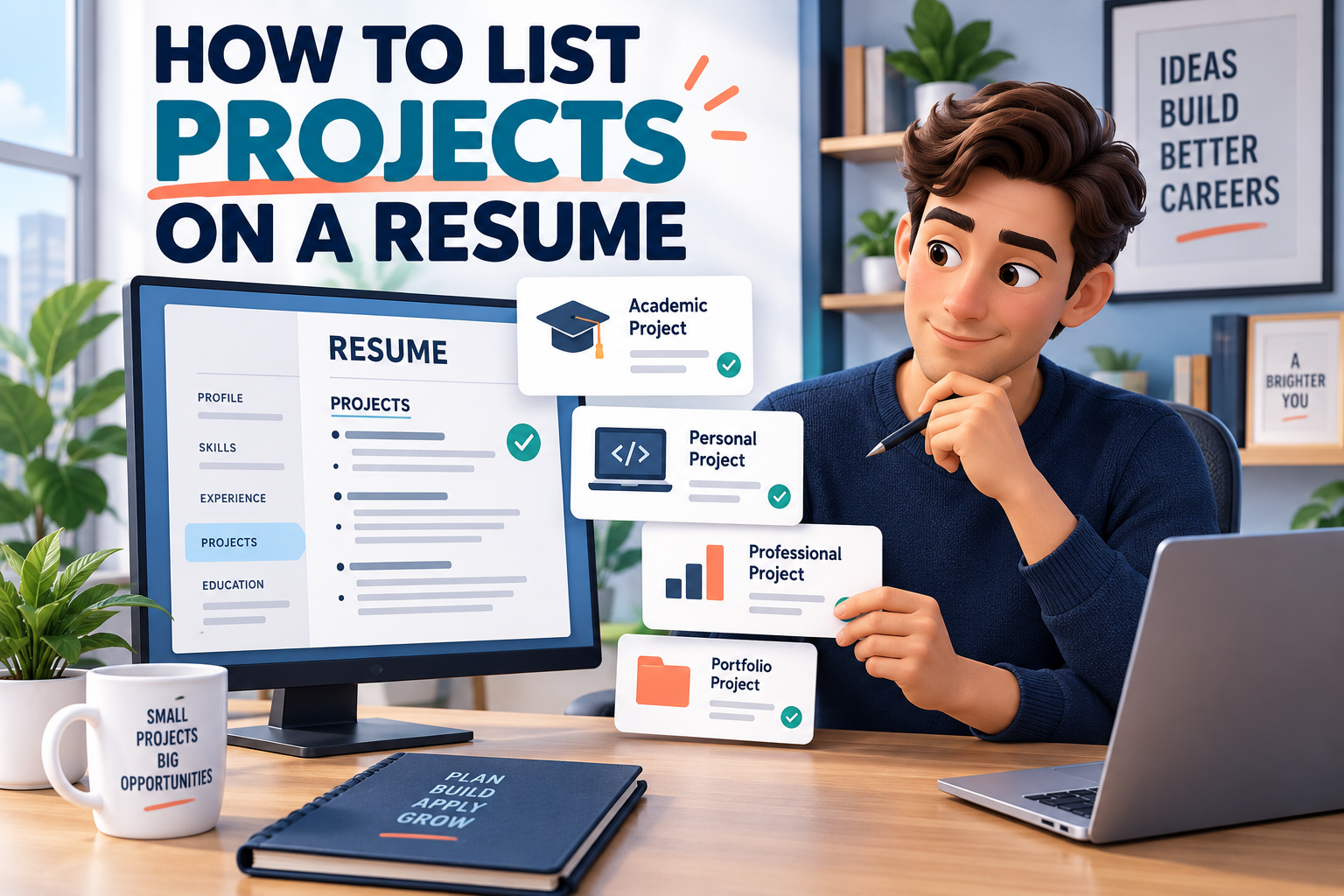

Projects can prove that you know how to apply your skills, not simply list them. A well-chosen project can strengthen a resume when your employment history does not fully reflect your abilities, whether you are a student, recent graduate, career changer, freelancer or experienced professional. The key is to present work that matters to the employer and explain your contribution clearly. This guide covers how to select, position and describe projects without exaggerating their value.
How to list projects on a resume
To list projects on a resume, choose work that demonstrates a qualification needed for the position. Give each project a clear title, identify your role and provide the organization or context when useful. Add the completion date or date range, then use concise bullets to explain what you personally did, which relevant skills or tools you used and what the work achieved. If the project is still underway, label it In Progress. Include a portfolio, GitHub repository, publication or live-project link only if it is polished, accessible and safe to share.
Use this basic formula:
Project title + role or context + action + relevant skills or tools + outcome
When should you include projects on a resume?
A project deserves space when it provides stronger evidence of your qualifications than another possible resume entry. Projects are especially useful when they show abilities that a job title or standard employment history might not reveal.
A project can also demonstrate communication across markets or audiences. Learn how to present languages on a resume with an appropriate proficiency level.
Consider including a project if it:
- Demonstrates a skill, tool or responsibility emphasized in the job description.
- Compensates for limited paid experience.
- Supports a move into a new industry or occupation.
- Proves recent or specialized technical knowledge.
- Represents meaningful freelance, consulting, volunteer or independent work.
- Shows that you kept your skills current during a career gap.
Leave a project out if it is unrelated, outdated or substantially weaker than your professional achievements. You should also exclude work that cannot be explained without disclosing confidential information or that merely repeats an accomplishment already listed under employment. Relevance and evidence matter more than quantity; two carefully selected projects usually communicate more than a long inventory of assignments.
Ready to Land Your Next Job?
Don’t let your resume get lost in the stack. Build a professional, ATS-friendly resume that highlights your leadership, achievements, and industry expertise.
Where should projects go on a resume?
The best location depends on where the project originated, how important it is to the target position and how much professional experience you have.
Create a dedicated project section on a resume
Use a separate section when several projects directly support your candidacy. Suitable headings include Projects, Selected Projects, Relevant Projects or Technical Projects. Students and career changers may place this section above work experience when the projects provide their strongest evidence of job readiness. Established professionals will generally position it below employment. Candidates for software, engineering or data roles may place technical projects near their skills section so recruiters can connect specific tools with practical applications.
Place academic projects under education
A capstone, thesis, research study, laboratory assignment or substantial course project can appear beneath the relevant degree. This arrangement makes its academic context clear and works particularly well when only one or two assignments are worth highlighting. Do not imply that coursework was paid employment.
Students and recent graduates should also organize the education section of a resume so their projects, degrees, coursework and academic achievements appear in a logical order.
Include workplace projects under professional experience
An employer-sponsored initiative typically belongs beneath the position in which you completed it. Keeping it there establishes the business context and prevents you from duplicating the same achievement in two sections. You can use a short project label followed by bullets if the initiative requires more detail than an ordinary accomplishment.
For additional guidance on presenting job titles, employers, dates and accomplishments, learn how to structure the work experience section of a resume.
Mention one standout project in the summary
A highly relevant project with an exceptional result can be referenced briefly in the professional summary. For example, a career changer might mention developing an inventory dashboard used by a local nonprofit. The complete entry should still appear elsewhere, where the methods and results can be evaluated.
You may also reinforce your area of expertise with a targeted resume headline, but reserve the supporting project details for the appropriate section.
Ready to Land Your Next Job?
Don’t let your resume get lost in the stack. Build a professional, ATS-friendly resume that highlights your leadership, achievements, and industry expertise.
What to include in every resume project entry
A consistent structure helps recruiters understand a project quickly. Include the following elements when they add useful context.
Project title
Choose a specific, professional title that communicates the purpose. Replace a vague label such as “Marketing Project” with “Local Restaurant Email Retention Campaign.” If the project has an official name that is unclear to outsiders, add a brief descriptive subtitle.
Role, organization and context
Identify your function, such as developer, researcher, designer, analyst or team lead. Name the school, employer, client or nonprofit when doing so is appropriate. A short phrase such as “Senior Capstone, Arizona State University” immediately helps the reader interpret the scope of the work.
Dates
Add the month and year of completion or a concise date range. For active work, use In Progress or include an expected completion date. Never describe an unfinished prototype as a completed or launched product.
Skills, tools and methods
Mention relevant technology, software, research methods or processes in the bullets. A bare list of tools provides little evidence; explain how you used Python to clean data, Figma to test a design or Scrum practices to coordinate delivery.
If the project involved software, digital platforms or technical systems, identify the most relevant computer skills for a resume and explain how you applied them to produce a result.
Individual contribution
Group work is acceptable, but recruiters need to understand what you did. Use “collaborated” when responsibility was genuinely shared, then specify what you personally researched, created, analyzed, tested or managed. Do not claim the team’s entire outcome as your own achievement.
Results or evidence
Use measurable results when reliable numbers exist. When they do not, point to another concrete result: an approved recommendation, completed prototype, published report, successful presentation, documented workflow or tested solution. Credible evidence is more valuable than an impressive but unsupported estimate.
Optional link
Link to a portfolio, GitHub repository, case study, publication or live product only if it opens correctly, looks professional and contains no restricted material. Use a short custom URL where possible and test it before submitting the resume.
Ready to Land Your Next Job?
Don’t let your resume get lost in the stack. Build a professional, ATS-friendly resume that highlights your leadership, achievements, and industry expertise.
How to write strong project descriptions
Good descriptions connect your work to the employer’s needs. Before drafting, review the job posting and identify its priority skills, tools, responsibilities and outcomes. Select details that demonstrate those requirements instead of trying to document every task you completed.
If several bullets begin with the same verb, explore these resume synonyms to vary your wording without changing the meaning of your achievements.
Use an action–method–outcome formula:
Action verb + what you created or improved + how you did it + result or practical value
Compare these versions:
Weak: Worked with classmates on a customer survey.
Stronger: Designed and analyzed a 300-response customer survey in Qualtrics, identified three purchasing barriers and presented recommendations to a five-member faculty panel.
The stronger version clarifies ownership, scale, method and purpose without making an unsupported claim about business impact.
Begin bullets with precise verbs such as analyzed, built, created, designed, developed, led, optimized, researched, tested or presented. Choose the verb that accurately reflects your role. “Led” is not a substitute for “contributed” when another person managed the project.
Numbers can show scope and impact. Useful measurements may include the number of users or participants, team size, budget, time saved, accuracy, engagement, completion time or performance improvement. Use only figures you can explain in an interview. If no metric exists, describe what changed or what deliverable was accepted, demonstrated or implemented.
Keep the entry proportional to its importance. A major, highly relevant project may need two to four bullets; a smaller project may require only one or two. Favor concise statements over paragraphs so the reader can identify your contribution quickly.
Ready to Land Your Next Job?
Don’t let your resume get lost in the stack. Build a professional, ATS-friendly resume that highlights your leadership, achievements, and industry expertise.
Project examples for different candidates
These examples show how different forms of project experience can be presented without treating them as interchangeable.
Academic projects on a resume
Academic projects can provide evidence of research, technical and presentation skills for students and recent graduates. Identify the course or university so the reader understands the setting.
If an academic or research project produced a paper, journal article or conference contribution, follow the correct conventions for listing publications on a resume rather than placing the complete citation inside the project description.
Urban Heat Mapping Study | Research Lead
Senior Capstone, University of Arizona | January–May 2026
- Cleaned and analyzed 12,000 public temperature readings with Python and ArcGIS to identify heat patterns across eight city neighborhoods.
- Developed the study methodology and coordinated data validation with a four-person research team.
- Presented three evidence-based cooling recommendations to faculty reviewers and representatives from a community planning organization.
Personal projects on a resume
A personal project can demonstrate initiative, curiosity and independent learning. Present it with the same professional precision you would use for paid work.
Community Food Access Dashboard | Independent Data Project
March–June 2026 | Portfolio link
- Built an interactive Tableau dashboard combining public transit, grocery location and census datasets for 40 ZIP codes.
- Created data-cleaning workflows in Excel and SQL and documented sources, assumptions and update procedures.
- Conducted usability tests with six volunteers and revised filters and labels based on their feedback.
Professional projects
A workplace project should normally appear under the related position. Emphasize the business problem and your role in improving it rather than repeating routine duties.
Order Fulfillment Workflow Redesign
- Mapped handoffs across sales, inventory and shipping and identified two approval steps that caused recurring delays.
- Partnered with operations and IT to introduce automated status alerts, reducing average order-processing time by 18% over three months.
Freelance or consulting projects
Name a client only when you have permission. If the relationship or work is confidential, use a truthful neutral description and omit sensitive data.
Patient Education Content System | Content Consultant
Regional healthcare client | February–April 2026
- Audited 75 patient-resource pages for readability, consistency and alignment with the client’s approved editorial standards.
- Designed a reusable content template and review checklist that reduced avoidable revision rounds during the next publishing cycle.
Volunteer projects
Volunteer work can demonstrate coordination, outreach, fundraising and process improvement, particularly when the responsibilities relate directly to the target role.
Spring Community Supply Drive | Volunteer Coordinator
Neighborhood Resource Alliance | March 2026
- Scheduled 22 volunteers across three collection sites and created a shared tracking process for shifts and donated items.
- Coordinated outreach with five local businesses, helping the campaign collect 1,400 school-supply items for area families.
Career-change projects
For a career transition, choose a project that proves newly acquired skills and their practical value. Focus on what you can do in the new field rather than repeatedly mentioning your lack of experience.
Small-Business Inventory Forecast | Business Analytics Project
Independent project | July–August 2026
- Analyzed two years of anonymized sales data in SQL to identify seasonal demand patterns across 120 products.
- Built a Power BI forecast dashboard with category and date filters and documented a repeatable monthly update process.
- Recommended revised reorder thresholds for 15 high-variability products based on demand and lead-time trends.
Ready to Land Your Next Job?
Don’t let your resume get lost in the stack. Build a professional, ATS-friendly resume that highlights your leadership, achievements, and industry expertise.
How to tailor a project section to the job
Start by highlighting the most important requirements in the job advertisement. Rank your possible projects by how directly they prove those qualifications, then select the strongest two to four. Put the most relevant project first and remove details that do not strengthen your fit. You may change the order and emphasis of bullets for different applications, but the underlying facts must remain accurate.
Suppose you created a customer-feedback dashboard. The same work can be framed differently without changing what happened:
- For a data analyst role: Analyzed 2,500 survey responses in SQL and Tableau, cleaned inconsistent category labels and visualized satisfaction trends by customer segment.
- For a product role: Synthesized 2,500 survey responses into five user pain points and presented feature priorities to a cross-functional review group.
- For a project coordinator role: Coordinated survey-data collection across three departments, tracked milestones and delivered the dashboard one week before the review meeting.
Match the employer’s terminology naturally when it accurately describes your experience. Do not copy entire phrases from the posting or insert keywords that the project cannot support.
Ready to Land Your Next Job?
Don’t let your resume get lost in the stack. Build a professional, ATS-friendly resume that highlights your leadership, achievements, and industry expertise.
Common mistakes when listing projects
Avoid these problems when creating a project section on a resume:
- Including every project instead of selecting the most relevant work.
- Describing the assignment without identifying your contribution.
- Using long paragraphs rather than concise, scannable bullets.
- Listing software without showing how or why it was used.
- Claiming a group’s entire result as an individual achievement.
- Relying on unexplained academic, company-specific or technical jargon.
- Linking to work that is unfinished, private, broken or poorly presented.
- Inventing results or describing a prototype as a launched product.
- Revealing confidential client, employer, research or user information.
- Allowing projects to push more relevant professional experience off the page.
Apply one final test to every line: does this detail establish relevance, capability or impact? If it does none of the three, remove it.
Conclusion
An effective project entry does more than name a project or list software. It shows what you did, how you completed the work and why the result matters to the target employer. Select a few relevant projects, describe your contribution honestly and adjust their emphasis for each application.
Ready to Land Your Next Job?
Don’t let your resume get lost in the stack. Build a professional, ATS-friendly resume that highlights your leadership, achievements, and industry expertise.
FAQ
1. Should projects be included on a resume?
Include projects when they provide relevant evidence that is not demonstrated more strongly elsewhere. They can be particularly valuable for students, recent graduates, career changers, freelancers and candidates in project-driven fields.
2. How many projects should you list on a resume?
Two to four highly relevant projects are usually enough, depending on your experience and available space. Quality and connection to the target role matter more than the total number.
3. Can you include unfinished projects?
Yes. Relevant ongoing work may be listed if you label it In Progress or provide an expected completion date. Describe only the stages and deliverables you have actually completed.
4. Do academic projects count as experience?
Academic projects provide practical experience and can demonstrate job-related skills. However, present them as coursework, research or capstone work—not as paid employment.
5. Should you include project links?
Add a link when it leads to polished, accessible and nonconfidential work that helps verify your abilities. Test the link and review the material from an employer’s perspective before submitting the resume.