
Are you thinking of resigning from your job?
While it is incredibly thrilling to have a new job opportunity, it is equally important to exit your current role correctly.
Writing a resignation email goes beyond just saying you are leaving; it is your last impression on the employer, which may impact future references and professional connections.
Whether you are moving to a different company, changing your career, or leaving due to personal reasons, mastering how to write a resignation email is vital for making the transition as smooth as possible. We also have templates for hospital resignation in case you are interested.
The article discusses everything from the types of resignation to possible templates and common mistakes.
“It’s not the load that breaks you down, it’s the way you carry it.”
— Lou Holtz
Key Takeaways
- A resignation email is a formal way to notify your employer that you’re leaving your job and should clearly mention your last working day.
- Writing a professional and respectful resignation email helps you leave on good terms and maintain positive professional relationships.
- There are different types of resignation, including standard notice, immediate resignation, retirement, and email-based resignation, depending on your situation.
- A well-written resignation email should be brief, polite, express gratitude, and offer support during the transition.
- Avoid emotional language or unnecessary details—keep your email clear, professional, and focused on a smooth exit.
Remember: Your last impression can be just as important as your first.
What Is a Resignation Email?
A resignation email means sending a professional note to your boss, supervisor, or HR department letting them know that you are leaving your post in the company.
This email is a written confirmation that you have signed a resignation and usually indicates the date when you will stop working, as well as a short note expressing your gratitude and offer for help during the transition period.
Unlike a formal resignation letter, a resignation email is sent electronically, and it has become the most preferred communication method in most companies nowadays, especially in the remote and hybrid working model.
The resignation email also creates a paper trail for both the employee and employer.
Some times aspirants turn down job altogether. They might be looking for career change or a short break.
💡 Important Information
A resignation email should be written and sent only after the employee has spoken to his/her boss about the resignation in person or by phone or video call.
Key Components of a Resignation Email
A resignation email must be properly written to be precise, formal, and polite. There may be differences in the layouts used in resignation emails, but almost all emails share certain characteristics that help deliver the message efficiently and facilitate the transfers.
- Subject Line: Use a clear and professional subject, such as Resignation – Your Name.
- Greeting: Use a proper salutation to greet your HR manager.
- Statement of Resignation: Clearly mention that you’re resigning from your position.
- Last Working Day: Include your last working day as per your notice period.
- Reason (Optional): You may choose to mention the reason for your resignation.
- Offer to Help: State your intention of helping in the transition process.
- Gratitude: Thank your employer for the opportunities and experiences you’ve gained.
- Professional sign-off: conclude by signing off formally with your name.
💡 Good to Know
A resignation email doesn’t need to be long. A concise, courteous, and well-structured message is often the most effective way to leave a positive final impression.
How to Write a Resignation Email: Step-by-Step
A professional resignation email is simple and straightforward. Following a clear structure ensures your message is respectful, easy to understand, and leaves a positive impression on your employer. Here’s how to write one:

- Make sure to read your contract and check how long the notice period will be.
- If possible, give notice to your boss before writing the email.
- Make sure that you send the email to the right people – immediate supervisor and HR person.
- Write a straight-to-the-point, yet clear subject line. For example, Resignation – Your Name.
- Start with a formal greeting using your manager’s name.
- Be very clear about your resignation, as well as your last working day.
- If you want to mention the reason for your resignation, do so briefly without being too detailed.
- Take the chance to thank your employer for all the experience, skills, and knowledge you gained throughout your employment.
- Offer to support the transition by helping with the handover of your responsibilities.
- End your email with a proper salutation
- Proofread your email before sending to ensure there are no errors.
📌 Quick Tip
Send your resignation email during business hours, preferably after you’ve spoken with your manager. This demonstrates professionalism and ensures your resignation is communicated respectfully.
Common Mistakes to Avoid
While it’s true that your resignation emails can be completely professional, minor omissions of crucial particulars can end up giving a wrong impression. Here are some blunders to avoid:
- Failing to state your final day of employment. Make sure to mention the date you stop working to avoid misunderstandings.
- Using harsh words. Do not criticize your employer, colleagues, or the workplace environment in the email message.
- Writing lengthy emails. Make sure to keep the message short, direct, and to the point.
- Neglecting to proofread your message. Always check for typos, punctuation mistakes, and formatting issues.
- Having an inappropriate email subject. Select proper email subject line, e.g. Resignation – Your Name.
Resignation Email Templates
Choosing the right resignation email template depends on your situation. Below are two professional templates you can customize before sending them to your manager or HR.

Template 1: Simple Resignation Email
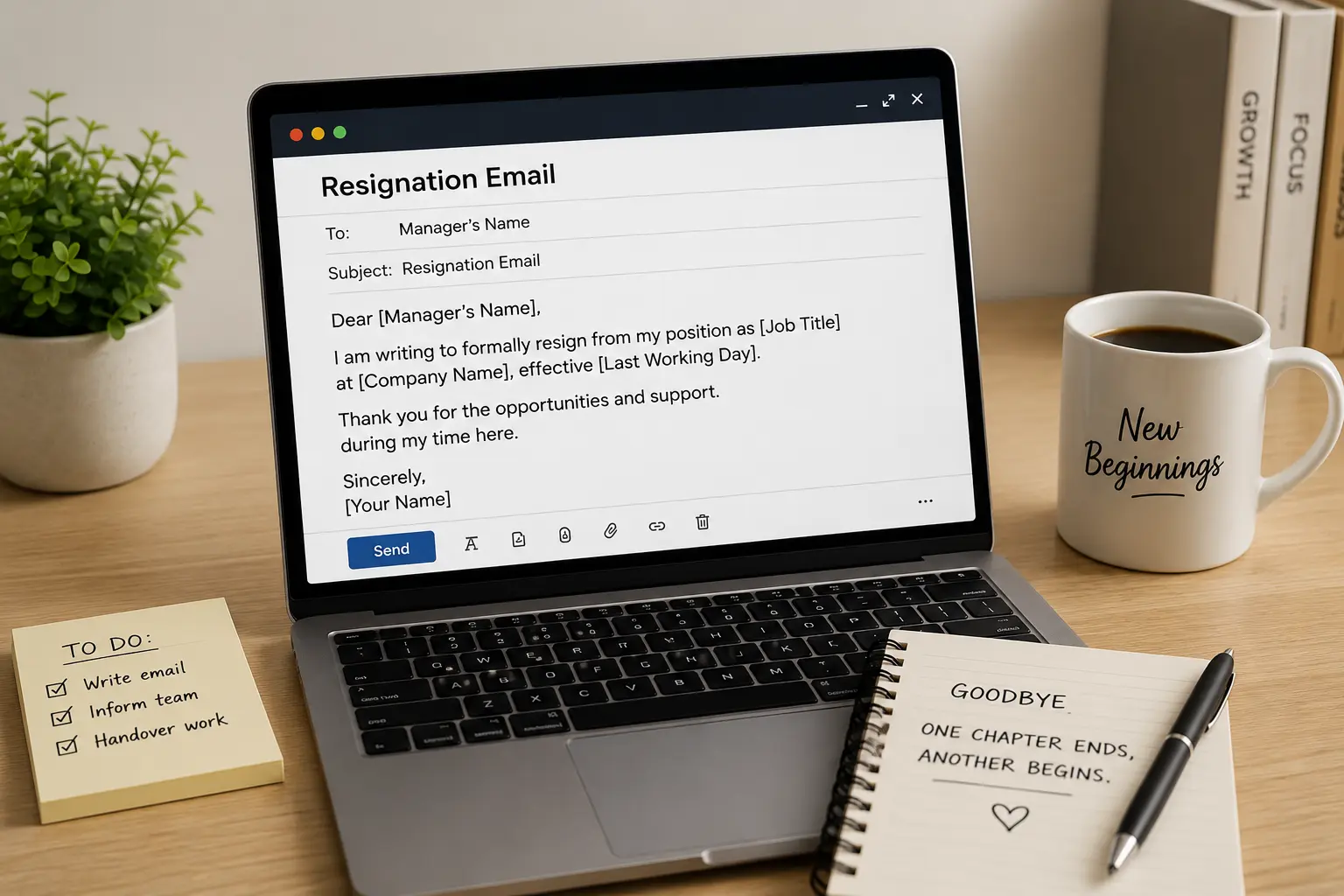
Subject: Resignation – [Your Full Name]
Dear [Manager’s Name],
I am writing to formally notify you of my resignation from my position as [Job Title] at [Company Name], effective [Last Working Day].
I sincerely appreciate the opportunities, guidance, and support I have received during my time with the company. Working with you and the team has been a valuable experience, and I am grateful for everything I have learned.
Over the coming weeks, I will do my best to ensure a smooth transition by completing my responsibilities and assisting with the handover wherever needed.
Thank you once again for your encouragement and support. I wish you and the entire team continued success in the future.
Best regards,
[Your Full Name]
[Contact Information]
Template 2: Resignation Email with a Brief Reason
Subject: Notice of Resignation – [Your Full Name]
Dear [Manager’s Name],
I hope you’re doing well. I am writing to formally inform you of my resignation from my position as [Job Title] at [Company Name], effective [Last Working Day].
After careful consideration, I have decided to pursue a new opportunity that aligns with my long-term career goals. This was not an easy decision, as I have truly valued my time with the company and the experiences I have gained.
I am committed to making the transition as smooth as possible and will be happy to assist with handing over my responsibilities before my last working day.
Thank you for your guidance, support, and the opportunities provided during my time here. I wish you and the entire team continued success in the future.
Best regards,
[Your Full Name]
[Contact Information]
Types of Resignation
| Type | What It Involves |
|---|---|
| 📝 Standard Resignation | The employee gives the required notice period and continues working until the final day. |
| ⚡ Immediate Resignation | The employee leaves without serving the notice period, usually due to urgent personal or workplace circumstances. |
| 🗣️ Verbal Resignation | The employee first informs the manager verbally, followed by a formal written resignation email or letter. |
| 📧 Email Resignation | The resignation is officially communicated through a professional email for documentation purposes. |
| 🎉 Retirement Resignation | An employee resigns after completing their professional career and entering retirement. |
| ⚖️ Constructive Resignation | The employee resigns because workplace conditions have become difficult or unsuitable. |
| 🤝 Mutual Resignation | The employee and employer agree on the resignation terms and departure date together. |
What to Do After Your Resignation Is Accepted
After acceptance of your resignation, ensure your work is completed in an orderly way so that everything goes smoothly.
- You must finish work before your last day at the company.
- Assist with the transition by handing over important documents and project details.
- Return any company items, such as your laptop, ID card, or key cards.
- Ask for important papers such as your experience letter, relieving letter, and final payment details.
- Maintain professionalism until your last hour, and do not burn your bridges with your boss and coworkers.
Leaving on good terms can help you secure positive references and keep valuable professional connections for the future.
Common Reasons People Resign
Many different reasons can cause people to resign from their jobs, and not always because they are unhappy with their current job.
While some choose to resign to move forward in their careers, others focus on their family commitments, education, or work-life balance.
Regardless of the reason, it is important for people to take a professional approach to crafting their resignation email instead of pouring personal details into it.
| Reason | What It Means |
|---|---|
| 📈 Career Growth | Moving to a role with better opportunities, responsibilities, or career progression. |
| 💰 Better Salary & Benefits | Accepting a position that offers higher pay or improved benefits. |
| ⚖️ Work-Life Balance | Leaving due to long working hours, stress, or burnout. |
| 📍 Relocation | Moving to another city or country for personal or professional reasons. |
| 🔄 Career Change | Switching to a different industry or profession. |
| 🤝 Workplace Culture | Seeking a work environment that better matches personal values or expectations. |
| 🎓 Higher Education | Leaving to pursue further studies, certifications, or training. |
| 👨👩👧 Personal Reasons | Resigning because of family responsibilities or other personal commitments. |
| 🚀 Entrepreneurship | Leaving to start a business or work independently. |
| 🌴 Retirement | Ending a professional career and transitioning into retirement. |
📌 Quick Tip
You don’t have to explain the exact reason for resigning in your email. If you choose to mention it, keep the explanation brief, professional, and positive.
Conclusion
When it comes to resignation emails, a resignation email is not just a simple resignation announcement. It can still prove to be your final chance to get an impression of your professionalism and help you with a smooth resignation process.
Regardless of whether you are changing your job for a new position, going to study or switching careers, following the proper format of a resignation email can help you retain strong relations with you in the business world.
Take advantage of a resignation email guide to resign confidently while leaving on good terms.
Every new beginning comes from some other beginning’s end.”
— Semisonic
Frequently Asked Questions (FAQs)
It is not obligatory to give the reason for leaving the position. If you choose to do so, make sure to do it briefly and courteously.
Stick to the notice period as per your employment agreement or company guidelines.
Yes. Wherever feasible, you should inform your supervisor before submitting a formal resignation email.
It should be short, courteous, and focused on the resignation issue.
Yes, especially in case of remote work, but it is advisable to inform the boss first.