

In the fast-paced world of healthcare, having a compelling Medical Secretary resume can make all the difference in securing your dream job. Our diverse collection of resume examples for Medical Secretary roles is designed to inspire and guide you in showcasing your skills and achievements effectively. Whether you’re a seasoned professional or just starting out, these examples will help you craft a resume that not only meets industry standards but also highlights your unique qualifications.
Medical Secretary Resume Examples
Ready to Land Your Next Job?
Don’t let your resume get lost in the stack. Build a professional, ATS-friendly resume that highlights your leadership, achievements, and industry expertise.
Entry Level Medical Secretary Resume Example
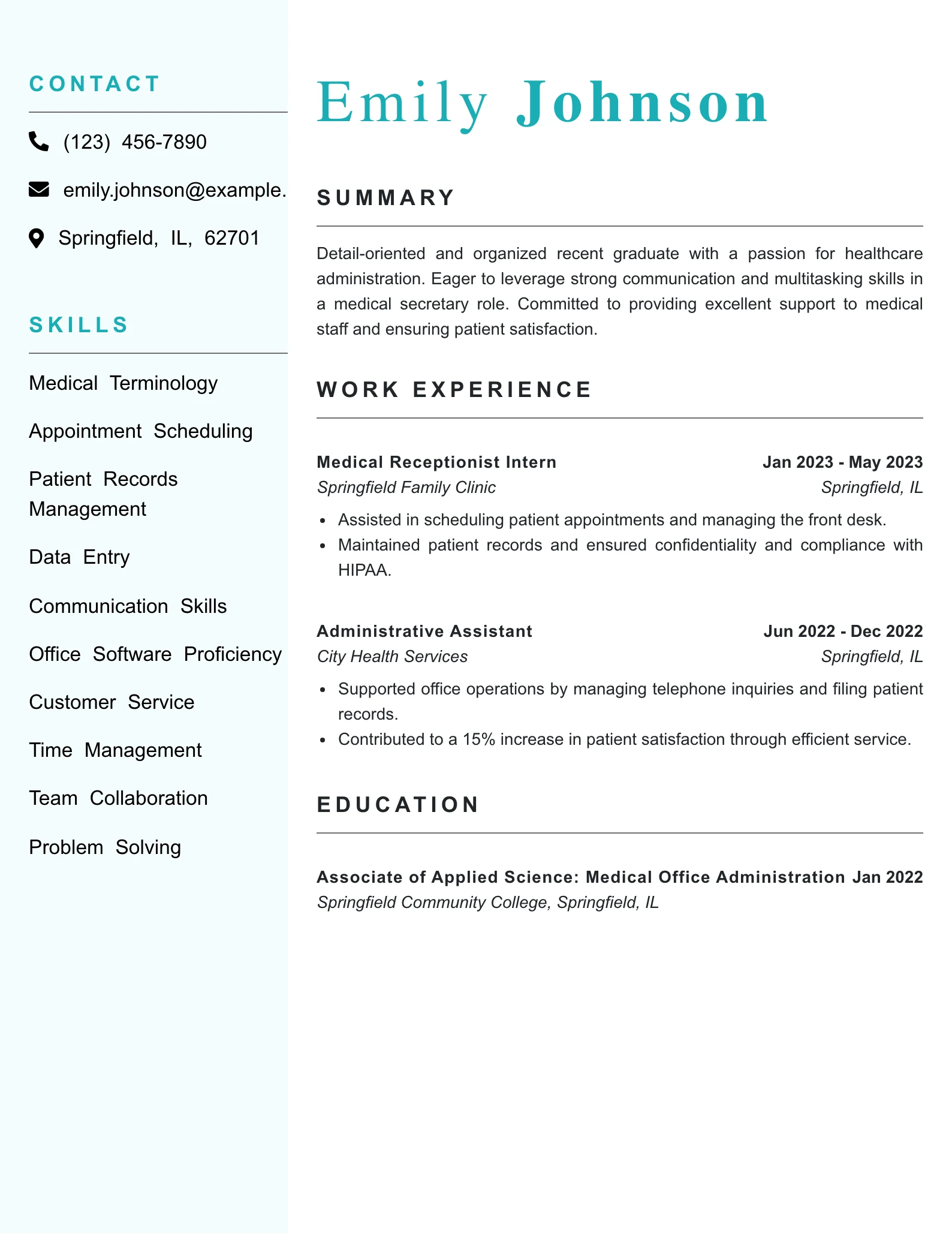
Why This Resume Works
- The summary is clear and directly communicates Emily’s recent graduation, specific career interest in healthcare administration, and eagerness to contribute, which sets a positive tone for her application.
- Relevant skills are well-articulated, showcasing a mix of technical (Medical Terminology, Office Software Proficiency) and soft skills (Communication Skills, Team Collaboration), making her a well-rounded candidate for the medical secretary role.
- The work history includes impactful contributions, such as the quantifiable 15% increase in patient satisfaction, which demonstrates her ability to make a positive impact in a healthcare setting.
- The resume aligns well with an entry-level position, reflecting Emily’s recent education and relevant internship experience, making her a suitable fit for the role she is seeking.
- The overall clarity and professional tone of the resume enhance its effectiveness, ensuring that her qualifications and experiences are presented in a straightforward and compelling manner.
Ready to Land Your Next Job?
Don’t let your resume get lost in the stack. Build a professional, ATS-friendly resume that highlights your leadership, achievements, and industry expertise.
Mid Level Medical Secretary Resume Example
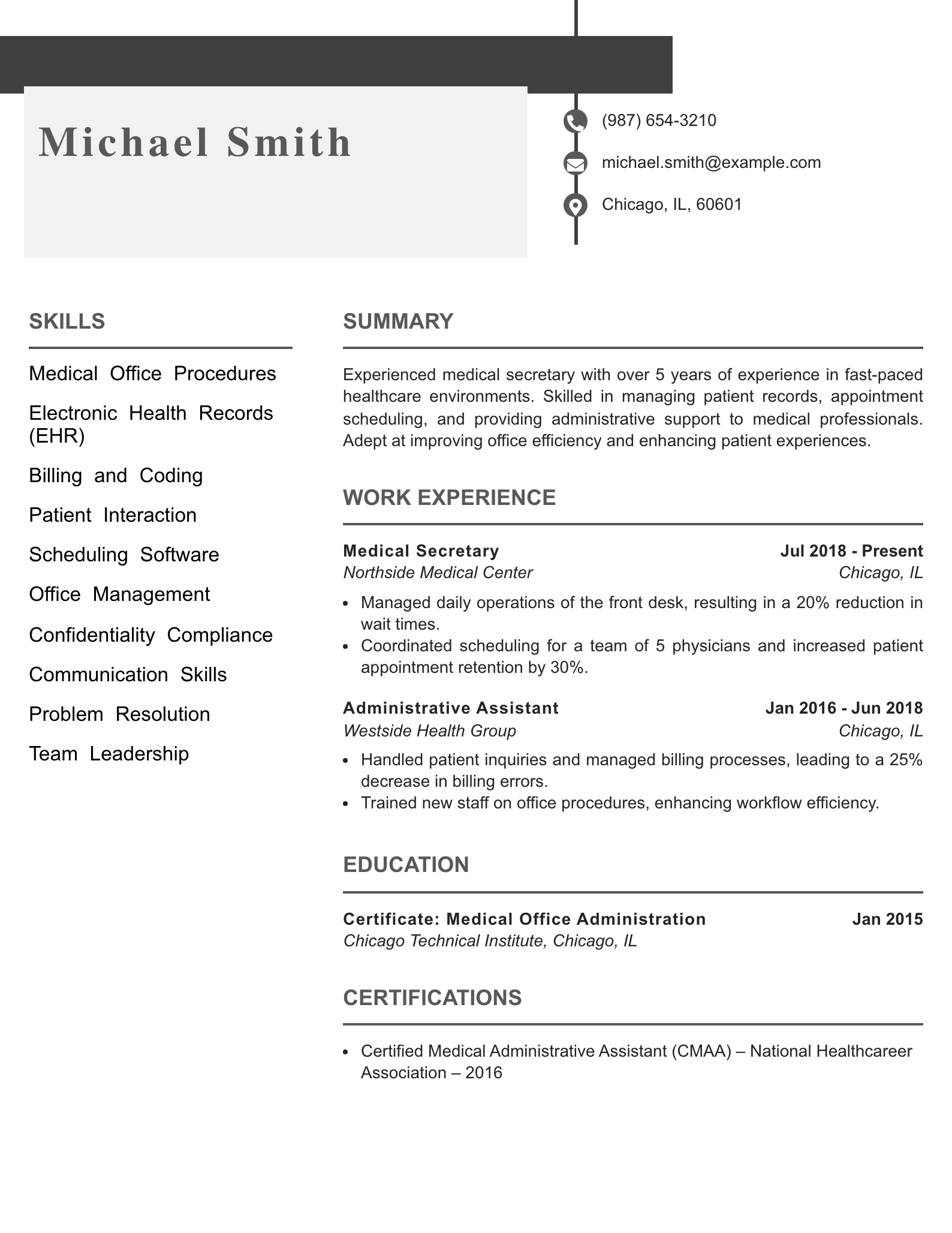
Why This Resume Works
- The summary is clear and concise, effectively highlighting Michael’s experience in healthcare and administrative support, making it easy for hiring managers to understand his qualifications at a glance.
- The skills section is relevant and comprehensive, showcasing both hard and soft skills that are essential for a medical secretary, thereby aligning well with the job requirements in the healthcare field.
- The work history demonstrates impactful contributions, such as reducing wait times and decreasing billing errors, which illustrate Michael’s ability to drive efficiency and improve patient experiences.
- The experience listed indicates a mid-level position, with responsibilities and achievements that suggest significant autonomy and leadership, suitable for a candidate seeking a role with increasing responsibility.
- The overall clarity and professional tone of the resume convey a sense of competency and reliability, which are critical attributes in the healthcare environment.
Ready to Land Your Next Job?
Don’t let your resume get lost in the stack. Build a professional, ATS-friendly resume that highlights your leadership, achievements, and industry expertise.
Senior Level Medical Secretary Resume Example
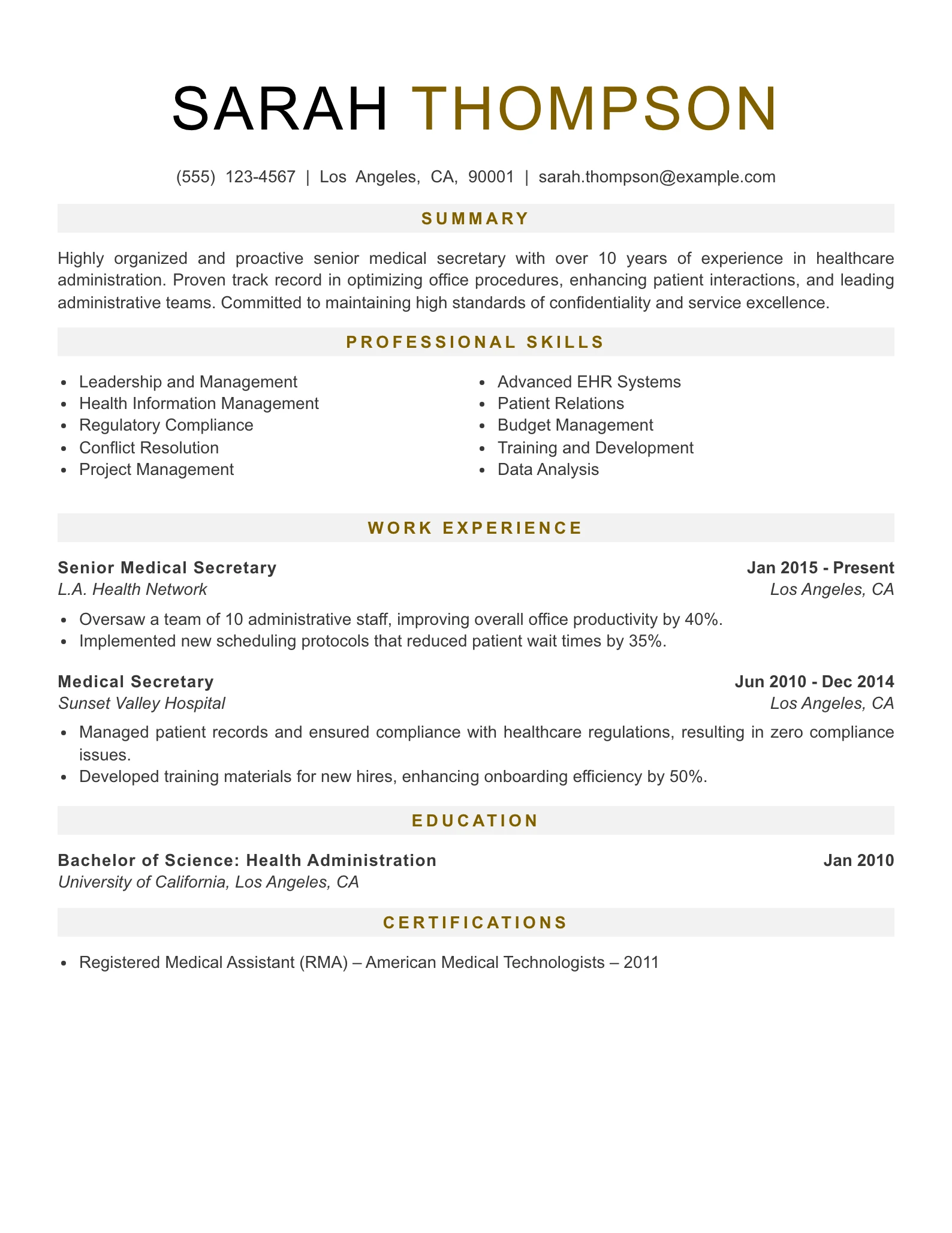
Why This Resume Works
- The summary clearly articulates Sarah’s extensive experience and commitment to high standards, effectively positioning her for a senior role in healthcare administration.
- Relevant skills are presented in a concise manner, highlighting key areas such as leadership, patient relations, and regulatory compliance, which are essential for a managerial position.
- The work history showcases impactful achievements, such as improving office productivity by 40% and reducing patient wait times by 35%, demonstrating a results-oriented approach.
- The resume reflects a strong job fit for a senior role, with over 10 years of experience and a progression from Medical Secretary to Senior Medical Secretary.
- The clarity and professional tone of the resume enhance readability, allowing hiring managers to quickly grasp her qualifications and contributions.
How to Craft a Strong Medical Secretary Resume
Creating a well-crafted resume is crucial for aspiring Medical Secretaries, as this document serves as the first impression in the competitive healthcare job market. Hiring managers seek candidates who demonstrate both technical proficiency and strong interpersonal skills, ensuring seamless patient interactions and office operations. This guide will help you highlight your strengths effectively, making you stand out to potential employers.
“Health care is a team sport.”
— Paul Grundy
1. Summary Statement
A compelling Medical Secretary resume summary gives hiring managers a quick overview of your administrative strengths and healthcare knowledge. Because healthcare offices operate in fast paced environments, employers want candidates who demonstrate strong organization, patient communication, scheduling accuracy, and familiarity with medical documentation. Your summary should highlight years of experience, measurable accomplishments, technical skills such as electronic health record systems, and relevant certifications.
Focus on showing how your work improves clinic efficiency and patient satisfaction. Strong summaries often mention metrics such as the number of patients supported per day, scheduling accuracy rates, or improvements in office workflow. Including details about HIPAA compliance, medical terminology, insurance verification, and appointment coordination can also strengthen your credibility.
When written effectively, your summary immediately communicates your value to healthcare employers. A well crafted paragraph can demonstrate that you are capable of supporting physicians, maintaining patient records, managing high call volumes, and ensuring smooth front desk operations in hospitals, clinics, or private practices.
Medical Secretary Resume Summary Work Example
Highly organized Medical Secretary with over 5 years of experience supporting physicians and clinical teams in fast paced healthcare environments. Skilled in managing patient records, scheduling more than 60 appointments daily, and maintaining 99 percent documentation accuracy within electronic health record systems. Experienced in insurance verification, HIPAA compliance, and coordinating communication between doctors, nurses, and patients. Known for improving front desk efficiency and reducing appointment scheduling conflicts by 25 percent through improved workflow organization.
Why This Summary Works
This summary clearly states experience level and highlights measurable achievements such as appointment volume and documentation accuracy. It also emphasizes healthcare specific skills including HIPAA compliance and electronic health records. Including metrics helps employers quickly understand the candidate’s impact on office efficiency.
Medical Receptionist Resume Summary Work Example
Professional Medical Receptionist with 4 years of experience managing busy clinic front desks and assisting more than 80 patients per day with appointment scheduling, check in procedures, and insurance documentation. Proficient in handling multi line phone systems, maintaining patient confidentiality, and updating digital medical records. Recognized for improving patient satisfaction scores by 20 percent through friendly service and efficient appointment coordination.
Why This Summary Works
This summary highlights patient interaction and front desk responsibilities, which are central to the receptionist role. It uses specific numbers to demonstrate workload capacity and patient service improvements. Mentioning patient satisfaction scores strengthens the candidate’s credibility.
Medical Office Assistant Resume Summary Work Example
Detail oriented Medical Office Assistant with 3 years of experience supporting administrative operations in outpatient clinics and specialty practices. Skilled in processing insurance claims, updating patient files, coordinating referrals, and managing more than 50 daily patient records using electronic health systems. Successfully reduced documentation errors by 30 percent through careful record verification and organized filing procedures.
Why This Summary Works
The summary focuses on administrative efficiency and record management. Metrics such as reduced documentation errors provide evidence of reliability. It also highlights tasks that hiring managers frequently look for in office assistant roles.
Clinic Medical Secretary Resume Summary Work Example
Experienced Clinic Medical Secretary with over 6 years of experience supporting physicians and nurses in high volume medical clinics serving more than 100 patients daily. Expertise includes appointment coordination, medical transcription, billing documentation, and maintaining compliance with healthcare regulations. Improved clinic scheduling efficiency by 35 percent through digital calendar management and streamlined patient check in procedures.
Why This Summary Works
This summary demonstrates leadership within clinic operations. It highlights collaboration with healthcare professionals and includes metrics that show measurable improvements in scheduling and workflow efficiency.
Healthcare Administrator Resume Summary Work Example
Results driven Healthcare Administrator with 8 years of experience overseeing administrative operations in hospitals and private clinics. Skilled in staff coordination, patient record management, compliance documentation, and improving operational efficiency across medical departments. Successfully supervised administrative teams supporting over 15 physicians and helped increase clinic productivity by 40 percent through workflow optimization and digital record systems.
Why This Summary Works
This summary emphasizes leadership, operational management, and measurable outcomes. Numbers such as physician support and productivity improvements help demonstrate the candidate’s scale of responsibility.
Career Changer Resume Summary Work Example
Motivated administrative professional transitioning into the healthcare field with over 5 years of office management experience and formal training in medical terminology and healthcare administration. Skilled in scheduling, document management, and customer service while supporting offices that handled more than 100 client interactions weekly. Recently completed medical office administration certification and eager to contribute strong organizational and communication skills to a busy medical practice.
Why This Summary Works
This summary explains the transition clearly while focusing on transferable skills. It shows readiness for the healthcare environment by mentioning certification and administrative experience that aligns with medical office work.
Recent Graduate Resume Summary Work Example
Recent graduate with a diploma in Medical Office Administration and hands on internship experience supporting a clinic that served more than 50 patients daily. Skilled in patient scheduling, electronic medical record updates, insurance verification, and front desk coordination. Recognized during internship for maintaining accurate patient documentation and assisting staff with administrative tasks that improved daily office workflow.
Why This Summary Works
This summary focuses on education and internship experience, which is essential for entry level candidates. Including patient volume and internship achievements demonstrates practical exposure to healthcare administrative work.
2. Skills & Qualifications
When applying for a Medical Secretary position, it’s vital to highlight both core and soft skills that align with the job requirements. Core skills typically include knowledge of medical terminology, proficiency in electronic health record systems, and appointment scheduling. Soft skills, on the other hand, involve communication, multitasking, and problem-solving capabilities.
To identify the right skills to include in your resume:
– Analyze Job Descriptions: Scrutinize job postings for keywords and skills that frequently appear.
– Match with Your Experience: Ensure that the skills you choose reflect your actual qualifications and experiences.
– Consider ATS Requirements: Use industry-specific terms to enhance your chances of passing Applicant Tracking Systems (ATS).
- Medical terminology proficiency
- Appointment scheduling
- Patient record management
- Insurance verification
- Multitasking
- Effective communication
- EHR software experience
- Data entry accuracy
Top ATS Keywords for Medical Secretary
3. Work History
Your Work Experience section is one of the most important parts of a Medical Secretary Resume because it shows hiring managers how you contribute to healthcare operations, patient satisfaction, and administrative efficiency. Instead of listing duties, focus on measurable achievements that demonstrate how your work improved clinic workflow, documentation accuracy, scheduling efficiency, or patient communication.
Healthcare employers value candidates who can manage high patient volumes, maintain compliance with medical regulations, and support physicians through strong administrative coordination. Including numbers such as the number of patients supported daily, appointment volumes, documentation accuracy rates, or reductions in scheduling errors makes your experience far more impactful.
Formatting Guidelines for Work Experience
Follow this format to ensure your work experience is clear, ATS friendly, and professional.
Recommended Structure
Job Title
Company Name, City, State
Month Year – Month Year
• Start every bullet point with a strong action verb such as coordinated, managed, implemented, streamlined, or improved.
• Focus on achievements instead of responsibilities and include measurable results whenever possible.
• Use numbers such as patient volume, percentage improvements, scheduling capacity, or documentation accuracy.
• Highlight healthcare specific tasks including electronic health records, insurance verification, appointment coordination, HIPAA compliance, and patient communication.
• Keep each bullet point detailed and descriptive so employers understand the scale and impact of your work.
Medical Secretary Work Experience Example
Medical Secretary
Cedars Sinai Medical Center, Los Angeles, California
March 2020 – Present
• Coordinated daily administrative operations for a busy outpatient clinic supporting 12 physicians and 18 nursing staff members, managing more than 75 patient appointments per day while maintaining a 98 percent scheduling accuracy rate through careful calendar management and patient follow up.
• Managed electronic health record documentation for over 1,500 patient files annually, ensuring HIPAA compliant recordkeeping and reducing documentation discrepancies by 32 percent through consistent verification and standardized filing procedures.
• Streamlined patient intake procedures by introducing updated digital forms and improved front desk coordination, reducing average patient check in time by 20 percent and improving clinic workflow efficiency during peak hours.
• Communicated with insurance providers and billing departments to verify patient coverage and resolve claim discrepancies, helping recover more than $150,000 in previously delayed reimbursements within a 12 month period.
• Assisted physicians with medical transcription, appointment preparation, and coordination of specialty referrals, supporting treatment plans for more than 1,200 patients annually and ensuring timely communication between medical teams and patients.
Medical Receptionist Work Experience Example
Medical Receptionist
Mayo Clinic, Phoenix, Arizona
January 2019 – February 2022
• Managed front desk operations for a high volume clinic that served more than 90 patients per day, coordinating appointment scheduling, patient registration, and insurance verification while maintaining a professional and welcoming environment.
• Operated a multi line phone system handling more than 120 patient calls daily, ensuring prompt responses to appointment inquiries, prescription requests, and physician communication.
• Improved appointment scheduling efficiency by implementing structured time blocks for physician consultations, reducing scheduling conflicts by 28 percent and improving patient flow throughout the clinic.
• Maintained patient confidentiality by strictly adhering to HIPAA guidelines and updating over 2,000 electronic patient records annually, ensuring documentation accuracy and regulatory compliance.
• Assisted with billing coordination and insurance documentation, helping resolve claim processing delays and improving payment turnaround times by 18 percent.
Medical Office Assistant Work Experience Example
Medical Office Assistant
Cleveland Clinic, Cleveland, Ohio
June 2018 – December 2021
• Supported daily administrative operations for a multi specialty medical practice serving more than 80 patients per day, managing appointment scheduling, patient intake documentation, and physician correspondence.
• Processed insurance claims and patient billing records for more than 1,200 medical visits annually, improving claim approval rates by 22 percent through accurate coding and documentation verification.
• Maintained organized electronic filing systems for over 3,000 patient records, reducing file retrieval time by 35 percent and improving staff productivity across administrative departments.
• Coordinated referrals and follow up appointments with specialists, ensuring timely patient care and assisting more than 600 patients annually with treatment coordination.
• Assisted physicians and nursing staff with medical documentation preparation, ensuring appointment readiness and improving consultation preparation efficiency by 25 percent.
Clinic Medical Secretary Work Experience Example
Clinic Medical Secretary
Kaiser Permanente, San Diego, California
April 2017 – May 2021
• Provided administrative support for a multidisciplinary clinic with 15 healthcare providers, managing appointment coordination for more than 100 patients per day while maintaining accurate scheduling records.
• Prepared medical documentation, physician reports, and patient summaries for more than 2,500 clinical visits annually, ensuring compliance with healthcare documentation standards.
• Implemented improved patient scheduling workflows that reduced appointment overlap by 30 percent, improving physician availability and patient wait times.
• Coordinated patient referrals, lab requests, and diagnostic appointments with external medical providers, supporting timely treatment plans for over 900 patients each year.
• Assisted with billing and insurance processing tasks that helped reduce delayed claims by 21 percent, improving financial operations within the clinic.
Healthcare Administrator Work Experience Example
Healthcare Administrator
Mount Sinai Health System, New York, New York
August 2016 – March 2022
• Supervised administrative operations for a healthcare department supporting 20 physicians and 35 clinical staff, ensuring efficient coordination of patient services across multiple medical units.
• Implemented workflow improvements that increased administrative productivity by 40 percent, reducing patient wait times and improving appointment availability.
• Managed electronic health record compliance for more than 5,000 patient files, ensuring accurate documentation and adherence to healthcare regulatory requirements.
• Coordinated training programs for administrative staff that improved scheduling accuracy and documentation standards across the department.
• Oversaw budgeting and operational reporting for administrative services, identifying efficiency improvements that reduced departmental costs by 15 percent.
Career Changer Work Experience Example
Administrative Assistant
UnitedHealth Group, Minneapolis, Minnesota
May 2019 – Present
• Transitioned into healthcare administration by supporting operational coordination for a medical services department that processed more than 2,500 patient inquiries monthly.
• Managed scheduling and documentation processes for multiple healthcare teams, improving internal communication efficiency by 26 percent through improved record tracking.
• Coordinated client records, billing documentation, and service reports for more than 1,800 administrative transactions annually, ensuring compliance with internal healthcare documentation standards.
• Assisted with patient communication and appointment coordination initiatives that reduced missed appointments by 19 percent through reminder scheduling systems.
• Completed certification training in medical terminology and healthcare administration while continuing to support operational tasks within a large healthcare organization.
Recent Graduate Work Experience Example
Medical Office Administration Intern
Johns Hopkins Hospital, Baltimore, Maryland
January 2025 – May 2025
• Assisted administrative staff in managing patient scheduling for a busy clinic serving more than 60 patients daily, helping maintain organized appointment calendars and patient records.
• Updated electronic health records and patient documentation for more than 500 medical visits during the internship period, ensuring accurate data entry and compliance with clinic standards.
• Supported front desk operations including patient registration, appointment confirmation calls, and insurance documentation verification.
• Assisted physicians and nurses with appointment preparation tasks such as organizing medical files, patient charts, and treatment documentation.
• Contributed to a clinic workflow improvement project that reduced patient check in processing time by 15 percent, improving overall front desk efficiency.
4. Education
The education section of a Medical Secretary resume helps employers quickly understand your academic preparation for healthcare administration roles. Medical offices and hospitals often look for candidates with formal training in medical office administration, health information management, medical terminology, or healthcare administration. Presenting this information in a clean and structured format improves readability and helps applicant tracking systems scan your credentials efficiently.
Your education should include the degree or diploma, the institution name, location, and the graduation date. If relevant, you may also include coursework, academic achievements, certifications, or specialized training related to medical administration, electronic health records, or healthcare compliance.
Education Section Formatting Guidelines
To keep your resume organized and professional, use a consistent structure when listing your educational background.
Recommended Format
Degree or Diploma
School Name, City, State
Graduation Month Year
Optional additions you may include below the education entry if they strengthen your profile.
• Relevant coursework related to medical administration or healthcare documentation
• Academic honors such as Dean’s List or graduation distinction
• Healthcare related training or certifications completed during your studies
• GPA if it is strong and you are an entry level candidate
Tips for Writing the Education Section
• Place this section below your summary and work experience if you have professional experience.
• Place it higher on the resume if you are a recent graduate with limited work experience.
• Keep the format simple and consistent so hiring managers can easily scan your credentials.
• Include certifications or healthcare training if they directly support your role as a medical secretary.
Education Section Template
You can use the following template when writing the education section on your resume.
Associate Degree in Medical Office Administration
School Name, City, State
Month Year
Relevant Coursework: Medical Terminology, Healthcare Documentation, Electronic Health Records, Medical Billing and Coding
Academic Achievement: Dean’s List (optional)
Education Section Example
Associate Degree in Health Information Management
Houston Community College, Houston, Texas
May 2022
Relevant Coursework: Medical Terminology, Healthcare Data Management, Medical Billing and Coding, Electronic Health Records Systems
Academic Achievement: Graduated with Honors and completed a clinical administration practicum supporting patient documentation processes.
5. Additional Sections
Including additional sections in your Medical Secretary resume can help you stand out by highlighting skills and achievements that may not appear in your work experience or education. Healthcare employers often value candidates who demonstrate professional development, language abilities that support patient communication, and recognition for their contributions to medical offices or healthcare organizations.
These sections provide an opportunity to show your commitment to healthcare administration, patient service, and continuous learning. Certifications demonstrate technical knowledge and compliance awareness. Language skills highlight your ability to support diverse patient populations. Awards can show dedication, reliability, and recognition from employers or academic institutions.
When structured correctly, additional sections strengthen your resume and give hiring managers a more complete picture of your qualifications. Present each section clearly with strong formatting so it is easy to read and scan during the hiring process.
Formatting Guidelines for Additional Sections
Use a clear and professional structure so employers can easily identify these qualifications.
Recommended Structure
Section Title
Certification or Achievement Name
Organization or Issuing Institution
Year Earned
Formatting Rules
• The title of the certification, language category, or award should be bold so it stands out clearly.
• The institution or organization should be italicized to distinguish it from the qualification name.
• Use concise bullet points or short explanations to clarify the significance of the credential.
• Keep formatting consistent throughout the section for readability and professionalism.
Ready to Land Your Next Job?
Don’t let your resume get lost in the stack. Build a professional, ATS-friendly resume that highlights your leadership, achievements, and industry expertise.
Certifications
Certifications demonstrate specialized knowledge in healthcare administration and show employers that you understand industry standards, medical terminology, and healthcare compliance requirements. Many employers prefer candidates with certifications because they indicate formal training and dedication to professional development.
Example
Certified Medical Administrative Assistant (CMAA)
National Healthcareer Association
2023
• Completed professional training covering medical terminology, electronic health record management, and patient scheduling systems used in modern healthcare facilities.
• Demonstrated competency in insurance verification procedures, HIPAA compliance requirements, and administrative coordination supporting physicians and healthcare staff.
Languages
Language skills are especially valuable in healthcare settings where medical offices often serve diverse patient populations. Being able to communicate with patients in multiple languages can improve patient comfort, reduce misunderstandings, and strengthen the quality of care coordination.
When listing languages, clearly indicate your proficiency level so employers understand your communication abilities.
Example
Languages
• Spanish
Professional Working Proficiency
Able to assist Spanish speaking patients with appointment scheduling, intake documentation, and general administrative communication in clinical environments.
• French
Conversational Proficiency
Capable of supporting basic patient inquiries, appointment coordination, and front desk communication within multilingual healthcare settings.
Awards and Professional Recognition
Awards can highlight your dedication to workplace excellence, patient service, or administrative efficiency. These recognitions help demonstrate that your work has made a measurable impact in healthcare environments.
Example
Outstanding Administrative Support Award
Houston Methodist Hospital
2022
• Recognized for improving appointment scheduling efficiency by 25 percent and maintaining consistent documentation accuracy while supporting physicians and nursing teams.
Employee Excellence Recognition
Cleveland Clinic Administrative Department
2021
• Awarded for demonstrating exceptional patient communication skills and supporting administrative operations that served more than 90 patients daily in a high volume clinic.
A well structured Additional Sections area helps reinforce your credibility as a Medical Secretary. By clearly presenting certifications, language abilities, and professional recognition, you demonstrate that you bring more than basic administrative skills to the healthcare workplace. These details help employers see your dedication to professional growth and patient focused service.
Do’s:
• Do highlight measurable achievements
Show the real impact of your work by including numbers. Mention how many patients you supported daily, how many appointments you scheduled, or how much you improved documentation accuracy. For example, you might state that you coordinated scheduling for 80 patients daily or reduced scheduling conflicts by 25 percent.
• Do emphasize healthcare administrative skills
Medical employers want candidates who understand medical terminology, patient record management, appointment coordination, insurance verification, and electronic health record systems. Clearly show that you have experience supporting physicians and healthcare teams.
• Do start bullet points with strong action verbs
Action verbs immediately demonstrate responsibility and initiative. Words like coordinated, managed, streamlined, implemented, organized, and improved make your accomplishments sound stronger and more professional.
• Do include knowledge of healthcare systems and compliance
Mention experience with electronic health records, HIPAA compliance, patient documentation, and healthcare scheduling software. These skills reassure employers that you understand medical office operations.
• Do tailor your resume for each healthcare employer
Different healthcare facilities have different priorities. Hospitals may focus on high patient volume and documentation accuracy. Private clinics may focus on patient communication and scheduling efficiency. Customize your resume to reflect these priorities.
• Do keep formatting professional and easy to scan
Use clear headings, consistent bullet points, and a structured layout. Hiring managers should be able to quickly find your summary, experience, education, and
Don’ts:
• Don’t list duties without showing results
Simply stating that you scheduled appointments or managed records does not demonstrate your impact. Instead, show how your work improved clinic efficiency, reduced errors, or enhanced patient service.
• Don’t ignore healthcare specific keywords
Applicant tracking systems often search for keywords such as electronic health records, medical terminology, patient scheduling, insurance verification, and HIPAA compliance. Without these terms, your resume may never reach the hiring manager.
• Don’t write long paragraphs in your experience section
Medical administrators reviewing resumes prefer clear bullet points that highlight achievements. Long paragraphs make your accomplishments harder to scan quickly.
• Don’t exaggerate medical knowledge or certifications
Accuracy is critical in healthcare roles. Only list certifications or skills that you actually possess. Employers often verify credentials before hiring.
• Don’t use generic summaries that could apply to any job
Your summary should clearly show that you specialize in healthcare administration. Mention patient coordination, clinic operations, medical documentation, or healthcare support responsibilities.
• Don’t forget proofreading and accuracy
Medical offices expect administrative professionals to maintain accurate documentation. Spelling mistakes or formatting errors can signal a lack of attention to detail and hurt your credibility.
Final Tips for Writing a Strong Medical Secretary Resume
Creating an effective Medical Secretary resume requires more than listing administrative duties. Healthcare employers expect candidates who demonstrate precision, organization, and the ability to support both patients and medical professionals. The following tips will help you refine your resume and present yourself as a reliable administrative professional in the healthcare field.
Show How Your Work Supports Patient Care
Even though medical secretaries handle administrative responsibilities, your work directly affects patient experience. When writing your resume, explain how your scheduling, documentation, and communication helped improve patient flow, reduce wait times, or support accurate medical records. Employers appreciate candidates who understand the connection between administrative efficiency and quality patient care.
Include Technology Used in Medical Offices
Modern healthcare facilities rely heavily on digital systems. Mention any electronic health record platforms, scheduling software, or billing systems you have used. Even basic familiarity with healthcare technology shows employers that you can adapt to the digital systems used in hospitals and clinics.
Demonstrate Attention to Detail Through Metrics
Accuracy is essential in healthcare administration. Including measurable results helps employers understand how reliable you are in maintaining records and coordinating appointments. Examples include documentation accuracy rates, patient volume handled daily, or improvements in scheduling efficiency.
Highlight Collaboration with Medical Teams
Medical secretaries work closely with physicians, nurses, technicians, and administrative staff. Show that you can communicate effectively with different departments and support clinical teams. Mention situations where you helped coordinate referrals, manage physician schedules, or assist with medical documentation preparation.
Ready to Land Your Next Job?
Don’t let your resume get lost in the stack. Build a professional, ATS-friendly resume that highlights your leadership, achievements, and industry expertise.
Add Certifications or Training That Strengthen Your Profile
Certifications in medical administration, billing, coding, or health information management can increase your credibility. Even short professional courses related to medical terminology, electronic records, or healthcare compliance can demonstrate your commitment to professional development.
Customize Your Resume for the Type of Healthcare Facility
Hospitals, private clinics, and specialty practices may prioritize different skills. Hospitals may focus on high patient volume and coordination across departments. Private practices may prioritize patient communication and front desk efficiency. Adjust your resume slightly so that your achievements reflect the environment you are applying to.
Keep Your Resume Clear and Professionally Structured
Healthcare hiring managers often review many resumes quickly. Use clear headings, concise bullet points, and consistent formatting. A well organized resume shows that you possess the same attention to detail that is required for maintaining medical records and managing patient information.
Proofread Your Resume Like You Would a Medical Document
Accuracy and professionalism are critical in healthcare administration. Review your resume carefully to ensure there are no spelling errors, formatting inconsistencies, or unclear statements. A polished resume reflects the level of care you would apply when handling patient records or medical documentation.
These final tips help ensure that your Medical Secretary resume communicates reliability, professionalism, and strong healthcare administrative skills. A resume that demonstrates measurable achievements, technical knowledge, and attention to detail will significantly improve your chances of securing interviews in hospitals, clinics, and medical offices.
FAQ’s
A Medical Secretary resume should include a clear summary, relevant work experience, education, certifications, and key administrative skills. Employers in the United States often look for experience with electronic health records, appointment scheduling, medical terminology, insurance verification, and HIPAA compliance. Your resume should also highlight measurable achievements such as the number of patients supported daily or improvements in office efficiency. Including certifications related to healthcare administration can further strengthen your application.
In most cases, a Medical Secretary resume in the United States should be one page if you have less than ten years of experience. Candidates with extensive experience in healthcare administration may use two pages. The key is to keep the content concise while highlighting achievements, patient coordination responsibilities, and administrative impact within medical offices or clinics.
The most important skills include patient scheduling, medical record management, electronic health record systems, medical terminology, insurance verification, and strong communication skills. Employers also value organizational ability, attention to detail, confidentiality awareness, and experience supporting physicians or healthcare teams. Demonstrating both technical and interpersonal skills helps show that you can manage administrative tasks while assisting patients effectively.
Certifications are not always required, but they can significantly improve your job prospects. Many employers prefer candidates with credentials such as Certified Medical Administrative Assistant or medical office administration certificates. These certifications demonstrate knowledge of healthcare procedures, documentation standards, and administrative responsibilities in medical settings. They also show your commitment to professional development in the healthcare field.