
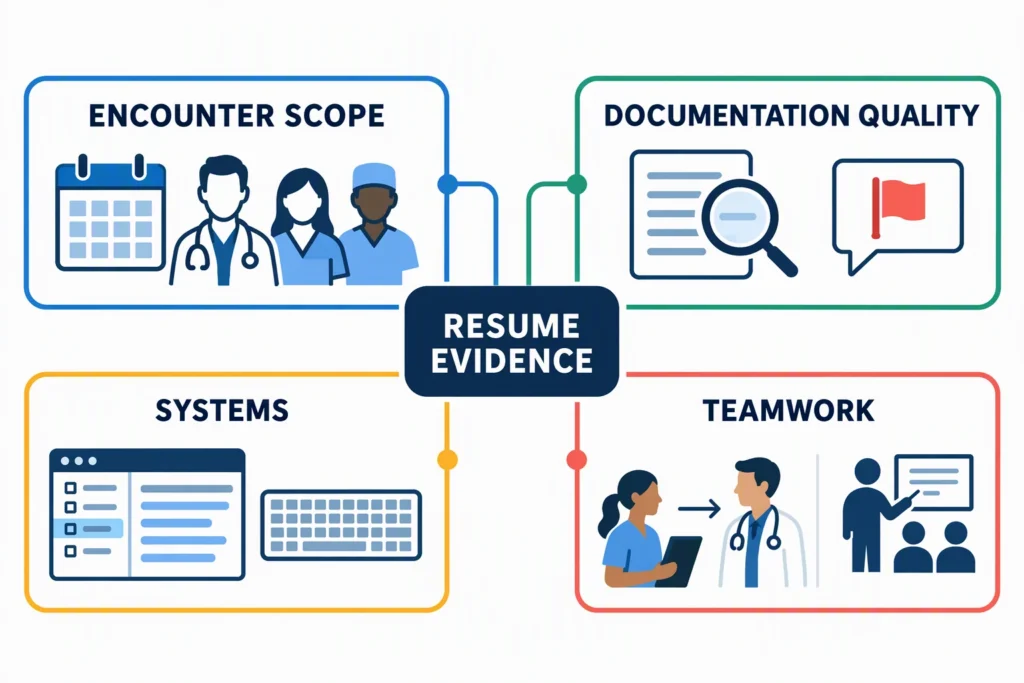
“Documented patient visits” leaves almost every hiring question unanswered. Was the work in emergency medicine or a scheduled clinic? How many providers did you support? Which parts of the note did you prepare? How did you handle clarification, record quality, and changing workloads?
A stronger resume supplies that operating context without exposing patient information. For example: “Prepared provider-directed documentation for approximately 25 outpatient encounters per shift in Epic, organized histories and exam findings, and routed incomplete items for review.” The numbers are illustrative, but the pattern is useful: setting, volume, system, action, and boundary.
Key Takeaways
- Show the encounter workflow. Connect listening, structured note preparation, clarification, provider review, and timely chart completion.
- Quantify only what you can defend. Encounters, providers, specialties, shifts, training volume, and turnaround expectations are useful when records support them.
- Keep clinical ownership clear. Describe documentation performed under provider direction; do not imply that you diagnosed, ordered, prescribed, or independently approved care.
- Protect patient privacy. Never include names, identifiers, chart screenshots, copied notes, or recognizable encounter details in an application file.
Translate the posting into evidence
Medical scribe postings vary by specialty, setting, and employer. Some prioritize rapid real-time documentation; others add chart preparation, results retrieval, referral tracking, or administrative support. Start with the posting, then match each requirement to work you actually performed.
| Posting language | Evidence to use | Wording boundary |
|---|---|---|
| Real-time documentation | Encounter types, note sections, provider count, average shift volume | Do not call a note “complete” if the provider still had to review or add content |
| EHR proficiency | Platform, templates, navigation, pending-item workflow, training completed | List only systems you used directly |
| Medical terminology | Specialties, anatomy coursework, abbreviations, terminology checks | Do not claim coding expertise from choosing terms in a template |
| Accuracy and quality | Clarifications raised, missing elements routed, feedback, audit results | Avoid an accuracy percentage unless a defined report supports it |
| Fast-paced teamwork | Concurrent providers, changing priorities, handoffs, peak volume | Separate your documentation work from the clinician’s decisions |
O*NET’s broader profile for medical records specialists emphasizes confidentiality, completeness, accuracy, and compliance in electronic records. Those principles are useful for checking resume language, even though medical scribing has its own real-time, provider-facing workflow.
Give employers a clear overview of your credentials by learning how to list certifications on a resume.
Make the workflow visible
A hiring manager should be able to see what happened between entering the room and handing the note back for review.
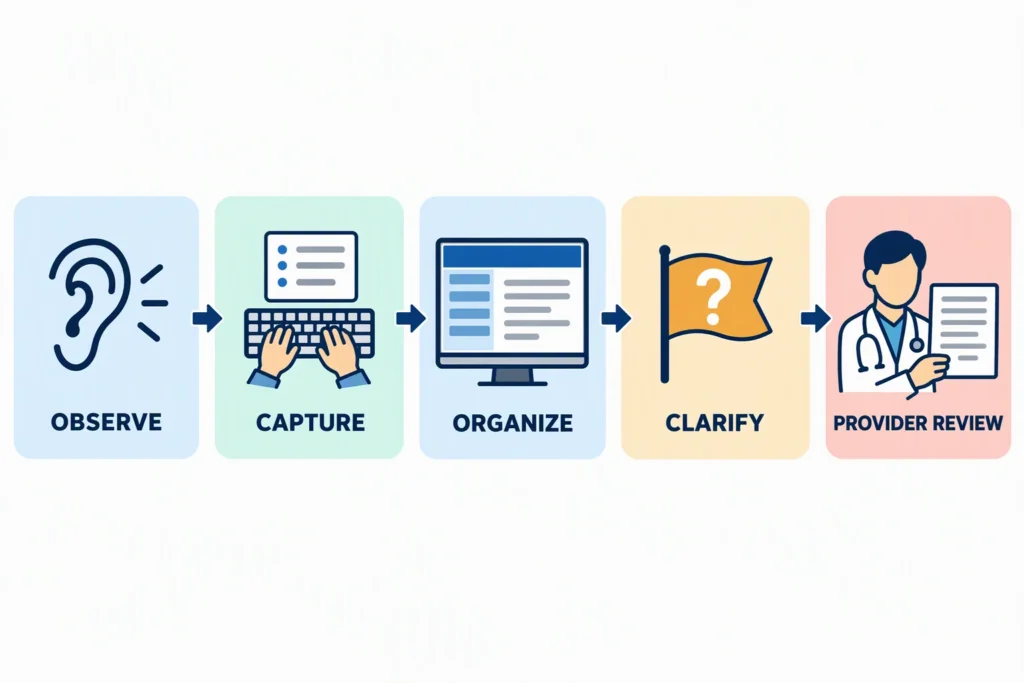
1. Observe: Follow the encounter and capture the provider-directed facts relevant to the assigned note.
2. Capture: Record histories, findings, procedures, results, and plan language within your approved scope.
3. Organize: Place information in the correct EHR sections and use authorized templates or smart tools.
4. Clarify: Flag unclear terms, missing elements, or inconsistencies instead of guessing.
5. Provider review: Route the note through the employer’s review and authentication process.
That sequence turns “assisted physicians” into useful evidence. It also prevents overstatement. A scribe can document a plan communicated by a provider without claiming to have created the plan.
Build bullets from records you can use
Start with schedules, training logs, performance feedback, approved productivity reports, and your own nonconfidential notes about systems and specialties. Never retain screenshots, copied charts, or patient-level material for a job search.
| Weak wording | Stronger fictional example |
|---|---|
| Wrote patient notes | Prepared real-time documentation for 20–30 emergency encounters per shift in Epic under provider direction. |
| Helped doctors work faster | Supported two emergency physicians during peak coverage and kept assigned notes organized for same-shift review. |
| Maintained accurate charts | Flagged unclear terminology and missing note elements for provider clarification before routing documentation for review. |
| Trained new scribes | Coached six new hires on approved templates, specialty terminology, privacy practices, and escalation procedures. |
Use a productivity or quality percentage only when you know the population, period, and source. If no formal metric exists, describe observable scope: “supported three cardiology providers,” “covered adult and pediatric visits,” or “completed employer training in Epic documentation workflows.”
Adapt an experienced example
This fictional candidate targets a multispecialty outpatient group. Every number is illustrative.
Jordan Rivera
Phoenix, AZ | (602) 555-0174 | jordan.rivera@example.com
Medical scribe with experience supporting high-volume outpatient documentation across internal medicine and cardiology. Prepares structured notes in Epic, identifies missing elements for clarification, and adapts to multiple provider preferences while protecting confidential information.
Experience
Desert Valley Medical Group, Phoenix, AZ
Senior Medical Scribe | March 2024 – Present
- Prepare provider-directed documentation for approximately 28 outpatient encounters per shift across internal medicine and cardiology.
- Organize histories, review-of-systems details, exam findings, procedures, and plan language in Epic using approved templates.
- Track assigned notes through same-day review, flag incomplete elements, and communicate clarification needs without interpreting clinical findings.
- Train and shadow eight new scribes on specialty terminology, privacy expectations, EHR navigation, and escalation procedures.
Southwest Urgent Care Network, Tempe, AZ
Medical Scribe | June 2022 – February 2024
- Documented 18–25 urgent care encounters per shift for three rotating providers using athenaOne.
- Retrieved prior results and visit information at provider request and placed relevant material in the designated workflow.
- Adjusted to walk-in volume, procedures, and provider handoffs while keeping assigned documentation ready for review before shift end.
Education
Arizona State University, Tempe, AZ
Bachelor of Science in Biological Sciences
Completed May 2022
Skills: Epic; athenaOne; medical terminology; real-time documentation; approved templates; chart preparation; provider clarification; privacy practices; new-hire training
Position an entry-level candidate
Candidates without paid scribe experience can use evidence from medical terminology, anatomy and physiology, health information coursework, transcription practice, customer service, or another documentation-heavy role. Keep classroom and simulated work clearly labeled.
Clinical Documentation Trainee, Northgate Scribe Program, Tucson, AZ
August 2026 – Present
- Complete simulated encounter notes using fictional cases and an EHR training environment.
- Apply medical terminology and approved abbreviations while separating patient history, findings, and provider plan language.
- Revise practice notes from instructor feedback and escalate unclear dictated content rather than inferring meaning.
Add a typing speed only if it comes from a recent, repeatable assessment, and state the context if useful. Accuracy and comprehension matter more than an isolated words-per-minute claim.
Preserve a website-ready experience entry
Medical Scribe
Southwest Urgent Care Network | Tempe, AZ
June 2022 – February 2024
- Documented 18–25 urgent care encounters per shift in athenaOne.
- Routed assigned notes for provider review before shift end.
Check the final file
Match the posting’s terminology without copying claims you cannot support. Spell out electronic health record (EHR) on first use for a general audience. Name a platform only when you used it, and list a certification only when it is current and verifiable; requirements differ among employers.
Review every specialty, encounter count, provider count, system, credential, and result. Remove patient information, screenshots, clinical anecdotes, and confidential employer material. Confirm that employer and job-title text is bold, locations are plain, and each complete date range is italicized.
Make documentation skill credible
The best evidence is not a list of medical terms. It is a clear account of how you captured an encounter, organized the record, raised questions, worked within provider direction, and protected confidential information. That combination shows speed, judgment, and trustworthiness without claiming authority the role did not carry.
Frequently Asked Questions
These answers address credentials, metrics, and privacy-safe examples.
Do I need a certification?
Follow the posting. Some employers train new hires, while others prefer prior experience, coursework, or a named credential. List only certifications you earned, include the issuing organization when useful, and do not label an internal completion certificate as a professional certification.
Should I include my typing speed?
Include it when the employer asks or when a recent assessment supports the number. Pair it with evidence of accurate documentation, medical terminology, and EHR work; speed alone does not show that you understood the encounter.
How can I quantify work without sharing patient information?
Use aggregate, nonidentifying scope: approximate encounters per shift, number of providers supported, specialties covered, systems used, trainees coached, or documented turnaround expectations. Never include names, dates of service, medical record numbers, copied notes, screenshots, or a recognizable case story.