


“Problem solver” is easy to type and hard to trust. A hiring manager cannot see how you think from that label. They can see it when you describe a real issue, the judgment you used, the action you took, and what happened next.
That proof may come from fixing an error, improving a slow process, preventing a failure, resolving a conflict, or making a sound decision with incomplete information. The best example is not necessarily dramatic. It is relevant to the target job and specific enough to survive a follow-up question.
All names, numbers, and situations below are fictional. Replace them with facts you can explain in an interview.
Key Takeaways
- Show a chain of evidence. Give the reader enough of the issue, diagnosis, decision, action, and outcome to understand your contribution.
- Choose the right kind of challenge. A help-desk role may value troubleshooting, while an operations role may need workflow analysis and prevention.
- Use a truthful result. Time, quality, risk, adoption, clarity, and a completed decision can show value when no clean percentage exists.
- Keep every claim interview-ready. You should be able to explain what you knew, which options you considered, and why your response made sense.
Show the thinking behind the result
A strong bullet does more than announce that something was fixed. It lets the reader infer the behavior behind the fix.
O*NET separates several related forms of work: diagnosing operating errors, weighing costs and benefits, analyzing systems, evaluating performance, and handling complex new challenges. That distinction matters. A candidate who reconciled conflicting records used different judgment from one who restored a failed application or calmed an escalating customer.
Use this five-part evidence chain as a drafting tool. The finished bullet may not need every word, but your notes should answer every part.
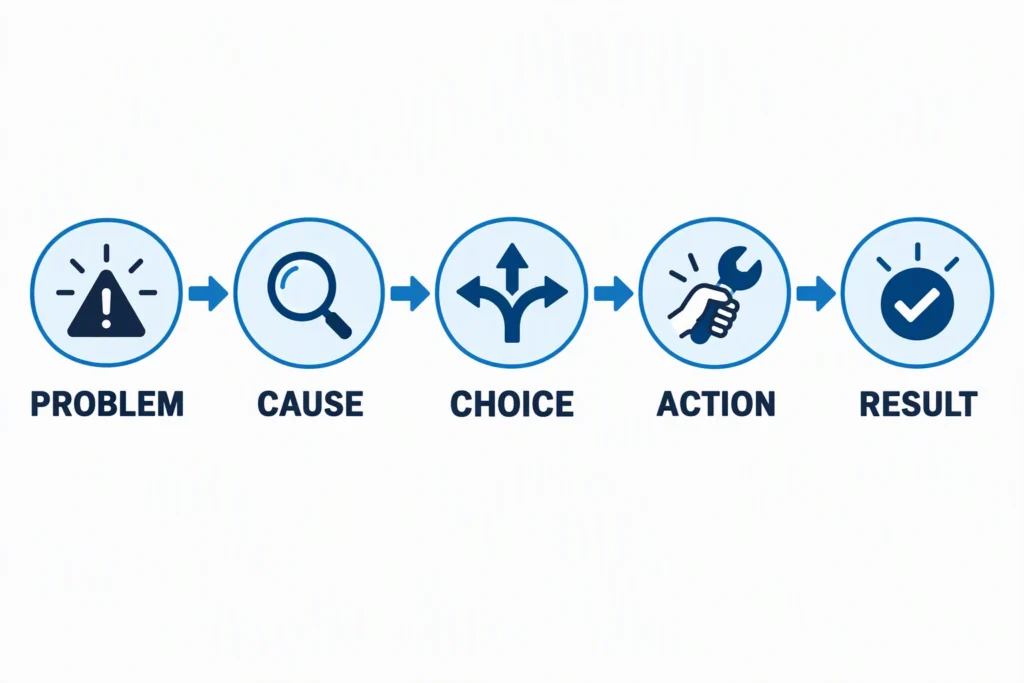
alt text – A five-step diagram connects a workplace problem to its cause, a choice, an action, and a verified result.
description – The process visual shows the evidence a resume bullet needs to make a solution credible.
| Evidence | Question to answer |
|---|---|
| Problem | What was wrong, blocked, risky, slow, or unclear? |
| Cause | What did you inspect, compare, test, or ask to understand it? |
| Choice | Which option did you select, and what constraint shaped the decision? |
| Action | What did you personally change, build, recommend, repair, or coordinate? |
| Result | What improved, resumed, finished, became safer, or stopped recurring? |
Do not force all five pieces into one long sentence. Keep the details that prove relevance and cut background the employer does not need.
Recover examples from work you have already done
People often overlook useful evidence because resolving the issue felt like part of the job. Search your memory for moments when the normal process stopped working or when you made it work better.
Ask yourself:
- What kept failing, running late, confusing people, or creating rework?
- What pattern did I notice that others had not named?
- When did I compare options, test a cause, or make a tradeoff?
- What did I prevent, simplify, restore, or make easier to repeat?
- Who used my recommendation, documentation, fix, or new process?
Check performance reviews, project notes, tickets, meeting summaries, and completed assignments. Evidence can also come from an internship, class project, volunteer role, student organization, military assignment, or personal project. Label the setting accurately and focus on your own contribution.
Match the example to the target role
Read the posting for situations the employee will face. Repeated verbs often reveal the type of evidence the employer wants.
| Posting signal | Evidence to prioritize |
|---|---|
| Investigate, reconcile, audit | Finding discrepancies, tracing causes, validating records |
| Troubleshoot, debug, restore | Testing possible causes, applying a fix, confirming service |
| Improve, streamline, optimize | Mapping a workflow, removing a bottleneck, tracking the change |
| Resolve, de-escalate, negotiate | Listening, clarifying interests, reaching a workable agreement |
| Assess, recommend, prioritize | Comparing options, constraints, risks, costs, or benefits |
| Prevent, monitor, control | Detecting risk early, creating checks, reducing recurrence |
If you are choosing problem solving skills for a resume, use the posting to select evidence rather than to collect labels. “Root-cause analysis” belongs on the page only if you actually used a defensible method to investigate a cause. “Decision-making” is stronger when a bullet shows what you weighed.
Write a compact bullet that carries proof
Start with this working formula:
Investigated or recognized [problem], used [method or judgment], took [action], and achieved [result].
Then remove any part the reader can already infer. These problem solving examples show how the emphasis changes by role.
Customer support
Weak: Solved customer complaints quickly.
Stronger: Reviewed 60 cancellation requests, identified unclear renewal notices as the leading complaint, and rewrote the response guide, reducing repeat contacts by 17% over eight weeks.
The stronger version shows analysis, an owned action, and a measured outcome. It does not claim that one employee changed the renewal policy.
Operations
Weak: Helped improve the supply process.
Stronger: Compared purchase logs with weekly stockouts, found a two-day approval bottleneck, and introduced an exception route for urgent orders that kept three scheduled installations on track.
The result is credible without a percentage: the candidate protected a specific delivery commitment.
Technical support
Weak: Troubleshot software and hardware problems.
Stronger: Isolated recurring login failures to an outdated device policy, tested the correction with IT, and documented the fix for the help desk, preventing the issue from reopening during the next rollout.
This example shows diagnosis and verification rather than a generic support duty.
Student or early-career project
Weak: Worked with a team to complete a research project.
Stronger: Reconciled conflicting survey responses, proposed a consistent coding rule, and rechecked 240 records, giving the four-person team a clean dataset for its final analysis.
Paid experience is not required. The context, individual contribution, and outcome still need to be clear.
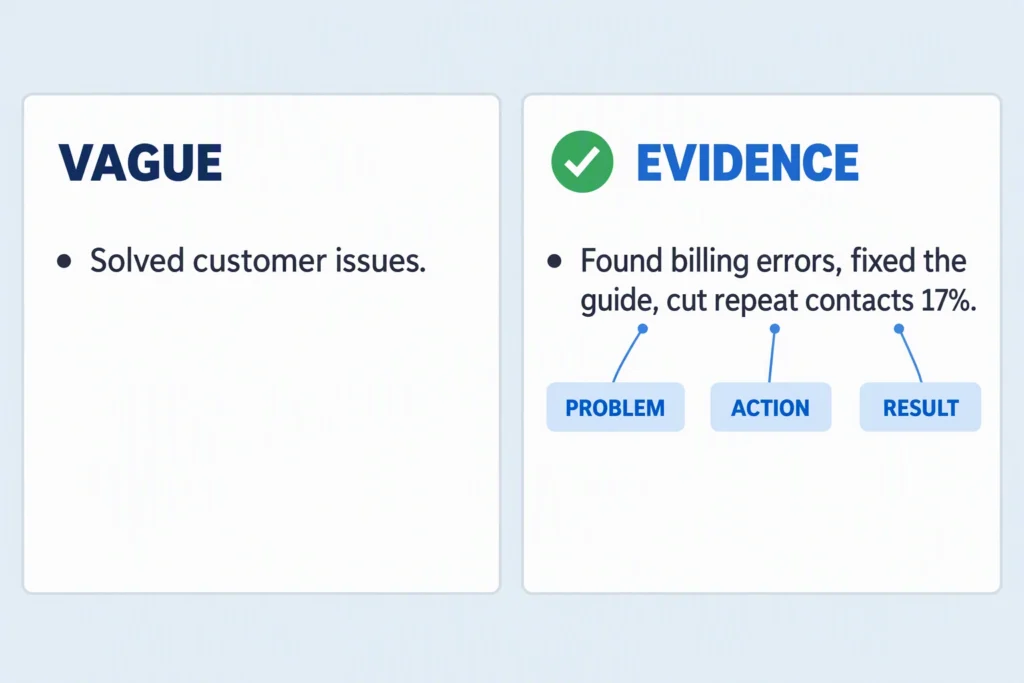
alt text – A vague resume line is compared with a specific bullet annotated for challenge, action, and outcome.
description – The comparison shows how concrete evidence turns a broad claim into an interview-ready resume bullet.
For a website that needs a copyable example, keep the markup literal until the client renders it:
- Traced recurring order errors to an outdated intake form, corrected the required fields, and eliminated incomplete submissions during the next monthly cycle.
Use honest outcomes when no number exists
Do not invent a metric or estimate a result you never tracked. Numbers help only when they are accurate and meaningful.
You can still show what changed:
- Completion: a delayed project moved forward or a decision was made.
- Quality: records became consistent, instructions became usable, or errors stopped recurring.
- Time: service resumed before a deadline or a handoff required fewer steps.
- Risk: a check caught an issue before release, payment, shipment, or submission.
- Adoption: a team accepted the recommendation or continued using the process.
- Clarity: stakeholders received a documented answer, owner, or next step.
Name scope when it helps: the number of records checked, teams consulted, locations affected, or weeks observed. Scope gives the reader context without pretending it is impact.
Put the claim where it earns its space
Use the summary for one high-value example that connects directly to the target role. Use the skills section for specific methods or capabilities such as incident triage, process mapping, data validation, conflict resolution, or risk assessment. Use experience and project bullets for the proof.
Avoid repeating the same story in all three places. A summary can state the pattern, the skills section can index the methods, and one bullet can show the strongest result.
Check whether the bullet survives an interview
Before submitting, test each claim with five questions:
- What information told you there was a problem?
- How did you separate a symptom from the likely cause?
- Which options or constraints did you consider?
- What part did you own, and who else contributed?
- How did you know the response worked?
Revise the bullet if your answer depends on “we” and your role remains unclear. Remove confidential details, but keep enough context to show judgment. Delete any method, tool, or result you cannot explain.
Make your evidence do the claiming
A resume does not need to call you a natural problem solver. It needs one or two relevant moments that show how you understood a challenge, chose a response, acted, and checked the outcome. Select those moments from your real history, write them with honest scope, and let the reader reach the conclusion.
Frequently Asked Questions
These answers cover the choices that usually remain after you have found a credible example.
Should I include the phrase “problem solver” in my skills section?
Usually, a more specific term is useful. List the capability the role requires, such as troubleshooting, process improvement, data validation, or conflict resolution, then support it in a bullet. Keep the broad phrase only when it appears in the posting and the rest of the page proves it.
How many examples should appear on one resume?
There is no fixed number. One strong example in each highly relevant recent role is often more persuasive than repeating the same claim in every position. Let the posting and your available evidence decide.
Can I use an example where the first solution failed?
Yes, if the final story shows sound judgment. Explain what the first result taught you, what you changed, and how you verified the next response. Do not hide a material mistake, but do not spend the bullet narrating every attempt.