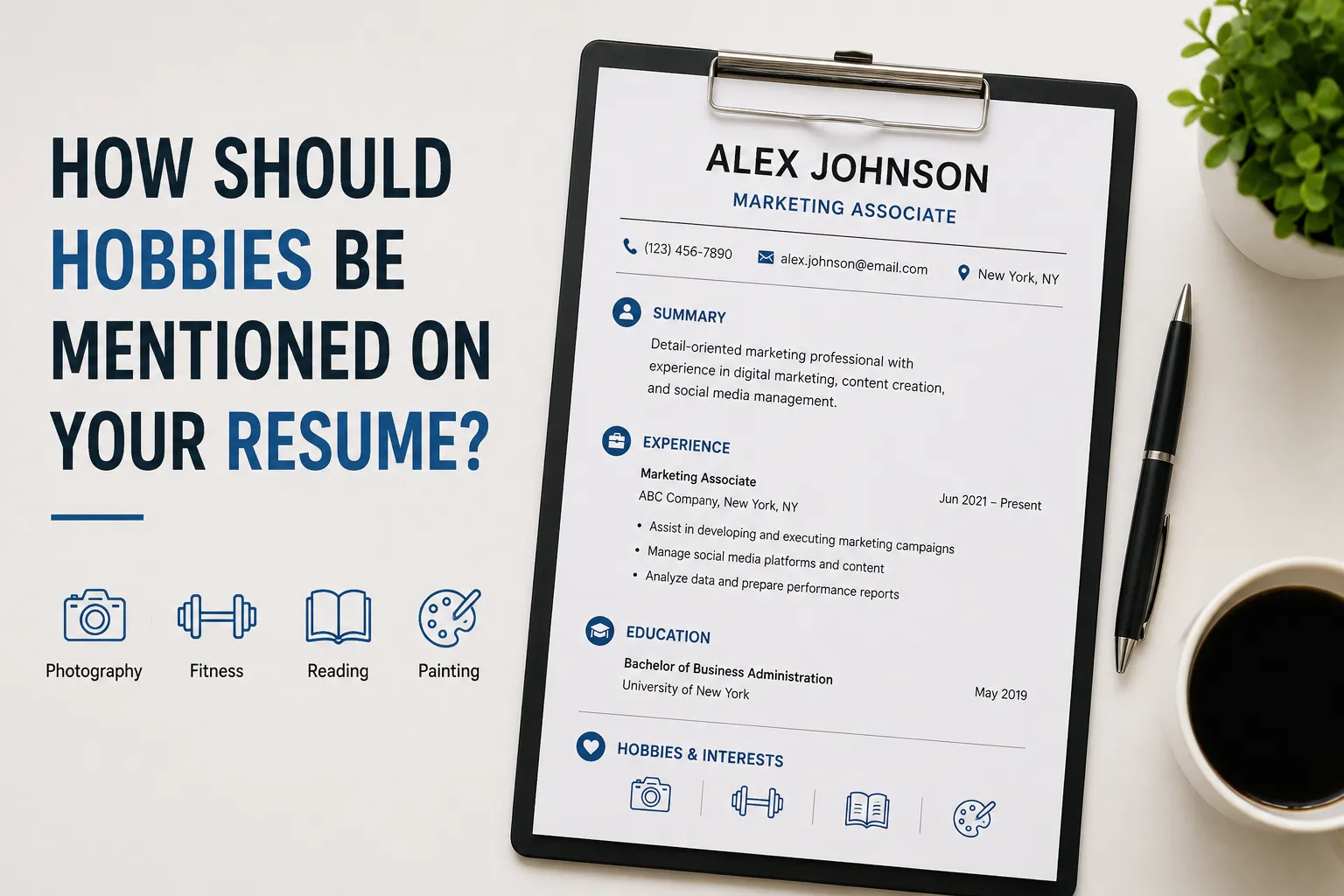

Your resume does more than list your qualifications; it gives employers a glimpse of who you are beyond your work experience.
While your skills and achievements should always take center stage, the right hobbies can showcase valuable qualities such as creativity, leadership, teamwork, or problem-solving. When chosen carefully, they can add personality to your resume and strengthen your overall application.
Here, you’ll learn when to include hobbies on your resume, how to list them effectively, which hobbies make the best impression, and the common mistakes to avoid.
Key Takeaways
- Include hobbies only if they strengthen your resume and support your professional profile.
- Choose hobbies that highlight valuable qualities like teamwork, leadership, creativity, or problem-solving.
- Tailor your hobbies to the job whenever possible instead of using the same list for every application.
- Keep the Hobbies & Interests section brief, relevant, and easy to scan.
- Be honest about every hobby you include, as employers may ask about it during an interview.
Real Resume Examples Featuring Hobbies
Knowing where to list hobbies is one thing, but seeing them in a real resume makes the process much easier. The examples below illustrate how different professionals can incorporate hobbies into their resumes without taking attention away from their qualifications.
Notice how each “Hobbies” section is tailored to the candidate’s career, highlights relevant strengths, and complements the overall resume rather than serving as filler.
Resume Example 1: Marketing Coordinator
Emily Carter
Chicago, IL • emily.carter@email.com • (312) 555-0187
LinkedIn: linkedin.com/in/emilycarter
Professional Summary
Creative marketing graduate with experience developing social media campaigns, writing engaging content, and supporting brand growth. Passionate about digital storytelling and creating meaningful customer experiences.
Skills
- Social Media Marketing
- SEO
- Content Writing
- Canva
- Adobe Photoshop
- Google Analytics
Education
Bachelor of Business Administration (Marketing)
University of Illinois Chicago | 2025
Experience
Marketing Intern
ABC Digital Agency | Jan 2025 – May 2025
- Supported digital marketing campaigns for 8+ client accounts, contributing to social media strategy, content planning, and campaign execution.
- Wrote 20+ SEO-optimized blog articles, email newsletters, and promotional copy, helping improve content consistency and audience engagement.
- Increased Instagram engagement by 18% through audience research, content scheduling, trend analysis, and optimized posting strategies.
- Assisted in developing monthly content calendars, ensuring 100% on-time delivery of marketing assets across multiple platforms.
Hobbies & Interests
- Photography
- Managing a personal marketing blog
- Video editing
- Volunteering at local community events
- Traveling
This example shows how creative hobbies can reinforce skills in content creation, branding, and digital marketing while presenting the candidate as innovative and visually driven.
Ready to Land Your Next Job?
Don’t let your resume get lost in the stack. Build a professional, ATS-friendly resume that highlights your leadership, achievements, and industry expertise.
Resume Example 2: Software Developer
Daniel Brooks
Austin, TX • daniel.brooks@email.com • (512) 555-0145
GitHub: github.com/danielbrooks
Professional Summary
Detail-oriented Software Developer with hands-on experience designing and building responsive web applications using modern technologies. Passionate about solving real-world programming challenges, writing clean and efficient code, and developing scalable, user-focused software solutions.
Skills
- JavaScript
- React
- Python
- SQL
- Git
- REST APIs
Education
Bachelor of Science in Computer Science
The University of Texas at Austin | 2024
Projects
Task Management App | React, Node.js, Express.js, MongoDB/Firebase
- Developed a full-stack task management application using React, Node.js, and Express.js, enabling users to create, update, delete, and organize tasks efficiently.
- Implemented secure user authentication and role-based access using JWT/Firebase Authentication, ensuring protected user access.
- Integrated cloud database storage (MongoDB Atlas/Firebase Firestore) for real-time data synchronization and reliable task management.
- Designed a responsive, mobile-friendly interface that improved usability across desktop and mobile devices.
- Built RESTful APIs to handle CRUD operations, reducing response time and ensuring seamless communication between the frontend and backend.
Hobbies & Interests
- Building personal coding projects
- Open-source contributions
- Chess
- Learning AI tools
- Hiking
Here, the hobbies reflect technical curiosity and continuous learning. They demonstrate problem-solving abilities, logical thinking, and a genuine passion for technology beyond the workplace.
Resume Example 3: Registered Nurse
Sophia Williams
Denver, CO • sophia.williams@email.com • (720) 555-0198
Professional Summary
Compassionate registered nurse with experience delivering patient-centered care in fast-paced healthcare environments. Strong communicator with a commitment to improving patient outcomes.
Skills
- Patient Care
- Electronic Health Records (EHR)
- Communication
- Critical Thinking
- Teamwork
Education
Bachelor of Science in Nursing (BSN)
University of Colorado Denver | 2023
Experience
Registered Nurse
City Medical Center | 2023 – Present
- Deliver comprehensive, patient-centered care to 20–30 patients per shift across fast-paced medical-surgical units while maintaining high standards of safety and quality.
- Collaborate with physicians, specialists, pharmacists, and multidisciplinary healthcare teams to develop and implement individualized treatment plans, improving continuity of care.
- Educate 100+ patients and family members on medications, treatment plans, post-discharge care, and recovery strategies, promoting better health outcomes and reducing readmission risks.
- Administer medications, monitor patient conditions, and respond promptly to changes in clinical status while ensuring 100% compliance with hospital protocols and documentation standards.
Hobbies & Interests
- Community health volunteering
- Yoga
- Reading healthcare journals
- Charity fundraising events
- Gardening
Here, the hobbies reflect a commitment to patient-centered care and ongoing professional development. They demonstrate empathy, strong communication skills, and a dedication to improving patient outcomes.
Resume Example 4: Graphic Designer
Olivia Bennett
Seattle, WA • olivia.bennett@email.com • (206) 555-0123
Professional Summary
Creative Graphic Designer with experience creating impactful branding, digital marketing assets, and user-focused visual designs. Skilled in transforming ideas into compelling visuals with strong attention to detail, creativity, and brand consistency.
Skills
- Adobe Photoshop
- Illustrator
- InDesign
- Figma
- Branding
- Typography
Education
Bachelor of Fine Arts in Graphic Design
Seattle University | 2024
Experience
Graphic Design Intern
Creative Studio Inc. | 2024
- Designed 200+ social media graphics, digital advertisements, banners, and promotional materials for marketing campaigns across multiple platforms, improving brand visibility and audience engagement. Assisted in creating 15+ brand identity packages, including logos, color palettes, typography, and brand guidelines, helping businesses establish consistent visual identities. Collaborated with cross-functional marketing teams to develop campaign visuals that contributed to 25% higher engagement and improved campaign performance. Produced print and digital marketing assets, including brochures, flyers, presentations, email graphics, and website visuals, ensuring 100% brand consistency across all channels.
Hobbies & Interests
- Digital illustration
- Photography
- Hand lettering
- UI inspiration research
- Visiting art museums
The hobbies in this example naturally align with the profession by showcasing creativity, artistic ability, and an interest in design, making the candidate’s portfolio even more credible.
Resume Example 5: Business Analyst
Michael Turner
Boston, MA • michael.turner@email.com • (617) 555-0162
Professional Summary
Results-driven Business Analyst with strong analytical, problem-solving, and data interpretation skills. Experienced in transforming complex data into actionable business insights, improving processes, and supporting data-driven decision-making to achieve organizational goals.
Skills
- Microsoft Excel
- SQL
- Power BI
- Data Visualization
- Business Analysis
Education
Bachelor of Science in Business Analytics
Boston University | 2024
Experience
Business Analyst Intern
XYZ Consulting | 2024
- Analyzed 100,000+ sales records to identify revenue trends, customer behavior, and business performance opportunities, contributing to a 15% improvement in sales forecasting accuracy. Designed and maintained 10+ interactive Power BI dashboards that enabled real-time KPI tracking, reducing manual reporting time by 40%. Prepared executive reports and presentations for senior management, delivering actionable insights that supported strategic planning and data-driven decision-making. Collaborated with cross-functional teams to gather business requirements, streamline reporting processes, and improve operational efficiency by 20%.
Hobbies & Interests
- Reading business and leadership books
- Stock market research
- Strategy board games
- Financial blogging
- Learning data visualization tools
This example highlights hobbies that demonstrate analytical thinking, strategic decision-making, and a commitment to continuous professional development, reinforcing the candidate’s data-driven mindset
Ready to Land Your Next Job?
Don’t let your resume get lost in the stack. Build a professional, ATS-friendly resume that highlights your leadership, achievements, and industry expertise.
Why You Should Include Hobbies On Your Resume
A resume is meant to showcase more than your qualifications, it should also give employers a sense of who you are as a person. While work experience, education, and skills remain the most important sections, relevant hobbies can add depth to your application and help you stand out from other candidates with similar credentials.
When chosen carefully, hobbies can communicate qualities that are difficult to demonstrate through job titles alone. They can highlight your work ethic, interests, and transferable skills while giving hiring managers a better understanding of how you might fit into their team and workplace culture.
- Showcase transferable skills. Many hobbies naturally demonstrate valuable workplace skills such as leadership, teamwork, communication, creativity, problem-solving, and time management.
- Add personality to your resume. Hobbies help employers see you as a well-rounded individual rather than just a list of qualifications, making your application more memorable.
- Strengthen a resume with limited experience. If you’re a student, recent graduate, or changing careers, relevant hobbies can help fill gaps by highlighting practical skills and personal strengths.
- Demonstrate initiative and commitment. Long-term involvement in activities such as volunteering, sports, or creative pursuits can reflect dedication, discipline, and a willingness to learn.
- Support your cultural fit. While skills determine whether you can do the job, hobbies can provide insight into your interests and working style, helping employers understand how you may fit within their team.
Used strategically, hobbies won’t replace strong qualifications, but they can reinforce your strengths and leave employers with a more complete picture of your potential as a candidate.
Hobbies vs. Interests: What’s the Difference?
Although the terms hobbies and interests are often used interchangeably, they don’t mean the same thing. Understanding the difference can help you decide what to include on your resume and how to present yourself more effectively to potential employers.
A hobby is an activity you actively participate in during your free time. It usually involves developing a skill, practicing regularly, or spending time on something you genuinely enjoy.
“The finest thing about a hobby is that you can’t do any pretending about it. You either like it, or you don’t.” – Dorothy Draper.
An interest, on the other hand, is a subject, industry, or idea that captures your attention and motivates you to learn more, even if you don’t actively engage in it.
Hobbies
- Activities you regularly participate in
- Often involve practicing a skill
- Demonstrate practical abilities
- Can be discussed through personal experience
- Example: Playing tennis
- Example: Photography
- Example: Blogging
- Example: Volunteering
- Example: Playing the guitar
Interests
- Topics or fields you enjoy learning about
- Usually reflect curiosity or long-term interest
- Show what motivates or inspires you
- Can be discussed through knowledge or enthusiasm
- Example: Sports science
- Example: Digital marketing
- Example: Artificial intelligence
- Example: Environmental sustainability
- Example: Music production
Which Should You Include on Your Resume?
In most cases, hobbies carry more value because they demonstrate action, commitment, and transferable skills. However, interests can also be worth mentioning when they’re relevant to the position or industry you’re pursuing. For the strongest impact, choose hobbies and interests that complement your qualifications and reinforce your professional profile.
Types of Hobbies to Include on a Resume
The hobbies you choose can say a lot about your strengths, interests, and personality. However, not every hobby belongs on a resume. The best hobbies are those that reflect valuable skills, demonstrate positive character traits, or support the role you’re applying for. Below are some of the most effective categories of hobbies to consider, along with examples that can help strengthen your resume and create a more well-rounded professional profile.

Physical Hobbies
Physical hobbies demonstrate much more than an active lifestyle. They can highlight qualities such as discipline, teamwork, perseverance, leadership, and time management, all of which are valuable in the workplace.
If you’re applying for a role that values commitment, collaboration, or resilience, including a relevant physical hobby can strengthen your resume and provide hiring managers with a more complete picture of your personality.
| Column 1 | Column 2 | Column 3 | Column 4 | Column 5 |
|---|---|---|---|---|
| Jogging | Cycling | Yoga | Basketball | Surfing |
| Running | Mountain biking | Pilates | Volleyball | Ice skating |
| Walking | Swimming | CrossFit | Soccer | Roller skating |
| Hiking | Weight training | Rock climbing | Cricket | Horseback riding |
| Trekking | Strength training | Tennis | Golf | Archery |
| Dance | Zumba | Rowing | Kayaking | Marathon training |
Why Do Physical Hobbies Matter?
Physical hobbies can make your resume more compelling because they demonstrate qualities that are difficult to convey through work experience alone. Activities that require consistency, teamwork, or perseverance often reflect the same characteristics employers look for in reliable employees.
While these hobbies should never replace relevant skills or experience, they can reinforce your professional profile and help you stand out as a well-rounded candidate.

Mental Activities
Mental activities showcase your ability to think critically, solve problems, and continuously learn—qualities that employers value across nearly every industry.
Whether you’re solving complex puzzles, learning a new language, or exploring technical subjects, these hobbies demonstrate intellectual curiosity and a commitment to personal growth.
Including relevant mental activities on your resume can help highlight transferable skills that go beyond your academic or professional experience.
| Column 1 | Column 2 | Column 3 | Column 4 | Column 5 |
|---|---|---|---|---|
| Reading | Creative writing | Rubik’s Cube | Learning history | Memory training |
| Chess | Journaling | Mathematics puzzles | Learning psychology | Trivia quizzes |
| Sudoku | Blogging | Logic games | Learning economics | Data analysis |
| Crossword puzzles | Research | Book clubs | Learning philosophy | Essay writing |
| Coding | Debate | Podcast listening | Learning science | Technical reading |
| Programming | Public speaking | Investing | Meditation | AI exploration |
| Learning a new language | Strategy games | Stock market analysis | Mind mapping | Academic |
Why Do Mental Activities Matter?
Mental hobbies demonstrate that you’re willing to challenge yourself, expand your knowledge, and develop new skills outside of work.
They often reflect qualities such as curiosity, discipline, adaptability, and problem-solving, traits that employers consistently look for in strong candidates.
Choosing mental activities that align with your target role can reinforce your resume and show that learning is an ongoing part of your personal and professional growth.

Creative Hobbies
Creative hobbies demonstrate your ability to think differently, generate new ideas, and approach challenges with imagination. They often reflect qualities such as innovation, attention to detail, communication, and artistic expression. Even if you’re not applying for a creative role, these hobbies can show employers that you’re resourceful, adaptable, and capable of bringing fresh perspectives to your work.
| Column 1 | Column 2 | Column 3 | Column 4 | Column 5 |
|---|---|---|---|---|
| Photography | Video editing | Poetry | Sewing | Baking |
| Painting | Filmmaking | Calligraphy | Fashion design | Cooking |
| Sketching | Content creation | Hand lettering | Interior decorating | Music composition |
| Drawing | Blogging | Pottery | DIY crafts | Playing guitar |
| Digital illustration | Vlogging | Sculpting | Woodworking | Playing piano |
| Graphic design | Podcasting | Knitting | Jewelry making | Singing |
| UI/UX design | Creative writing | Crocheting | Candle making | Origami |
Why Do Creative Hobbies Matter?
Creative hobbies can help your resume stand out by showcasing skills that aren’t always reflected through work experience alone. They demonstrate your ability to think creatively, solve problems, communicate ideas, and pay attention to detail.
Whether you’re applying for a creative position or a more traditional role, these hobbies highlight valuable qualities that employers appreciate, including initiative, innovation, and a willingness to keep learning.

Social & Volunteer Activities
Social and volunteer activities demonstrate how you interact with others, contribute to your community, and take initiative outside of work or school. These activities often highlight valuable workplace qualities such as teamwork, leadership, communication, empathy, and responsibility. If you’ve actively participated in clubs, nonprofit organizations, or community programs, they can strengthen your resume and show employers that you’re engaged beyond your professional responsibilities.
| Column 1 | Column 2 | Column 3 | Column 4 | Column 5 |
|---|---|---|---|---|
| Community volunteering | Mentoring students | Food bank volunteering | Toastmasters | Organizing workshops |
| Animal shelter volunteering | Tutoring | Coaching youth sports | Networking events | Peer mentoring |
| Blood donation drives | Youth mentoring | Cultural club participation | Community outreach | Campus ambassador programs |
| Charity fundraising | Environmental cleanups | Student government | Nonprofit work | Volunteer teaching |
| Event planning | Tree planting | Debate club | Religious community service | Neighborhood initiatives |
Why Social & Volunteer Activities Matter?
Employers value candidates who can work well with others and make a positive contribution to their workplace. Social and volunteer activities demonstrate qualities such as leadership, communication, empathy, and collaboration in real-world settings.
They also show that you’re willing to give back to your community, take on responsibilities, and develop skills outside of your professional experience. When relevant, these activities can make your resume more well-rounded and memorable.
Ready to Land Your Next Job?
Don’t let your resume get lost in the stack. Build a professional, ATS-friendly resume that highlights your leadership, achievements, and industry expertise.
Other Productive Activities
Not every valuable hobby fits into a traditional category. Many productive activities help you build practical skills, expand your knowledge, and demonstrate initiative outside of work.
These hobbies reflect a growth mindset and show employers that you’re committed to continuous learning and self-improvement. Whether you’re developing technical skills or managing personal projects, these activities can add meaningful value to your resume.
| Column 1 | Column 2 | Column 3 | Column 4 | Column 5 |
|---|---|---|---|---|
| Gardening | Budgeting | Reading biographies | Learning AI tools | Genealogy research |
| Birdwatching | Personal finance | Listening to educational podcasts | Website building | Astronomy |
| Travel planning | Investing | Watching documentaries | Freelancing | Home improvement projects |
| Traveling | Collecting stamps | Learning Excel | Entrepreneurship | Furniture restoration |
| Home organization | Coin collecting | Learning Photoshop | Language exchange | Beekeeping |
Why Do Productive Activities Matter?
Productive activities demonstrate that you’re willing to invest time in developing new skills, exploring your interests, and staying current with changing technologies and industry trends.
They reflect qualities such as initiative, adaptability, curiosity, and self-discipline—all of which employers value regardless of the role. When these activities align with the position you’re applying for, they can reinforce your qualifications and help present you as a motivated, growth-oriented candidate.
Skills vs. Personality Traits: What Your Hobbies Reveal
The hobbies you include on your resume do more than show how you spend your free time—they also give employers insight into your abilities and your personality.
While some hobbies demonstrate practical, job-related skills, others highlight personal qualities that influence how you work with others and approach challenges. Understanding the difference can help you choose hobbies that strengthen your resume.
| Hobby | Skills It Demonstrates | Personality Traits It Reflects |
|---|---|---|
| Playing Team Sports | Teamwork, communication, leadership | Cooperative, disciplined, dependable |
| Photography | Creativity, attention to detail, editing | Observant, patient, artistic |
| Volunteering | Organization, collaboration, problem-solving | Compassionate, responsible, community-minded |
| Blogging | Writing, research, content creation | Curious, self-motivated, creative |
| Chess | Strategic thinking, decision-making | Analytical, patient, focused |
| Public Speaking | Communication, presentation, confidence | Outgoing, persuasive, confident |
| Running or Marathon Training | Goal setting, consistency, time management | Determined, resilient, self-disciplined |
| Learning a Foreign Language | Communication, adaptability, cultural awareness | Open-minded, curious, eager to learn |
When selecting hobbies for your resume, try to include activities that showcase a balance of professional skills and positive personality traits. This helps employers see not only what you’re capable of doing but also the kind of colleague and team member you’re likely to be.
Skills Employers Can Identify Through Your Hobbies
These are practical, transferable abilities that employers often look for during the hiring process.
- Leadership
- Teamwork
- Communication
- Problem-solving
- Creativity
- Time management
- Organization
- Adaptability
- Critical thinking
- Analytical thinking
- Decision-making
- Research skills
- Presentation skills
- Project management
- Technical proficiency
- Attention to detail
- Collaboration
- Planning and coordination
- Writing and editing
- Public speaking
Personality Traits Your Hobbies Can Reflect
These qualities help employers understand how you approach work, interact with others, and handle responsibilities.
- Self-motivated
- Curious
- Disciplined
- Responsible
- Reliable
- Patient
- Confident
- Adaptable
- Resilient
- Compassionate
- Creative
- Organized
- Detail-oriented
- Open-minded
- Resourceful
- Goal-oriented
- Positive
- Independent
- Collaborative
- Lifelong learner
The strongest hobbies often showcase a combination of both skills and personality traits. For example, volunteering can demonstrate collaboration and organization while also reflecting compassion and responsibility. Choosing hobbies that highlight both aspects helps create a more well-rounded and compelling resume.
Ready to Land Your Next Job?
Don’t let your resume get lost in the stack. Build a professional, ATS-friendly resume that highlights your leadership, achievements, and industry expertise.
Standard Rules for Listing Hobbies on a Resume
Adding hobbies to your resume can make your application more well-rounded, but only when they’re included with purpose. Instead of listing every activity you enjoy, focus on hobbies that strengthen your professional profile and give employers a better understanding of the skills and qualities you can bring to the role.
Following a few simple guidelines can help ensure this section adds value rather than becoming unnecessary filler.
- Keep your hobbies relevant. Choose hobbies that complement the role or demonstrate qualities that employers value, such as creativity, teamwork, leadership, or discipline.
- Tailor them to the job. Don’t use the same hobbies for every application. Review the job description and include activities that align with the position whenever it makes sense.
- Prioritize quality over quantity. A short list of three to five meaningful hobbies is more effective than a long list of unrelated interests.
- Be genuine. Only include hobbies you actually enjoy and can confidently discuss if they come up during an interview.
When used thoughtfully, hobbies can do more than fill space on a resume, they can reinforce your strengths and help create a stronger overall impression. A relevant, honest, and well-placed hobbies section can give hiring managers another reason to remember your application.
How to Add Hobbies to a Resume
Adding hobbies to your resume isn’t limited to a single section. Depending on your background and the role you’re targeting, you can mention them in different ways. The key is to include them only when they strengthen your application and demonstrate skills or qualities that are relevant to the position.
1. Hobbies & Interests Section
The simplest and most common way to include hobbies is in a dedicated Hobbies & Interests section. Keep it short and list three to five hobbies that reflect your strengths or personality.
Example:
Hobbies & Interests
- Photography
- Community volunteering
- Trail running
- Chess
- Blogging about personal finance
2. Resume Summary or Objective
If one of your hobbies is closely related to the role you’re applying for, you can briefly mention it in your resume summary or objective to reinforce your suitability for the position.
Example:
Resume Summary
Recent marketing graduate with a passion for photography, content creation, and digital storytelling. Skilled in creating engaging visual content and managing social media campaigns through hands-on experience with student organizations. Eager to apply creativity, marketing knowledge, and strong communication skills to help brands grow their online presence.
3. Volunteer Experience or Extracurricular Activities
If a hobby has led to meaningful volunteer work or participation in clubs, organizations, or community events, showcase it as experience instead of simply listing it as a hobby.
Example:
Volunteer Experience
Community Volunteer
Local Food Bank | June 2024 – Present
- Coordinated weekly food distribution events, ensuring efficient organization and timely delivery of essential supplies.
- Collaborated with volunteers to organize donation drives, increasing community participation and resource collection.
- Assisted in planning and executing community outreach programs to support local families and promote food security.
4. Projects or Achievements
When a hobby leads to a real project, measurable achievement, or portfolio, it deserves more than a simple mention. Showcasing it in your Projects or Achievements section highlights the practical skills you’ve developed and demonstrates initiative, creativity, and commitment to potential employers.
Example
Projects
Personal Photography Portfolio
- Built and maintained an online portfolio showcasing landscape and portrait photography.
- Edited and published over 150 high-quality photographs using professional photo-editing tools.
- Grew a photography-focused social media page by consistently sharing engaging visual content and interacting with followers.
- Strengthened skills in visual storytelling, branding, content creation, and digital marketing through self-directed projects.
No matter where you include your hobbies on your resume, ensure they reinforce your professional profile. Focus on activities that demonstrate relevant skills, align with the job you’re applying for, and add meaningful value to your application.
Tips for Choosing the Right Hobbies
The hobbies you choose should support your resume—not distract from it. Instead of listing every activity you enjoy, focus on interests that highlight your strengths and align with the role you’re applying for. A thoughtful selection can help employers see qualities that aren’t immediately visible through your work experience alone.
- Choose Quality Over Quantity- A short list of relevant hobbies is far more effective than a long collection of unrelated interests. In most cases, three to five hobbies are enough to make a positive impression.
- Think About the Employer’s Perspective- Before adding a hobby, ask yourself what it says about you. Does it demonstrate creativity, discipline, teamwork, leadership, or another valuable trait? If not, it may not belong on your resume.
- Be Specific Whenever Possible- Generic hobbies like Reading or Sports don’t provide much insight. Instead, mention activities that give employers a clearer picture, such as Reading historical biographies, Trail running, or Community volunteering.
- Stay Authentic- Only include hobbies that genuinely reflect your interests. If a hiring manager asks about one during an interview, you should be able to discuss it naturally and confidently.
- Update Your Hobbies for Different Roles- Just as you tailor your skills and experience for each application, your hobbies should also be reviewed. Small adjustments can make your resume feel more relevant to the position you’re targeting.
Choosing the right hobbies takes only a few minutes, but it can make your resume feel more personal, balanced, and memorable. The goal is to let your hobbies reinforce the strengths you want employers to notice.

Do’s and Don’ts of Listing Hobbies on a Resume
Choosing the right hobbies can strengthen your resume, while the wrong ones may weaken your application. Keep these simple do’s and don’ts in mind to ensure your hobbies section supports your professional profile.
Do’s
- Include hobbies that highlight relevant skills or positive personality traits.
- Tailor your hobbies to match the role whenever appropriate.
- Keep the section brief with three to five meaningful hobbies.
- Be honest about every hobby you include.
- Choose hobbies that reflect qualities like teamwork, creativity, leadership, or discipline.
- Place hobbies in a dedicated Hobbies & Interests section for better readability.
Don’ts
- List hobbies that have no connection to the job or your professional image.
- Use the exact same hobbies for every job application.
- Overload your resume with a long list of unrelated activities.
- Exaggerate or make up hobbies to impress employers.
- Include controversial or potentially offensive hobbies unless they’re directly relevant to the role.
- Let the hobbies section take attention away from your experience, skills, or achievements.

Common Mistakes to Avoid When Listing Hobbies on a Resume
Even the best hobbies can hurt your resume if they’re presented the wrong way. Avoid these common mistakes to ensure your hobbies strengthen your application, showcase relevant skills, and leave a positive impression on hiring managers.
1. Including Hobbies That Aren’t Relevant
Not every hobby belongs on a resume. Choose activities that complement your professional profile or demonstrate qualities that employers value, such as teamwork, creativity, leadership, or discipline. Irrelevant hobbies can take attention away from your qualifications.
2. Listing Too Many Hobbies
Your hobbies section should be concise and easy to scan. Including an extensive list can make your resume look cluttered and reduce the impact of your most relevant strengths. In most cases, three to five hobbies are enough.
3. Using Generic or Overly Broad Terms
Vague entries like Reading, Sports, or Music don’t tell employers much about you. Whenever possible, be specific. For example, reading business and leadership books or Playing recreational soccer provides more meaningful insight into your interests.
4. Adding Hobbies Just to Fill Space
A hobbies section should never be included simply because your resume feels short. If your hobbies don’t add value or reinforce your suitability for the role, it’s better to use the space for achievements, certifications, projects, or relevant skills.
5. Including Controversial or Sensitive Hobbies
Avoid listing hobbies related to politics, religion, or other topics that could unintentionally create bias unless they’re directly relevant to the position. Focus on interests that present you in a positive and professional light.
6. Exaggerating or Misrepresenting Your Interests
Only include hobbies you genuinely participate in. Hiring managers may ask about them during an interview, and being unable to discuss a hobby you’ve listed can affect your credibility.
7. Using the Same Hobbies for Every Job Application
Just as you customize your resume for different positions, your hobbies should also be tailored when appropriate. Select hobbies that align with the role and reinforce the skills or qualities the employer is looking for.

Conclusion
Think of your hobbies as the finishing touch to your resume. They won’t replace strong experience or relevant skills, but they can help paint a more complete picture of who you are as a candidate. The right hobbies can highlight your personality, demonstrate valuable soft skills, and show employers how you might contribute to their team beyond your job responsibilities.
“Sometimes when you turn a hobby into a job, it becomes work.”– Jeff Bennet
Instead of treating this section as an afterthought, use it intentionally. Include hobbies that are genuine, relevant, and aligned with the role you’re applying for. When chosen carefully, they can add credibility to your resume, reinforce your professional profile, and leave hiring managers with a stronger and more memorable impression.

Frequently Asked Questions
Still have questions about adding hobbies to your resume?
You’re not alone. Below are answers to some of the most common questions job seekers ask, helping you choose the right hobbies and present them in a way that strengthens your resume.
Not necessarily. Include hobbies only if they add value to your application, showcase relevant skills, or help strengthen your professional profile. If they don’t support your candidacy, it’s better to leave them out.
Hobbies are typically listed in a dedicated Hobbies & Interests section near the end of your resume. Keep the section brief and include only a few relevant activities.
Hobbies alone won’t get you a job, but they can leave a positive impression by highlighting qualities such as teamwork, creativity, leadership, or discipline. They work best when they complement your skills and experience.
In most cases, three to five hobbies are enough. A short, carefully selected list is more effective than including every activity you enjoy.
Yes. Just like the rest of your resume, your hobbies should be tailored to the position whenever possible. Choosing hobbies that align with the role can make your resume more relevant and appealing to employers.