
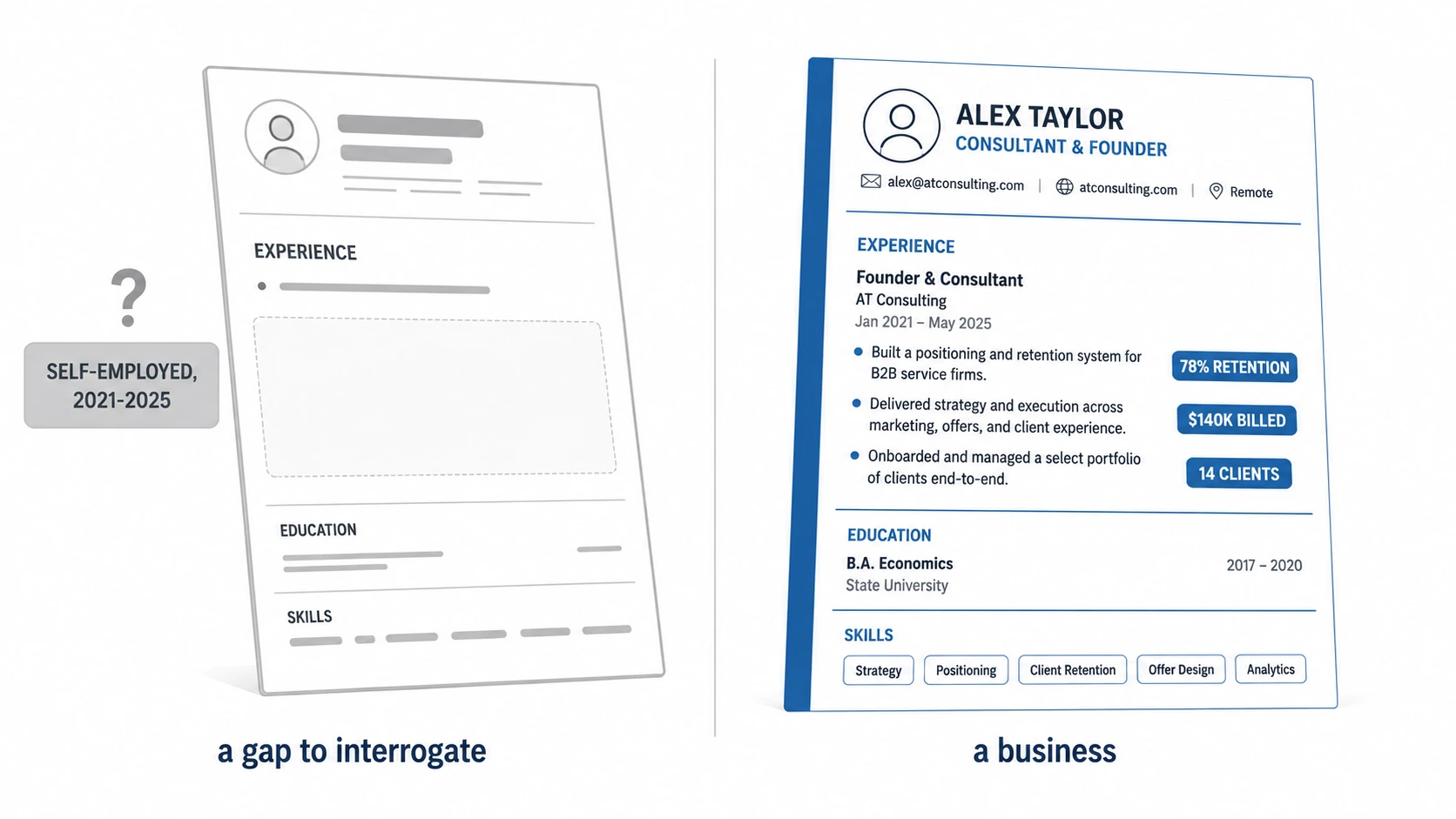

Here’s a sentence that has quietly cost people more interviews than almost anything else on a resume:
Self-Employed — 2021 to 2025
That’s it. That’s the whole entry. Four years of a person’s working life, compressed into a hyphenated shrug.
And the maddening part is that those four years were probably the most demanding of their career. They found their own clients. They set their own prices. They did the work, chased the invoices, filed the taxes, handled the disasters, and answered to nobody but the people paying them. Then they wrote it down as if they’d been on a long nap.
Meanwhile, here is the same four years written by someone who knew what they were doing:
Freelance Content Strategist — Coleman Content Studio (Sole Proprietorship), Austin, TX · Mar 2021 – Aug 2025
Ran a solo content practice serving 14 B2B SaaS clients, billing $95K–$140K annually.
• Grew one client’s organic traffic from 4,000 to 61,000 monthly sessions in 18 months, which they credited in a case study.
• Held a 78% annual client-retention rate across four years — average engagement ran 22 months.
• Built and sold a documentation template pack that generated $11K in passive revenue.
Same person. Same four years. Same actual work. One version reads as a gap the recruiter has to interrogate; the other reads as a business.
You are, by the way, in enormous company. Somewhere around 72.9 million Americans worked independently in 2026, and roughly 39% of US workers did some freelancing that year — a figure that has been climbing steadily and is projected to approach half the workforce.
Self-employment isn’t a detour from a career anymore. For a huge number of people, it is the career.
And yet. Here’s the uncomfortable half of the story, and the reason this guide exists.
One study of corporate recruiters found that roughly 60% responded less favourably to resumes showing former entrepreneurship than to otherwise identical conventional resumes. Not because the work was worse.
Because it was unfamiliar — harder to verify, harder to slot into a pipeline, and wrapped in a set of quiet assumptions we’re going to name and dismantle later in this guide.
So the situation is genuinely strange: more people are self-employed than at any point in modern history, and the resume conventions for describing it are still catching up.
Which means the gap between a well-written self employed resume and a badly written one is enormous — much bigger than the equivalent gap for someone with a tidy row of corporate logos. There’s simply more room to get it wrong, and therefore more room to get it spectacularly right.
That’s the opportunity. Most of your competition is still writing “Self-Employed, 2021–2025.”
What follows is the whole playbook: what actually counts as self employment on resume terms and which label fits you, how to decide whether to include it at all (sometimes the honest answer is no), the five fields every entry needs, how to name yourself when you were the company, what to write in the company field when there isn’t one, how to handle dates and overlapping clients without creating the appearance of chaos, how to write achievement bullets when your team was one person, worked examples across twenty different lines of work, how to satisfy a background check, and what to do about the four specific fears that make recruiters hesitate.
Open your resume in another window. This one’s meant to be edited as you read.
Key Takeaways
- Self-employment is work experience. It belongs in your work experience section, formatted identically to every other job on the page — same fields, same font, same structure. Anything that visually separates it invites suspicion.
- Never use “Self-Employed” as your job title. It’s a tax status, not a role. Use the title a company would have given you — “Freelance Graphic Designer,” “Marketing Consultant,” “Owner & Lead Electrician” — and match it to the job you’re applying for.
- You do need something in the company field. A registered business name is best; “Yourname Consulting” is fine; “Self-Employed” or “Independent Contractor” is acceptable. Leaving it blank looks like an omission.
- Scope beats size. You won’t have enterprise numbers. You have client counts, retention rates, revenue, project volume, and percentage growth — and a 78% retention rate is impressive at any scale.
- Recruiters have four specific fears: you’ll leave to freelance again, you can’t take direction, you’ve never worked on a team, and your business failed. Each one has a concrete counter-move you can build into the page.
- Verification is a real hurdle, and it’s solvable. Tax returns, 1099s, Schedule C, business licenses, a CPA letter, and client references all work. Get your dates exactly right, because these documents will be checked against them.
- Sometimes you should leave it off. If it’s irrelevant, tiny, or something you wouldn’t want to discuss in an interview, omit it — unless doing so opens an unexplained gap, in which case include it briefly.
- A portfolio link is worth more than any adjective. For self-employed candidates it’s the single fastest way to convert “unverifiable” into “obviously real.”
What Counts as Self-Employment on Resume Terms?
Before you can write the entry, you have to decide what to call the thing — and this trips people up more than it should, because six fairly different working lives all get filed under the same tax category.
The distinction matters for a practical reason. Each label carries a different implication about seniority, rate, and how you worked, and picking the wrong one either undersells you or invites a question you can’t answer comfortably.
A person who advised three companies’ executive teams should not describe themselves as a freelancer. A person who wrote 200 blog posts for an agency should not describe themselves as a consultant.
Here’s how the six break down.
| Type | What it actually means | Signals to a recruiter | Best label to use |
|---|---|---|---|
| Freelancer | Works with multiple clients concurrently on project-based assignments, usually providing creative, technical, or professional services. | Flexibility, broad experience, speed, adaptability, and strong self-management. | Freelance [Role] |
| Independent contractor | Works under contract with one or a small number of companies for a defined period, often operating closely with an internal team. | Reliability, teamwork, structured delivery, and corporate-adjacent experience. | [Role], Independent Contractor |
| Consultant | Provides specialist advice, diagnosis, strategy, or recommendations rather than primarily executing day-to-day deliverables. | Seniority, expertise, strategic judgment, and authority in a specific domain. | [Domain] Consultant |
| Business owner | Built and operates a business entity that generates revenue and may involve employees, systems, clients, or customers. | Ownership, leadership, P&L exposure, decision-making, entrepreneurship, and risk tolerance. | Owner & [Role] or Founder |
| Gig / platform worker | Completes work sourced through a digital platform, such as rideshare, delivery, or task marketplaces. | Reliability, consistency, initiative, and hustle; typically provides weaker evidence of specialised expertise. | Use the platform-specific role, framed accurately |
| Side hustle | Runs freelance or self-employed work alongside a full-time job or another primary professional commitment. | Initiative, energy, time management, and entrepreneurial drive; may prompt questions about professional focus. | [Role] (Concurrent Freelance) |
A few notes on choosing between them, since the boundaries blur in real life.
Freelancer vs. consultant is mostly about whether you were hired to do or to decide. If a client handed you a brief and you executed it, you freelanced. If a client handed you a problem and you told them what to do about it, you consulted. Consultants command more authority on a resume, so use it if it’s true — but be ready to describe the recommendation you made and what happened next, because that’s the first thing an interviewer will reach for.
Independent contractor is the most underrated label on this list, particularly if recruiter scepticism is your main worry. It implies you were embedded in somebody else’s team, working to their standards, on their timeline — which quietly demolishes two of the four fears we’ll cover later. If you spent a year contracted to one company, write “Independent Contractor” and name the company. It reads almost exactly like employment, because functionally it was.
Business owner is the strongest and the riskiest. It signals ownership and P&L exposure, which senior roles genuinely value. It also triggers the flight-risk fear harder than anything else. Use it when the scale justifies it, and pair it with a title that names your functional role — “Owner & Lead Developer” tells a hiring manager both that you ran a business and what you actually did all day.
Gig and platform work deserves more respect than it usually gets, and more honesty than it usually gets too. Two years of full-time rideshare driving is legitimately two years of work with real, describable competencies — route optimisation, customer service under pressure, vehicle and expense management, a 4.9 rating maintained across 6,000 trips. What it isn’t is professional experience in a specialty. Frame it accurately and it fills a timeline honestly. Inflate it into “Independent Transportation Logistics Consultant” and you’ve created a credibility problem where none existed.
Side hustles are optional in a way the others aren’t. If you freelanced on weekends while holding a full-time job, that’s genuinely impressive, but it’s also the entry most likely to be cut for space or to raise a “were you distracted?” question. Include it when it’s directly relevant to the target role or demonstrably substantial. Cut it when it’s neither.

Should You Include Self-Employment on Resume At All?
Let’s deal with this before the formatting, because there’s no point perfecting an entry that shouldn’t be there.
The default answer is yes, include it — and the reason is structural rather than motivational. A resume is read as a continuous timeline.
When there’s a hole in it, the reader doesn’t think “they were probably doing something reasonable”; they think “what happened here?” and they start generating explanations, none of which are as good as the truth.
Leaving out eighteen months of freelancing to avoid a hard conversation guarantees a harder one, because now you have to explain a gap and explain why you concealed it.
But “usually yes” isn’t “always yes,” and the honest exceptions are worth knowing.
| Include it when | Leave it off when |
|---|---|
| It occupies a meaningful period of your timeline — around three months or more. | It consisted of only a handful of small jobs scattered across years when you were otherwise employed. |
| It is relevant to the role you are targeting. | It has no connection to your target career and demonstrates no useful transferable skills. |
| Leaving it out would create a visible, unexplained employment gap. | The same period is already covered by concurrent full-time employment, so no gap exists. |
| You can describe measurable results, notable clients, projects, or revenue. | There is genuinely little to say beyond “I tried this for a while.” |
| You would be comfortable discussing the experience for several minutes in an interview. | You would prefer that an interviewer did not ask about the experience. |
| It demonstrates a valuable skill that is not otherwise visible in your employment history. | It could appear to be a competing interest or raise a conflict-of-interest concern with the employer you are applying to. |
That last row on the right deserves a flag, because people miss it. If you currently run a business in the same space as the company you’re applying to, a hiring manager may read it as a conflict of interest or as evidence you’ll be splitting your attention.
That’s not a reason to lie — but it is a reason to think carefully about framing, and if the business is genuinely winding down, saying so explicitly in the entry (“practice closed to new clients as of Jan 2026“) resolves the ambiguity in one line.
The Interview Test
Here’s the cleanest decision rule I know, and it comes up repeatedly in career-advice circles because it works:
Would you be glad to talk about this for five minutes in an interview? If yes, put it on the resume. If no, leave it off.
Everything on your resume is an invitation. Every line is something you’ve volunteered to discuss. If the thought of an interviewer landing on a particular entry makes you tense up, that tension is information — either the entry needs to be written better, or it doesn’t belong.
Run the test on each self-employed stint separately. It’s very common for the answer to be yes for one and no for another, and there’s nothing inconsistent about including the eighteen-month consulting practice and cutting the six weeks you spent trying to sell handmade candles.
The Special Case: The Business That Didn’t Work
This is the question underneath the question for a lot of people, so let’s be direct about it.
A business that failed is still experience, and you should almost always include it. Employers are considerably less squeamish about this than founders expect. Running something that didn’t survive still required you to find customers, price a service, manage cash, make decisions with incomplete information, and keep going when it was unpleasant — and every one of those is a competency most employees never have to develop.
What matters is the framing. Don’t editorialise about the failure, don’t apologise for it, and don’t dramatise it either. Write the entry exactly as you would for a business that succeeded: real title, real dates, real numbers for the period it operated.
If it closed, a neutral clause is plenty — “wound down operations in 2025” or “closed the practice to return to in-house work.” That’s a complete answer and it closes the loop without inviting a therapy session.
The instinct to hide it is understandable and almost always counterproductive. Two years of unexplained blank space on a resume reads far worse than two years of a business that ran, taught you a great deal, and ended.

How To Put Self-Employed On Resume: The Five-Field Formula
Right. You’re including it. Here’s the structure.
Every self-employed entry needs exactly the same five fields as every conventional job on your resume, and it needs them in the same visual format. This is the single most important formatting principle in this entire guide, so let me state it plainly: do not let your self-employed entry look different from your employed entries.
Same font, same weight, same indentation, same field order, same bullet style. Any visual distinction — a different heading, an italicised note, a separate section stuck near the bottom — signals this one’s different, be careful, and the reader obliges.
The five fields:
| Field | What goes in it | Common mistake |
|---|---|---|
| Job title | The professional role a company would have hired you to perform. | Writing only “Self-Employed” or “Freelancer” instead of naming the actual role. |
| Company | Your business name, “[Your Name] Consulting,” or “Self-Employed.” | Leaving the company field blank. |
| Location | City and state, or “Remote” for location-independent work. | Omitting the location entirely, which can make the entry look incomplete or unclear. |
| Dates | Month and year for both the start and end dates; use Present if the work is ongoing. | Using year-only date ranges that can obscure employment gaps. |
| Content | A brief scope line followed by 3–5 achievement-focused bullet points. | Listing services or responsibilities without showing results, impact, or achievements. |
Here’s the whole thing assembled, which is worth studying for a moment because almost everything else in this guide is a variation on it:
Freelance UX Designer | Ridgeline Design Co. (Sole Proprietorship) | Remote — Denver, CO | Feb 2022 – Present
Solo UX practice serving early-stage B2B SaaS companies; 11 clients to date, $80K–$115K annual billings.
• Redesigned onboarding for a fintech client, cutting first-week drop-off from 44% to 19% and lifting trial-to-paid conversion 31%.
• Built a 40-component design system adopted by three separate client engineering teams, reducing their average feature-design time from 5 days to 1.
• Ran end-to-end research on 9 engagements — 120+ moderated interviews — and turned findings into prioritised roadmaps clients still cite.
• Maintained an 82% repeat-engagement rate; average client relationship runs 14 months.
Notice the scope line in italics under the header. This is the highest-leverage sentence available to a self-employed candidate and most people don’t include it.
In one line it establishes what kind of clients you served, how many, and roughly what scale of money moved — which pre-answers the three questions a recruiter would otherwise have to guess at. It’s the difference between “freelanced for a while” and “ran a practice.”
Let’s take each field in turn.
The Job Title Field
Use the title a company would have used to hire you for the work you did. Then, if the arrangement needs clarifying, add a qualifier: Freelance, Contract, Independent, Consultant, Owner.
“Freelance Copywriter” is a job title. “Self-Employed” is not — it’s a tax classification, and using it as your title is roughly like writing “W-2 Employee” where “Senior Accountant” should go. We’ll spend a whole section on titles next, because this is where the most points are won and lost.
The Company Field
Something must go here. A registered business name is the strongest option; a constructed one like “Marsh Editorial” is perfectly acceptable; “Self-Employed” or “Independent Contractor” are honest and fine. What doesn’t work is leaving it empty, because a blank field in a column of filled ones reads as a hole rather than a choice. More on the options shortly.
The Location Field
Put your city and state, or “Remote,” or both. This is a small field that does a surprising amount of work: it makes the entry look like a real job, it helps with location filters in applicant tracking systems, and it removes a tiny question mark. If you served clients in multiple places, your own base city is the right answer — that’s what an employer’s location field means too.
The Dates Field
Use months, not just years. “2022–2024” could mean twenty-five months or three, and a recruiter who notices the ambiguity assumes the shorter, less flattering reading. “Feb 2022 – Nov 2024” is precise, confident, and — importantly — matches what a background check will find. We’ll get to the harder date questions, like overlapping clients and stints that ran alongside employment, in a dedicated section.
The Content Block
One italic scope line, then three to five bullets that are achievements, not services.
This is the failure mode that sinks otherwise-good self-employed entries. People write a menu:
Services included logo design, brand guidelines, social media assets, and packaging design.
That’s a price list. It tells the reader what you were willing to be paid for, not what happened when you were. Compare:
Rebranded a regional coffee roaster — new identity, packaging, and in-store system — which the owner credited with a 26% lift in retail foot traffic over the following two quarters.
Same skills, entirely different document.

Naming Yourself: Job Titles for a Self Employed Resume
This is the section that changes the most outcomes, so it’s worth slowing down.
When you work for a company, someone else decides your title, and you inherit whatever the HR system says. When you work for yourself, nobody assigns you one — which means you have to, and most people either default to the tax word (“Self-Employed”), the arrangement word (“Freelancer”), or something wildly inflated (“Chief Executive Officer” of a business with one employee, who is you).
All three are mistakes, and they fail in different ways.
“Self-Employed” fails because it’s not a job. It describes your relationship with the tax authorities. It tells a hiring manager nothing about what you can do, contains no keyword any recruiter would search for, and reads as though you couldn’t think of anything better to say about four years of your life.
“Freelancer” alone fails because it’s only half a title. Freelance what? It describes the arrangement and omits the profession — like writing “Employee” where “Nurse” belongs.
“CEO” or “Founder” alone fails in the opposite direction. Not because it’s untrue — if you started the thing, you founded it — but because on a one-person business it reads as inflation, and worse, it hides your actual craft. A hiring manager looking to fill a senior developer role and seeing “CEO, Bramble Digital” has learned that you ran something and nothing about whether you can code.
The Title Formula
Here’s the shape that works:
[Qualifier] + [Real Job Title] — and match the job title to the posting wherever it’s honest to do so.
The qualifier clarifies the arrangement: Freelance, Contract, Independent, Consulting, Owner &. The real job title is what the work actually was. And the matching is where the strategic value sits, because applicant tracking systems and human recruiters both reward a title that mirrors the one they’re hiring for.
That last part needs a boundary, because it’s where people cross a line. Matching means choosing the most accurate of several honest options — it does not mean inventing seniority. If you did marketing work for six small clients, “Freelance Marketing Manager” is defensible — and it is very different from “Director of Marketing,” which implies a department and a budget you didn’t have. If the posting says “Content Strategist” and you’ve been doing content strategy under the label “writer,” calling yourself a Freelance Content Strategist is a legitimate translation. Calling yourself a Head of Content is a lie you’ll have to defend in a room.
Twenty-Five Titles, Fixed
| Instead of this | Write this | Why it works |
|---|---|---|
| Self-Employed | Freelance Graphic Designer | Names the profession, improves searchability, and reads like a real job title. |
| Freelancer | Freelance Copywriter | Completes the title by identifying the actual professional craft. |
| Entrepreneur | Owner & Operations Lead, Vessel Home Goods | Combines business ownership with a clear functional role. |
| CEO (of a solo business) | Founder & Lead Developer | Preserves founder-level ownership while highlighting the hands-on professional function. |
| Independent Consultant | HR Compliance Consultant | Identifies the specific domain in which the consulting expertise was provided. |
| Contractor | Electrician, Independent Contractor | Puts the skilled trade first and the employment arrangement second. |
| Gig Worker | Delivery Driver (DoorDash, Uber Eats) | Provides an honest, specific, and easily verifiable description of the work. |
| Small Business Owner | Owner & Head Baker, Fern Street Bakery | Shows both business ownership and the primary day-to-day professional function. |
| Consultant | Supply Chain Consultant | Adding the domain makes the title more credible, relevant, and searchable. |
| Virtual Assistant | Executive Assistant, Independent Contractor | Maps the experience to a recognised role that employers actively hire for. |
| Online Seller | Ecommerce Owner & Merchandiser (Etsy, Shopify) | Highlights the professional function rather than describing the work only by platform. |
| Content Creator | Freelance Video Editor & Motion Designer | Translates a broad label into specific skills that can fit directly into a company team. |
| Tutor | Freelance SAT Math Instructor | Adds a specific subject and instructional focus, increasing relevance and credential value. |
| Handyman | Licensed General Contractor (Residential) | Highlights the professional license and specialised residential contracting scope. |
| Blogger | Freelance SEO Content Writer | Aligns the experience with a recognised job title commonly used in hiring. |
| Photographer (self-employed) | Owner & Lead Photographer, Luna Lens | Combines business ownership with the core professional craft. |
| Rideshare Driver | Rideshare Driver — 6,000+ Trips, 4.9 Rating | Adds measurable scale and performance evidence that strengthens credibility. |
| Consultant/Advisor | Fractional CFO | Uses a recognised modern title that clearly communicates senior financial expertise. |
| Freelance Developer | Freelance Full-Stack Developer (React/Node) | Adds the technical stack to improve specificity and keyword visibility. |
| Coach | Executive Leadership Coach (ICF-Certified) | Adds the coaching specialty and professional certification to strengthen credibility. |
| Marketing Person | Freelance Demand Generation Manager | Mirrors a specific job title commonly used in real marketing job postings. |
| Bookkeeper | Independent Bookkeeper (QuickBooks ProAdvisor) | Adds a recognised certification that immediately strengthens professional credibility. |
| Translator | Freelance Translator, EN↔ES (ATA-Certified) | Specifies the language pair and professional certification. |
| Event Planner | Owner & Lead Event Producer, Fieldnote Events | Combines ownership with a more senior, execution-focused professional title. |
| Personal Trainer | Owner & Head Trainer (NASM-CPT) | Combines business ownership with an industry-standard fitness certification. |
A pattern runs through that whole right-hand column: every fix adds either a profession, a specialisation, a credential, or a number. Those are the four things that convert a vague self-description into a title a recruiter can act on. If your current title has none of them, it’s costing you.
One Title or Several?
If your self-employment spanned genuinely different kinds of work, you have two choices, and the right one depends on coherence.
Use one umbrella entry when the work was all recognisably the same profession, even across many clients. Fifteen writing clients over four years is one entry titled “Freelance Content Writer,” not fifteen entries.
Split into separate entries when you did substantially different jobs — say, eighteen months of contract project management for one company, then two years of freelance design.
Those are two careers, and blending them into “Freelance Professional” describes neither. And when you were contracted to a single company for a meaningful stretch, name that company in the company field and put “Independent Contractor” in the title.
This is the most powerful move available to anyone worried about looking unemployable, because the resulting entry is nearly indistinguishable from conventional employment — which is a fair reflection of what actually happened.

The Company Name Problem
“But I don’t have a company.” Right — and yet the field is sitting there, and leaving it empty makes your entry look like a fragment.
Here’s the thing worth internalising: the company field on a resume is answering “who paid you?”, not “what corporation employed you?” Once you read it that way, four legitimate answers open up, and at least one of them fits everybody.
| Option | What it looks like | Best when | Watch out for |
|---|---|---|---|
| Registered business name | Ridgeline Design Co., LLC | You have an LLC, DBA, incorporated company, or other formally registered business entity. | Generally the strongest option when the name accurately reflects your legally registered business. |
| Constructed practice name | Marsh Editorial or Coleman Consulting | You operated as a sole proprietor and used a professional practice or trading name. | Do not imply a legal structure you do not have. Adding “(Sole Proprietorship)” can make the status clear when needed. |
| Plain, honest label | Self-Employed or Independent Contractor | The work involved short engagements, gig work, or you prefer a simple and transparent description. | It is slightly less distinctive than a business name, but it is clear, accurate, and completely acceptable. |
| Client’s name | Northwind Logistics (Contract) | You worked primarily with one client or company for a meaningful contracted period. | Use the client’s name only for a genuine single-client engagement and make the contract relationship clear. |
If You Have a Registered Entity, Use It
An LLC, a DBA, an S-corp, a Ltd — whatever the structure, that name is a real business name and it belongs in the field. It’s verifiable through a state or county registry, which quietly solves your background-check problem before it starts, and it reads with more weight than any alternative.
If the structure is worth clarifying, a short parenthetical does it without cluttering the line: Ridgeline Design Co. (Single-Member LLC). That’s useful when you want a hiring manager to understand you were the whole operation rather than assume you had thirty staff — expectation management that pays off in the interview.
If You Don’t, You Can Construct One
This is the option people worry is dishonest, and it isn’t. Trading under a name you chose is the normal condition of sole proprietorship in most of the world, and describing a solo practice as “Coleman Content Studio” is not a claim to be a corporation — it’s the ordinary way independent professionals refer to their practice. Lawyers, accountants, therapists, architects and designers have done it for a century.
Two guardrails, though. Don’t append Inc., LLC, or Ltd unless you actually hold that registration — that’s a legal-status claim rather than a naming convention, and it’s the one thing here that can genuinely rebound on you.
And be consistent: whatever name you use on the resume should be the name on your LinkedIn, your invoices, your website, and your email signature. A background checker who finds three different business names for the same period has found a problem.
If You’d Rather Keep It Simple
“Self-Employed” in the company field, with a real job title above it, is entirely fine:
Freelance Photographer | Self-Employed | Portland, OR | Jun 2023 – Present
This reads cleanly and honestly. It’s mildly weaker than a named practice — a name implies a business, and “Self-Employed” implies an arrangement — but it is emphatically not a red flag. The catastrophic version was “Self-Employed” in the title field with nothing else. Down here in the company field, it’s doing exactly the job it should.
If You Were Contracted To One Company
Use the client’s name, with the arrangement marked:
Senior Business Analyst, Independent Contractor | Northwind Logistics | Chicago, IL | Mar 2023 – Feb 2025
This is the single most conventional-looking way to present self-employment, and if recruiter scepticism is your main concern, it’s your best friend. It names a real, verifiable, googleable company. It shows you worked inside somebody else’s organisation to their standards. It’s completely honest about the arrangement.
The rule is simply that it has to be true. If you had eight clients, you can’t pick the most impressive one and put it in the company field as though it were an employer — but you can name your best clients in the scope line, which we’ll come to next.

Dates, Gaps, and the Timeline Question
Dates are where self-employed resumes most often create problems that the underlying work never justified. Three situations come up over and over.
Many Clients, One Continuous Period
If you freelanced steadily across many clients, write it as one continuous entry. Your dates run from when you started freelancing to when you stopped, and the client churn inside that window is irrelevant to the timeline.
Freelance Marketing Consultant | Hale Marketing Co. | Remote | Jan 2022 – Present
Solo consultancy serving 12 clients across ecommerce and DTC; notable engagements include Verity Skincare, Tobias Coffee, and Marlow Athletics.
Listing twelve separate entries with overlapping dates for twelve clients is the mistake here. It fragments your history into confetti, eats a third of your page, and makes a coherent four-year practice look like four years of scrambling.
One entry, with the significant client names in the scope line — that’s the move. The scope line is also where you get to name-drop legitimately, which is worth real money if any of your clients are recognisable.
Gaps Between Contracts
Freelance work is lumpy. You had a great Q1, a quiet Q2, a busy autumn. Do you need to account for the quiet stretches?
No — and please don’t try. Nobody expects a freelance practice to have been at capacity every week for four years, any more than they expect a salesperson to have closed a deal every day.
The continuous date range is the honest representation of a practice that was open for business throughout. Annotating your slow periods invents a problem the reader didn’t have.
The exception is a genuinely long stop — say, a year where you did no work at all in the middle of a self-employed stretch. That’s a real gap and it’s better addressed directly (a short “Career break — [reason]” entry) than smoothed over with dates that imply continuous activity.
Self-Employment That Overlapped Employment
Two clean options, and the choice is about emphasis.
Option one — list it as its own entry with honest overlapping dates, and mark the concurrency:
Freelance Web Developer (Concurrent) | Self-Employed | Remote | Sep 2022 – Present
The word “Concurrent” does all the necessary work. Without it, overlapping dates look like an error, and an alert reader will spot the collision and wonder which entry is wrong.
Option two — fold it into a Projects or Freelance Work section further down the page, if the side work is relevant but genuinely secondary. This keeps your main timeline clean and single-threaded while preserving the evidence.
Pick option one when the freelance work is a major part of your case for the job. Pick option two when it’s supporting material.
Getting Your Dates Right Actually Matters
One practical warning, because this catches people out at the worst possible moment. Self-employment dates get verified against tax filings, 1099s, business registration records, and invoices — documents with hard dates that you don’t control after the fact.
If your resume says you ran your business from January 2022 and your Schedule C first appears for tax year 2022 with a mid-year start, that’s a discrepancy a verification service will flag, at the offer stage, when you have the least leverage.
Go and check. Look at the actual dates on your registration paperwork and your first and last invoices, and use those. Approximate dates that flatter you slightly are not worth the risk of a rescinded offer.

Writing Bullet Points When You Were the Whole Company
Here’s the real difficulty of a self employed resume, and it’s not formatting. It’s scale.
Someone from a big company writes “Led a team of 14 to deliver a $4M platform migration” and the numbers do the persuading for them.
You ran a practice with three clients and revenue in the low six figures. Your numbers are smaller. Does that mean your bullets are weaker?
No — but only if you choose the right numbers.
Scope Beats Size
The insight that unlocks this: a recruiter is reading for evidence of judgment and results, not for the biggest available integer. And there’s a whole category of number that self-employed people have and employees usually don’t.
A salaried marketing manager cannot tell you their client retention rate, because they don’t have clients who can leave.
They can’t tell you their close rate on new business, their pricing strategy, their margin, or what happened when they raised rates 30% and kept 90% of their book. You can.
Those numbers are genuinely rarer and more interesting than another headcount figure.
Here’s where to look:
| Number type | Example | What it proves |
|---|---|---|
| Client count | 14 clients over four years | Shows sustained demand rather than reliance on a single successful contract. |
| Retention rate | 78% annual retention; average engagement: 22 months | Shows that clients continued paying for your work, providing strong evidence of recurring value. |
| Revenue or billings | $95K–$140K in annual billings | Demonstrates real market demand and financial validation of your services. |
| Revenue growth | Grew billings 240% from year one to year three | Shows upward trajectory and business growth rather than a single revenue snapshot. |
| Client outcomes | Reduced client onboarding drop-off from 44% to 19% | Demonstrates measurable impact on a client’s business performance. |
| Project volume | Delivered 60+ projects, with 94% completed on or before deadline | Shows reliability, consistency, and the ability to deliver at volume. |
| Referral share | 70% of new business came from referrals | Provides reputational proof that satisfied clients were willing to recommend your work. |
| Rate progression | Raised rates from $65 to $125/hour with no client loss | Shows increasing market value and clients’ willingness to continue paying at higher rates. |
| Recognisable clients | Engagements included Verity Skincare and Tobias Coffee | Adds legitimate credibility through identifiable client relationships. |
| Efficiency gains | Built templates that reduced project delivery time from 3 weeks to 9 days | Demonstrates process improvement, efficiency, and systems thinking beyond basic execution. |
That retention row deserves its own moment. Client retention is the most underused number on self-employed resumes and one of the most persuasive things you can put on a page. Every renewal was a decision by someone with a budget and other options who chose you again. An employee cannot produce an equivalent statistic. If you know your retention rate, put it in your top two bullets.
The Scope-Action-Result Shape
The reliable structure for a self-employed bullet has three parts: whose problem it was, what you did, and what changed.
The scope element is the part employees can skip and you can’t. “Redesigned onboarding” is missing the context that makes it legible — for whom, at what size, under what constraint. “Redesigned onboarding for a 40-person fintech client” gives the reader a frame in half a dozen words.
Creative and content work
| Before | After |
|---|---|
| Wrote blog posts and articles for various clients. | Wrote 400+ SEO articles for 9 B2B clients; increased one account’s organic traffic from 4,000 to 61,000 monthly sessions in 18 months. |
| Responsible for graphic design services including logos and branding. | Rebranded a regional coffee roaster end to end — including identity, packaging, and in-store systems — contributing to a 26% increase in retail foot traffic, according to the owner. |
| Did freelance video editing work. | Edited 120+ short-form videos for 6 DTC brands; a series created for one client averaged 3.1× its previous engagement rate. |
| Managed social media accounts for small businesses. | Managed organic social media for 5 local businesses, growing their combined following from 11K to 74K and generating 1,900 tracked bookings through link-in-bio. |
What changed: every rewrite added a count, a client type, and an outcome that belonged to the client’s business rather than to the task list.
Technical and professional services
| Before | After |
|---|---|
| Freelance web development for various clients. | Built and launched 15 small-business websites using Next.js; clients averaged a 25% increase in online sales during the first quarter after launch. |
| Provided consulting services to businesses. | Advised 7 manufacturing clients on procurement; one engagement identified $340K in annual savings, with $260K implemented within two quarters. |
| Did bookkeeping for small companies. | Managed monthly bookkeeping for 22 small businesses generating $400K–$3M in revenue; closed every month by the 5th with zero restatements across three years. |
| Independent IT support and repairs. | Provided sole IT support for 30 small-business accounts, handling 600+ tickets annually with a 4-hour average response time and 91% same-day resolution rate. |
What changed: the client’s industry and size got named, which converts “consulting” from a word into a picture.
Trades, service, and operations
| Before | After |
|---|---|
| Self-employed general contractor doing home renovations. | Licensed general contractor managing 8–12 residential renovations annually ($40K–$180K each); maintained zero safety incidents across 6 years, with 70% of projects generated through referrals. |
| Drove for Uber and DoorDash. | Completed 6,200+ rideshare and delivery trips while maintaining a 4.9 rating; independently managed scheduling, route planning, customer service, and vehicle expenses. |
| Personal trainer with my own clients. | Built an independent training practice from 3 to 34 recurring clients in two years (NASM-CPT), achieving an 81% three-month client retention rate. |
| Sold handmade goods online. | Built and operated Etsy and Shopify storefronts generating $86K in lifetime revenue across 2,400 orders, while maintaining a 4.9 customer rating and a return rate below 2%. |
What changed: nothing was invented. These are the numbers those jobs actually produce — trips, ratings, referral share, retention, order counts. The originals simply didn’t bother to look them up.
That’s the honest summary of this whole section. Almost nobody’s self-employed bullets are weak because the work was small. They’re weak because the numbers were never collected.
If you’re mid-practice right now, start tracking retention, referral share, and project counts today, because in two years you’ll want them and they’ll be nearly impossible to reconstruct.

Resume Self Employed Examples Across Twenty Domains
Enough theory. Here is the formula applied across twenty different lines of self-employed work, because the right title and framing for a freelance illustrator is nothing like the right one for a licensed electrician or a rideshare driver.
Find the row closest to your situation and adapt it. The structure underneath every one is identical: real title, real company field, scope, and a result.
| Domain | Job title to use | Company field | Sample bullet |
|---|---|---|---|
| Writing & content | Freelance Content Strategist | Coleman Content Studio | Grew a B2B client’s organic traffic from 4K to 61K monthly sessions in 18 months; maintained 78% annual client retention across four years. |
| Graphic design & branding | Freelance Brand Designer | Marsh Design Co. | Delivered 45+ brand identities for SMB clients; one rebrand was credited by the owner with a 26% increase in retail foot traffic. |
| Web & software development | Freelance Full-Stack Developer (React/Node) | Bramble Digital (Sole Prop.) | Shipped 15 production websites; clients averaged 25% higher online sales during the first quarter after launch. |
| Marketing & growth | Freelance Demand Generation Consultant | Hale Marketing Co. | Managed paid acquisition and lifecycle marketing for 6 DTC brands, reducing blended CAC by 31% while holding spend flat. |
| Management consulting | Operations Consultant | Independent | Advised 7 manufacturers on procurement; identified $340K in annual savings, with $260K implemented within two quarters. |
| Finance & accounting | Independent Bookkeeper (QuickBooks ProAdvisor) | Fenwick Books, LLC | Closed monthly books for 22 businesses generating $400K–$3M in revenue by the 5th, with zero restatements across three years. |
| Fractional executive | Fractional CFO | Independent | Served 4 concurrent SaaS clients ($2M–$9M ARR); built the financial model that supported one client’s $6M Series A. |
| Photography & video | Owner & Lead Photographer | Luna Lens Photography | Shot 90+ weddings and 200+ commercial sessions over 5 years; maintained a 4.9 average rating with 65% of bookings generated through referrals. |
| Illustration & art | Freelance Illustrator | Self-Employed | Delivered 300+ commissioned illustrations for publishing and packaging clients, including work used across two national retail lines. |
| Trades & construction | Licensed General Contractor (Residential) | Ridge & Co. Construction | Managed 8–12 residential renovations annually ($40K–$180K each); maintained zero safety incidents across 6 years, with 70% of projects referral-sourced. |
| Skilled trades (solo) | Master Electrician, Independent Contractor | Self-Employed | Completed 400+ residential and light-commercial jobs while maintaining licensing and continuing education with zero code violations. |
| Real estate | Licensed Realtor (Independent) | Anchor Realty Group | Closed $18.4M across 62 transactions in 4 years, averaging 12 days below the local market time-to-close. |
| Ecommerce & retail | Ecommerce Owner & Merchandiser | Verity Goods (Etsy, Shopify) | Built an ecommerce storefront to $86K in lifetime revenue across 2,400 orders while maintaining a 4.9 rating and a return rate below 2%. |
| Tutoring & education | Freelance SAT Math Instructor | Self-Employed | Tutored 60+ students over 3 years, producing an average 140-point score improvement; 18 students were admitted to top-50 programs. |
| Coaching & training | Executive Leadership Coach (ICF-Certified) | Thorne Coaching | Coached 40+ mid-to-senior leaders across 5 industries; 85% of engagements were renewed or extended beyond the initial term. |
| Health & wellness | Owner & Head Trainer (NASM-CPT) | Field Strength Studio | Grew the practice from 3 to 34 recurring clients in two years while achieving an 81% three-month retention rate. |
| Virtual assistance & admin | Executive Assistant, Independent Contractor | Self-Employed | Supported 5 concurrent founder clients across calendar, travel, and inbox management, reclaiming an estimated 12 hours per week for each client. |
| Translation & language | Freelance Translator, EN↔ES (ATA-Certified) | Self-Employed | Translated 1.2M+ words across legal and medical documents with a 99.4% first-pass client acceptance rate. |
| Gig & platform work | Rideshare & Delivery Driver | Uber, Lyft, DoorDash | Completed 6,200+ rideshare and delivery trips while maintaining a 4.9 rating and independently managing scheduling, routing, and vehicle costs. |
| Events & hospitality | Owner & Lead Event Producer | Fieldnote Events | Produced 70+ events for 40–900 guests, managing budgets up to $220K with a 96% on-budget delivery rate. |
Some patterns worth pulling out of that table, because they generalise beyond the twenty rows.
Licenses and certifications go in the title, not buried in a section below. Notice how many rows do this — NASM-CPT, ATA-Certified, ICF-Certified, QuickBooks ProAdvisor, Licensed General Contractor, Master Electrician. For self-employed people these are disproportionately valuable, because they’re the one piece of your credibility that a third party issued and anyone can verify. That’s precisely the thing a sceptical reader is looking for.
Gig and platform work should name the platforms. “Uber, Lyft, DoorDash” in the company field is verifiable, honest, and immediately understood. Vagueness is what hurts here, not the nature of the work.
“Independent” or “Self-Employed” in the company field appears in a third of these rows and none of them are weakened by it, because in every case the title above is doing real work. That’s the trade: a strong title buys you a simple company field.
Every single bullet contains a number. Twenty rows, twenty numbers, and none of them are enterprise-scale. 34 clients. 62 transactions. 4.9 rating. 140-point average improvement. Scale was never the point.

The Self Employed Resume Summary
Your summary is the two-to-four-sentence paragraph under your name, and for a self-employed candidate it carries a heavier load than it does for anyone else. It’s where you get to frame the whole self-employment question before the reader forms their own opinion of it.
Three jobs, in order:
1. Say what you are, in the language of the job you want.
2. Establish the scale of your independent practice, so nobody has to guess.
3. If you’re moving from self-employment back into a role, say so explicitly and without apology.
That third one matters more than people expect. A recruiter reading a resume that’s been self-employed for four years is silently asking why are they applying for a job? — and if you don’t answer it, they’ll invent an answer, which is usually “the business must have failed.” One clause fixes it.
Six Summary Examples
Six situations, six openings you can adapt directly:
Freelancer moving to full-time
Content strategist with four years running a solo B2B practice — 14 clients, $140K peak annual billings, 78% retention. Deepest work has been in developer-audience SaaS content. Now looking to bring that inside one company as a full-time content lead rather than splitting attention across a roster.
Consultant seeking a senior in-house role
Operations consultant, 9 years, with 7 manufacturing engagements focused on procurement and throughput; identified $340K in annual savings for one client and implemented $260K of it. Ready to own outcomes long-term in one organisation instead of advising and handing off.
Business owner whose business closed
Founder and operations lead of a 6-person home-goods brand, built to $1.2M revenue over 4 years before winding down in 2025. Hands-on across supply chain, ecommerce, and a team of six. Bringing that ownership and P&L exposure to a senior operations role.
Side-hustler with concurrent employment
Marketing manager with 5 years in-house at a mid-market SaaS company, alongside a concurrent freelance practice serving 6 DTC brands. The freelance work is where I built paid-social and lifecycle depth; the in-house role is where I learned to run it at scale.
Tradesperson moving to an employer
Licensed general contractor, 6 years self-employed, running 8–12 residential renovations annually at $40K–$180K each with zero safety incidents and 70% referral-driven work. Looking to move into a project management role with an established builder.
Gig worker returning to a specialty
Customer operations specialist with 4 years in SaaS support, followed by 2 years of full-time rideshare and delivery driving (6,200+ trips, 4.9 rating) while completing a CompTIA A+ certification. Returning to technical support with credentials current as of 2026.
Notice what all six do. They give a number in the first sentence or two. They name the specialty rather than the arrangement. And every one of them answers the unasked question about why now — “rather than splitting attention,” “instead of advising and handing off,” “before winding down in 2025,” “credentials current as of 2026.” None of them apologise, and none of them pretend the transition isn’t happening.
Skills, Portfolio, and Proof
Self-employment has one structural disadvantage on paper: there’s no HR department to confirm you existed. Everything else being equal, that makes you harder to verify than a candidate with three recognisable logos — and the fix is to build the verification into the document.
The Skills Section
Two specific things to do here.
Include the business-side skills, not just the craft ones. You did things a salaried peer never had to: client acquisition, proposal and scope writing, contract negotiation, pricing, invoicing and collections, project management, vendor management, budgeting. These are real, teachable-to-others competencies, and they’re a significant part of why self-employed candidates are worth hiring. List them.
Keep it nouns. Tools, platforms, certifications, methodologies — the concrete things both a recruiter and an applicant tracking system search for. Figma, Webflow, GA4, HubSpot, QuickBooks, Notion, Agile, SEO, contract negotiation, P&L management. Not “hardworking” and “self-motivated,” which every self-employed person is assumed to be anyway.
The Portfolio Link
For a self-employed candidate, a working portfolio link is worth more than any sentence on the page. It converts an unverifiable claim into something a hiring manager can check in thirty seconds, and it’s the fastest available answer to “is this person real?”
Put it in your header, next to your email — not buried at the bottom. Use a clean custom domain if you have one. And then actually check that it loads, that it isn’t three years stale, and that the first three pieces on it are relevant to the job you’re applying for rather than whatever you happened to make most recently.
For domains where a visual portfolio doesn’t apply — bookkeeping, consulting, trades — a simple one-page site with a service description, two anonymised case summaries, and three client testimonials does the same job. It’s an afternoon of work and it repositions you from “was self-employed” to “runs a practice.”
Client References
Conventional advice says leave references off your resume. For self-employed candidates, that advice is worth partially ignoring.
You don’t need a full reference block, but a single line — “Client references available on request, including [Client A] and [Client B]” — signals that real people with budgets will vouch for you. Volunteering it preempts the doubt rather than waiting for it.
Do the groundwork first. Contact the two or three clients who know your work best, ask whether they’d act as a reference, and make sure they’ll confirm both the work and the dates. A reference who can’t remember when you worked together is worse than none, because your dates are exactly what a verification service will be checking.
Testimonials and Public Proof
A single quantified line of third-party proof outperforms a paragraph of self-description. If a client credited you publicly, said something specific in a review, or wrote you into a case study, that’s usable — and it’s the rare kind of evidence a salaried candidate can’t produce.
Client-credited with a 26% lift in retail foot traffic post-rebrand (case study available).
Public artefacts count too: a 4.9 rating across 6,000 platform trips, a published byline, a Google Business rating, a named credit on a shipped product. Anything a stranger can independently look up is doing verification work for you while you sleep.
Beating the Bias: What Recruiters Actually Worry About
Now the part that most guides on this topic skip entirely, and the part that probably matters most.
Earlier I mentioned the study finding that around 60% of corporate recruiters responded less favourably to resumes showing former entrepreneurship, and the broader industry sentiment that, in the words of one long-running recruiting column, some hirers still assume “if you’re self-employed, it’s because you can’t get full-time work.”
That’s obviously unfair. It’s also useless to be angry at, because you can’t argue with a bias you never get to hear articulated. What you can do is figure out what the specific worry is and answer it on the page, before anyone has to ask.
There are four of them. That’s it — four recurring fears, and each has a concrete counter-move.
| The fear | What they’re actually thinking | Your counter-move on the page |
|---|---|---|
| Flight risk | They may take this job temporarily and return to freelancing as soon as another attractive client opportunity appears. | State your transition to full-time employment clearly in the professional summary. Explain what an in-house role offers that independent work did not, such as long-term ownership, deeper collaboration, or sustained impact. |
| Can’t take direction | After working without a traditional manager for several years, will they adapt to feedback, established processes, and someone else’s priorities or roadmap? | Highlight contract work completed within client teams. Use a title such as “Independent Contractor” where accurate, and mention the managers, stakeholders, or cross-functional leaders you worked with or reported to. |
| Never worked on a team | If they have mainly worked independently, can they collaborate effectively, hand work off, communicate across functions, and share responsibility for outcomes? | Show collaboration explicitly. Mention client teams you embedded with, subcontractors you managed, and designers, developers, marketers, or other specialists you worked alongside. |
| The business failed | They may assume the move back to employment happened because the business struggled or something went wrong. | Use a brief, neutral, factual explanation when needed, such as: “Wound down in 2025 to return to in-house work.” Keep it concise and avoid unnecessary justification. |
Let’s take them one at a time, because the counter-moves are more specific than the table can hold.
Fear One: You’ll Leave Again
This is the biggest one, and the most rational of the four. From a hiring manager’s seat, someone who has demonstrated they can generate their own income is genuinely more able to leave than someone who can’t.
The counter-move is to answer “why now?” before they ask it. One clause in your summary does it, and the more specific the reason, the more credible:
- “Looking to go deep on one product instead of context-switching across a client roster.”
- “Want to build something over years rather than in eight-week engagements.”
- “The part of the work I liked least was selling; I’d rather spend that time on the craft.”
- “Closed my practice to new clients in January and I’m looking for a permanent role.”
These land because they’re true reasons people actually leave self-employment — the selling, the churn, the isolation, the shallowness of short engagements, the desire for a team. A vague “seeking new challenges” does nothing. A specific reason reads as a decision you’ve already made, which is exactly the reassurance required.
Fear Two: You Can’t Take Direction
Nobody will ever say this to you. They’ll just quietly prefer the other candidate.
The counter-move is evidence that you already worked inside somebody else’s structure and standards. Concretely:
- Use “Independent Contractor” where it applies, and name the client company. An entry reading “Senior Analyst, Independent Contractor | Northwind Logistics” implies you sat in their stand-ups, hit their deadlines, and worked to their spec.
- Name the people you reported to functionally. “Reported to the VP of Marketing on a weekly cadence” or “Worked directly with the client’s in-house design lead through review cycles.”
- Mention revision and feedback processes without embarrassment. “Delivered through three structured review rounds per project” reads as professional maturity.
There’s a nice irony to lean on here, incidentally, and it’s worth understanding even if you don’t put it on the page: freelancers take more direction than employees, not less. An employee has one boss. A freelancer with twelve clients has twelve, all with different standards and none of whom are obliged to be patient. Anyone who has survived four years of that has more experience accommodating other people’s preferences than most salaried peers.
Fear Three: You’ve Never Worked on a Team
Often the least true and the easiest to dismantle, because almost nobody’s self-employment was genuinely solitary.
The counter-move is to make the collaboration visible, since a resume that only says “I” invites the assumption:
- Client-side teams you embedded with: “Worked alongside the client’s 4-person engineering team through weekly sprint reviews.”
- Subcontractors you managed: “Subcontracted and managed 3 specialist freelancers — copy, photography, and paid media — on larger engagements.”
- Peer collaborations: “Partnered with two other independent consultants to deliver a joint engagement neither of us could staff alone.”
- Anything you handed off: documentation, onboarding, training a client’s internal team.
If you managed subcontractors, say so plainly and count them. Managing three freelancers on a deadline you’re financially responsible for is management experience, and it’s a materially better story than most people’s first team-lead role.
Fear Four: Something Went Wrong
Covered earlier, but the framing bears repeating because it’s where people over-explain.
The counter-move is a single neutral clause and then moving on. “Wound down operations in 2025.” “Closed the practice to return to in-house work.” “Sold the business in 2024.” No narrative, no defence, no lesson-learned paragraph. Confidence here is largely a function of brevity — the more words you spend explaining, the more it reads as something requiring explanation.
And keep the achievements in place. A business that ran for three years and closed still generated three years of revenue, clients, and results. Those numbers didn’t retroactively stop being true.

ATS and the Self Employed Resume
Applicant tracking systems create a couple of problems specific to self-employment, and both are avoidable once you know they exist.
The Parsing Problem
Applicant tracking software expects a predictable shape: job title, company, location, dates, bullets. When it finds that shape, it maps your history correctly. When it doesn’t, it guesses — and its guesses are poor.
The most common self-employment parsing failure is the missing or unusual company field. Leave it blank and some parsers will pull the next line of text into the employer slot, so your resume arrives in the recruiter’s dashboard listing your employer as “Grew organic traffic from 4,000 to 61,000 monthly sessions.” Nobody reads that charitably.
Three rules keep you safe:
- Fill every field. Title, company, location, dates — always all four, in that conventional order.
- Keep self-employment in the standard “Work Experience” section, using the standard heading. A creatively-titled section like “My Journey” or “Independent Ventures” may not be recognised as employment history at all, which can drop your entire self-employed period out of the system’s calculation of your years of experience.
- Avoid tables, columns, text boxes, and graphics anywhere in your experience section. Many parsers skip them entirely, and content that vanishes might as well not exist.
That middle point has a real cost attached. Some systems screen on total years of relevant experience. If four years of freelancing sits in a section the parser doesn’t recognise as employment, you can be filtered out for insufficient experience while having plenty of it.
The Title-Matching Problem
Most systems rank resumes substantially on keyword match, and the job title is among the most heavily weighted signals available. “Self-Employed” matches nothing. Not a single posting anywhere is searching for it.
So the strategic move is straightforward: make your job title mirror the posting’s title, wherever that’s honest. If the posting is for a “Content Strategist” and you’ve been operating as a “Freelance Writer” doing strategy work, “Freelance Content Strategist” is both accurate and matched. If the posting says “Business Analyst” and you contracted as one, put “Business Analyst, Independent Contractor” — leading with the searchable term rather than the arrangement.
That word order matters more than it looks. Some parsers and many human skim-readers weight the beginning of a field most heavily. “Independent Contractor, Business Analyst” buries the term they’re looking for behind one they aren’t.
Section-Naming Strategy
If you have a lot of self-employed work and want to give it its own section, name it something a system recognises and a recruiter respects:
- Good: “Relevant Experience,” “Consulting Experience,” “Professional Experience,” “Contract & Freelance Experience”
- Risky: “Self-Employment,” “Side Projects,” “My Work,” “Independent Ventures”
The distinction is whether the heading contains a word the system associates with employment. “Consulting Experience” contains “Experience” and reads as senior. “Side Projects” tells both the software and the human that this part is optional.
My default recommendation, though, is simpler: put it in your main Work Experience section alongside everything else, in strict reverse-chronological order. A separate section — however well named — visually quarantines the work, and quarantining is exactly the signal you’re trying not to send.
Verification and Background Checks
This is the part people don’t anticipate, and it arrives at the worst possible moment — after the offer, during onboarding, when a third-party verification service is trying to confirm your history and cannot find an HR department to call.
Worth being calm about: self-employment is verifiable, verification services deal with it constantly, and it is a completely routine process. It just requires documents you may not have thought about in a while.
What They’ll Accept
| Document | What it proves | How easy it is to get |
|---|---|---|
| Federal tax returns (with Schedule C) | Shows self-employment income and the tax years during which the business operated. | Usually easy if you filed; copies may be available through your tax software, tax preparer, or IRS records. |
| 1099-NEC / 1099-MISC forms | Shows that specific clients or companies paid you reported amounts for independent work. | Usually easy if the forms were issued; check your tax records, email, accounting files, or payer portals. |
| Business registration / LLC or DBA filing | Confirms that the business entity or trade name existed and can establish an official registration or start date. | Usually easy; records are often available through the relevant state, county, or local registration authority. |
| Business license or trade license | Shows that you were authorised to operate a particular business or trade, often with effective or renewal dates. | Usually easy if records are current; check the issuing authority and renewal history. |
| CPA or accountant letter | Provides third-party confirmation of your self-employment status, operating dates, and potentially income. | Moderate effort; request it from your accountant or CPA, who may charge a preparation fee. |
| Client contracts or invoices | Documents specific client engagements, services provided, payment terms, and relevant date ranges. | Usually easy if you maintained business records, invoicing software, or signed agreements. |
| Bank statements (business account) | Shows that business revenue or client payments were received consistently over a particular period. | Usually easy to obtain from your bank, although sensitive account or transaction details may need to be redacted. |
| Client references | Provides human confirmation that you performed the stated work and can verify the approximate engagement dates. | Usually easy when you have maintained client relationships; ask permission and confirm availability in advance. |
| Sales-tax or VAT registration | Confirms registered trading activity and may help establish the dates during which the business operated. | Usually easy where applicable; retrieve records from the relevant tax authority or registration portal. |
Get Your Dates Exactly Right
I’ll say this twice in one guide because it’s the one item here that can actually cost you an offer.
Every document in that table has hard dates. Your resume’s dates will be compared against them. If your resume says you started in January 2022 and your business registration is dated August 2022 with no earlier invoices, that’s a discrepancy — and at the offer stage, a date discrepancy gets categorised as a misrepresentation rather than a rounding error.
So before you send anything: open your actual records and check. First invoice date. Registration date. First tax year. Last invoice. Use the real numbers. If there’s a legitimate reason your operating dates precede your registration — plenty of people trade for months before formalising — that’s fine and easily explained, but know about it in advance rather than discovering it in an email from a verification service.
Prepare the Packet Before You Need It
Twenty minutes now saves a stressful week later. Make a folder with:
- Your last two or three years of tax returns, including Schedule C
- Your 1099s
- Your business registration or DBA certificate
- Your current business or trade license
- Two or three client reference contacts who’ve agreed in advance
- A short one-page summary: business name, exact operating dates, entity type, nature of services, approximate annual revenue
That last item is the underrated one. Verification staff are working through a queue, and handing them a clean summary with the exact information they need — rather than a pile of PDFs to interpret — genuinely speeds things up and makes you look organised at a moment when organisation is being assessed.
If You Were Paid Informally
Be honest about the awkward version, because plenty of people are in it. If you were paid in cash, or through Venmo and Zelle with no invoices, or you never registered anything and filed inconsistently, verification is harder — though rarely impossible.
Work with what exists: bank deposits showing regular income, text or email threads agreeing to work, client references, whatever platform records you have, photos of completed work for trades. Multiple weaker sources in combination usually satisfy a verifier where one clean document would have.
And say so upfront rather than letting them discover it — “I was self-employed during this period; I can provide tax returns and client references, though I don’t have traditional pay stubs” is a normal, unremarkable sentence that verification teams hear every week.

Special Situations
Six scenarios that don’t fit the standard template, and what to do in each.
You Freelanced While Unemployed and Job Hunting
Extremely common, and there’s nothing wrong with it — but be honest with yourself about scale. If you took two small projects across eight months of searching, that’s not a freelance practice, and presenting it as one risks unravelling under one follow-up question.
The honest and effective framing is a modest entry with real dates and real work:
Freelance Marketing Consultant (Project-Based) | Self-Employed | Remote | Mar 2025 – Present
Two client engagements while pursuing full-time roles: a website audit for a regional retailer and a paid-social rebuild for a DTC brand.
That reads as someone who stayed active and kept their skills current — which is genuinely what it is. It reads much better than an eight-month blank, and much better than an inflated “consultancy” that turns out to be two projects.
Your Self-Employment Was a Career Break in Disguise
Sometimes “freelancing” is the label on a period that was mostly caregiving, health recovery, study, or travel, with a little paid work at the edges.
You have two honest options. Either list the small amount of freelance work accurately, or list the break for what it was:
Career Break | Apr 2023 – Feb 2025
Family caregiving; maintained skills through 3 freelance design projects and completed Google UX Professional Certificate (2024).
Career breaks have become dramatically more normal to disclose, and this framing is clean, complete, and closes the question in two lines. What doesn’t work is stretching three projects into a two-year practice — it invites detailed questions about a period you’d rather summarise.
You’ve Been Self-Employed a Very Long Time
If you’ve been independent for eight, twelve, or twenty years, your problem isn’t the gap — it’s the flight-risk fear at maximum intensity, plus a hiring manager wondering whether you’d cope with organisational life.
Three things help. Segment your history internally rather than presenting two decades as one undifferentiated block — break it into phases by focus or client type, so it reads as a career with progression instead of a long flat plateau.
Foreground every scrap of structured, embedded work — the long retainers, the contracts where you sat inside a client’s team, the engagements with formal reporting lines. And be very concrete about why you want in now, because at this length of tenure a vague answer is genuinely disqualifying.
You Only Have Platform or Gig Work
If your recent history is rideshare, delivery, or task-platform work and you’re applying for something else, the goal is honest framing plus a bridge to the target role.
Rideshare & Delivery Driver | Uber, Lyft, DoorDash | Phoenix, AZ | Jan 2024 – Present
Full-time independent driving while completing IT certification.
• Completed 6,200+ trips at a 4.9 rating across three platforms.
• Managed own scheduling, routing, vehicle maintenance, and expense tracking as a sole proprietor.
• Earned CompTIA A+ certification (2025) while working full-time.
That entry does three things at once: it fills the timeline honestly, it names competencies that are real, and the certification line makes the whole period read as deliberate rather than drifting. The certification is what converts it from a holding pattern into a plan.
You’re a Non-US Applicant, or Applying Across Borders
Two adjustments worth knowing.
Entity language doesn’t translate. “LLC” means nothing in most of Europe, “Ltd” and “GmbH” and “Pty Ltd” mean nothing to many US readers, and “sole trader” is standard in the UK and Australia while being unfamiliar elsewhere. If you’re applying into a different market, either use the local equivalent term or skip the entity designation and let the business name stand alone.
Verification norms differ substantially. Some markets routinely expect employment references and detailed documentation; others barely check. If you’re applying into a market with stricter norms than your own, assume documentation will be requested and prepare accordingly.
One convention to keep regardless: months and years, written unambiguously. “03/2022 – 11/2024” is read as March in the US and as March in most of Europe too, but “03/11/2024” is genuinely ambiguous across markets. Spelling the month out — “Mar 2022 – Nov 2024” — removes the problem entirely.
You’re Still Self-Employed and Applying Anyway
Very common, slightly delicate, and easy to handle in one clause.
Use “Present” in your dates, because that’s the truth. Then signal your intent so the hiring manager isn’t left wondering whether they’re competing with your business for your attention:
Practice closed to new clients as of Jan 2026; wrapping up final engagements.
One line. It says you’ve already decided, which is the entire reassurance needed. Without it, a reader may reasonably assume they’d be hiring someone with a side business — and some will pass on that basis rather than ask.
Advanced Tips and Best Practices
- Mirror the posting’s job title in your own. This is the highest-leverage single edit available to a self-employed candidate. It improves your keyword match, and it makes a hiring manager see a peer rather than a puzzle. Rewrite it for every application, since it takes about fifteen seconds.
- Lead with your best client’s outcome, not your longest engagement. Your first bullet is read closely and the rest are skimmed. Put the number that would most impress this specific employer in position one, and reorder it per application.
- Name recognisable clients in your scope line. If you worked with a company a hiring manager has heard of, that’s borrowed credibility and it’s yours to use. Check your contracts for confidentiality clauses first, and describe rather than name if you’re restricted (“a Fortune 500 logistics client”).
- Track retention and referral share starting today. These are your two most persuasive numbers and almost nobody has them, because nobody thinks to record them until they need them. Retention rate, referral percentage, average engagement length. Write them down quarterly.
- Keep one name across every surface. The business name on your resume should match your LinkedIn, invoices, website, and email signature exactly. Verification services notice mismatches, and a mismatch reads as evasion even when it’s just untidiness.
- Put licenses and certifications in your job title. For self-employed people these carry outsized weight, because they’re third-party issued and independently checkable — exactly what a sceptical reader wants. NASM-CPT, ATA-Certified, Licensed GC, QuickBooks ProAdvisor.
- Never let the self-employed entry look visually different. Same font, same weight, same field order, same bullet style as your employed entries. Visual difference reads as an asterisk, and readers supply their own reason for it.
- Answer “why a job now?” in your summary, always. It’s the question every reader of a self-employed resume is silently holding. One specific clause defuses it; silence lets them invent an answer, and the invented one is rarely generous.
- Build the verification packet before you’re asked. Tax returns, 1099s, registration, license, and two pre-agreed references in one folder. It takes twenty minutes and it removes the only genuinely stressful part of this process.
Do’s and Don’ts
| Do | Don’t |
|---|---|
| Use a specific professional job title, such as “Freelance Graphic Designer.” | Use only “Self-Employed” or “Freelancer” as your job title. |
| Always include a clear company or business name in the company field. | Leave the company field blank. |
| Use verified month-and-year dates that match your business, tax, or client records. | Use year-only ranges or dates you have not verified. |
| Create one continuous self-employment entry when you served multiple clients during the same period. | Create a separate overlapping work-experience entry for every individual client. |
| Lead achievement bullets with measurable client outcomes, impact, and numbers. | List services or responsibilities as though they were items on a price list. |
| Include meaningful metrics such as client count, retention, revenue, project volume, or growth. | Assume smaller numbers are not worth mentioning when they still demonstrate real performance. |
| Keep substantial self-employment experience in the standard Work Experience section. | Move meaningful professional experience into vague sections such as “Side Projects” or “My Journey.” |
| Place a current, relevant portfolio link prominently in the resume header when applicable. | Bury the portfolio link at the bottom of the resume or link to an outdated portfolio. |
| Make your reason for pursuing a full-time role clear when transitioning from self-employment. | Leave recruiters wondering about the “why now?” behind your move to full-time employment. |
| If a business has ended, explain the transition with one brief, neutral, factual clause when necessary. | Over-explain, justify, or apologise for closing the business. |
| Include a legitimate business experience even if the business ultimately closed or did not succeed. | Create a large unexplained employment gap simply to avoid discussing an unsuccessful business. |
| Mention relevant subcontractors, client teams, stakeholders, or specialists you collaborated with. | Write the entire entry as though every result was achieved completely alone. |

Final Thoughts
Here’s what I’d want you to take away from all of this.
The years you spent working for yourself were not a break from your career, and they are not a liability to be managed on the page. They were a period in which you did something most employees never have to do: you found the work, priced it, delivered it, and stood behind it with nobody above you to absorb the consequences. That’s a genuinely unusual set of competencies, and the only reason it sometimes reads as weakness on a resume is that the conventions for describing it are still catching up to how many people are living it.
So the whole job here is translation. A real title instead of a tax status. A company name instead of a blank. Months instead of vague years. Client outcomes instead of a service menu. Retention and referral numbers instead of an apology for not having a headcount. One clause explaining why you want a team now, so nobody has to guess.
None of that is spin. Every one of those moves makes the entry more accurate, not less — which is why it works. The badly written version wasn’t modest, it was just incomplete, and incompleteness is what invites a reader to fill the space with their own assumptions.
Go and write the version that’s actually true. It’s better than the one you have.
Glossary
A handful of terms recur throughout this guide. Here’s a quick reference for each.
| Term | Definition |
|---|---|
| Self-employment | Working for yourself rather than an employer and earning income directly from clients or customers. An umbrella term that can include freelancing, contracting, consulting, business ownership, and platform-based work. |
| Freelancer | A self-employed professional who typically serves multiple clients on a project basis and delivers defined creative, technical, or professional work. |
| Independent contractor | A self-employed worker contracted by one or a small number of companies for a defined period or scope, sometimes working closely with the client’s internal team and processes. |
| Consultant | A professional hired primarily for specialised expertise, analysis, recommendations, or strategic judgment. Consultants may advise, implement, or do both depending on the engagement. |
| Sole proprietorship | An unincorporated business owned by one person. In the U.S., the owner and business are generally not separate legal entities, and business income is typically reported on the owner’s personal tax return. |
| DBA (“Doing Business As”) | A registered trade or assumed name that allows a person or business to operate under a name different from its legal name. Registration requirements vary by state and locality. |
| LLC (Limited Liability Company) | A business structure created under state law that can provide liability separation between the business and its owners. Use the LLC designation only when the business is actually registered as one. |
| Schedule C | A U.S. federal tax form used by many sole proprietors to report profit or loss from a business. It can help document self-employment income and operating years. |
| 1099-NEC | A U.S. tax form generally used to report certain nonemployee compensation. It can help document payments received from specific clients or businesses. |
| Scope line | A brief sentence beneath a work-experience heading that summarizes the type of clients served, the scale of the work, or the overall scope of responsibility. |
| Client retention rate | The percentage of clients who continue working with a business or professional over a defined period. On a resume, it can demonstrate recurring value and client satisfaction. |
| Referral share | The percentage of new business generated through referrals from existing or previous clients. It can provide evidence of reputation, trust, and client advocacy. |
| Fractional executive | A senior professional who serves one or more organizations on a part-time or fractional basis in an executive role, such as Fractional CFO, CMO, or CTO. |
| ATS (Applicant Tracking System) | Software employers use to collect, organize, search, filter, and sometimes rank job applications and resumes. Clear formatting and relevant job-description keywords can improve resume compatibility. |
| Concurrent employment | Two or more professional roles that overlap in time, such as self-employment performed while holding a salaried position. Clear labeling can help recruiters understand overlapping dates. |
| Employment verification | A hiring-stage process used to confirm elements of a candidate’s work history. Self-employment may be documented through records such as tax documents, business registrations, licenses, contracts, invoices, or client references, depending on the verifier’s requirements. |
How To Include Self Employment On Resume: The Short Version
Self-employment belongs on your resume, in your main work experience section, formatted exactly like every other job. Give yourself the job title a company would have given you. Put something real in the company field.
Use months, and check them against your tax records. Replace your service list with client outcomes and the numbers only you can report — retention, referrals, billings, growth.
Then add one clause explaining why you want a full-time role now, and let your portfolio link do the rest of the convincing. Ninety minutes of honest rewriting, and the most-questioned section of your resume becomes the most interesting one.
Frequently Asked Questions
No. It’s a tax classification rather than a role, and it tells a hiring manager nothing about what you can do. Use the title a company would have used to hire you for that work — “Freelance Graphic Designer,” “Marketing Consultant,” “Owner & Lead Electrician” — and add a qualifier like Freelance, Contract, or Independent if the arrangement needs clarifying. “Self-Employed” is perfectly fine in the company field, where it’s answering a different question.
You have four workable options. Use your registered business name if you have an LLC or DBA. Construct a practice name from your own — “Coleman Content Studio” — which is entirely normal for sole proprietors. Write “Self-Employed” or “Independent Contractor,” which is honest and acceptable. Or, if you were contracted to a single company for a meaningful period, name that company and mark the arrangement in your title. The only wrong answer is leaving the field empty, which reads as an omission and can confuse applicant tracking software into pulling the wrong text into the employer slot.
In your main work experience section, in reverse-chronological order alongside your employed roles, formatted identically. Resist the urge to create a separate section for it — visual separation signals “this one’s different,” and a creatively named section may not be recognised as employment history by applicant tracking software at all, which can cost you credit for those years entirely. If you genuinely have enough independent work to warrant its own section, name it something conventional like “Consulting Experience” or “Contract & Freelance Experience.”
One continuous entry covering the whole period, with the client count and any recognisable client names in a short italic scope line beneath the header. Listing each client as a separate job with overlapping dates fragments your history, consumes enormous page space, and makes a coherent practice look chaotic. The individual engagements belong in your bullets, not in your timeline.
Often, yes — usually at the offer stage through a third-party verification service. They’ll accept tax returns with Schedule C, 1099 forms, business registration or DBA filings, business licenses, a letter from your accountant, client invoices or contracts, and client references. It’s a routine process they handle constantly. The critical detail is that your resume dates must match the dates on those documents, so check your actual records before you write them down rather than estimating.
Almost always yes. Employers are far less bothered by this than founders expect — running something that didn’t survive still required finding customers, pricing a service, managing cash, and making decisions with incomplete information. Write the entry exactly as you would for a successful business, with real dates and real numbers for the period it operated, and close it with one neutral clause like “wound down operations in 2025.” No apology, no explanation. A two-year unexplained gap reads considerably worse.
Directly, specifically, and in your summary, before anyone has to ask. Vague answers (“seeking new challenges”) don’t work; concrete ones do, because they’re the real reasons people leave independent work: you’d rather go deep on one product than context-switch across a roster, you want to build over years instead of eight-week engagements, you dislike the selling, you want a team. This single clause is the counter-move to the flight-risk concern, which is the biggest unspoken objection you face.
Yes, if it occupies meaningful time on your timeline — an honest entry beats an unexplained gap every time. Name the platforms in the company field, use a straightforward title, and add the numbers that make it credible: trip counts, ratings, tenure. Describe the real competencies involved — self-scheduling, customer service, expense and vehicle management. What doesn’t work is inflating it into a consulting title, which creates a credibility problem the plain version never had. If you earned a certification or studied during that period, include it in the same entry; it reframes the whole stretch as deliberate.
You should strongly want one. For a self-employed candidate it’s the single fastest way to convert an unverifiable claim into something a hiring manager can check in thirty seconds, and it directly addresses the verification disadvantage you carry versus someone with recognisable logos. Put the link in your header next to your email. If your field doesn’t lend itself to a visual portfolio — bookkeeping, consulting, trades — a one-page site with a service description, two anonymised case summaries, and three testimonials does the same work in an afternoon.
No, on both counts. Trading under a name you chose is the ordinary condition of sole proprietorship, and independent professionals have described their practices that way for a very long time. Assigning yourself an accurate job title is likewise just describing your work in the language employers use. Two lines you shouldn’t cross: don’t append Inc., LLC, or Ltd unless you actually hold that registration, since that’s a legal-status claim rather than a naming convention; and don’t inflate seniority you didn’t have. Translating “writer who does strategy” into “Content Strategist” is fair. Translating it into “Head of Content” is not.