


Your manager knows you’re dependable. Your coworkers come to you when something gets complicated. Then an internal opening appears, and your resume still describes the person the company hired four years ago.
That leaves your strongest case unwritten.
Keep the familiar resume structure, but select evidence for the responsibilities of the role you want: decisions you’ve handled, improvements you’ve made, and work you’ve helped others deliver. Give your current company the most relevant detail, with accurate titles and dates. The reader should be able to see why the next step makes sense without filling in the story for you.
Key Takeaways
- Being internal doesn’t remove the entry requirements. Check the role’s required qualifications and your employer’s eligibility rules before investing in the application.
- The job you want isn’t the job you hold. Label a target position clearly; keep your actual title in your employment history.
- A familiar employer can still mean an unfamiliar reader. Someone outside your team may review the application, so explain projects and results in language they can follow.
Start with what changes at the next level
“I’ve been here a long time” tells the reader about tenure. It doesn’t tell them which new responsibilities you can handle.
Read the internal posting or written promotion criteria and identify the work that changes. A first management role may add coaching, workload decisions, or responsibility for other people’s performance. A senior specialist role may require deeper judgment and influence without giving you direct reports. Don’t force both paths into a people-management story.
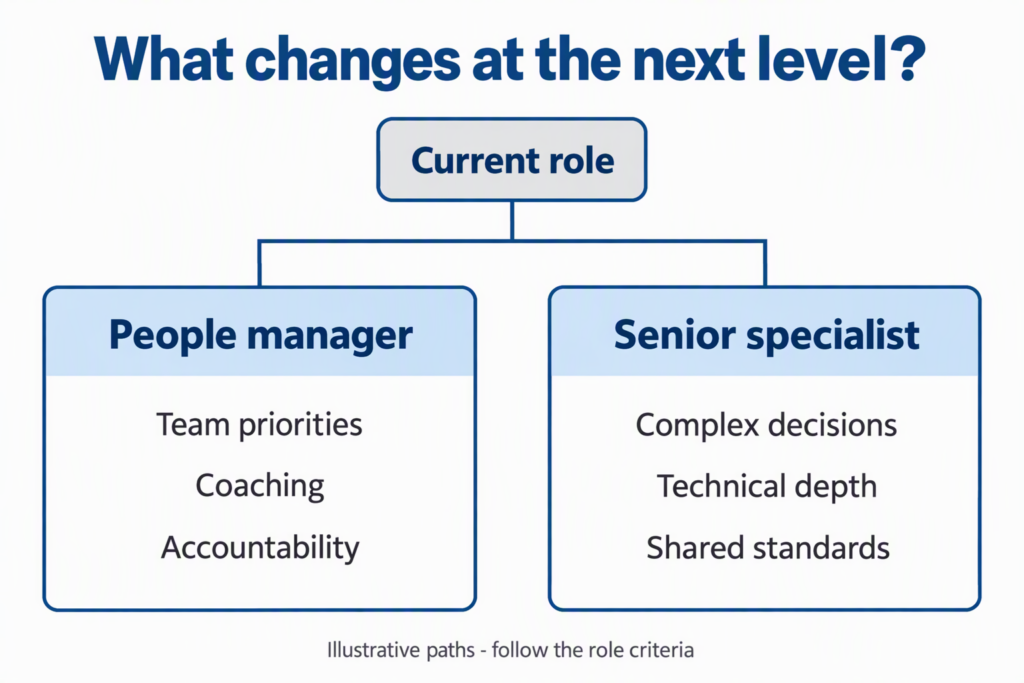
The Center for Creative Leadership’s research on first-time managers describes the shift from personal output to guiding other people’s work. For that move, show more than your own strong production figures.
Turn the actual criteria into a short evidence search. For a support-team opening, your preparation might look like this:
| What the role asks for | Records worth reviewing | What to establish |
|---|---|---|
| Coordinate coverage | Shift plans and handoff notes | Which scheduling decisions you handled and who approved them |
| Coach colleagues | Training materials and onboarding feedback | What you taught, who used it, and how you checked understanding |
| Improve service processes | Project notes and consistent performance reports | Your contribution, the change adopted, and any defensible result |
Use those records to recover facts, not to paste your entire performance review into the resume. A comment such as “excellent team player” is a lead to investigate. The project behind it is the useful material.
For a senior analyst opening, a different example fits: “Resolved conflicting revenue figures across two systems and documented a reconciliation method adopted for month-end reporting.” This illustrative bullet shows judgment and a useful improvement without claiming supervision.
A complete example: specialist to team lead
Suppose a support-team opening involves onboarding, daily coverage, and escalations. The applicant below has relevant experience without claiming to have managed direct reports. All names, organizations, dates, and results in this sample are fictional.
Jordan Ellis
Columbus, OH | jordan.ellis@example.com | (614) 555-0142
Target role: Customer Support Team Lead
Profile
Senior support specialist with experience across billing and product-support queues at Northline Software. Brings firsthand knowledge of recurring customer problems and the handoffs between Support, Finance, and Product.
Experience
Northline Software, Columbus, OH
Senior Customer Support Specialist | May 2024–Present
- Trained three new hires on case triage and escalation procedures, using practice cases and feedback sessions before independent queue work.
- Coordinated coverage across two support queues during June–August 2026, proposing shift adjustments for the manager’s approval and documenting daily handoffs.
- Introduced an escalation checklist; cases returned for missing information fell from 18 in May to 7 in August 2026 in the team’s monthly review.
- Worked with Product to reproduce a recurring billing error, document affected scenarios, and update customer guidance after the fix.
Customer Support Representative | April 2022–April 2024
- Resolved billing and account-access cases, recording troubleshooting steps so colleagues could continue work without repeating customer questions.
- Updated help-center instructions when support tickets revealed unclear setup steps.
Parkview Services, Columbus, OH
Customer Service Associate | July 2019–March 2022
- Handled order issues and coordinated with warehouse staff to confirm replacement shipments.
Skills
Zendesk; Excel reporting; case triage; onboarding; escalation documentation
Education
Riverton State University, Columbus, OH
Bachelor of Science in Business Administration
Graduated May 2019
Relevant Training
Supervisor Foundations, Northline Software | Completed June 2026
Notice where the sample draws a boundary: Jordan proposed coverage changes for approval. That is useful coordination experience, but it isn’t a claim to have owned staffing decisions. The internal course is also labeled as training, not presented as a management credential.
Use the structure, then replace the content with your own evidence. Don’t borrow the sample’s figures. If your reports don’t support a before-and-after comparison, describe the deliverable and its use instead.
Show growth without upgrading your title
More responsibility doesn’t always arrive with a new job title. You can make the change visible without rewriting your employment record.
When your responsibilities grew within the same role
Keep the official role and its dates, then put the added work in a bullet. Add a specific period when a duty was temporary; otherwise, a summer assignment can read like an ongoing responsibility.
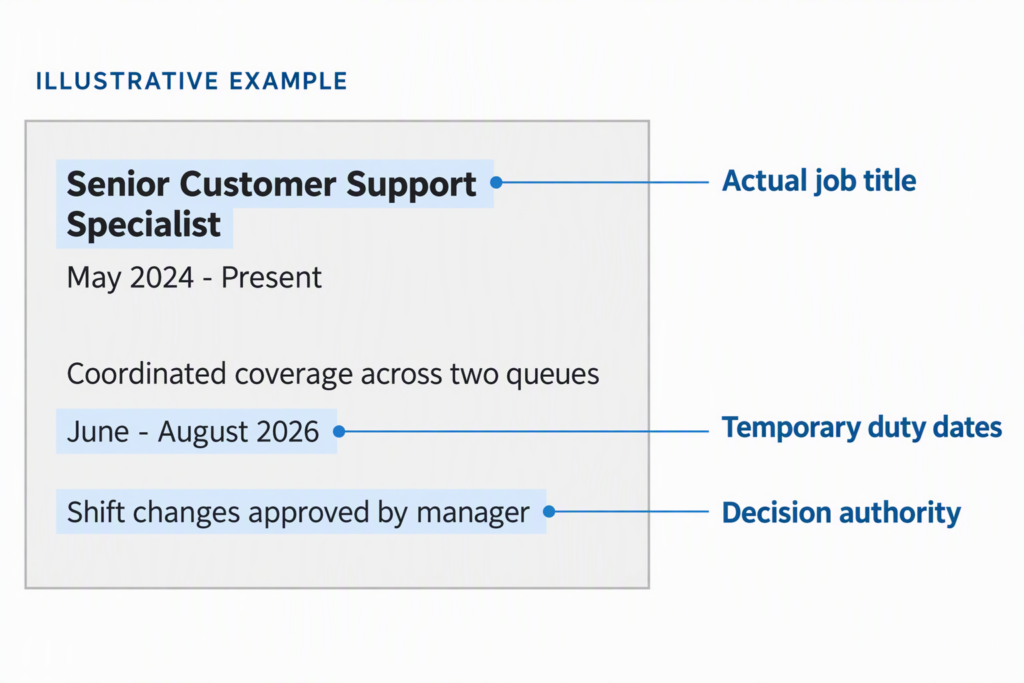
If you received a formal acting appointment, identify it accurately, such as “Acting Team Lead,” with its actual dates. If you simply covered selected tasks, name those tasks. “Ran the weekly handoff meeting during the lead’s leave” is clearer than awarding yourself an unofficial title.
When you’ve already earned earlier promotions
For distinct roles at the same employer, use separate titles, dates, and bullets under the company name, as the sample does. Give each role the work performed during that period. An improvement you made as a representative shouldn’t migrate into the senior-role entry just because it’s impressive.
If a title changed but the work stayed largely the same, a compact list of dated titles with shared bullets may be enough. Choose separate entries when combining them would hide a meaningful change in responsibility.
Make the application ready to circulate
Read the draft as if it were forwarded to someone in another department. Replace unexplained project nicknames with a short description: “Led Project Beacon” becomes “Coordinated the customer-onboarding pilot across Sales and Support.” Keep the internal name only when it helps identify the work.
Check sensitive details separately. An internal application doesn’t automatically give every reviewer access to customer names, financial figures, or personnel information. Use details you’re permitted to share with that audience. Describe scope more generally when necessary, without making up a replacement number.
Then follow the submission instructions. Upload the current resume to the right internal posting, review any fields populated from it, and supply additional materials the employer requests. A cover letter, when needed, can explain why this opportunity interests you and how you’d approach the transition; it doesn’t need to repeat every bullet.
Check the manager-notification and reference-check policy before contacting people. Employers differ on when a supervisor must be informed. Don’t assume that telling your manager first is universally required—or that applying through an internal portal guarantees confidentiality.
Give the reader a clear reason to consider you
Ask someone outside your immediate team to read the resume alongside the role criteria. Have them identify the strongest evidence for the move. Where they can’t make the connection, sharpen the example before adding another claim about your potential.
FAQ
Internal applications can involve questions that the resume itself doesn’t settle. These situations call for a decision about scope, process, or supporting material.
Should I include jobs from before this company?
Yes, when they add relevant experience or help explain your background. Keep them shorter if your current work makes the strongest case. Don’t remove an earlier role that supplies a required skill simply because it happened elsewhere. Follow any separate request for a complete employment history.
What if there isn’t a posted vacancy?
Ask how promotions are considered: a new opening, a change in job level, or a review process may require different materials. A resume can support the conversation, but your manager or HR may need a promotion statement or evidence against written level criteria. Find out before building the wrong document.
Should I name colleagues who recommend me?
Usually, leave endorsements out of the resume unless requested. If the process allows references or recommendations, ask the person first and submit their details through the requested channel. Choose someone who can speak to relevant work, not simply the most senior person you know.