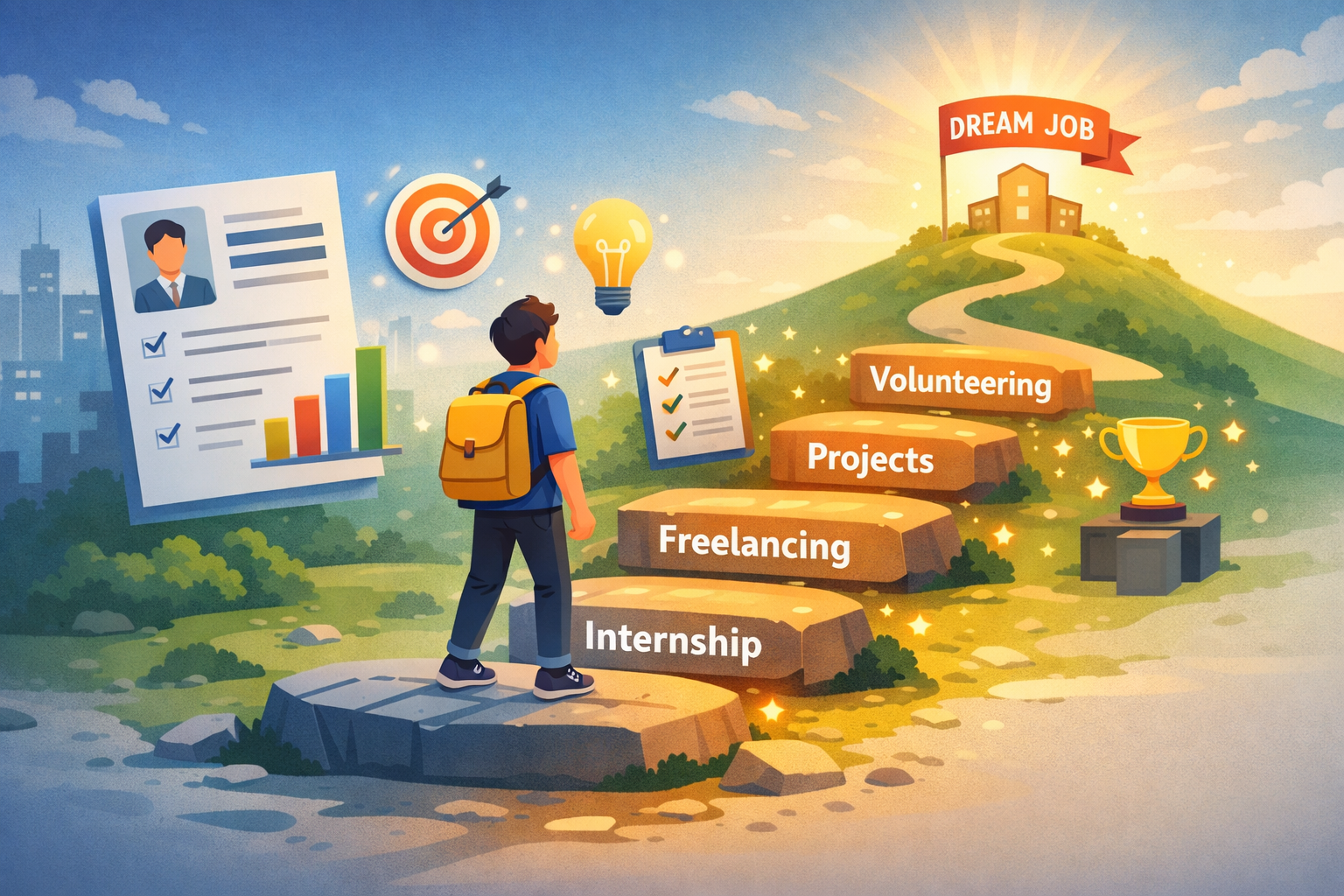

Let’s be honest, getting your dream job rarely starts with getting the job itself. It usually starts much earlier, in smaller roles, side projects, or experiences that don’t look perfect on paper but quietly move you forward.
You might not have the exact title yet, but you can still get closer to the work, the people, and the skills that define it. That is where real progress happens. This article is about understanding which experiences actually bring you closer, and how to choose them in a way that makes your next career move feel natural and achievable.
“If opportunity doesn’t knock, build a door.”
— Milton Berle
Best Experiences Based on Career Stage
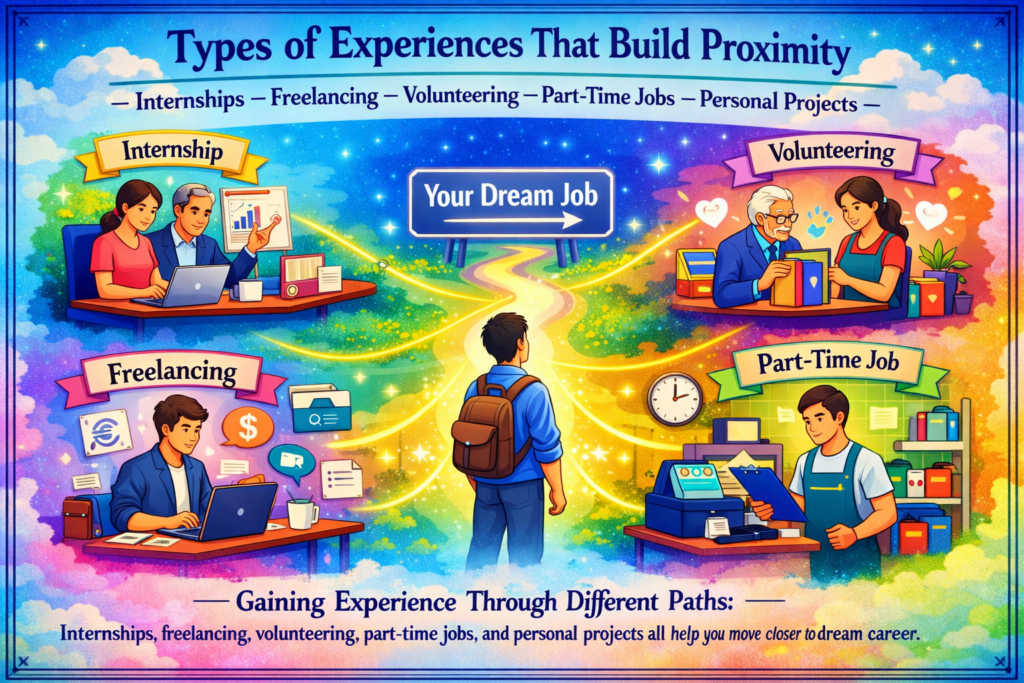
The right experience depends on where you are in your career. The goal is not to do everything, but to choose experiences that fill your current gap and clearly show progress toward your target role. At every stage, your focus should remain the same: relevance, measurable impact, and clear value. To present these experiences effectively, it is equally important to understand how to mention your work experience on a resume so your efforts translate into clear, impactful achievements.
A. Students / Recent Graduates
At this stage, the priority is exploration and exposure. You are still understanding the industry, so your experiences should help you learn how things actually work.
Internships, volunteering, and campus projects are the most effective here because they give you structured environments to learn and contribute. Even if your role is small, what matters is how you present it.
Instead of writing general tasks, focus on outcomes. For example, rather than saying you “assisted in research,” you can show impact by writing that you “conducted research on 5+ topics and contributed to a project that improved presentation quality and clarity.”
👉 Tip: Even academic or college projects can be written like professional experience if you include results, tools used, and your contribution.
B. Entry-Level / Freshers
At this stage, employers expect proof that you can apply your skills independently. This is where freelancing, part-time roles, and certifications with projects become valuable.
Freelancing is especially powerful because it shows ownership and real-world problem-solving. Part-time roles demonstrate consistency and responsibility, while projects linked to certifications show initiative.
For example, instead of saying you “worked as a freelance writer,” you can say you “delivered 20+ articles for clients, improving content engagement by 30 percent through SEO-focused writing.”
👉 Tip: If you have multiple experiences, choose the ones that show the strongest results. Two strong, measurable experiences are better than five vague ones.
C. Mid-Level Professionals
At the mid-level, the focus shifts to growth, specialization, and leadership. Employers are now looking for how you contribute beyond basic responsibilities.
Cross-functional projects, leadership roles, and advanced certifications help you show this progression. You should highlight how your work impacted teams, processes, or business outcomes.
For example, instead of stating you “managed a team,” you can write that you “led a team of 8 members, improving project delivery time by 25 percent and increasing client satisfaction scores.”
👉 Tip: Prioritize recent experiences that show measurable results and progression. Your resume should clearly reflect how your responsibilities and impact have grown over time.
D. Career Switchers
For career switchers, the goal is to build credibility in a new field while connecting your past experience to your new direction.
Freelance work in the new domain, bootcamps, and portfolio projects are the most effective ways to do this. These experiences show that you are not just interested, but actively working in the field.
For example, if you are switching to digital marketing, instead of only listing your past job, include something like “executed 3 independent marketing campaigns, increasing website traffic by 40 percent using SEO and content strategies.”
👉 Tip: Focus on transferable skills and back them with results. Show how your previous experience supports your new career path.
Ready to Land Your Next Job?
Don’t let your resume get lost in the stack. Build a professional, ATS-friendly resume that highlights your leadership, achievements, and industry expertise.
How to Present Multiple Experiences Effectively
No matter your career stage, the way you present your experience matters as much as the experience itself. Listing multiple roles without showing impact will not add value.
Each experience should:
- Be relevant to your target role
- Include clear responsibilities
- Show measurable achievements
The best way to do this is by combining responsibility with results in one line. For example:
- Developed content strategies for 3 campaigns, increasing audience engagement by 35 percent
- Managed client communication for 10+ projects, improving retention rate by 20 percent
This approach ensures that every point reflects both what you did and the value you created.
👉 Final Tip: Do not overload your resume with experiences. Select the ones that best demonstrate skills, relevance, and measurable impact. A focused, results-driven profile always stands out more than a long, unfocused one.
How to Choose the Right Experience
| Current Situation | Best Experience to Choose | Why It Works | How to Show Impact |
|---|---|---|---|
| Lack of experience | Internships | Provides structured learning, real-world exposure, and guidance from professionals | Assisted in 3+ projects, improved task completion speed by 20 percent, gained hands-on experience with industry tools |
| Have skills but no proof | Freelancing | Helps apply skills independently and build a strong portfolio with real clients | Completed 15+ client projects, increased client engagement by 30 percent, delivered projects within deadlines |
| Need industry connections | Volunteering | Builds network, exposes you to professionals, and creates hidden opportunities | Coordinated 5+ events, collaborated with teams and vendors, improved event attendance by 25 percent |
| Switching careers | Projects + Certifications | Builds credibility in a new field and demonstrates active learning and commitment | Completed 3 certification projects, increased website traffic by 40 percent using new skills, built a portfolio of work |
| Need consistency and work discipline | Part-time roles | Shows reliability, time management, and ability to handle responsibilities consistently | Managed daily operations, handled 50+ customer interactions per day, improved service efficiency by 15 percent |
💡 Pro Tip:
Always pair your experience with numbers, results, and outcomes. This transforms your profile from “I have done this” to “Here is the impact I created.”
What Makes an Experience Actually Move You Closer to Your Dream Job
Not all experience is equally valuable. You can spend months or even years working, but if that experience does not bring you closer to the role you actually want, it does very little for your long-term career. What matters is not just having experience, but having the right kind of experience, the kind that aligns with your goals and clearly shows your value.
A strong experience typically stands on three key elements: relevance, skill-building, and exposure. But what truly makes it powerful is the impact you create and how clearly you show it, especially when your resume and cover letter are structured in a way that turns those experiences into opportunities that can actually secure interviews and move you closer to a job offer.
Relevance: Is your experience aligned with your goal?
The first thing to evaluate is whether your experience connects to the job you are aiming for. Employers are not just scanning your resume to see where you have worked. They are trying to understand whether your background prepares you for their role.
This is why simply listing tasks is not enough. You need to show that your work reflects the kind of responsibilities expected in your target job.
For example, saying you “handled social media” is vague and does not communicate much value. But when you say you “managed three social media platforms and increased engagement by 40 percent in three months,” it immediately becomes clear that your work is both relevant and results-driven.
Relevance ensures that every experience you include feels intentional, not random.
Skill-Building: What did you actually gain from it?
Experience should always translate into skills, but more importantly, those skills should be visible through your work. Employers want to see how you apply what you know in real situations.
This includes both technical abilities and soft skills. However, instead of simply listing skills like “leadership” or “communication,” it is far more effective to demonstrate them through outcomes. For instance, leading a team project that was completed ahead of schedule clearly reflects both leadership and coordination skills without needing to state them directly.
When your experience shows growth and capability, it becomes much more convincing and practical.
Ready to Land Your Next Job?
Don’t let your resume get lost in the stack. Build a professional, ATS-friendly resume that highlights your leadership, achievements, and industry expertise.
Exposure: How close did this bring you to the real industry?
Another important factor is how much your experience exposed you to real-world work environments. The closer your experience is to actual industry settings, tools, and people, the more valuable it becomes.
This could mean working with clients, collaborating with teams, handling real projects, or using industry-standard tools. For example, assisting in event planning is a basic description, but coordinating logistics for multiple live events while working with vendors and clients shows direct exposure to the field.
This kind of experience builds confidence and gives you a clearer understanding of how the industry actually works.
Why Impact and Metrics Matter More Than Responsibilities
One of the biggest mistakes people make is focusing only on what they were responsible for, rather than what they achieved. Responsibilities tell a recruiter what your role was, but achievements show what you actually contributed.
This is where metrics become essential. Numbers make your work specific, measurable, and credible. They help employers quickly understand the scale and effectiveness of your efforts.
For example, instead of saying you were responsible for data entry, it is far more impactful to say you processed over 1,000 records weekly with high accuracy and helped reduce errors significantly. Similarly, rather than mentioning that you helped in sales, highlighting that you contributed to closing multiple deals or increasing revenue gives your experience real weight.
When you use numbers, you shift your resume from being descriptive to being results-oriented. It shows that your work created a measurable difference.
How Many Experiences Should You Include?
Another important aspect of building a strong profile is knowing how much experience to include. More is not always better. What matters is selecting experiences that are relevant and impactful.
For students and freshers, one to three strong experiences are usually enough. These could include internships, academic projects, or volunteer work. At this stage, the focus should be on learning, skill development, and small but meaningful achievements.
For entry-level professionals, two to four experiences work well. This can include internships along with early job roles, where the emphasis should be on demonstrating growth and measurable contributions.
Mid-level professionals should typically include three to five experiences, focusing more on results, responsibilities, and any leadership or ownership they have taken. Recent and relevant roles should always be prioritized.
For career switchers, a mix of past experience and new, relevant work is important. Two to four well-chosen experiences that highlight transferable skills and measurable outcomes can effectively show readiness for a new field.
Ready to Land Your Next Job?
Don’t let your resume get lost in the stack. Build a professional, ATS-friendly resume that highlights your leadership, achievements, and industry expertise.
Common Mistakes to Avoid While Documenting Experience
When it comes to building a strong resume, the problem is often not a lack of experience but how that experience is presented. Many candidates have done meaningful work, but fail to communicate its value clearly. As a result, their resume looks ordinary, even when their efforts were not. Understanding what to avoid while documenting your experience can make a significant difference in how your profile is perceived.
If you are unsure how to present your experience effectively, especially when you are just starting out, you can have a look at our guide on how to write a resume summary with no experience to better structure your profile.
Common Mistakes
- Listing responsibilities instead of achievements: Simply stating what you were responsible for does not show your value. Employers want to know what you accomplished. Instead of writing “handled customer queries,” it is more effective to show impact, such as handling a high volume of queries while improving response time or customer satisfaction.
- Not using numbers or measurable results: A resume without numbers feels vague and unconvincing. Metrics help employers understand the scale and effectiveness of your work. Adding details like percentages, targets, or quantities makes your experience more credible and impactful.
- Including irrelevant experiences: Not every experience deserves a place on your resume. Adding roles or tasks that do not align with your target job can dilute your profile and distract from your strengths. Focus only on experiences that support your career direction.
- Writing generic or unclear descriptions: Phrases like “worked on projects” or “helped the team” do not provide clarity. Your descriptions should be specific enough to explain what you did and how it contributed to results.
- Overloading the resume with too many experiences: Including every role you have ever had can make your resume cluttered and unfocused. It is better to select a few strong experiences and present them well, rather than listing many without clear impact.
- Ignoring the outcome or impact of your work: Many people stop at describing the task but forget to mention the result. Every experience should answer one key question: what changed because of your work?
Ready to Land Your Next Job?
Don’t let your resume get lost in the stack. Build a professional, ATS-friendly resume that highlights your leadership, achievements, and industry expertise.
Conclusion
Landing the perfect role is the goal, and every career decision should move you in that direction. But getting there rarely happens in one step. It is built through the experiences you choose, the skills you develop, and the impact you create along the way.
When your experiences are relevant, measurable, and aligned with your target role, they start working in your favor. They position you closer to the opportunities you want and make your profile stronger with every step.
The difference is not in how much you do, but in how intentionally you do it.
Your dream job is the destination. The right experiences are what get you there.
FAQs
The most valuable experience is one that is directly relevant to your target role and shows measurable impact. It is not about the type of experience, but how well it builds skills, provides exposure, and demonstrates results. For example, a small freelance project with clear outcomes can be more valuable than a generic internship with no defined contribution.
If you are starting from scratch, internships, volunteering, and personal projects are the best options. These allow you to build initial exposure and develop skills in a structured or self-driven way. Even small projects can become strong experiences if you focus on results and clearly document what you achieved.
It depends on your current gap. Internships are better when you need guidance and structured learning, while freelancing is more effective when you already have skills and need proof of your work. The right choice depends on whether you need exposure or evidence.
Start by building experience through projects, certifications, and freelance work in your new domain. Focus on creating a portfolio and generating measurable results. At the same time, connect your previous experience to your new field by highlighting transferable skills.