

In the competitive world of roofing, having a standout Roofer resume is essential for catching the attention of hiring managers. Our collection of resume examples for Roofer in 2026 showcases the best practices to highlight your skills, certifications, and experience effectively. Whether you’re just starting out or looking to advance your career, these tailored examples will provide the inspiration you need to create a compelling resume that opens doors to your next opportunity.
Roofer Resume Examples
Entry Level Roofer Resume Example
Why This Resume Works
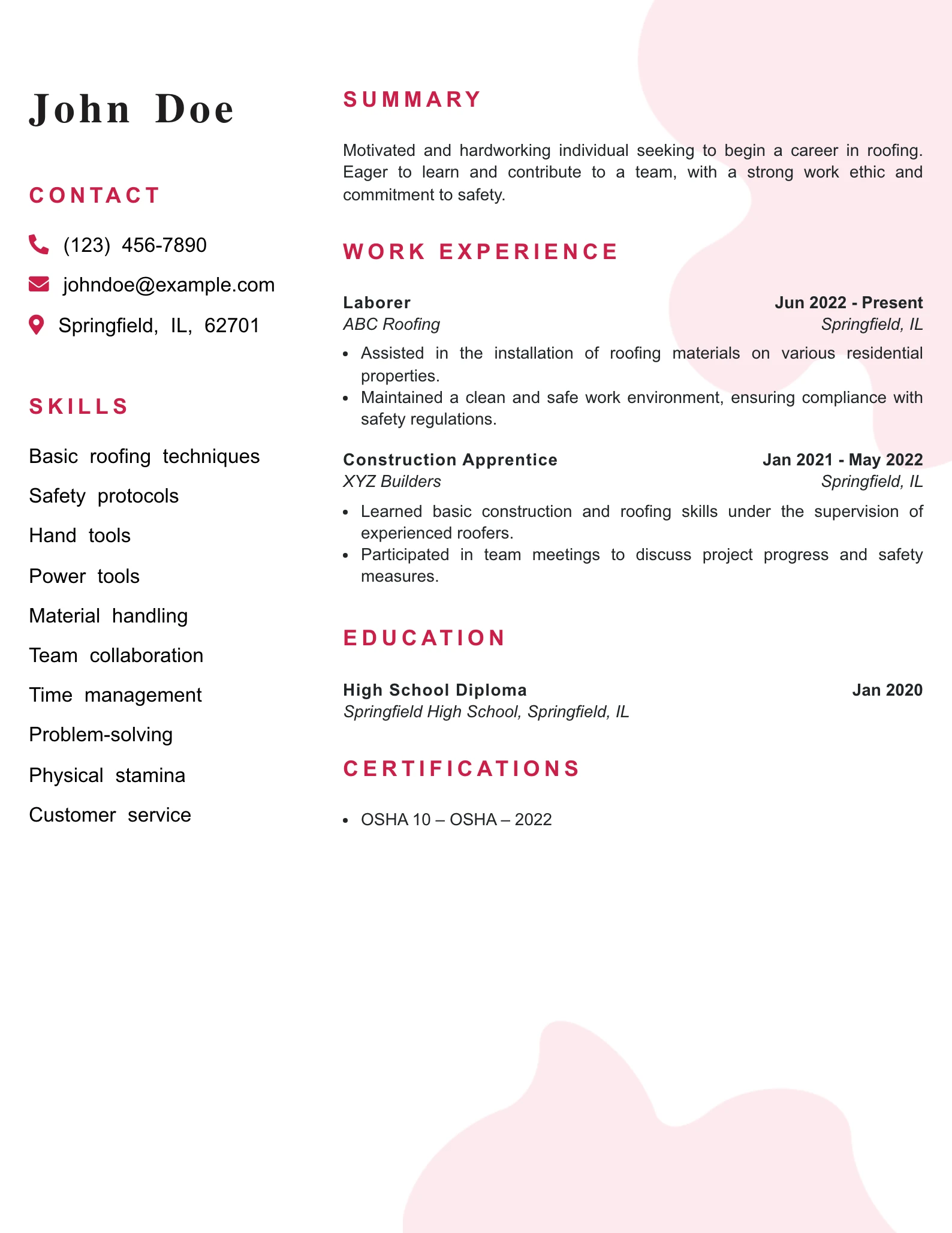
- The resume features a clear and focused summary that outlines the candidate’s motivation and eagerness to start a career in roofing, effectively setting the stage for the rest of the document.
- Relevant skills are well-defined, showcasing a mix of technical and soft skills that align with the requirements of entry-level roles in the roofing industry, such as safety protocols and teamwork.
- The work history includes impactful descriptions of roles that highlight practical experience and a commitment to safety, demonstrating the candidate’s hands-on involvement and growth in the field.
- The resume reflects an entry-level job fit, with work experiences that are appropriate for someone just starting in the roofing industry, emphasizing learning and development.
- The clarity and tone of the resume are professional and straightforward, making it easy for hiring managers to quickly understand the candidate’s qualifications and intentions.
Mid Level Roofer Resume Example
Why This Resume Works
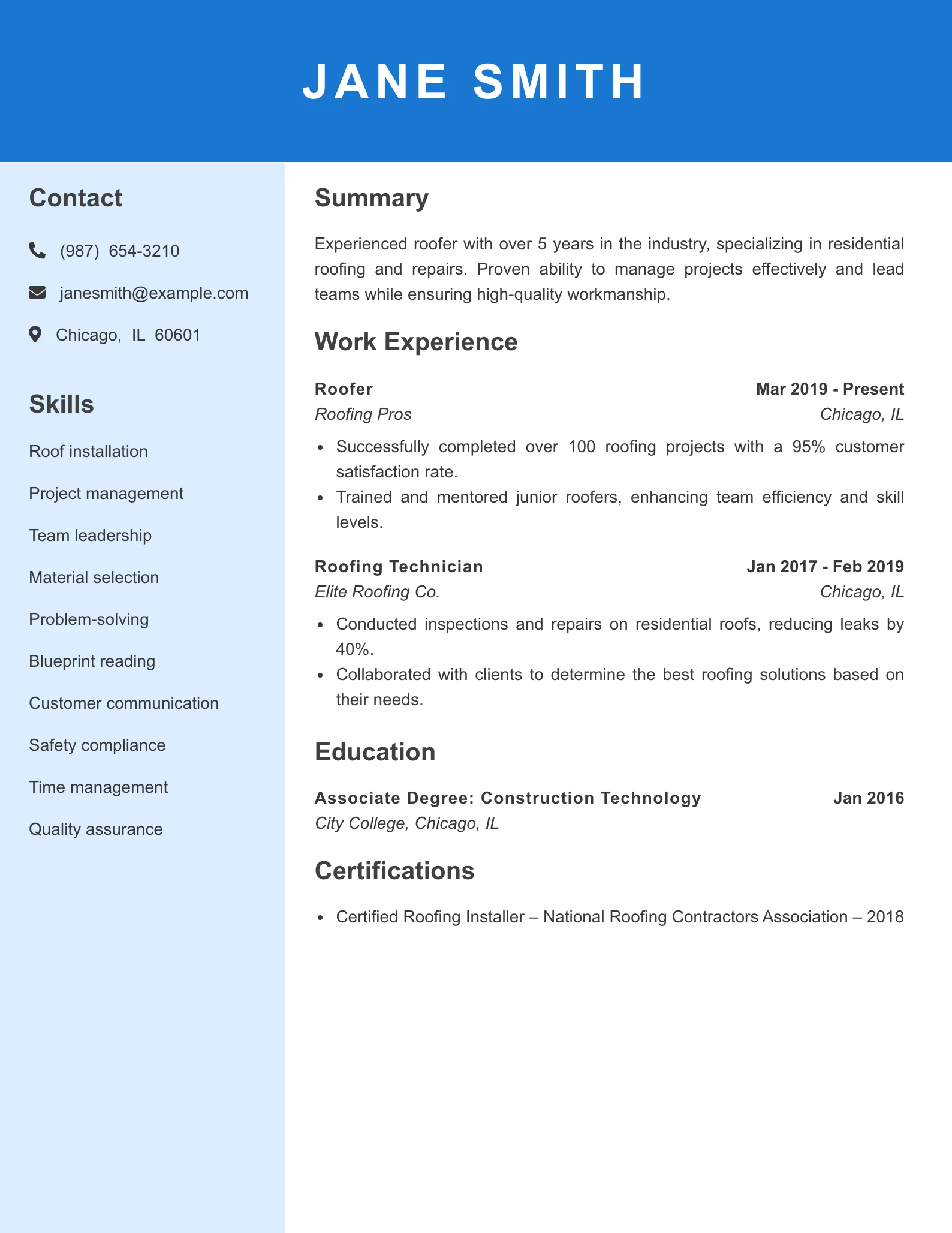
- The summary clearly outlines Jane’s experience in the roofing industry, highlighting her specialization and leadership abilities, which sets a strong foundation for her qualifications.
- Relevant skills are presented in a comprehensive list, showcasing a diverse range of competencies essential for a successful roofing manager, emphasizing both technical and interpersonal skills.
- The work history includes impactful achievements, such as completing over 100 projects with high customer satisfaction and reducing leaks significantly, demonstrating a direct contribution to company success and customer trust.
- The resume indicates a mid-level fit for Jane as it reflects over 5 years of experience and responsibilities that align with a managerial role, making her a strong candidate for similar positions.
- The clarity and tone of the resume are professional and straightforward, effectively communicating Jane’s qualifications without unnecessary jargon, making it easy for hiring managers to assess her fit for the role.
Senior Level Roofer Resume Example
Why This Resume Works
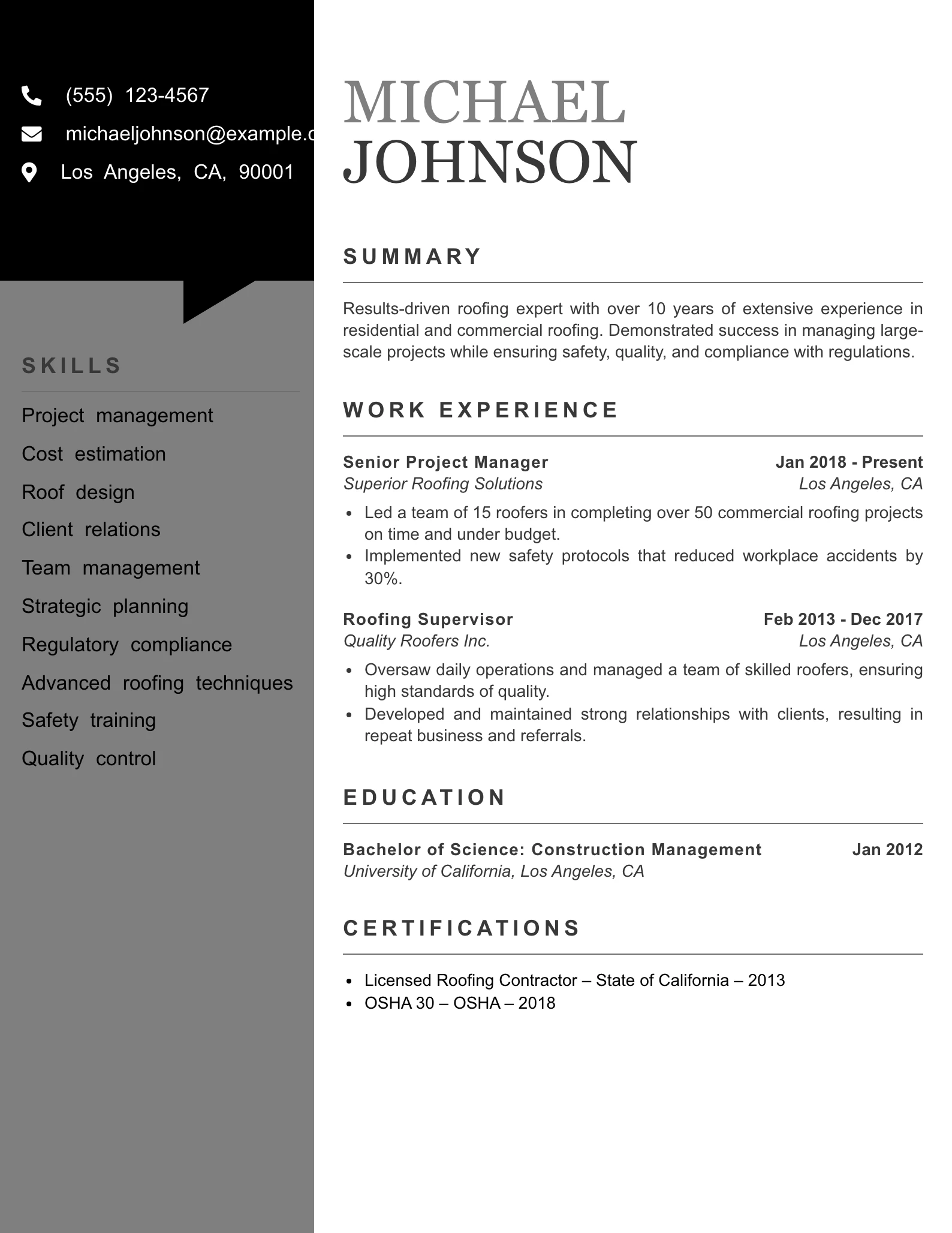
- The summary clearly highlights Michael’s extensive experience and results-driven approach, establishing his qualifications as a senior professional in the roofing industry.
- Relevant skills are well-articulated, showcasing a blend of technical expertise and leadership abilities essential for a senior project management role in construction.
- The work history demonstrates impactful achievements, such as leading a large team and implementing safety protocols, which illustrate his ability to drive project success and enhance workplace safety.
- The progression from Roofing Supervisor to Senior Project Manager indicates a clear career advancement, aligning with the expectations of a mid to senior-level candidate.
- The clarity and tone of the resume are professional and focused, reflecting a strong command of the industry language and emphasizing key accomplishments effectively.
How to Craft a Strong Roofer Resume
Crafting a well-structured resume is crucial for roofers looking to enhance their job prospects in a competitive field. Hiring managers typically seek candidates who demonstrate relevant experience, technical skills, and a strong work ethic. This guide will help you effectively showcase your strengths and build an impressive resume that stands out.
Summary Statement
A strong Summary Statement is one of the most important sections of a roofer’s resume because it is often the first thing hiring managers read. This short section should clearly communicate who you are as a professional, what type of roofing work you specialize in, and the value you bring to an employer.
An effective summary goes beyond listing duties. It highlights years of experience, roofing systems handled, measurable results, and safety or technical certifications. Employers should immediately understand whether you are a residential roofer, commercial roofing technician, installer, or metal roofing specialist—and why you are worth interviewing.
When writing your summary, keep it concise but impactful. Focus on results, reliability, safety awareness, and craftsmanship, and tailor the wording to the specific role you are applying for. Using numbers (years, projects, square footage, safety records) improves credibility and helps your resume perform better in ATS systems.
Roofer Resume Summary Example
Experienced Roofer with over 8 years of hands-on experience completing residential and commercial roofing projects. Skilled in shingle, tile, and flat roofing systems, with a proven record of completing 200+ roof installations and repairs on schedule and within budget. Consistently maintained a zero-incident safety record while working at heights and in demanding environments. Known for strong teamwork, accurate blueprint interpretation, and dependable workmanship.
Why this summary works:
This summary clearly communicates experience, scope of work, and safety performance. To improve it further, consider adding leadership experience or specific roofing systems such as TPO or EPDM if applying for a senior role.
Roofing Technician Resume Summary Example
Detail-oriented Roofing Technician with 6+ years of experience supporting installation, inspection, and maintenance of commercial roofing systems. Experienced in diagnosing leaks, conducting preventive maintenance, and assisting with large-scale projects exceeding 50,000 square feet. Strong understanding of OSHA safety standards and proficient with industry-standard tools. Recognized for technical accuracy, reliability, and efficient job-site coordination.
Why this summary works:
It emphasizes technical expertise and large-scale project exposure. Adding certifications or experience with inspection reporting software could further strengthen this summary.
Roofing Installer Resume Summary Example
Reliable Roofing Installer with 5 years of experience installing asphalt shingles, metal panels, and flat roofing systems for residential and light commercial properties. Contributed to the successful completion of 150+ roofing installations with consistent quality and minimal rework. Physically strong, detail-oriented, and committed to meeting project deadlines while following safety protocols. Works effectively as part of a fast-paced roofing crew.
Why this summary works:
This summary highlights productivity and dependability, which employers value highly. You could enhance it by adding average installation time or customer satisfaction outcomes.
Metal Roofer Resume Summary Example
Skilled Metal Roofer with 7+ years of specialized experience working with standing seam, corrugated, and custom metal roofing systems. Successfully completed 120+ metal roofing projects, including complex commercial installations. Strong knowledge of metal fabrication, flashing, and waterproofing techniques. Known for precision workmanship, durability standards, and strict compliance with safety regulations.
Why this summary works:
It clearly establishes specialization and technical depth. Mentioning specific metals or fabrication equipment can make this summary even stronger.
Career Changer Roofer Resume Summary Example
Motivated Roofing Professional transitioning from general construction, bringing 4 years of transferable construction experience and hands-on roofing training. Assisted with 30+ roofing repair and installation projects, gaining practical knowledge of materials, tools, and safety procedures. Fast learner with a strong work ethic and a commitment to building long-term roofing expertise. Recognized for reliability and teamwork on active job sites.
Why this summary works:
This summary addresses the career shift directly while emphasizing relevant skills. Including certifications or mentorship experience can further boost employer confidence.
Recent Graduate Roofer Resume Summary Example
Entry-level Roofer and recent trade school graduate with formal training in residential roofing systems, job-site safety, and material installation. Completed 500+ hours of hands-on training and participated in supervised roofing projects. Physically fit, safety-conscious, and eager to apply technical knowledge in real-world environments. Strong communication skills and a commitment to quality workmanship.
Why this summary works:
It frames limited experience as structured training and readiness. Adding internship experience or manufacturer certifications can make it even more compelling.
“Excellence is doing ordinary things extraordinarily well.”
— John W. Gardner
Skills & Qualifications
In the roofing industry, certain core and soft skills are crucial to highlight on your resume. Core skills may include technical abilities such as roofing installation, repair, and safety compliance. Soft skills, on the other hand, can showcase your ability to work within a team and communicate effectively with clients.
To identify the right skills to include:
– Review job descriptions for specific skills and qualifications mentioned.
– Ensure that your skills match the requirements of the position.
– Utilize industry-specific terminology that resonates with hiring managers.
Important Skills
- Roof installation
- Repair and maintenance
- Safety compliance
- Team collaboration
- Blueprint reading
- Customer service
- Problem-solving
- Time management
Top ATS Keywords for Roofer
Work History
Your Work History section is the backbone of your roofer resume. This is where employers evaluate your hands-on experience, technical skill level, safety awareness, and on-the-job impact. Rather than listing tasks, focus on achievements, scope of responsibility, and measurable results that show how you contributed to successful roofing projects.
Strong work history entries demonstrate progression, reliability, and performance under real job-site conditions. Whether you are an experienced roofer, a specialist, a career changer, or a recent graduate, this section should clearly show how your experience translates into value for the employer.
Recommended Formatting Guidelines
- Use a reverse-chronological format, starting with your most recent role.
- Include Job Title | Company Name | City, State | Employment Dates.
- Highlight measurable achievements such as number of projects, square footage, budgets, timelines, or safety records.
- Write five bullet points per role, each focused on outcomes, not just duties.
- Begin each bullet with a strong action verb and avoid repetition.
- Use bold for job titles and italicized text for company names and locations for clarity and visual structure.
Roofer – Work Experience Example
Roofer
ABC Roofing & Construction – Dallas, TX
March 2018 – Present
- Led and executed 180+ residential and commercial roofing projects, consistently completing jobs 10–15% under projected timelines while maintaining strict quality standards across shingle, tile, and flat roofing systems.
- Installed, repaired, and replaced roofing systems covering over 250,000 square feet, ensuring compliance with local building codes and manufacturer specifications on every project.
- Maintained a zero-accident safety record over 5 consecutive years by enforcing OSHA-compliant safety procedures and conducting daily job-site inspections.
- Coordinated daily work activities with a 6–8 member roofing crew, improving workflow efficiency and reducing material waste by 12% annually.
- Communicated project updates directly with homeowners, inspectors, and project managers, resulting in a 95% customer satisfaction rating and repeat business referrals.
Roofing Technician – Work Experience Example
Roofing Technician
Beacon Commercial Roofing – Phoenix, AZ
June 2019 – February 2024
- Supported inspection, maintenance, and repair of large-scale commercial roofing systems exceeding 60,000 square feet, identifying issues early and preventing costly structural damage.
- Conducted detailed leak diagnostics and preventive maintenance that reduced emergency repair requests by 22% year over year.
- Assisted senior technicians in installing TPO, EPDM, and modified bitumen systems while adhering to manufacturer guidelines and safety regulations.
- Utilized digital reporting tools to document inspections, repair plans, and material usage, improving reporting accuracy and project tracking efficiency.
- Followed OSHA safety standards rigorously, contributing to 1,200+ labor hours without a recordable incident across multiple active job sites.
Roofing Installer – Work Experience Example
Roofing Installer
Sunrise Residential Roofing – Orlando, FL
April 2020 – January 2024
- Installed asphalt shingle, metal, and flat roofing systems on 150+ residential properties, consistently meeting project deadlines despite weather and site constraints.
- Measured, cut, and secured roofing materials with high precision, reducing material waste by 18% through improved installation accuracy.
- Assisted in tear-off and replacement projects involving roofs over 3,000 square feet, ensuring safe debris removal and proper disposal.
- Collaborated closely with crew leads to streamline installation workflows, improving average project completion time by 20%.
- Followed safety procedures at all times, contributing to a four-year record with no job-site injuries or rework incidents.
Metal Roofer – Work Experience Example
Metal Roofer
SteelTop Roofing Solutions – Denver, CO
May 2017 – December 2023
- Specialized in standing seam and corrugated metal roofing installations across 120+ commercial and industrial projects, delivering durable, weather-resistant results.
- Fabricated and installed custom metal panels, flashing, and trim components with high precision, reducing post-installation repairs by 30%.
- Worked extensively with aluminum, steel, and copper systems, ensuring proper waterproofing and thermal performance on every installation.
- Interpreted architectural drawings and shop plans accurately, preventing installation errors and costly rework on high-value projects.
- Maintained full compliance with safety protocols while working at heights, contributing to 6 consecutive years without safety violations.
Career Changer Roofer – Work Experience Example
Roofer Trainee
Liberty Roofing Group – Columbus, OH
August 2022 – Present
- Transitioned from general construction into roofing, applying 4 years of transferable trade experience to assist with 35+ roofing installations and repairs.
- Supported senior roofers with material handling, surface preparation, and installation tasks, accelerating skill development and on-the-job competency.
- Gained hands-on experience with residential roofing systems while maintaining compliance with safety standards and company procedures.
- Demonstrated rapid learning ability by independently completing assigned installation tasks within 90 days of onboarding.
- Earned recognition for reliability and attendance, maintaining 100% on-time job-site presence throughout the first year.
Recent Graduate Roofer – Work Experience Example
Entry-Level Roofer
EverSafe Roofing Services – Tampa, FL
June 2024 – Present
- Applied trade school training to assist in 25+ supervised roofing projects, contributing to installation, repairs, and safety setup activities.
- Completed material preparation, measurement, and installation support tasks with a strong focus on accuracy and efficiency.
- Logged 500+ hours of hands-on roofing experience under senior supervision, gaining exposure to multiple roofing systems.
- Followed safety procedures consistently, helping maintain a 100% incident-free record during training and early employment.
- Demonstrated strong work ethic and adaptability, earning positive evaluations for teamwork, punctuality, and skill progression.
Final Tip
Your work history should tell a story of growth, reliability, and impact. Focus on achievements, quantify results wherever possible, and tailor each role to the roofing job you are applying for. This approach not only strengthens your resume visually but also significantly improves ATS performance and hiring manager engagement.
Education
While formal education isn’t always mandatory in roofing, relevant training and certifications can enhance your resume. Common educational backgrounds for roofers include high school diplomas or equivalent programs, along with specialized training in construction or roofing.
When formatting your education section:
– List your degree and the institution attended.
– Include the city and state, along with your graduation year.
Education Section – Recommended Format (Template)
Use the structure below to ensure clarity and consistency. This format works well for both experienced roofers and entry-level candidates.
Degree or Program Name
Institution Name – City, State
Year of Completion or Graduation Year
Education Section – Example
High School Diploma
Jefferson High School – Los Angeles, CA
2016
Placement Tip
On a roofer resume, the Education section typically appears after Work History for experienced professionals and before Work History for recent graduates or career changers. This placement ensures employers see your most relevant qualifications first.
Additional Sections
The Additional Sections area allows you to highlight qualifications that may not fit naturally into your work history or education but still add significant value to your roofer resume. Well-chosen optional sections can strengthen your credibility, improve ATS performance, and help you stand out, especially in competitive job markets.
Only include sections that are relevant, current, and verifiable. Keep formatting clean and consistent so hiring managers can quickly scan for certifications, language skills, or recognition.
Certifications
Certifications are highly valued in roofing because they demonstrate safety awareness, technical competence, and commitment to industry standards. Always list certifications in reverse-chronological order and include the full certification name, issuing organization, and year earned.
Formatting rules:
- Bold the certification name for visibility
- Italicize the issuing organization
- Use plain text for the year
- Do not abbreviate unless the abbreviation is widely recognized
Example:
- OSHA 30-Hour Construction Safety Certification – Occupational Safety and Health Administration (OSHA) – 2023
- Certified Roofing Contractor (CRC) – National Roofing Contractors Association (NRCA) – 2022
- Fall Protection Competent Person Certification – American Safety Council – 2021
Languages
Language skills are especially valuable for roofing crews that work with diverse teams or communicate directly with clients. Only list languages you can confidently use in a professional setting.
Formatting rules:
- Bold the language
- Use parentheses for proficiency level
- Keep descriptions concise and honest
Example:
- English (Fluent)
- Spanish (Professional Working Proficiency)
Awards and Recognition
Awards and recognition help demonstrate reliability, performance, and professionalism. These can come from employers, safety programs, or industry organizations. Focus on awards that reflect work ethic, safety, or quality craftsmanship.
Formatting rules:
- Bold the award title
- Italicize the issuing organization
- Include the year received
- Add a short clarifying phrase if needed
Example:
- Safety Excellence Award – ABC Roofing & Construction – 2023
Recognized for maintaining a zero-incident safety record across multiple job sites. - Employee of the Year – Sunrise Residential Roofing – 2022
Awarded for outstanding productivity, teamwork, and customer satisfaction.
Optional Sections to Include Only If Relevant
Depending on your experience level, you may also include:
- Licenses (state roofing license, contractor license)
- Apprenticeships or Trade Programs
- Professional Affiliations (NRCA membership)
- Equipment & Tools Proficiency (if not covered elsewhere)
Final Tip
Additional sections should enhance—not clutter—your resume. Use clean formatting, consistent styling, and only include information that strengthens your candidacy. When done correctly, these sections reinforce your professionalism and give hiring managers more reasons to choose you for an interview.
Do’s and Don’ts
To create a standout roofer resume, keep these do’s and don’ts in mind:
Do:
– Tailor your resume for ATS (Applicant Tracking Systems).
– Showcase your impact and achievements through metrics.
– Use industry-specific terms and jargon.
Don’t:
– Rely on generic statements that lack detail.
– Ignore the importance of soft skills in your experience.
– Overuse buzzwords without context.
By following this guide, you can craft a strong roofer resume that effectively highlights your strengths and maximizes your chances of landing that desired position.
For those looking for a comprehensive set of tools to enhance your resume, check out our collection of resume templates designed to suit various professions and needs. Whether you’re starting from scratch or looking to refine your current resume, our templates can help you create a polished presentation of your skills and experience.
Final Tips for a Strong Roofer Resume
To wrap up your roofer resume article, here are high-impact, field-tested tips that hiring managers, contractors, and roofing companies in the U.S. consistently look for. These go beyond generic resume advice and focus on what truly matters in the roofing industry.
Prioritize Safety Proof, Not Just Safety Claims
Instead of stating that you “follow safety protocols,” prove it with outcomes. Mention zero-incident records, completed OSHA training, or years worked without lost-time accidents. Safety metrics immediately build trust with employers who carry high liability.
Show Scale and Scope of Work Clearly
Hiring managers want to know how big and complex your jobs were. Include square footage, project value ranges, crew sizes, or number of roofs completed per year. This helps employers quickly assess whether your experience matches their project scale.
Match Roofing Systems to the Job Posting
If a job focuses on metal, commercial flat roofs, or residential shingles, make sure those systems appear both in your summary and work history. Many roofing companies scan resumes for system-specific experience before reading further.
Use Action Verbs That Reflect Physical and Technical Skill
Words like installed, fabricated, inspected, reinforced, sealed, coordinated, and executed carry more weight than generic verbs. Roofing is a hands-on trade—your language should reflect precision and physical competence.
Avoid Overcrowding With Irrelevant Certifications
Only list certifications that are current and recognized in the roofing industry. Outdated or unrelated credentials dilute impact. Quality always matters more than quantity.
Keep Bullet Points Outcome-Focused
Every bullet point should answer at least one of these:
- Did it save time?
- Did it improve safety?
- Did it reduce waste or cost?
- Did it increase efficiency or quality?
If a bullet doesn’t show impact, rewrite it.
Respect Resume Length Based on Experience
- Entry-level or recent graduates: 1 page
- Mid-level roofers: 1–2 pages
- Supervisors or specialists: 2 pages max
Long resumes are acceptable only when they reflect real, measurable experience.
Don’t Hide Career Transitions
If you changed trades or moved from general construction into roofing, address it directly and confidently. Employers value transferable skills when they are clearly explained and supported with hands-on experience.
Consistency Signals Professionalism
Consistent formatting, tense usage, spacing, and punctuation show attention to detail—an underrated but critical trait in roofing work. Inconsistent resumes raise red flags about job-site discipline.
Think Like a Contractor, Not a Job Seeker
Your resume should read like a work performance record, not a personal biography. Focus on reliability, production, safety, and results—the same factors contractors use to evaluate crews on real job sites.
Closing Insight
A strong roofer resume doesn’t try to impress with flashy language. It earns attention by clearly showing what you’ve built, how safely you worked, and the results you delivered. When your resume reflects real job-site value, interviews follow naturally.
Most Popular Roofer Resume FAQs
You should include 10–15 years of relevant roofing experience at most. Employers prioritize recent, hands-on experience, especially with current roofing systems and safety standards. Older roles can be summarized briefly or removed if they no longer reflect your current skill level.
The most important skills include roofing system installation, safety compliance, material handling, leak detection, blueprint reading, and teamwork. Soft skills like reliability, communication, and time management are also highly valued on U.S. job sites.
Yes. Many large U.S. roofing companies and contractors use Applicant Tracking Systems (ATS). Use clear headings, standard job titles, and keyword-rich bullet points related to roofing systems, safety certifications, and tools to ensure your resume passes initial screenings.
Absolutely. Certifications such as OSHA 10 or OSHA 30 significantly increase your credibility. Safety credentials show employers that you reduce risk, protect job sites, and comply with U.S. construction regulations.