

Crafting an impressive Carpenter resume is essential for standing out in the competitive job market of 2026. Our collection of resume examples for Carpenter will guide you in showcasing your skills, experience, and accomplishments effectively. With the right format and content, you can increase your chances of landing your dream job in the carpentry field.
Carpenter Resume Examples
Entry Level Carpenter Resume Example
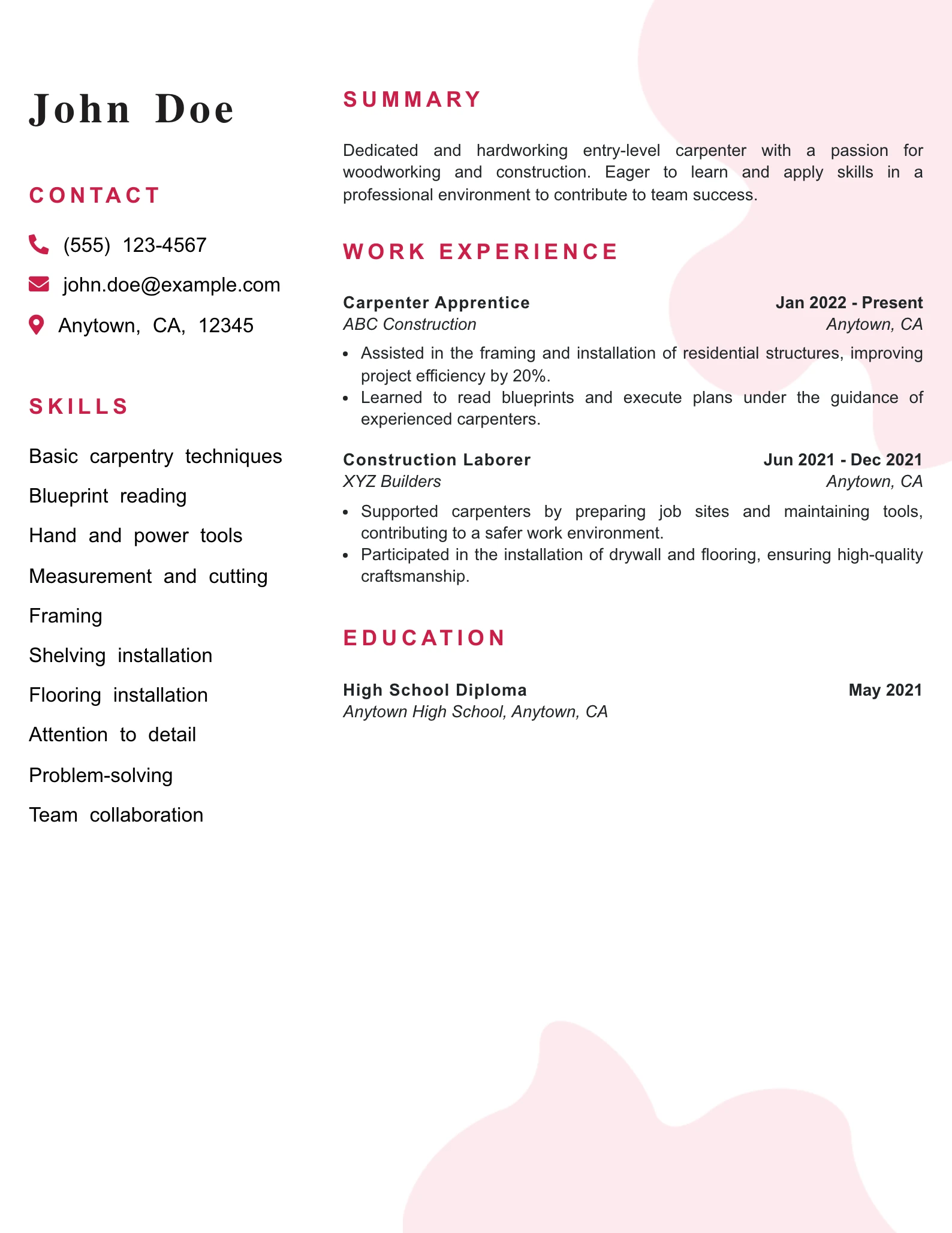
Why This Resume Works
- The summary clearly outlines John’s status as an entry-level carpenter while highlighting his enthusiasm for learning and contributing, which sets an appropriate tone for potential employers.
- Relevant skills listed align well with the requirements of carpentry roles, showcasing both technical abilities and soft skills like attention to detail and collaboration.
- The work history emphasizes impactful experiences, such as improving project efficiency by 20%, which demonstrates John’s contributions and potential value to future employers.
- The resume is tailored for an entry-level position, indicating a clear job fit by focusing on foundational skills and experiences that are appropriate for someone new to the industry.
- The clarity and straightforward tone of the resume enhance readability, allowing hiring managers to quickly grasp John’s qualifications and potential as a carpenter.
Mid Level Carpenter Resume Example
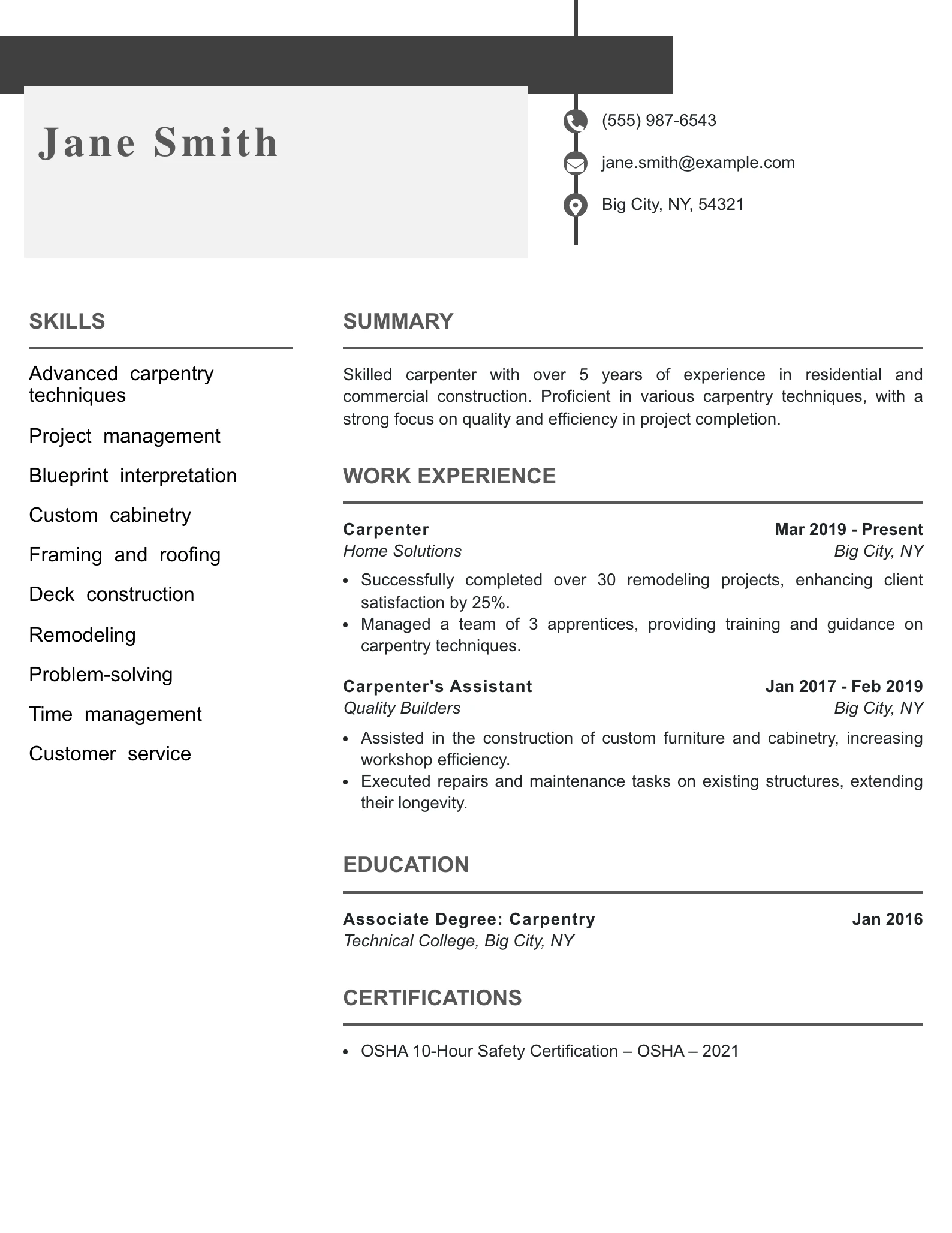
Why This Resume Works
- The summary effectively highlights Jane’s relevant experience and skills in carpentry, providing a clear overview of her qualifications for potential employers.
- The skills section is comprehensive and directly related to the carpentry field, showcasing both technical abilities and essential soft skills necessary for project management and customer interaction.
- Jane’s work history includes quantifiable achievements, such as enhancing client satisfaction by 25%, demonstrating her impact and effectiveness in previous roles.
- The resume indicates a mid-level experience with over 5 years in the industry, aligning well with expectations for a candidate in the carpenter role.
- The clarity and professional tone throughout the resume convey competence and reliability, making a positive impression on hiring managers.
Senior Level Carpenter Resume Example

Why This Resume Works
- The summary clearly outlines Michael’s extensive experience and specialization in construction, establishing his expertise and positioning him as a strong candidate for roles in the field.
- The skills section is comprehensive and directly relevant to the construction industry, showcasing both technical competencies and leadership abilities that are crucial for managerial roles.
- The work history highlights impactful achievements, such as reducing rework and improving workflow efficiency, demonstrating Michael’s effectiveness and contributions to previous employers.
- The resume is well-suited for a mid to senior-level position, given the years of experience and leadership roles indicated, making it clear that he is prepared for increased responsibilities.
- The overall clarity and professional tone of the resume convey confidence and competence, making it easy for hiring managers to assess Michael’s qualifications at a glance.
How to Craft a Strong Carpenter Resume
A well-crafted resume is essential for carpenters looking to stand out in a competitive job market. Hiring managers typically seek candidates with relevant experience, specialized skills, and a strong work ethic. Following this guide will help you effectively highlight your strengths and present a compelling case for why you are the ideal candidate for the job.
“Quality is never an accident. It is always the result of intelligent effort.”
— John Ruskin
Summary Statement
Crafting a strong Carpenter resume summary is one of the most important steps in standing out in the competitive job market of 2026. A well written summary gives hiring managers a clear snapshot of your experience, core skills, and professional value within seconds. Whether you specialize in finish carpentry, rough framing, cabinet making, or are transitioning into the trade, your summary should highlight measurable achievements, years of experience, and the specific carpentry skills employers are actively seeking. The examples below demonstrate how to tailor your summary based on job title, career stage, and background.
Carpenter Resume Summary Example
Carpenter Resume Summary Example
Skilled Carpenter with over 8 years of hands on experience in residential and commercial construction projects. Proven ability to read blueprints, install framing, and complete finish work with high accuracy while meeting tight deadlines. Successfully contributed to more than 120 completed projects, maintaining a 98 percent client satisfaction rate. Strong knowledge of OSHA safety standards, material estimation, and power tool operation.
Why this summary works and how to improve it
This summary works because it clearly states years of experience, quantifies project volume, and highlights both technical and safety skills. To improve it further, you can add a specialization such as remodeling, custom homes, or commercial interiors to better target a specific role.
Finish Carpenter Resume Summary Example
Finish Carpenter Resume Summary Example
Detail oriented Finish Carpenter with 6 plus years of experience delivering high-quality interior finishes for residential and commercial properties. Expertise in trim installation, crown molding, cabinetry, and custom woodwork with consistent precision. Completed over 90 interior finishing projects while reducing material waste by 15 percent through accurate measurements and planning. Known for clean workmanship, problem-solving skills, and strong collaboration with contractors and designers.
Why this summary works and how to improve it
This summary is effective because it emphasizes precision-based skills and measurable results related to efficiency. To strengthen it, include specific materials such as hardwood, MDF, or laminate, and mention any luxury or high-end project experience.
Rough Carpenter Resume Summary Example
Rough Carpenter Resume Summary Example
Reliable Rough Carpenter with 7 years of experience specializing in structural framing and large-scale construction projects. Proficient in framing walls, floors, and roofs for residential and multi-unit buildings using industry-approved methods. Supported the completion of 60-plus structures while maintaining full compliance with safety and building codes. Strong physical endurance and ability to work efficiently in fast-paced environments.
Why this summary works and how to improve it
This summary works because it focuses on structural expertise and safety compliance, which are critical for rough carpentry roles. To improve it, add equipment experience such as nail guns or scaffolding systems and include teamwork or leadership responsibilities if applicable.
Cabinet Maker Resume Summary Example
Cabinet Maker Resume Summary Example
Experienced Cabinet Maker with over 9 years of expertise in custom cabinetry design, fabrication, and installation. Skilled in working with hardwoods, veneers, and engineered wood products to produce functional and visually appealing results. Delivered more than 200 custom cabinet units for kitchens and commercial spaces while maintaining a 99 percent quality approval rate. Adept at interpreting design plans and collaborating with clients to meet exact specifications.
Why this summary works and how to improve it
This summary is strong because it highlights craftsmanship, volume of work, and client-focused results. To enhance it further, you can mention software tools such as CAD or CNC machinery experience if relevant to the role.
Framer Resume Summary Example
Framer Resume Summary Example
Dedicated Framer with 5 years of experience constructing wood and metal framing for residential and commercial structures. Demonstrated ability to interpret construction drawings and execute precise framing layouts. Contributed to projects valued at over 3 million dollars while meeting strict deadlines and safety standards. Recognized for efficiency, teamwork, and consistent structural accuracy.
Why this summary works and how to improve it
This summary works well because it includes financial impact and emphasizes structural accuracy. To improve it, consider adding square footage metrics or leadership experience such as supervising apprentices.
Career Changer Carpenter Resume Summary Example
Career Changer Carpenter Resume Summary Example
Motivated Carpenter transitioning from a construction related support role with 4 years of transferable experience in site coordination and material handling. Recently completed hands on carpentry training covering framing, finish work, and tool safety. Assisted in over 25 residential renovation projects while developing strong foundational carpentry skills. Known for adaptability, reliability, and a strong work ethic.
Why this summary works and how to improve it
This summary works because it reframes transferable experience and highlights training and project exposure. To strengthen it, include certifications, apprenticeships, or licenses to reinforce credibility for hiring managers.
Recent Graduate Carpenter Resume Summary Example
Recent Graduate Carpenter Resume Summary Example
Recent Carpentry program graduate with practical training in framing, finish carpentry, and basic cabinet installation. Completed over 300 hours of hands on workshop and site based learning with consistent instructor evaluations above 90 percent. Strong understanding of construction safety practices and blueprint reading. Eager to contribute to professional job sites while continuing to develop technical expertise.
Why this summary works and how to improve it
This summary works because it focuses on training hours, performance metrics, and enthusiasm to learn. To improve it, add internship experience or specific tools and materials you are comfortable using to make the summary more job ready.
Skills & Qualifications
Highlighting the right skills is vital for a carpenter’s resume. Core skills may include proficiency in various carpentry techniques, familiarity with tools, and understanding blueprints. Soft skills such as attention to detail, communication, and time management are equally important.
To identify the most relevant skills, carefully review job descriptions and note the specific qualifications that hiring managers emphasize. This will help you align your skills with what is required for the position and improve your chances with Applicant Tracking Systems (ATS).
- Blueprint reading
- Framing
- Cabinet construction
- Finish carpentry
- Tool maintenance
- Time management
- Problem-solving
- Communication
Top ATS Keywords for Carpenter
Work History
How to Format Your Carpenter Work Experience
Your work experience section should clearly demonstrate your hands on carpentry expertise, technical skills, and measurable impact on past projects. Employers want to see what you built, how well you built it, and the scale of your work.
Follow these formatting guidelines:
- Use a reverse chronological format, listing your most recent position first.
- Job titles should be bold.
- Company name, city, and state should be italicized.
- Employment dates should be aligned on the right or placed neatly after the location.
- Begin each bullet point with a strong action verb.
- Quantify results using numbers, percentages, square footage, budgets, timelines, or project counts.
- Keep bullet points long and descriptive to fully showcase responsibilities and impact.
Carpenter Work Experience Example
Carpenter
Turner Construction Company, New York, NY
January 2019 – Present
- Executed residential and commercial carpentry projects including framing, drywall installation, and finish work across more than 45 active job sites, ensuring all work met structural specifications, blueprints, and local building codes.
- Collaborated closely with project managers, electricians, and plumbers to coordinate workflow and maintain construction timelines, contributing to a 20 percent reduction in project delays over a three year period.
- Measured, cut, and installed wood, plywood, and composite materials with high precision, reducing material waste by approximately 18 percent through accurate planning and execution.
- Inspected completed work to ensure quality, durability, and compliance with safety standards, consistently passing OSHA inspections with zero violations reported.
- Trained and mentored 4 junior carpenters and apprentices, improving team productivity and ensuring consistent workmanship across all assigned projects.
Finish Carpenter Work Experience Example
Finish Carpenter
Skanska USA Building Inc., Boston, MA
March 2020 – February 2024
- Performed detailed interior finish carpentry including crown molding, baseboards, door casings, stair components, and custom trim work for high end residential and commercial properties.
- Completed over 70 interior finishing projects while maintaining a high standard of craftsmanship, contributing to a client satisfaction rating consistently above 95 percent.
- Interpreted architectural drawings and interior design plans to deliver visually precise finishes that aligned with client expectations and project specifications.
- Operated hand tools and power tools safely and efficiently, maintaining a clean and organized workspace that met company and site safety requirements.
- Coordinated directly with designers and site supervisors to resolve on site challenges, ensuring seamless integration of finish carpentry elements into completed structures.
Rough Carpenter Work Experience Example
Rough Carpenter
PulteGroup Inc., Dallas, TX
June 2018 – December 2022
- Constructed structural frameworks including walls, floors, roofs, and stair systems for large scale residential housing developments exceeding 150,000 square feet.
- Read and interpreted blueprints, technical drawings, and layout plans to ensure precise structural placement and long term building integrity.
- Installed framing components using industry approved methods while adhering strictly to safety protocols and local construction regulations.
- Assisted in completing more than 60 housing units on schedule by maintaining efficiency in fast paced, high volume construction environments.
- Collaborated with site supervisors to identify structural issues early, preventing costly rework and maintaining project budgets.
Cabinet Maker Work Experience Example
Cabinet Maker
California Closets, Los Angeles, CA
August 2017 – May 2023
- Designed, fabricated, and installed custom cabinetry for kitchens, offices, and commercial interiors using hardwoods, veneers, and engineered wood materials.
- Produced over 200 custom cabinet units with consistent accuracy, meeting exact client specifications and achieving a quality approval rate above 98 percent.
- Operated woodworking machinery including table saws, routers, and sanding equipment to achieve precise finishes and durable construction.
- Collaborated with clients and interior designers to refine design concepts, ensuring functionality, aesthetics, and space optimization.
- Maintained detailed records of materials, measurements, and production timelines to support efficient workflow and cost control.
Framer Work Experience Example
Framer
Lennar Homes, Phoenix, AZ
February 2019 – July 2023
- Constructed wood framing for single family and multi family residential buildings, including load bearing walls, roof trusses, and floor systems.
- Completed framing work on projects valued at over 4 million dollars while maintaining accuracy, safety compliance, and strict deadline adherence.
- Utilized measuring tools and layout techniques to ensure precise alignment and structural integrity across all framing stages.
- Worked effectively as part of a framing crew to meet daily production targets in demanding outdoor conditions.
- Assisted with inspections and corrections, ensuring all framed structures passed municipal and safety inspections on the first review.
Career Changer Carpenter Work Experience Example
Carpentry Apprentice
Habitat for Humanity, Columbus, OH
September 2022 – Present
- Transitioned into carpentry after a career in logistics, applying transferable skills such as planning, teamwork, and time management to construction environments.
- Assisted licensed carpenters with framing, drywall installation, and finish work across more than 20 residential renovation and new build projects.
- Gained hands on experience using carpentry tools, measuring equipment, and safety gear while completing structured on site training.
- Supported material handling and job site preparation, ensuring efficient workflow and adherence to safety protocols.
- Demonstrated rapid skill development and reliability, earning consistent positive feedback from supervisors and team leaders.
Recent Graduate Carpenter Work Experience Example
Carpentry Trainee
ABC Construction Services, Denver, CO
January 2024 – Present
- Completed over 350 hours of supervised carpentry training covering framing, finish carpentry, and basic cabinetry installation.
- Assisted in residential remodeling projects by measuring, cutting, and installing materials under the guidance of senior carpenters.
- Applied classroom knowledge of blueprint reading and construction math to real world job sites with growing accuracy and confidence.
- Maintained a strong safety record by following OSHA guidelines and proper tool handling procedures at all times.
- Demonstrated strong work ethic, attention to detail, and eagerness to learn, positioning for advancement into a full Carpenter role.
Education
Education Formatting Guidelines
The education section should be concise, well structured, and easy for hiring managers to scan. List your education in reverse chronological order, starting with the most recent qualification. Always include the credential earned, institution name, city and state, and completion date. If you completed vocational training or an apprenticeship, place it here even if you do not hold a college degree.
Where to place it on your resume:
- Entry level, recent graduate, or career changer: place Education above Work Experience
- Experienced carpenters: place Education below Work Experience
Education Template for a Carpenter Resume
Use the format below to present your educational background clearly and professionally.
Credential or Program Name
Institution Name, City, State
Month Year – Month Year or Graduation Month Year
Optional details to include if relevant:
- Coursework or training focus related to carpentry or construction
- Certifications earned during the program
- Apprenticeship hours completed
- Honors or distinctions
Education Example for a Carpenter Resume
Diploma in Carpentry and Construction Technology
ABC Trade School, Phoenix, AZ
Graduated May 2021
Completed a comprehensive carpentry program focused on residential and commercial construction techniques. Gained hands-on training in framing, finish carpentry, blueprint reading, and construction safety. Completed over 600 hours of supervised shop and job site instruction, including OSHA compliant safety practices and tool operation
Additional Sections
Why Include Additional Sections on a Carpenter Resume
Additional sections allow you to showcase qualifications that may not fit naturally into your work experience or education but still add significant value. Certifications, languages, and awards help employers quickly identify specialized training, safety compliance, and professional recognition. When used correctly, these sections can strengthen your resume without cluttering it, especially in competitive carpentry roles.
Certifications
Certifications demonstrate formal training, safety awareness, and commitment to professional standards. Include only certifications that are relevant to carpentry or construction. Place this subsection directly under Additional Sections if you hold one or more recognized credentials.
Formatting guidelines:
- Certification name should be bold
- Issuing organization should be italicized
- Year of completion should appear at the end
Example:
OSHA 30 Hour Construction Safety Certification
Occupational Safety and Health Administration | 2023
Completed advanced safety training focused on hazard recognition, fall protection, and workplace compliance standards commonly required on U.S. commercial and residential job sites.
Licenses and Specialized Training
Licenses and trade specific training highlight your technical qualifications beyond general carpentry experience. This may include apprenticeship completion, specialty tool training, or state level trade licenses.
Formatting guidelines:
- License or training title in bold
- Issuing authority in italics
- Location optional if license is state specific
Example:
Registered Carpentry Apprenticeship Completion
U.S. Department of Labor | 2022
Successfully completed a federally recognized apprenticeship program involving over 4,000 hours of supervised on the job training and classroom instruction in structural and finish carpentry.
Languages
Language skills are especially valuable in construction environments where clear communication improves safety, coordination, and efficiency. Only include languages you can confidently use in a professional setting.
Formatting guidelines:
- Language in bold
- Proficiency level in regular text
Example:
Spanish
Professional working proficiency, including job site communication and safety instructions.
Awards and Recognition
Awards help validate your performance and professionalism through third party recognition. Include company awards, safety recognition, or craftsmanship based honors.
Formatting guidelines:
- Award title in bold
- Issuing organization in italics
- Year awarded at the end
Example:
Outstanding Craftsmanship Award
Turner Construction Company | 2021
Recognized for consistent quality workmanship, attention to detail, and contribution to high profile commercial construction projects.-
Volunteer or Community Work
Volunteer experience related to carpentry demonstrates initiative, community involvement, and hands on skill application. This is particularly effective for career changers or early career professionals.
Formatting guidelines:
- Role title in bold
- Organization name in italics
- Location optional
Example:
Volunteer Carpenter
Habitat for Humanity
Contributed carpentry support to residential construction projects by assisting with framing, interior finishing, and material preparation for community housing initiatives.
Do’s and Don’ts
Do’s
- Do quantify your carpentry experience: Numbers instantly build credibility. Mention square footage completed, number of projects handled, years of experience, or cost value of builds to show the real scale of your work.
- Do tailor your resume to the specific carpentry role: A finish carpenter resume should not read like a rough framing resume. Adjust skills, tools, and project types to match the exact job you are applying for.
- Do highlight safety training and certifications: Employers prioritize safe job sites. Listing OSHA certifications or formal safety training signals professionalism and reduces employer risk.
- Do use strong action verbs that show impact: Start bullet points with words like built, installed, constructed, supervised, or completed to clearly show what you contributed on the job.
- Do keep formatting clean and consistent: Consistent font sizes, spacing, and bullet alignment make your resume easier to scan and improve your chances of passing applicant tracking systems.
- Do showcase specialization and craftsmanship: If you specialize in cabinetry, framing, remodeling, or finish work, make it obvious. Specialization helps you stand out in a crowded job market.
Don’t’s
Do not submit a generic one size fits all resume
Employers can spot a recycled resume instantly. Generic resumes reduce your chances of getting called for an interview.
Do not overload your resume with irrelevant experience
Unrelated roles from years ago distract from your carpentry skills. Focus on experience that strengthens your value as a trades professional.
Do not ignore measurable results
Saying you helped on projects is weak. Showing how many projects you completed or how much waste you reduced is far more persuasive.
Do not use vague job descriptions
Avoid phrases like responsible for carpentry tasks. Be specific about what you built, installed, or improved.
Do not forget to proofread carefully
Spelling errors and formatting inconsistencies signal lack of attention to detail, which is a red flag in skilled trades.
Do not list certifications you cannot verify
Only include certifications you have actually earned. Employers often verify licenses and safety training during the hiring process.
Final Tips for a Standout Carpenter Resume
Think like a hiring manager reading fast
Most employers spend less than 10 seconds on an initial resume scan. Make your job titles, certifications, and core skills instantly visible so your value is clear at first glance.
Let your projects speak louder than your job titles
Two carpenters with the same title can have very different skill levels. Emphasize what you built, how complex the work was, and the scale of the projects to show real capability.
Balance craftsmanship with efficiency
Employers want quality work completed on time. Highlight examples where you met deadlines, reduced rework, or improved workflow without sacrificing craftsmanship.
Match your resume language to the job posting
If the job description mentions framing, cabinetry, or remodeling, reflect those exact terms in your resume. This improves ATS performance and shows alignment with employer needs.
Use numbers that reflect real job site impact
Include metrics that matter in construction, such as square footage, project value, team size, or materials handled. Avoid exaggeration and keep all figures realistic.
Show growth, not just experience
Demonstrate progression by listing increased responsibility, leadership of apprentices, or movement into specialized carpentry roles over time.
Include safety as a core professional skill
Safety is not optional in U.S. construction. Mention safety training, clean inspection records, or compliance with OSHA standards where relevant.
Avoid overcrowding your resume
White space improves readability. A clean layout with focused content is more effective than trying to include every task you have ever performed.
Keep your resume updated every six months
Adding recent projects, new tools, or certifications keeps your resume ready for opportunities and prevents important achievements from being forgotten.
Proofread with a builder’s mindset
Just like a finished structure, your resume should have no weak joints. Review spelling, alignment, and formatting carefully to ensure a professional final product.
FAQ’s:
1. What should a carpenter put on a resume?
A carpenter should include a clear summary, relevant work experience, key carpentry skills, education or apprenticeship training, and any certifications such as OSHA safety training. Employers in the U.S. also expect measurable achievements, such as the number of projects completed, years of experience, or types of structures built. Tailoring the resume to the specific carpentry role significantly improves interview chances.
There is no fixed requirement, but most employers prefer at least 2 to 4 years of hands on experience for full Carpenter roles. Entry level candidates often start through apprenticeships or vocational programs, while senior carpenters may have 8 or more years of experience. Practical skills and on site performance often matter more than formal education.
Certifications are not always mandatory, but they are highly valued by U.S. employers. OSHA safety certifications, apprenticeship completion certificates, and state specific licenses can make a resume more competitive. Many commercial job sites require OSHA training before allowing workers on site.
Most carpenter resumes should be one page long, especially for entry-level and mid-level professionals. Experienced carpenters with extensive project histories may use two pages if the information is highly relevant. Employers prefer concise resumes that clearly highlight skills, experience, and results without unnecessary details.