

Crafting a compelling Surgeon resume in 2026 is essential for making a memorable impression in a crowded job market. Our selection of resume examples for Surgeon positions showcases the best practices to highlight your unique skills, clinical expertise, and accomplishments. With these templates and insights, you’ll be well on your way to securing your next prestigious role.
You can also explore our healthcare resume examples for additional resume guides across a wide range of medical specialties.
Key Takeaways :
- Choose a clean, ATS-friendly resume format that highlights your surgical specialty, certifications, and career progression.
- Write a strong professional summary that showcases your surgical expertise, leadership, and measurable patient outcomes.
- Highlight quantifiable achievements such as surgical volumes, success rates, reduced complication rates, and improved patient recovery.
- Include board certifications, medical licenses, fellowships, and technical skills to strengthen your credibility as a surgeon.
- Customize your surgeon resume for each role by matching your experience, specialty, and keywords to the employer’s job description.
Surgeon Resume Examples
Entry Level Surgeon Resume Example
Why This Resume Works
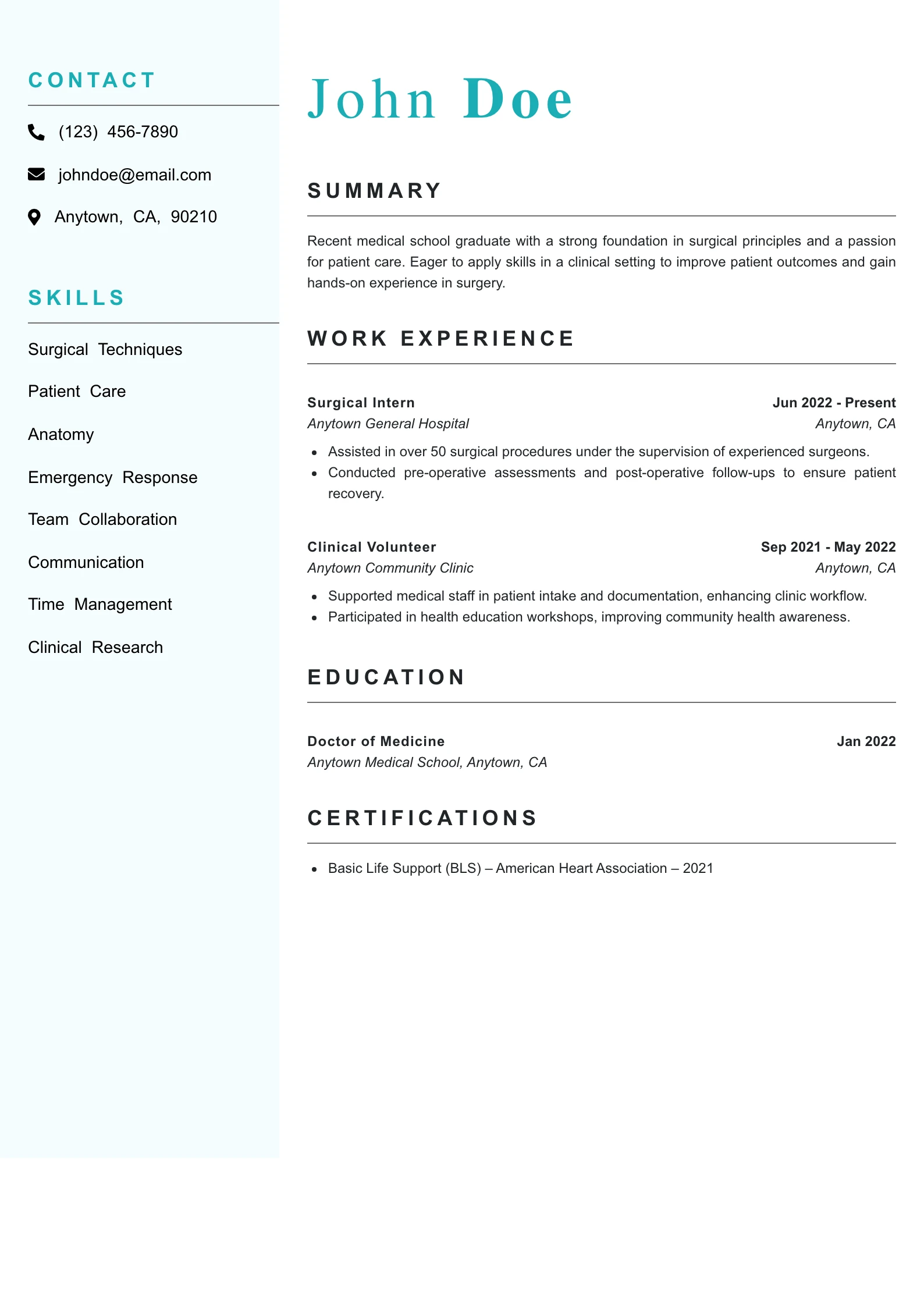
- The summary clearly articulates John’s recent educational background and his enthusiasm for applying his medical knowledge in a clinical setting, demonstrating a focused career goal.
- Relevant skills are highlighted effectively, showcasing a combination of technical abilities (Surgical Techniques, Emergency Response) and interpersonal skills (Team Collaboration, Communication) that are crucial for a medical role.
- The work history includes impactful experiences that reflect hands-on involvement in surgical procedures and patient care, indicating practical application of skills and a commitment to professional growth.
- The resume is well-suited for an entry-level position, as it emphasizes internship and volunteer experiences, which are appropriate for a recent graduate entering the medical field.
- The clarity and tone of the resume are professional and straightforward, making it easy for hiring managers to quickly assess John’s qualifications and fit for a surgical role.
Mid Level Surgeon Resume Example
Why This Resume Works
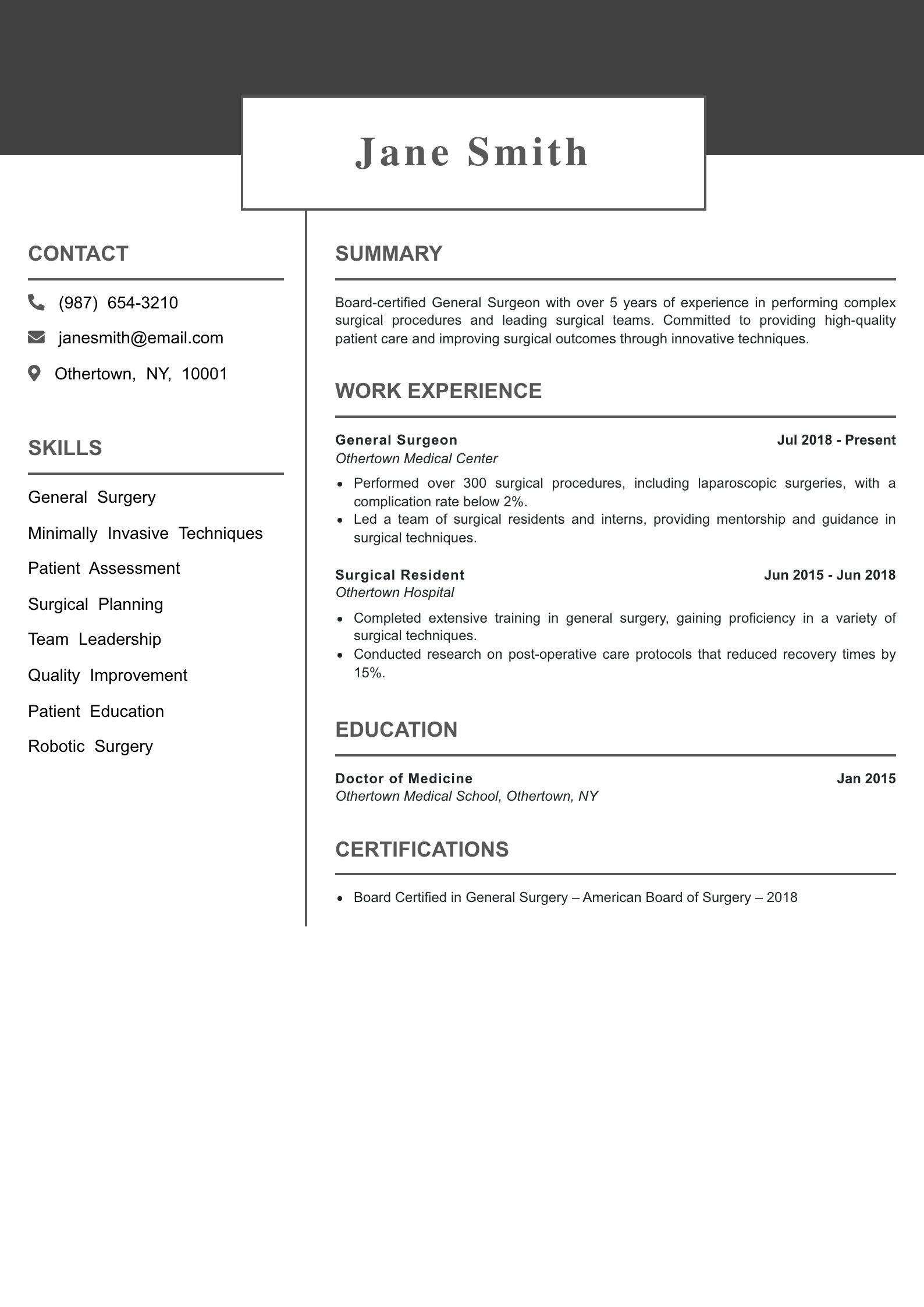
- The summary is clear and effectively highlights Jane’s unique qualifications as a General Surgeon, emphasizing her commitment to patient care and innovative techniques, which sets a strong tone for the rest of the resume.
- Relevant skills are well-defined, showcasing a comprehensive range of competencies that align with the demands of a General Surgeon, including both technical and leadership abilities.
- The work history is impactful, detailing significant achievements such as a low complication rate and leadership in mentoring, which not only demonstrate her expertise but also her contributions to the surgical team and patient outcomes.
- Jane’s experience aligns well with mid-level positions, as indicated by her 5 years of relevant experience and her role in leading a surgical team, making her a strong candidate for similar or advanced roles in the field.
- The overall clarity and professional tone of the resume convey confidence and competence, which are essential traits for a healthcare professional in a high-stakes environment.
Senior Level Surgeon Resume Example
Why This Resume Works
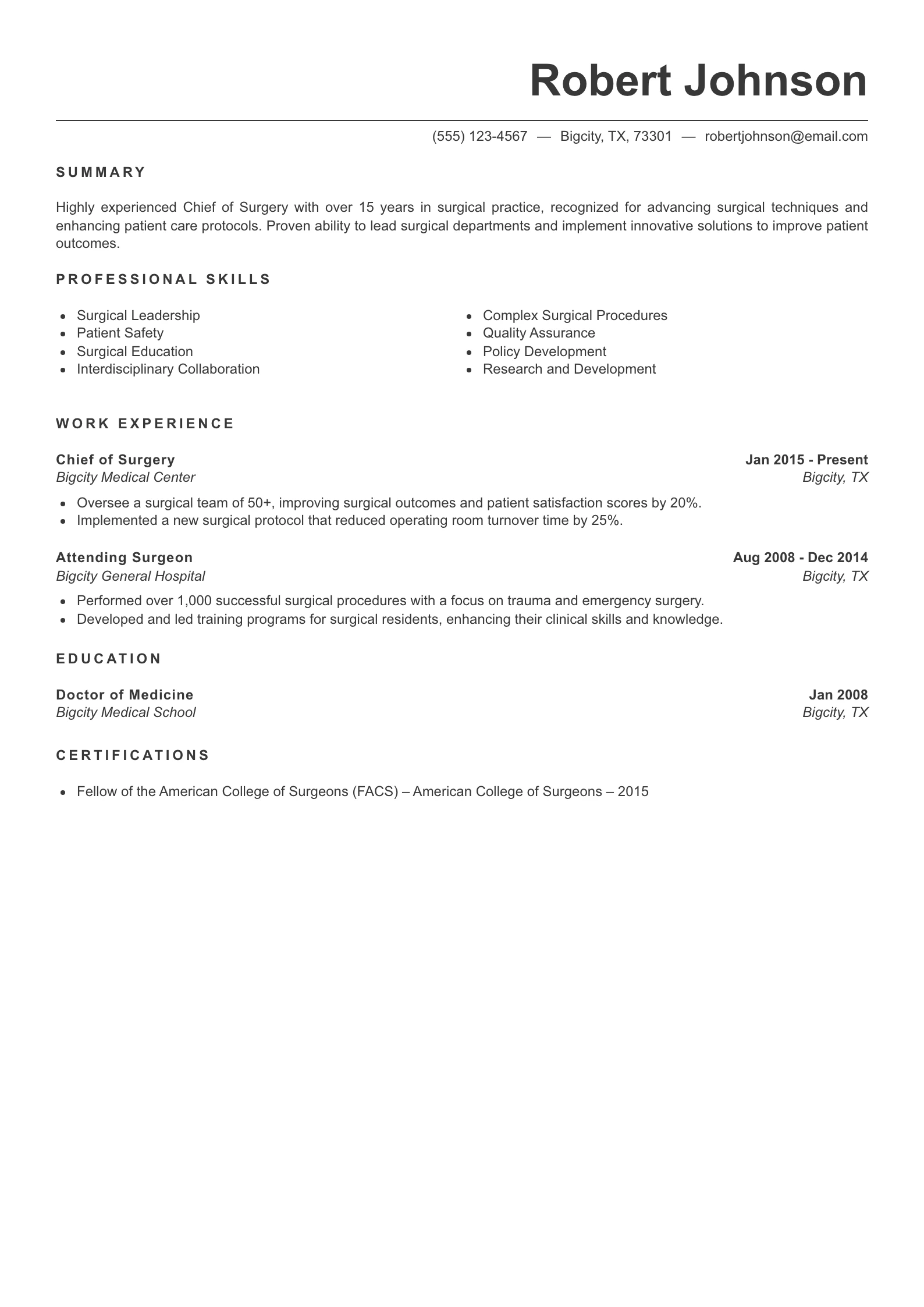
- The summary clearly highlights Robert’s extensive experience and leadership in surgery, effectively positioning him as a senior-level candidate with a focus on patient care and innovative practices.
- Relevant skills are well-articulated, showcasing a blend of clinical expertise and leadership qualities essential for a Chief of Surgery role, which enhances his appeal to hiring managers in the medical field.
- The work history demonstrates impactful achievements, such as improving patient satisfaction scores and reducing operating room turnover, illustrating his ability to drive measurable results in surgical settings.
- The resume is tailored for a senior-level position, as evidenced by the roles held and the responsibilities outlined, indicating a strong fit for leadership roles within surgical departments.
- Clarity and tone are professional and confident, effectively communicating Robert’s qualifications and contributions while maintaining a focus on outcomes and team collaboration.
How to Craft a Strong Surgeon Resume
Creating a compelling resume is crucial for Surgeons, as it serves as the first impression to potential employers. Hiring managers typically seek candidates who demonstrate a blend of extensive medical knowledge, practical experience, and interpersonal skills. This guide will help you effectively highlight your strengths and experiences to create a resume that stands out in a competitive job market.
“The good physician treats the disease; the great physician treats the patient who has the disease.” — William Osler
Summary Statement
A strong summary statement is essential for a Surgeon, as it encapsulates your professional identity and sets the tone for the rest of your resume. In this section, you should clearly convey your experience level, specialization, and any relevant soft skills or certifications. This summary acts as a hook to draw in hiring managers and gives them a glimpse of what you bring to the table.
When crafting your summary, aim for a confident, tailored, and result-focused tone. Use concise language that reflects your expertise and your unique contributions to previous roles.
General Surgeon Resume – Summary Example
Board-certified General Surgeon with 10+ years of experience performing 3,500+ successful surgical procedures across abdominal, gastrointestinal, and trauma cases. Proven expertise in minimally invasive laparoscopic techniques, reducing average patient recovery time by 25%. Strong background in emergency surgery, pre-operative assessment, and post-operative care within high-volume hospital environments. Recognized for maintaining a 98% patient satisfaction rate while collaborating effectively with multidisciplinary medical teams.
If you’re looking for resume guidance for clinical support roles, explore our Medical Assistant Resume examples.
Orthopedic Surgeon Resume – Summary Example
Experienced Orthopedic Surgeon with 12+ years of clinical practice specializing in joint replacement, sports injuries, and musculoskeletal trauma. Performed over 2,800 orthopedic surgeries, including knee and hip replacements, achieving a 96% surgical success rate. Adept at using advanced imaging, robotic-assisted procedures, and evidence-based treatment plans to improve patient mobility outcomes by 30%. Known for precision, patient education, and long-term rehabilitation planning.
Neurosurgeon Resume – Summary Example
Highly skilled Neurosurgeon with 15+ years of experience managing complex cranial and spinal surgeries in tertiary care hospitals. Successfully completed 1,900+ neurosurgical procedures, including brain tumor resections and spinal decompressions, with a complication rate below national benchmarks. Expert in microsurgical techniques, neuro-navigation systems, and trauma-based interventions. Trusted leader in multidisciplinary surgical teams, consistently delivering life-saving outcomes under high-pressure conditions.
Surgical Oncologist Resume – Summary Example
Dedicated Surgical Oncologist with over 11 years of experience treating complex cancer cases through precision-driven surgical interventions. Conducted 2,200+ oncologic surgeries with a focus on tumor excision, staging procedures, and organ-preserving techniques. Played a key role in improving five-year patient survival rates by 20% through evidence-based surgical planning and collaboration with oncology specialists. Known for compassionate patient communication and strict adherence to oncology safety protocols.
Cardiothoracic Surgeon Resume – Summary Example
Board-certified Cardiothoracic Surgeon with 14+ years of experience performing advanced heart and lung surgeries in high-acuity medical centers. Completed 1,600+ open-heart and thoracic procedures, including bypass surgeries and valve replacements, with a 97% procedural success rate. Highly proficient in minimally invasive cardiac techniques and post-operative critical care management. Recognized for reducing ICU stay durations by 18% while maintaining exceptional surgical precision and patient safety standards.
You can also review our Registered Nurse Resume guide to see how nursing professionals highlight patient care, clinical skills, and measurable achievements.
Skills & Qualifications
Surgeons should highlight a combination of core and soft skills that showcase their technical abilities and interpersonal strengths. Core skills may include surgical techniques, patient assessment, and familiarity with medical technology, while soft skills could encompass teamwork, communication, and problem-solving abilities.
To determine the most relevant skills to include, carefully analyze the job descriptions you’re interested in. Look for keywords that appear frequently and match the qualifications you possess. Incorporate these skills into your resume to ensure that it aligns with Applicant Tracking System (ATS) requirements.
- General surgical skills
- Patient assessment
- Surgical planning
- Communication
- Team collaboration
- Critical thinking
- Post-operative care
- Time management
Top ATS Keywords for Surgeon
For additional ATS optimization, review our healthcare resume keywords guide to identify the terms healthcare employers search for most frequently
Work History
When detailing your work history, focus on aspects such as patient care, metrics, leadership roles, and specialty procedures depending on your experience level. Use a reverse-chronological format, listing your most recent position first. Quantified bullet points are essential; they provide concrete evidence of your impact and capabilities.
Emphasize not just what you did in your roles, but how your actions positively affected patient outcomes or improved hospital operations. This approach allows hiring managers to see your value at a glance.
General Surgeon
General Surgeon
City General Hospital, New York, NY | July 2016 – Present
- Performed 400+ general and emergency surgical procedures annually, maintaining a 98% surgical success rate across abdominal and gastrointestinal cases.
- Led minimally invasive laparoscopic initiatives, reducing average patient recovery time by 25% and postoperative complications by 18%.
- Collaborated with anesthesiology, nursing, and critical care teams to deliver coordinated perioperative care for high-risk patients.
- Mentored 6 surgical residents annually, improving procedural accuracy and compliance with hospital safety protocols.
- Implemented enhanced surgical checklists that decreased operating room delays by 20% and improved patient throughput.
You can also review our Physician Resume guide for broader medical resume writing strategies.
Orthopedic Surgeon
Orthopedic Surgeon
Regional Orthopedic Center, Chicago, IL | March 2015 – Present
- Conducted 300+ orthopedic surgeries per year, including joint replacements and fracture repairs, achieving a 96% patient mobility improvement rate.
- Specialized in knee and hip replacement procedures, reducing post-surgical rehabilitation time by an average of 30%.
- Utilized advanced imaging and minimally invasive techniques to lower readmission rates by 15%.
- Coordinated closely with physical therapists to design customized rehabilitation plans for long-term functional recovery.
- Improved operating room efficiency by standardizing preoperative assessments and surgical workflows.
Neurosurgeon
Neurosurgeon
Advanced Neuroscience Institute, Houston, TX | January 2013 – Present
- Successfully completed 150+ complex cranial and spinal surgeries annually with a complication rate below national benchmarks.
- Performed high-precision tumor resections and spinal decompressions using neuronavigation and microsurgical techniques.
- Led multidisciplinary case conferences to optimize surgical planning and patient outcomes in critical neurological cases.
- Reduced ICU length of stay by 20% through improved post-operative monitoring and early intervention protocols.
- Trained junior neurosurgeons and fellows in advanced surgical techniques and patient safety practices.
Surgical Oncologist
Surgical Oncologist
Comprehensive Cancer Center, Boston, MA | May 2014 – Present
- Performed 200+ cancer-related surgical procedures annually, focusing on tumor excision and organ-preserving techniques.
- Contributed to a 20% improvement in five-year patient survival rates through evidence-based surgical planning.
- Collaborated with medical oncologists and radiologists to develop multidisciplinary cancer treatment strategies.
- Ensured compliance with oncology safety standards, maintaining zero surgical site infection incidents over three consecutive years.
- Provided detailed patient education and post-operative counseling to improve treatment adherence and recovery outcomes.
Cardiothoracic Surgeon
Cardiothoracic Surgeon
Heart & Lung Specialty Hospital, Los Angeles, CA | August 2012 – Present
- Performed 120+ open-heart and thoracic surgeries annually, including bypass and valve replacement procedures.
- Achieved a 97% procedural success rate while reducing post-operative ICU stays by 18%.
- Implemented minimally invasive cardiac surgery techniques to decrease patient hospitalization time by 22%.
- Managed complex high-risk surgical cases while maintaining strict compliance with cardiac safety protocols.
- Worked closely with critical care teams to optimize post-surgical recovery and long-term cardiac function outcomes.
Education
A typical educational background for a Surgeon includes a medical degree from an accredited institution, along with relevant residency training. When formatting your degrees and certifications, be sure to list the degree type, school name, city, state, and graduation year clearly.
Highlighting additional training or fellowships can also enhance your qualifications and demonstrate a commitment to continuous learning in the medical field.
“Quality is never an accident. It is always the result of intelligent effort.” — John Ruskin
Education – Recommended Resume Format (Template)
Doctor of Medicine (MD)
Name of Medical School, City, State
Graduation Year
Residency in [Surgical Specialty]
Name of Hospital or Medical Center, City, State
Residency Years
Fellowship in [Subspecialty] (Optional)
Name of Institution, City, State
Fellowship Years
Key Formatting Notes (Best Practices):
- Degree titles should always be bold
- Institution names and locations should be italicized
- Dates should be aligned consistently (right-aligned if space allows)
- List education in reverse-chronological order
- Keep wording concise and formal for ATS compatibility
Education – Example (Surgeon Resume)
Doctor of Medicine (MD)
Harvard Medical School, Boston, MA
2010
Residency in General Surgery
Massachusetts General Hospital, Boston, MA
2010 – 2015
Fellowship in Minimally Invasive Surgery
Cleveland Clinic, Cleveland, OH
2015 – 2017
Recent graduates and physicians in training can also explore our Resident Doctor Resume guide.
Additional Sections
Adding targeted supplemental sections can strengthen your resume by highlighting credentials that extend beyond clinical experience. For Surgeons, certifications and board credentials demonstrate verified expertise, ongoing professional development, and compliance with national medical standards. These sections should remain concise, clearly formatted, and easy for hiring managers and ATS systems to scan.
Healthcare professionals considering travel-based clinical careers can also review our Travel Nurse Resume guide.
Certifications & Board Credentials
Board Certified in General Surgery
American Board of Surgery | 2017
Advanced Trauma Life Support (ATLS) Certification
American College of Surgeons | 2021
Do’s and Don’ts
To ensure your Surgeon resume makes a positive impact, keep these practical tips in mind:
Do:
- Tailor your resume for ATS by using specific keywords related to the role.
- Highlight your impact through measurable achievements.
- Use industry-specific terminology throughout your resume.
Don’t:
- Use generic statements that do not reflect your unique experiences.
- Ignore the importance of soft skills; they are critical in patient interactions.
- Overuse buzzwords without backing them up with concrete examples.
If you prefer an editable format, browse our Word resume templates to create a professional ATS-friendly resume
Final Thoughts & Resume Tips for Surgeons
A well-crafted surgeon resume should reflect not only your clinical expertise but also the measurable impact you’ve made throughout your medical career. As hiring committees and hospital recruiters often review resumes quickly, clarity, structure, and quantified achievements are essential. Focus on presenting your experience in a way that highlights patient outcomes, procedural volume, and leadership contributions rather than listing duties alone.
Always tailor your resume to the specific surgical specialty and institution you are applying to. Use precise medical terminology, include relevant certifications, and align your experience with the hospital’s case mix and patient population. Consistency in formatting, clean section headings, and reverse-chronological ordering help ensure your resume is both ATS-friendly and easy to read.
Finally, remember that your resume is a professional snapshot, not your entire career story. Keep it concise, results-driven, and updated with your most recent accomplishments. When combined with a strong cover letter and verified credentials, a focused and data-backed surgeon resume positions you as a confident, capable candidate ready to contribute at the highest level of surgical care.
If you’re transitioning to a new healthcare role, our hospital jobs resignation letter guide can help you leave your current position professionally
Frequently Asked Questions (FAQs)
In the U.S., a surgeon resume is typically 2 to 4 pages long, depending on experience level, specialty, and academic involvement. Early-career surgeons may keep it closer to two pages, while senior surgeons with extensive clinical, research, or leadership experience may require additional pages. Hospitals and academic medical centers value completeness over brevity, as long as the information is well-organized and relevant.
Yes, including case volumes, success rates, and outcome metrics is strongly recommended. Quantified data such as the number of surgeries performed annually, complication rates, or reductions in recovery time helps hiring committees quickly assess clinical competency. Metrics also improve ATS keyword matching and differentiate candidates with similar qualifications.
Surgeons should always list board certification, state medical licensure, and key certifications such as ACLS and ATLS. Specialty-specific certifications and recent recertifications should also be included. These credentials signal compliance with U.S. medical standards and are often required during the credentialing and privileging process.