

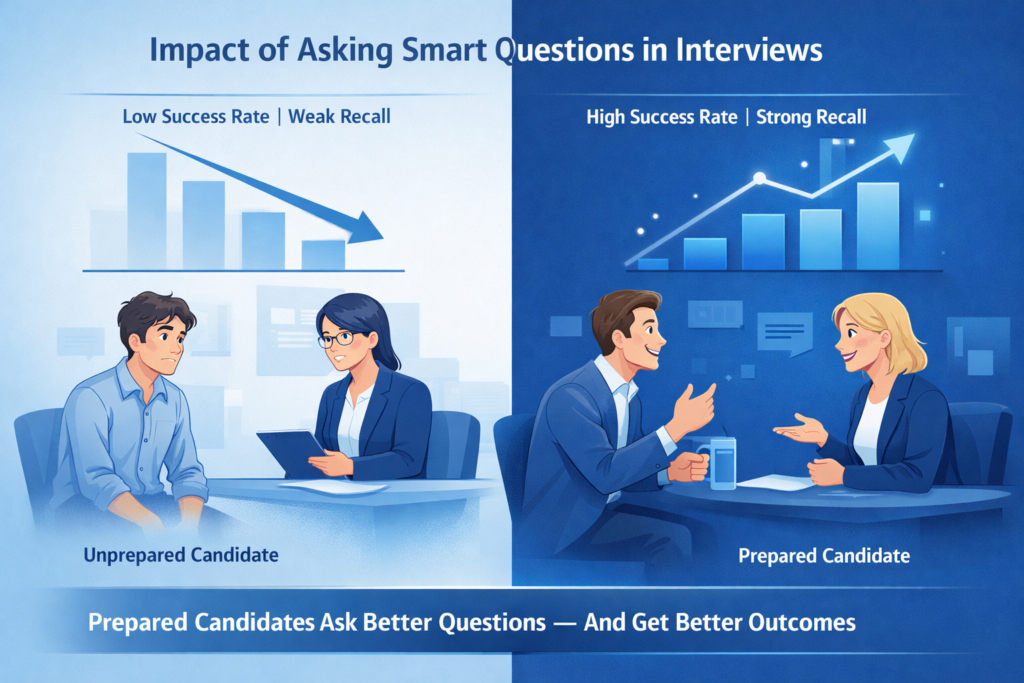
By the time you reach the end of an interview, you already know you’re expected to ask questions. But here’s where most candidates miss the mark. It’s not about having a long list or trying to sound impressive. It’s about asking questions that actually tell you something useful. The kind that reveal how the role works day to day, how the team functions, and what the manager truly expects. When you shift your focus from asking more questions to asking better ones, the entire conversation changes in your favor.
The key is knowing which questions actually uncover meaningful insights about the role, the team, and the company.
“Successful people ask better questions, and as a result, they get better answers.” — Tony Robbins
4 Smart Questions to Ask a Hiring Manager
These four questions are designed to go beyond surface-level information and help you understand how the role actually functions. Instead of asking what sounds good, these questions help you uncover what actually matters once you’re in the role.
What are the biggest challenges someone in this role would face right now?
Why this question matters
Most job descriptions highlight responsibilities, but they rarely talk about what’s difficult. This question helps you uncover the friction points of the role. It signals that you’re not just interested in the opportunity, but also in understanding what it takes to succeed when things get demanding. It also positions you as someone who is prepared to solve problems, not just complete tasks.
Sample answer
“Right now, one of the biggest challenges is managing communication across teams while working with tight deadlines. Since we’re scaling, some processes are still being refined, so adaptability is really important.”
What to look for
- Specific, real-world challenges rather than generic statements
- A sense of transparency and honesty from the hiring manager
- Indications that the company acknowledges challenges and is working through them
When a hiring manager openly discusses challenges, it often reflects a more mature and realistic work environment.
Red flags 🚩
- Responses like “there aren’t really any challenges”
- Avoiding the question or staying overly general
- Framing challenges as problems caused only by previous employees
These can indicate a lack of awareness, poor leadership, or unrealistic expectations.
If you’re still building your professional foundation and learning how to approach roles strategically, you can also explore our guide on how to get a job with no experience to understand how to position yourself effectively even in challenging situations.
Ready to Land Your Next Job?
Don’t let your resume get lost in the stack. Build a professional, ATS-friendly resume that highlights your leadership, achievements, and industry expertise.
What does a typical “busy week” in this role look like?
Why this question matters
Instead of asking about a generic day, this question focuses on intensity. A “busy week” reveals how work actually flows when things are at their peak. It gives you a clearer picture of workload, pressure, deadlines, and how responsibilities are managed when it matters most.
It also helps you understand whether the role aligns with your working style and capacity.
Sample answer
“A busy week usually involves handling multiple client requests, attending internal meetings, and meeting project deadlines. There’s a lot of coordination between teams, especially during peak periods.”
What to look for
- A structured explanation of tasks and priorities
- Realistic expectations around workload
- Insight into how time and responsibilities are managed
Pay attention to whether the answer sounds organized or overwhelming. That distinction matters more than you think.
Red flags 🚩
- Descriptions that sound chaotic or constantly overwhelming
- No clear prioritization or structure
- Expectations of high workload without mention of support or systems
This could point to burnout-heavy environments or lack of planning.
How would you describe your management style and how the team collaborates?
Why this question matters
Your manager and team will shape your everyday experience more than the job title itself. This question helps you understand how decisions are made, how feedback is delivered, and whether the environment encourages independence or constant oversight.
It also gives you insight into whether the team operates with trust, structure, or confusion.
Sample answer
“I like to give my team autonomy while staying available for support. We have weekly check-ins, and the team collaborates closely through shared tools and regular communication.”
What to look for
- Clear communication practices such as meetings or feedback loops
- A balance between autonomy and guidance
- Evidence of collaboration rather than isolated work
A strong answer often includes examples, not just descriptions.
Red flags 🚩
- Hints of micromanagement or excessive control
- Lack of structured communication
- Overuse of vague phrases like “we’re very collaborative” without explanation
These can signal unclear leadership or inconsistent team dynamics.
What would the next steps in the hiring process look like?
Why this question matters
This question might seem simple, but it plays an important role in how you’re perceived. It shows that you are organized, forward-thinking, and genuinely interested in moving ahead. It also helps you set expectations instead of waiting passively after the interview.
Sample answer
“We’re completing interviews this week and will get back to candidates within five business days with feedback and next steps.”
What to look for
- A clear and structured timeline
- Defined stages in the hiring process
- Professional and transparent communication
Clarity here often reflects how organized the company is overall.
Red flags 🚩
- Unclear or shifting timelines
- No defined hiring process
- Vague responses like “we’ll let you know”
This may indicate delays, poor coordination, or lack of internal alignment.
Understanding what happens after the interview is just as important as preparing for it. If you’re also working on strengthening your application overall, you can explore our guide on how to write a cover letter for a teacher to improve how you present yourself before even reaching this stage.
Other Questions You Can Ask
Beyond the core questions, you don’t need to rely on a fixed script. The best candidates adapt based on how the conversation unfolds. These questions are flexible, practical, and can help you explore specific areas depending on what matters most to you in the role.
📌 About the Role
These questions help you move from a general job description to understanding how the work actually plays out on a daily basis.
- What would a typical day or week look like?
This gives you a clearer sense of how your time will be spent, how structured the role is, and whether responsibilities are consistent or constantly shifting. - What tools or systems are essential for this role?
This helps you understand the technical environment and whether you’ll be expected to learn new systems quickly or already be familiar with certain tools.
👉 Use these when you want clarity on execution, workload, and expectations.
📌 About the Team
These questions help you understand how people work together, especially under pressure.
- How does the team handle deadlines and pressure?
This reveals whether the team is collaborative and organized, or reactive and stressful during high-demand periods. - What makes someone successful on this team?
This gives you insight into unspoken expectations like communication style, ownership, or adaptability.
👉 Listen carefully here. You’re not just learning about the team, you’re understanding if you would actually fit into it.
Ready to Land Your Next Job?
Don’t let your resume get lost in the stack. Build a professional, ATS-friendly resume that highlights your leadership, achievements, and industry expertise.
📌 About the Manager
Your manager can make or break your experience in a role, so this section matters more than most candidates realize.
- How do you provide feedback?
This tells you whether feedback is structured, regular, and constructive, or inconsistent and unclear. - What are your expectations from this role?
This helps you align with the manager’s priorities early and understand what they truly value.
👉 Pay attention to tone here. The way they answer often reflects how they actually manage.
📌 About Company Culture
Culture is often described in broad terms, but these questions help you get something more real.
- How would you describe the work environment?
Look for specifics. Do they talk about collaboration, flexibility, or fast-paced execution? - How does the company support work-life balance?
This helps you understand whether balance is actively supported or just mentioned as a concept.
👉 What’s said matters, but how confidently and specifically it’s said matters even more.
📌 About Growth & Development
If you’re thinking long-term, this is where you start assessing real opportunities.
- What opportunities exist for learning and advancement?
This reveals whether growth is structured or left to individual effort. - How do employees typically grow within the company?
This helps you understand real career paths, not just promises.
👉 Strong companies will have clear examples. Weak ones will stay vague.
📌 About the Future
These questions help you connect your role to the bigger picture.
- Where is the company or team heading in the next 1–2 years?
This gives you insight into stability, direction, and priorities. - How does this role contribute to long-term goals?
This helps you understand whether your work will have real impact or just support day-to-day operations.
👉 This is where you shift from thinking like a candidate to thinking like a contributor.
Tips for Asking Questions Effectively
Asking the right questions is not just about preparation, it’s about how you think and respond in the moment. The way you ask matters just as much as what you ask.
- Ask relevant and thoughtful questions, not too many: It’s tempting to prepare a long list, but asking too many questions can feel forced. Instead, focus on 2–4 well-chosen questions that connect directly to the role and conversation. A few strong questions will always leave a better impression than a long list of generic ones.
- Build on what the interviewer has already shared: The strongest questions don’t feel rehearsed. They feel like a natural continuation of the conversation. If the interviewer mentions a challenge, a project, or a team dynamic, use that as your entry point.
👉 For example: “You mentioned cross-team collaboration can be challenging. Could you tell me more about how that typically plays out?”
- Listen actively and ask follow-ups: Don’t just wait for your turn to speak. Pay attention to the details in their answers and use them to ask deeper questions. This shows curiosity, engagement, and the ability to think on your feet. Often, a thoughtful follow-up question leaves a stronger impression than a prepared one.
- Avoid generic or easily searchable questions: If a question can be answered by reading the job description or company website, it doesn’t add value in an interview. Focus on questions that require insight, experience, or context from the hiring manager.
- Stay confident and conversational: You don’t need to sound formal or overly polished. The goal is to have a genuine conversation. Speak clearly, maintain a natural tone, and don’t rush. Confidence here comes from clarity, not perfection.
💡 Quick Insight:
The best candidates don’t treat this part of the interview as a formality. They use it as an opportunity to understand how the role actually works and whether it aligns with what they’re looking for.
If You’re Not Sure What to Ask
Even with preparation, it’s completely normal to go blank at the end of an interview. Instead of memorizing questions, it helps to rely on simple frameworks you can adapt based on the conversation.
Think of these as starting points you can shape depending on what has already been discussed.
- “What would success look like in this position?”
A reliable go-to when you’re unsure what to ask. It shifts the focus to expectations and helps you understand how performance is measured. - “What challenges should I be prepared for?”
This helps you uncover the realities of the role and shows that you’re thinking beyond the surface. - “How does the team typically operate?”
Use this when you want insight into communication, collaboration, and day-to-day workflow. - “What growth opportunities are available?”
This signals long-term interest and helps you understand whether the role offers progression.
The goal is not to ask these questions exactly as written, but to adapt them naturally to the conversation. Even one well-framed question from this list can create a strong and lasting impression.
Ready to Land Your Next Job?
Don’t let your resume get lost in the stack. Build a professional, ATS-friendly resume that highlights your leadership, achievements, and industry expertise.
Conclusion
By the end of an interview, what you ask often matters more than how much you ask. It’s not about having a long list of questions, but about choosing ones that reveal how the role actually works and whether it aligns with what you’re looking for. The right questions help you evaluate the team, the manager, and the expectations with clarity.
As you refine your interview approach, it’s equally important to present yourself strongly on paper. You can explore our collection of resume templates in Word to ensure your application makes the right impression even before the interview begins.
When you approach this part of the interview with intention, you don’t just leave a good impression, you leave a thoughtful one. And more importantly, you walk away with the information you need to make the right decision for yourself.
FAQs
Most candidates benefit from asking 2 to 4 thoughtful questions. This is enough to show interest and preparation without overwhelming the interviewer. The focus should always be on relevance and depth rather than the number of questions.
This happens more often than you think. Instead of repeating the same question, you can acknowledge it and go deeper. For example:
“You mentioned earlier about team collaboration, could you share a recent example of how that works in practice?”
You should do both. Prepare a few core questions beforehand, but stay flexible during the interview. The best questions often come from actively listening and building on what the interviewer shares.